 Bangladesh Defense

Saif
Senior Member
- Joined
- Jan 24, 2024
- Messages
- 22,417
- Likes
- 9,875
- Nation

- Axis Group


Sustainable path to Bangladesh's semiconductor future
Without strong collaboration between universities, industry, and policymakers, can the country truly move beyond being a technology consumer to becoming a technology creator?
 en.prothomalo.com
Sustainable path to Bangladesh's semiconductor future
Ariful Islam & Tasnia Fatin
Published: 21 Aug 2026, 16: 15

Semiconductor chips Reuters file photo
A semiconductor is a material like silicon with electrical conductivity between a conductor and an insulator, serving as the foundational microchip "brain" for modern electronics. The widespread adoption of artificial intelligence (AI), rapid growth of cloud data centers, and increasing demand for high-performance computing have substantially boosted the need for advanced semiconductor chips. Reflecting this trend, the Semiconductor Industry Association (SIA) reported that global semiconductor sales reached a record US$791.7 billion in 2025, marking a 25.6 per cent increase over the previous year.
In addition, Gartner estimated that AI-related semiconductors generated more than US$200 billion in revenue, accounting for almost one-third of the industry's total market value. Looking ahead, the global semiconductor market is projected to exceed US$1 trillion in annual sales by 2026, underscoring its growing role as a key driver of technological innovation, digital transformation, and global economic competitiveness.
Recently, Bangladesh has thrown its full policy weight behind semiconductors, betting on the same tax-incentive playbook that built its garment industry. The government has scrapped duty, VAT, and advance tax on chip-related raw materials until 2031, formed a national task-force under BIDA to bring diaspora experts and industry leaders into one room, and is actively courting investors in Malaysia, South Korea, and the US with promises of 30 percent lower costs and full foreign ownership. Yet the numbers tell a more modest story: semiconductor exports stand at just USD 8 million a year, against a 2030 target of USD 1 billion, and industry leaders are still asking for basics the government hasn't delivered, simplified visas for foreign experts, a dedicated tech investment fund, and real infrastructure inside Hi-Tech Parks. The ambition is there. The machinery to match it isn't, at least not yet.
Interestingly, Bangladesh’s semiconductor push keeps hitting the same wall; there’s still no real bridge between academia and industry. The country has only around 700 chip designers today. A few universities have added VLSI and chip-design courses, but there's no shared national curriculum. No industry-funded labs. No clear pipeline turning graduates into job-ready engineers. This gap matters more than it seems. Every country that built a real semiconductor industry did it by treating universities as industry's first supplier.
Policies across developing countries
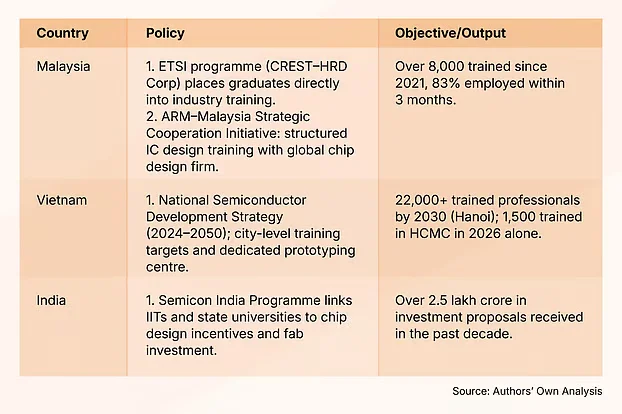
The table makes one thing obvious, every serious semiconductor push pairs policy with a placement pipeline, students inside real factories or design houses before they graduate, not after. Vietnam trains tens of thousands with hard deadlines. Malaysia gets 83 per cent of trainees employed within three months. Bangladesh h as none of this. It has a taskforce and a recommendation for university courses, nothing operational yet. With just a few professional chip designers nationwide, Bangladesh isn't behind on ambition. It's behind on execution.
Recommendations don't train engineers. Placement programmes do.
At this point, a dedicated council should bring together policymakers, universities, multinational firms, and local industries under one strategic platform. The council should include the Ministry of ICT, Ministry of Industries, BIDA, BEZA, universities, and private technology companies. Its role should be to identify future workforce demand, coordinate research funding, remove regulatory barriers, and monitor national progress. Malaysia's Penang ecosystem demonstrates that strong government coordination can transform a region into a global semiconductor hub, contributing over 5 per cent of global semiconductor exports.
Many engineering graduates possess strong theoretical knowledge but limited exposure to semiconductor design tools and industrial practices. Universities should redesign curricula with direct input from industry. Courses should include IC design, VLSI, semiconductor materials, AI hardware, embedded systems, FPGA programming, and Electronic Design Automation (EDA) software. Every final-year project should solve an industrial problem rather than remain purely academic. Faculty members should also spend short industrial attachments every few years to keep teaching aligned with technological developments.
The future of Bangladesh's semiconductor industry depends not only on investment but also on how effectively knowledge is transformed into innovation
Instead of isolated laboratories, Bangladesh should establish joint Semiconductor Innovation Centers where universities and firms conduct collaborative research. Companies can provide real-world technical challenges while universities contribute research expertise. Government can offer matching grants where every dollar invested by industry is matched by public funding. South Korea and Taiwan adopted similar models to accelerate commercialization of university research.
Most university research ends with journal publications. Policymakers should shift incentives toward commercialization. Universities should establish technology transfer offices, simplify patent applications, support startup incubation, and provide seed funding for semiconductor innovations. Faculty promotion criteria should reward patents, industrial projects, and technology licensing alongside publications. The semiconductor industry requires highly specialized engineers rather than general graduates.
Bangladesh should introduce national scholarships for semiconductor-related master's and PhD programs. Graduates receiving government funding could commit to working in Bangladesh for several years after completing their studies. Similar talent-development strategies have strengthened semiconductor ecosystems in Taiwan and Singapore.
In reality, the future of Bangladesh's semiconductor industry depends not only on investment but also on how effectively knowledge is transformed into innovation. Without strong collaboration between universities, industry, and policymakers, can the country truly move beyond being a technology consumer to becoming a technology creator? Building this bridge will strengthen research, develop skilled talent, accelerate commercialization, attract quality investment, and create high-value employment. Ultimately, a sustainable semiconductor ecosystem is not built by infrastructure alone, but by an ecosystem where knowledge, innovation, and industry grow together.
* Dr. Ariful Islam is an academic and mixed methods researcher, PhD (Putra Business School, AACSB), MBA (Staffordshire University, UK)
* Dr. Tasnia Fatin is an academic and business sustainability researcher, PhD (Putra Business School, AACSB), MBA (Dhaka University)
Ariful Islam & Tasnia Fatin
Published: 21 Aug 2026, 16: 15
Semiconductor chips Reuters file photo
A semiconductor is a material like silicon with electrical conductivity between a conductor and an insulator, serving as the foundational microchip "brain" for modern electronics. The widespread adoption of artificial intelligence (AI), rapid growth of cloud data centers, and increasing demand for high-performance computing have substantially boosted the need for advanced semiconductor chips. Reflecting this trend, the Semiconductor Industry Association (SIA) reported that global semiconductor sales reached a record US$791.7 billion in 2025, marking a 25.6 per cent increase over the previous year.
In addition, Gartner estimated that AI-related semiconductors generated more than US$200 billion in revenue, accounting for almost one-third of the industry's total market value. Looking ahead, the global semiconductor market is projected to exceed US$1 trillion in annual sales by 2026, underscoring its growing role as a key driver of technological innovation, digital transformation, and global economic competitiveness.
Recently, Bangladesh has thrown its full policy weight behind semiconductors, betting on the same tax-incentive playbook that built its garment industry. The government has scrapped duty, VAT, and advance tax on chip-related raw materials until 2031, formed a national task-force under BIDA to bring diaspora experts and industry leaders into one room, and is actively courting investors in Malaysia, South Korea, and the US with promises of 30 percent lower costs and full foreign ownership. Yet the numbers tell a more modest story: semiconductor exports stand at just USD 8 million a year, against a 2030 target of USD 1 billion, and industry leaders are still asking for basics the government hasn't delivered, simplified visas for foreign experts, a dedicated tech investment fund, and real infrastructure inside Hi-Tech Parks. The ambition is there. The machinery to match it isn't, at least not yet.
Interestingly, Bangladesh’s semiconductor push keeps hitting the same wall; there’s still no real bridge between academia and industry. The country has only around 700 chip designers today. A few universities have added VLSI and chip-design courses, but there's no shared national curriculum. No industry-funded labs. No clear pipeline turning graduates into job-ready engineers. This gap matters more than it seems. Every country that built a real semiconductor industry did it by treating universities as industry's first supplier.
Policies across developing countries
The table makes one thing obvious, every serious semiconductor push pairs policy with a placement pipeline, students inside real factories or design houses before they graduate, not after. Vietnam trains tens of thousands with hard deadlines. Malaysia gets 83 per cent of trainees employed within three months. Bangladesh h as none of this. It has a taskforce and a recommendation for university courses, nothing operational yet. With just a few professional chip designers nationwide, Bangladesh isn't behind on ambition. It's behind on execution.
Recommendations don't train engineers. Placement programmes do.
At this point, a dedicated council should bring together policymakers, universities, multinational firms, and local industries under one strategic platform. The council should include the Ministry of ICT, Ministry of Industries, BIDA, BEZA, universities, and private technology companies. Its role should be to identify future workforce demand, coordinate research funding, remove regulatory barriers, and monitor national progress. Malaysia's Penang ecosystem demonstrates that strong government coordination can transform a region into a global semiconductor hub, contributing over 5 per cent of global semiconductor exports.
Many engineering graduates possess strong theoretical knowledge but limited exposure to semiconductor design tools and industrial practices. Universities should redesign curricula with direct input from industry. Courses should include IC design, VLSI, semiconductor materials, AI hardware, embedded systems, FPGA programming, and Electronic Design Automation (EDA) software. Every final-year project should solve an industrial problem rather than remain purely academic. Faculty members should also spend short industrial attachments every few years to keep teaching aligned with technological developments.
The future of Bangladesh's semiconductor industry depends not only on investment but also on how effectively knowledge is transformed into innovation
Instead of isolated laboratories, Bangladesh should establish joint Semiconductor Innovation Centers where universities and firms conduct collaborative research. Companies can provide real-world technical challenges while universities contribute research expertise. Government can offer matching grants where every dollar invested by industry is matched by public funding. South Korea and Taiwan adopted similar models to accelerate commercialization of university research.
Most university research ends with journal publications. Policymakers should shift incentives toward commercialization. Universities should establish technology transfer offices, simplify patent applications, support startup incubation, and provide seed funding for semiconductor innovations. Faculty promotion criteria should reward patents, industrial projects, and technology licensing alongside publications. The semiconductor industry requires highly specialized engineers rather than general graduates.
Bangladesh should introduce national scholarships for semiconductor-related master's and PhD programs. Graduates receiving government funding could commit to working in Bangladesh for several years after completing their studies. Similar talent-development strategies have strengthened semiconductor ecosystems in Taiwan and Singapore.
In reality, the future of Bangladesh's semiconductor industry depends not only on investment but also on how effectively knowledge is transformed into innovation. Without strong collaboration between universities, industry, and policymakers, can the country truly move beyond being a technology consumer to becoming a technology creator? Building this bridge will strengthen research, develop skilled talent, accelerate commercialization, attract quality investment, and create high-value employment. Ultimately, a sustainable semiconductor ecosystem is not built by infrastructure alone, but by an ecosystem where knowledge, innovation, and industry grow together.
* Dr. Ariful Islam is an academic and mixed methods researcher, PhD (Putra Business School, AACSB), MBA (Staffordshire University, UK)
* Dr. Tasnia Fatin is an academic and business sustainability researcher, PhD (Putra Business School, AACSB), MBA (Dhaka University)
