
โ˜• Support Us โ˜•
[๐Ÿ‡ง๐Ÿ‡ฉ] - Energy Security of Bangladesh | Page 49 | PKDefense

[๐Ÿ‡ง๐Ÿ‡ฉ] Energy Security of Bangladesh

Reply (Scroll)
Press space to scroll through posts
G Bangladesh Defense
[๐Ÿ‡ง๐Ÿ‡ฉ] Energy Security of Bangladesh
484
15K
More threads by Saif


Govt pays $360.99m for 11 cargos of LNG in Nov
Bangladesh Sangbad Sangstha . Dhaka 14 December, 2025, 23:28

1765762920723.webp


The government has paid $360.99 million for 11 cargos of Liquefied Natural Gas (LNG) totaling around 3.52 crore MMBTu in November to ensure energy security along with meeting the growing demand of Bangladesh.

โ€˜Weโ€™re importing LNG regularly under long term, short term agreement as well as also spot markets to meet growing energy demand in the country,โ€™ Petrobangla director AKM Mizanur Rahman told BSS here on Sunday.

He said in October Bangladesh received nine cargos of LNG totaling around 2.88 crore MMBTu under the long term and short term agreement along with the spot markets.

The government also procured 10 cargos of LNG amounting around 3.20 crore MMBTu under the long term and short term agreement along with spot markets, Rahman said.

He said that on an average 32 lakh MMBTu (Million British Thermal units) LNG was in each cargo.

According to Petrobangla, QatarEnergy received $115.97 million for four cargos of LNG, while Omanโ€™s OQ Trading (OQT) got $55.28 million for two cargos of LNG under long term deal.

It said the Oman based OQT received $75.21 million for two liquefied natural gas under short term agreement, while the government procured three cargos with $114.53 million from spot markets.

The information, however, said petroChina International received $38.08 million for one cargo, TotalEnergies Gas and Power got $76.45 million for two cargos under the spot markets in November.

According to purchase committee, the advisersโ€™ council committee on government purchase approved separate proposals for importing LNG to meet gas demand in the country earlier.

Earlier, in the purchase committee meeting, the finance adviser said the committee members are focusing on enhancing the supply side of LNG side by side reducing pressure on the government.

He informed that the government was purchasing LNG at a comparatively reasonable price from international market.​
 

Bangladesh to boost LNG imports on lower global prices

Falling spot prices and weak demand in Asia prompt Dhaka to look beyond its initial import plan for this year

1765933509127.webp


Bangladesh is preparing to ramp up its liquefied natural gas (LNG) imports as global spot prices soften and local gas output continues to fall behind the domestic demand.

For the current fiscal year 2025-26, the government initially planned to import 115 cargoes of LNG through a mix of long-term contracts and spot purchases. That is already higher than the 94 cargoes bought in the previous year.

Google News LinkFor all latest news, follow The Daily Star's Google News channel.
Now, the authorities are considering importing even more as international prices have remained subdued amid weak demand from major buyers such as China and Japan.

"LNG prices reduced significantly. So, I am going to suggest the energy ministry to import more," said Finance Adviser Salehuddin Ahmed.

"I hope LNG imports this year will be higher compared to the initial plan," he told The Daily Star.

Ahmed said money is not a problem here, though physical capacity limits how much LNG the country can bring in at short notice.

Of the planned 115 LNG cargoes in FY26, each consignment would carry 33.60 lakh mmBtu of gas, according to Rupantarita Prakritik Gas Company Limited, the state-owned firm responsible for LNG conversion and supply.

On Monday, the government approved the purchase of one spot cargo at $9.99 per mmBtu.

In 2022, after the Russia-Ukraine war broke out, LNG averaged $18.43 per mmBtu. That dropped to $12.84 in 2024. The spot rate stood at $13.52 per mmBtu in June this year before easing further to $11.02 in November.

World Bank commodity price data also point to a gradual downward trend, while international energy analysts say LNG prices may decline further as supply remains ample.

According to international media reports, North Asian spot LNG prices have hovered around $9 per mmBtu, with the region's largest buyers staying largely out of the market for the coming months.

Chinese importers are holding strong inventories and are not seeking additional cargoes. Demand in Japan also remains weak, while South Korea has shown only limited spot buying interest despite being the world's third-largest LNG buyer.

Bangladesh sources LNG through two channels, long-term supply agreements and the spot market.

Amid declining domestic gas extraction, the government began importing LNG in 2018 to meet the domestic fuel demand.

Gas demand is projected to reach 6,240 million cubic feet per day (mmcfd) by 2030, according to the Integrated Energy and Power Master Plan 2023, which maps out the energy sector through to 2050.

By the end of 2023, domestic gas production stood at about 2.08 billion cubic feet per day from all fields, including those operated by international oil companies. That is lower than the 2012 average of around 2.20 billion cubic feet per day, according to state-run Petrobangla.

Under existing long-term agreements, the government is set to buy 40 LNG cargoes from Qatar and 16 from Oman in FY26. In 2026, supplies are due to rise further, with an additional 12 cargoes from Qatar and four from Oman.

A separate deal with US-based Excelerate Energy will see 14 cargoes supplied each year, beginning from January 2026. Besides, the government will purchase 33 cargoes from the spot market during the current fiscal year.

In the first five months of FY26 up to November, Bangladesh bought a total of 50 LNG cargoes. Of these, 29 arrived under long-term contracts, with the rest sourced from the spot market.

Preferring anonymity, an official of Rupantarita Prakritik Gas Company said LNG under long-term contracts is currently being bought at around $9.5 per mmBtu.

Despite the price drop, imports cannot be expanded aggressively, according to the official.

Because Bangladesh has only two floating storage and regasification units, operated by Excelerate Energy and Summit LNG Terminal Company. Together, the two terminals have a regasification capacity of 1,100 million cubic feet per day.

At present, two land-based LNG terminals are being established in Cox's Bazar, with a combined daily regasification capacity of 2,000 million cubic feet. However, both projects are still at an early stage.​
 

Energy efficiency saved $3.3b in FY24

Households and industries adopting LED lighting, efficient furnaces, and waste-heat recovery contributed to the amount.

1766023743185.webp


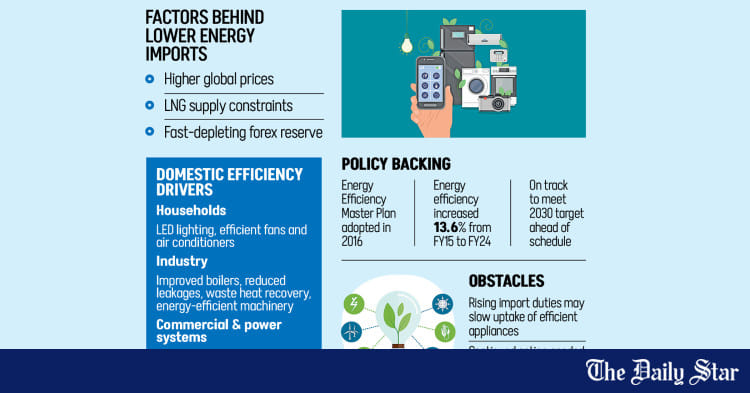
Bangladesh saved an estimated $3.3 billion in energy costs in a single year by using electricity and fuel more efficiently across homes, factories and the power system, according to a report.

Besides, the savings reflect reduced fossil fuel consumption and avoided energy imports equivalent to 7 million tonnes of oil in fiscal year 2023-24, said the report published by the Institute for Energy Economics and Financial Analysis (IEEFA) yesterday.

In that period, the country faced higher global fuel prices, spiked rates for liquefied natural gas (LNG) deliveries and a severe dollar crisis.

The report said the savings were achieved through efficiency improvements across major consuming sectors, allowing the economy to deliver the same level of output while using less fuel.

In the report, IEEFA, a United States-based nonprofit organisation that promotes the transition to cleaner energy, said that the country's effort to improve energy efficiency by adopting a national master plan in 2016 is now paying off.

The Energy Efficiency and Conservation Master Plan set a target to cut energy intensity by 15 percent by 2021 and 20 percent by 2030.

From fiscal year 2014-15 to 2023-24, energy efficiency rose by 13.64 percent, according to the report, titled "Bangladesh's Energy Efficiency Goals Within Reach".

Although the progress remained limited until FY2020-21, energy efficiency gained momentum thereafter as global fuel volatility and domestic supply disruptions made it a priority, according to the report.

"The regulatory framework and awareness created a favourable ecosystem to enhance energy efficiency amid supply disruptions and rising tariffs, with further gains possible," the report mentioned.

"Bangladesh's efficiency gains have put it on track to meet its targets under the masterplan and its updated climate commitments, potentially a year ahead of schedule," it added.

According to the report, widespread adoption of energy-efficient appliances in households, particularly LED lighting, fans and air conditioners, helped reduce electricity demand. This eventually reduced the need for fuel-based power generation.

Industry, the country's largest energy consumer, also contributed through improved boilers, reduced leakages, waste heat recovery from captive generators and adoption of technologies such as vertical roller mills and efficient furnaces, said the report.

"Yet, the industry still offers significant untapped energy-efficiency opportunities such as using more efficient motors, a gradual shift towards electric boilers from gas boilers, and upgrades in captive power machineries," it added.

The report mentioned a previous IEEFA study, saying almost half of the country's captive power generators do not operate efficient generators and fail to utilise waste heat in industrial processes, which could save Bangladesh up to 50.18 billion cubic feet of LNG imports a year.

The report recommended setting minimum energy performance standards and labelling for household appliances to guide consumers towards the most efficient options.

It also urged enforcement of the national building code, which promotes passive design and energy-efficiency features in new buildings to reduce cooling demand.

Additional savings came from the commercial sector and reductions in transmission and distribution losses across the power system.

While the commercial sector uses less energy than households or industry, its reliance on air conditioning makes efficiency gains critical as rising temperatures are expected to increase cooling demand.

The report noted that stronger enforcement of appliance standards and labelling is needed to secure real savings.

It also warned that recent rises in import duties could undermine efficiency gains by making efficient appliances more expensive.

Customs duties on key components of LED lights were raised sharply in FY2025-26, potentially pushing price-sensitive consumers towards cheaper, lower-quality products.

Similarly, higher minimum import duties on inverter-based compressors for energy-efficient air conditioners and refrigerators could also slow adoption of efficient cooling technologies, it said.

IEEFA clarified that the $3.3 billion figure represents avoided fuel import costs rather than direct budgetary savings and does not appear as a line item in government accounts.

The report concluded that without stronger enforcement of efficiency standards and faster modernisation of industry and buildings, the country risks locking itself into higher fuel costs despite recent gains.

"For Bangladesh, energy efficiency is a strategic necessity to curb unchecked energy consumption and strengthen the resilience of its energy system. Achieving these gains will require a coordinated effort among regulatory authorities, industries, financial institutions, and technology providers," it said.​
 

Bangladesh's second oil refinery in sight: Project ready with Tk 355b domestic financing

JAHIDUL ISLAM
Published :
Dec 19, 2025 07:18
Updated :
Dec 19, 2025 07:20

1766192316442.webp


Bangladesh's second oil refinery is now in sight as a project with an estimated cost Tk 355 billion in domestic financing awaits ECNEC seal at its next meeting, officials say.

With this decisive initiative by the interim government a prolonged wait for nearly 17 years, after the feasibility study launched in 2008, is going to be over.

The project to set up the second refinery unit of Eastern Refinery Limited (ERL) is set to be placed before the Executive Committee of the National Economic Council (ECNEC) for approval.

The new refinery, with an annual crude oil-processing capacity of 3.0 million tonnes, is in the agenda for the ECNEC meeting to be held next Tuesday, sources at the Ministry of Planning have confirmed.

An official of the Energy and Mineral Resources Division (EMRD) says the country's only existing refinery, established way back in 1968, has a capacity of 1.5 million tonnes-meeting just about 20 per cent of the current annual demand.

Once completed, the new unit would raise the combined refining capacity to 4.5 million tonnes, covering about 42 per cent of the projected annual demand for 10.79 million tonnes by 2030 and thereby substantially cutting import-dependence.

The proposed unit aims to strengthen the country's energy security by producing more environment-friendly fuels and reducing dependence on imported refined petroleum products.

EMRD officials say the plant will produce Euro-5-quality fuels, including octane and diesel, with sulfur content below 10 PPM, adhering to global environmental standards and promoting cleaner air for future generations.

"Implementing the project is also expected to save much-needed foreign exchange by cutting imports of refined petroleum," says one official.

"Additionally, the plant will help boost Bangladesh Petroleum Corporation's (BPC) income by processing various value-added byproducts alongside the production of liquid fuels from crude oil," the project document reads.

The EMRD Secretary, Mohammad Saiful Islam, says the basic design has been completed using Arabian Light Crude (ALC) and Murban crude as feedstock, with arrangements to refine crude from other sources, including Russia, Norway, and Nigeria.

"The second unit will be capable of processing Russian Urals crude or Nigeria's Brass River crude by separately boiling the fuels before refining," he told The Financial Express.

Following the feasibility study, the government first formulated a Tk 130-billion project in 2010, seeking funding from the Islamic Development Bank (IsDB).

The development project proposal or DPP was redesigned in 2023 with an estimated cost of Tk 237.36 billion to search foreign aid.

However, the proposal was later withdrawn to implement the project with funding from the controversial S Alam industrial group, which fell out of government's favour after the previous administration's collapse.

Recently, the EMRD resubmitted the proposal to the Planning Commission with a revised estimate of Tk 429.74 billion funded entirely from domestic sources.

The Project Evaluation Committee (PEC) meeting held last November recommended reducing the project's component-wise costs. Following PEC's suggestions, the EMRD resubmitted the project with a cut-down cost of Tk 354.65 billion, with Tk 212.78 billion as government loans and Tk 141.87 billion from the implementing agency's own sources, resulting in a cost saving of Tk 75.09 billion.

"Upon completion, the project will enable ERL to process 3.0 million metric tonnes of crude oils annually and produce cleaner petroleum products, enhancing the population's access to clean energy and modern fuels," it is stated in the proposal.

The refinery is expected to generate around 60,000 metric tonnes of LPG, 0.6 million tonnes of gasoline, 0.5 million tonnes of jet fuel, 1.1 million tonnes of diesel, and 0.15 million tonnes of bitumen, significantly reducing the country's reliance on imports of these refined petroleum products, it adds.​
 

Phulbari coal, power crisis, and a dangerous revisionism

1766193459144.webp


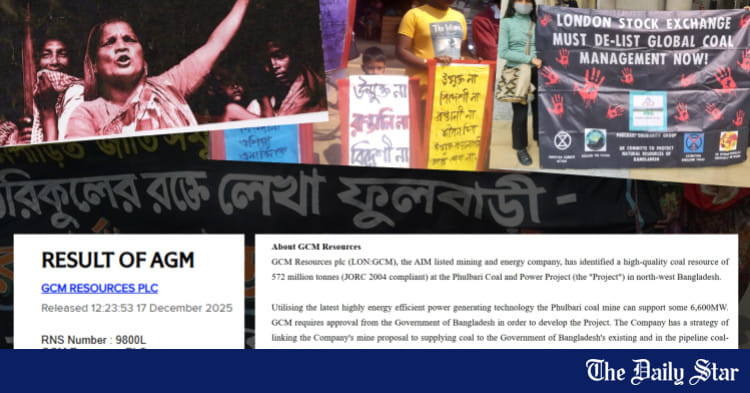
Regarding the Phulbari Open-Pit Coal Mining Project, the chief adviser's press secretary recently made a Facebook post suggesting that Bangladesh is facing a severe power crisis because coal at Phulbari was not extracted. He went further, implying that those who resisted the project are responsible for today's dependence on India and the resulting energy insecurity. When a press secretary speaks on a matter of such national importance, it is natural to expect the chief adviser to clarify his stance if the views expressed by his press secretary do not coincide with his. The reason for that is, the press secretary's post is not only misleading but also factually incorrect, historically distorted, and deeply unjust to a movement that remains one of the proudest examples of public resistance in Bangladesh's history.

The claim that Bangladesh would not have faced a power crisis had Phulbari coal been extracted is simply untrue. The proposed 30-year project by British company Asia Energy was based on open-pit mining, which would have required excavating vast areas of Dinajpur, destroying three-crop agricultural land across six upazilas in one of the country's most important food-producing regions. To reach the coal, underground water aquifers would have been permanently drained. Hundreds of thousands of people would have been forced from their homes, turning them into environmental refugees, many with nowhere to go but already overstretched cities like Dhaka. The environmental damage would not have been contained within Phulbari and its adjacent region. Given Bangladesh's dense network of rivers and wetlands, contamination would have spread far beyond the mining site, creating a cascading ecological disaster.

And in return for all this destruction, Bangladesh was offered only a six percent royalty. Eighty percent of the coal was earmarked for export. Even more absurdly, the plan included a railway line from Dinajpur to the project site to facilitate that export, with the cost to be borne by Bangladesh. In other words, the country would have lost land, water, food security, and livelihoods along with its coal resources, while paying to export its own coal abroad to ensure huge profit for the company. This was not development; it was an absurd project of a company to make super profit at the cost of unprecedented environmental destruction for the country, along with its loss of agricultural land and human catastrophe.

That is why people resisted. On August 26, 2006, more than a hundred thousand people gathered in Phulbari to protest the project. The then Bangladesh Rifles opened fire on the crowd. Three people were killed. Many more were injured. What followed was a mass uprising and protest across the country, which forced the then-government to retreat from signing the project with Asia Energy. Instead, the government signed the Phulbari Agreement with local people and the National Committee to Protect Oil, Gas, Mineral Resources, Port and Power as their representative just four days later, on August 30. Among local resistance movements in Bangladesh, Phulbari stands out not only for its scale but also for its global significance. It remains a rare example of a grassroots movement successfully stopping a powerful multinational project. To now blame that resistance for today's power crisis is to patronise that destructive project and to erase people's sacrifice, suffering, and democratic courage to uphold national interest.

Bangladesh's current energy crisis and import dependence did not emerge because coal was left underground in Phulbari. It emerged because of deliberate wrong policy choices. Over the past decade, the state pushed ahead with coal-based power plants such as Rampal, Payra, Matarbari, and Banshkhali despite sustained warnings that Bangladesh cannot afford to take the coal path to meet demand for power generation. Instead, the focus should be on investments in renewable energy and building national capability for domestic gas exploration. The past government did not listen; on the contrary, it adopted an expensive, environmentally risky, import-dependent energy model, increasing reliance on LNG (liquified natural gas) and imported coal under the Power System Master Plan (PSMP). When global prices rose, the consequences were inevitable, and ordinary people are now paying the cost. Environmental problems are also accumulating. Trying to rationalise another destructive coal project to supply coal to these problematic power plants will only deepen the crisis and disaster.

What makes the FB post even more alarming is that it tries to rationalise a problematic corporate operation. Asia Energy, now operating as GCM Resources, does not hold a mining licence in Bangladesh. The company's Phulbari project was effectively cancelled after the mass uprising of 2006. Since then, the licence has never been renewed. Yet, year after year, the company has continued to trade on the London stock exchange market by presenting Bangladesh's coal resources as its asset (GCM Resources PLC filings), despite having no legal right to mine them. Successive governments have acknowledged this reality on multiple occasions, but no serious attempt has been made to stop the illegal use of Bangladesh's natural resources in foreign financial markets.

It is imperative to investigate the network of beneficiaries of this illegal share market business. The reason is that, even without any licence, Asia Energy continues to enter into agreements with foreign investors, including Chinese companies, projecting Phulbari as a future mine. No visible action has been taken by the present government to challenge or halt these activities. These activities are not harmless technical lapses; they are a continuing breach. The timing of the press secretary's statement is also significant as it was posted only one and a half weeks before the company's annual general meeting held on December 17. The FB post written in English is likely to convince hesitant shareholders that Bangladesh's government may revive the Phulbari project. This is how speculative share prices are inflatedโ€”through political signalling and lobbying. That's why the government must officially clarify its position immediately.

Besides, it is particularly disturbing to hear pro-coal lobbyist arguments coming from an official of the government, whose chief speaks globally of "Three Zeros"โ€”zero carbon emissions, zero unemployment, and zero poverty. Supporting coal expansion does the opposite. It worsens environmental risk, displaces communities, and locks a country into an unsustainable economic path.

The government's responsibility now is clear. It must respect public resistance against a disastrous project, and not rewrite history to please corporate interests. It must fully uphold the Phulbari Agreement, stop Asia Energy's illegal activities in foreign markets, withdraw the false and harassing cases against Phulbari organisers, and commit to energy choices that are environmentally sound, economically rational, and rooted in public interest. Phulbari is not just about coal. It is about whether truth still matters in policymaking, and whether people's interest and their struggles still count in the future of this country.

Anu Muhammad is a former professor of economics at Jahangirnagar University.​
 

Members Online

Latest Posts

Latest Posts