| Global Defense, OSINT & Geopolitics Wire

Wars 2022 02/24 Monitoring Russian and Ukraine War.

Wars 2022 02/24 Monitoring Russian and Ukraine War.
740
42K
More threads by PakistanProud

G War Archive

Ukraine lets firms deploy air defences
Agence France-Presse . Kyiv, Ukraine 10 April, 2026, 01:09


Facing daily barrages of Russian drones and missiles, Ukraine has invited private companies to get their own air-defence systems in a bid to ease the burden on its military.

In an interview with AFP, a senior Ukrainian military official detailed the plan — involving state authorisation and integration into the air force coordination system — hailed as the ‘first’ in the world and that has already resulted in Russian drones being shot down.

The goal is to give businesses ‘the possibility, at their own expense and with their own employees, to protect themselves against aerial threats,’ Yuriy Myronenko, 48, inspector general at the Ukrainian defence ministry and the main architect of the project, said.

Since it invaded in 2022, Russia has regularly launched hundreds of long-range Shahed drones, originally Iranian-designed but now mass-produced in Russia, at Ukraine.

Cheap but lethal, the drones target residential areas and critical infrastructure, sometimes hundreds of kilometres from the front line.

The largest attack since the start of the invasion came at the end of March, when Russia fired nearly 1,000 drones in 24 hours, along with missiles.

Ukraine’s air-defence system — which includes thousands of mobile anti-drone teams — is fairly effective but cannot cover the entire country. That is why the defence ministry has opted to partly outsource the task to private actors, including energy companies, frequently targeted by Russian strikes, logistics firms and security groups to protect their sites.

For now, the Ukrainian authorities have released few details of the plan.

But Myronenko said that 16 firms have received the necessary authorisation and ‘some companies are already shooting down Shaheds’.

‘I think we are the first in the world to create such a system,’ Myronenko said, referring to the plan he said was already yielding results.

‘The first shoot-downs were two weeks ago,’ added the lieutenant-colonel who used to command a drone unit.

In the northeastern Kharkiv region, near the front line, one company — unnamed for security reasons — used heavy machine guns mounted on remote-controlled turrets to intercept several Russian drones.

At a centre in an undisclosed location, AFP saw masked instructors from a private security company training would-be drone operators on simulators and computers as part of the initiative.

After the defence ministry published a statement on the matter, ‘dozens’ of other groups contacted the authorities to enquire about the scheme, Myronenko said.

‘We don’t expect private air defence to solve all our problems,’ he conceded. ‘We are forced to take this step because every opportunity to shoot down one, two, three, four, five Shaheds helps.’

Companies wanting to take part must undergo a special authorisation process, including to rule out any Russian ties, before they can purchase weapons and train their staff.

They must also integrate into the air force’s real-time coordination system, a key element of the sophisticated network that manages thousands of air-defence teams.

The special software allows commanders to see ‘who is shooting down what, with which systems, which teams,’ and to locate incoming targets, said Myronenko.

For him, the future of private air defence lies in drone interceptors — small unmanned aircraft designed to destroy incoming drones mid-air.

Under the pressure of relentless attacks, Ukraine has already developed around 50 different interceptor models, an industry that barely existed a year ago.

Intense competition is pushing manufacturers to improve effectiveness while slashing costs, sometimes to less than $1,000 per unit, making them ‘affordable’, Myronenko said.

In the longer term, private companies could even be allowed to acquire weapons capable of downing cruise missiles that Russia frequently uses against Ukraine, such as man-portable air-defence systems, he added.

‘We don’t limit what protective means they can buy,’ he said, adding: ‘because we understand that the war will change in three months, six months.’

The main goal set by defence minister Mykhailo Fedorov — appointed in January — for this year is to ‘detect 100 per cent of all air targets’, both drones and missiles, and ‘shoot down 95 per cent of them,’ up from around 80 per cent currently.

Myronenko called the target ‘absolutely realistic,’ citing the surge in interceptor production, with tens of thousands now being delivered to the army each month.

‘We must clearly demonstrate to Russia that terrorising our population and civilian infrastructure will not work.’​
 

Easter truce between Russia, Ukraine begins
Agence France-Presse . Kyiv, Ukraine 12 April, 2026, 01:01

A temporary truce between Russia and Ukraine entered into force on Saturday, with Kyiv warning it would respond ‘immediately’ if Russia violated it.

Russian president Vladimir Putin ordered the ceasefire on Thursday to coincide with Orthodox Easter, more than a week after Ukrainian president Volodymyr Zelensky first made the proposal.

Both sides have agreed to observe it.

The ceasefire is due to last for 32 hours, from 4:00pm (1300 GMT) on Saturday until the end of the day on Sunday, according to the Kremlin.

‘Ukraine will adhere to the ceasefire and respond strictly in kind. The absence of Russian strikes in the air, on land, and at sea will mean no response from our side,’ Ukrainian president Volodymyr Zelensky said in a post on X.

The Ukrainian army said it was ready to ‘immediately’ respond if Russia violated it.

Hours before the truce was due to start, Russia launched at least 160 drones at Ukraine, killing four people in the country’s east and south and wounding dozens of others, Ukrainian authorities said.

The southern Odesa region was among the hardest hit, with authorities reporting two dead and damage to civilian infrastructure.

A wave of Ukrainian drones sparked a fire at an oil depot and damaged apartment buildings in Russia’s southern Krasnodar region, authorities said.

Four people died in Ukrainian drone strikes on Russian-occupied parts of Ukraine’s eastern Donetsk and Kherson regions, according to Russian-installed officials.

Ukrainians have expressed scepticism about whether the truce will hold.

The two sides held a ceasefire for Orthodox Easter last year, but both accused the other of hundreds of violations.

Despite tensions over the truce, the warring sides exchanged 175 prisoners of war each on Saturday, according to officials.

The United Arab Emirates helped mediate the exchange, the Russian defence ministry said.

Prisoner of war exchanges are one of the few areas of cooperation between the warring sides.

US-led talks aimed at ending the four-year conflict have stalled in recent weeks because of the war in the Middle East.

Even before the Iran war, progress towards a peace deal in Ukraine had been slow, due to differences over the issue of territory.

Ukraine has proposed freezing the conflict along the current front lines.

But Russia has rejected this, saying it wants Ukraine to give up all the territory in the Donetsk region that it currently controls — a demand Kyiv says is unacceptable.

Several rounds of US-led talks have failed to bring the warring sides closer to an agreement.

Kremlin spokesman Dmitry Peskov denied Russia had discussed the ceasefire with Ukraine or the United States in advance and said it was not linked to negotiations to end the war.

The war has cost hundreds of thousands of lives and forced millions to flee their homes, making it Europe’s deadliest conflict since World War II.

After four years, fighting on the front has come to a near standstill.

Russia has made small territorial gains at a high cost.

But Kyiv recently managed to push back in the southeast and Russian advances have been slowing since late 2025, according to the US-based Institute for the Study of War.

Apart from Ukrainian counter-attacks, analysts attributed the slowdown to Russia being banned from using SpaceX’s Starlink satellites and Moscow’s own efforts to block the Telegram messaging app.

But the situation is unfavourable for Ukraine in the Donetsk region, near the cities of Kramatorsk and Sloviansk, according to the ISW.

Moscow occupies just over 19 per cent of Ukraine, most of which was seized during the first weeks of the conflict.​
 

Russian billionaire says Ukrainian drone attacks affect nitrogen fertiliser trade

REUTERS
Published :
Apr 17, 2026 19:19
Updated :
Apr 17, 2026 19:19

1776470632691.webp

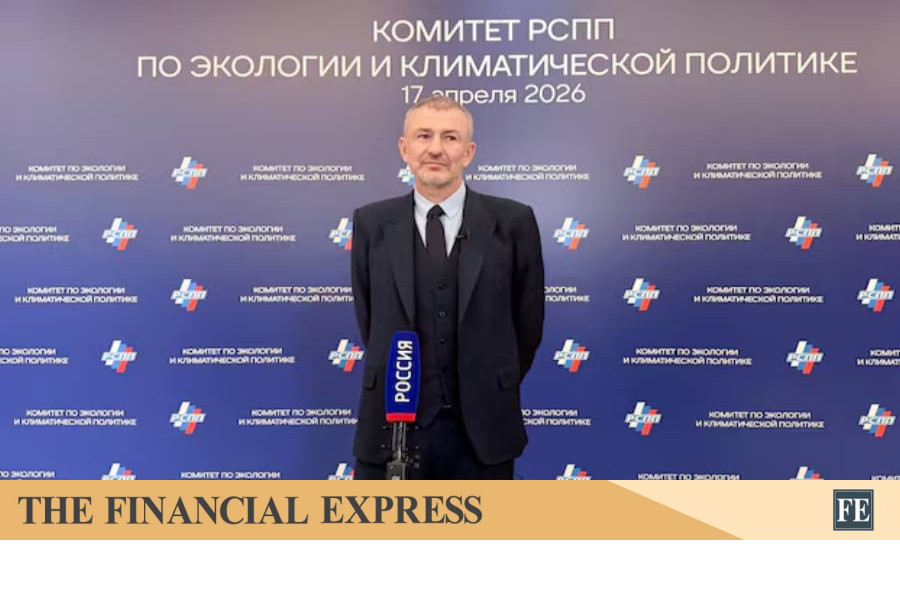
Billionaire and founder of fertilizer producer EuroChem Andrei Melnichenko speaks with journalists during a meeting of the Committee on Ecology and Climate Policy of the Russian Union of Industrialists and Entrepreneurs in Moscow, Russia, April 17, 2026. Photo : REUTERS/Olesya Astakhova

Ukrainian drone attacks in recent months ‌are having a significant impact on the Russian nitrogen fertiliser industry, billionaire Andrei Melnichenko, founder of fertiliser producer EuroChem, told reporters on Friday.

Shortages and rising prices due to the blockade of the Strait of Hormuz, conduit for about a third of global fertiliser trade, are a major concern in terms of global food security.

Russia accounts for about one-fifth of the global trade, but ⁠limited capacity, domestic export caps and recent Ukrainian attacks on major plants all constrain its ability to ramp up fertiliser output.

"Well-known events occurring on our country's territory are leading to increased drone attacks on Russian (fertiliser) enterprises," Melnichenko told reporters on the sidelines of a conference in Moscow, adding that the impact was "significant enough".

A Ukrainian drone attack on Dorogobuzh, one of Russia's largest fertiliser plants, owned by major producer Acron, on February 25 killed seven people and has temporarily knocked out about 5% of the country's overall production capacity.

Dorogobuzh accounts for 11% of Russia's ammonium nitrate output and 9% of its NPK ‌fertiliser ⁠production, a mixture of nitrogen, phosphorus and potassium. The plant is expected to be operational again in May.

Several other attacks have taken place in towns where major fertiliser plants are located.

Melnichenko said that although prices for all three major types of fertilisers had risen, in his view the effective closure of the Strait of Hormuz ⁠has had no impact on the trade in potash, while disruption to phosphate trading was temporary as Middle East producers switch to ports outside the Gulf.

This, he estimated, would happen more quickly than the six months Russian fertiliser ⁠producers needed to switch from European to local ports after Western sanctions were imposed.

Melnichenko said that production of nitrogen fertilisers from natural gas had suffered the most since a large share is produced ⁠from gas extracted from deposits around the Gulf.

Russia, which controls up to 40% of the global trade in ammonium nitrate, said on March 21 that it would stop exports of the fertiliser for one month.​
 

Russian strikes wound 25 in Ukraine overnight
Agence France-Presse . Kyiv, Ukraine 22 April, 2026, 04:07

Russian strikes across Ukraine wounded more than a dozen people in at least four regions, at a time when US-led peace talks to end the war have ground to a halt, officials said Tuesday.

In the northeastern city of Sumy, Russian drones wounded 15 people and damaged apartment buildings and a medical facility, the head of the region said.

Emergency services released images showing rescue workers in the night dousing cars set ablaze in the attacks and helping evacuate residents from damaged buildings.

‘Due to the threat of repeated attacks, rescuers had to suspend their operations several times and move to a safe location,’ the emergency service said. Three people were wounded in aerial attacks in the northeastern Kharkiv region and another three in the eastern city of Sloviansk, officials said.

Four more were wounded in the Dnipropetrovsk region, the governor announced on social media.

Russia launched two missiles and 143 drones in the barrage, the Ukrainian air force said, adding that its air defence units had intercepted one of the missiles and 116 drones.

Russia hoped its invasion would quickly topple Ukraine’s leadership but over more than four years has spiralled into the deadliest conflict in Europe since World War II, killing hundreds of thousands on both sides and displacing millions.​
 

4 killed in Russia, Ukraine after exchange of strikes
Agence France-Presse . Kyiv, Ukraine 23 April, 2026, 00:45

Four people, including a child, were killed in Russia and Ukraine after the latest exchange of drone strikes between the warring countries, officials said on Wednesday.

As diplomatic talks have stalled and neither side has made a breakthrough on the front, Moscow and Kyiv have both stepped up their long-range drone attacks, firing swarms of the unmanned explosive-packed devices at each other on a nightly basis.

An overnight Ukrainian drone strike killed two people in the central Russian city of Syzran, home to one of the country’s top air force schools.

‘Two people — an adult woman and a child — have died in Syzran following an attack by an enemy drone,’ regional governor Vyacheslav Fedorischev said on social media.

Photos provided by the Russian emergencies ministry showed a four-storey apartment building partly collapsed, with rescuers working in the debris.

In Ukraine, Russian drones killed two people in the frontline regions of Kharkiv and Zaporizhzhia, local officials said.

Russia said it had repelled 155 Ukrainian drones in the overnight attack.

Ukraine said Russia had launched 215 drones, of which 189 were intercepted.

Tens of thousands of civilians have been killed since Russia invaded in February 2022.

US-brokered talks on the conflict have failed to push the sides closer to a deal, with negotiations frozen for weeks amid the war in the Middle East.​