War Archive

Saif
Senior Member
- Joined
- Jan 24, 2024
- Messages
- 22,387
- Likes
- 9,875
- Nation

- Axis Group


Iran tells US there is no military solution to Middle East war
In Iran, oil minister Mohsen Paknejad has resigned, the president’s office said on Sunday, as the US maintains a blockade on the country’s oil exports.
 en.prothomalo.com
Iran tells US there is no military solution to Middle East war
AFP
Tehran
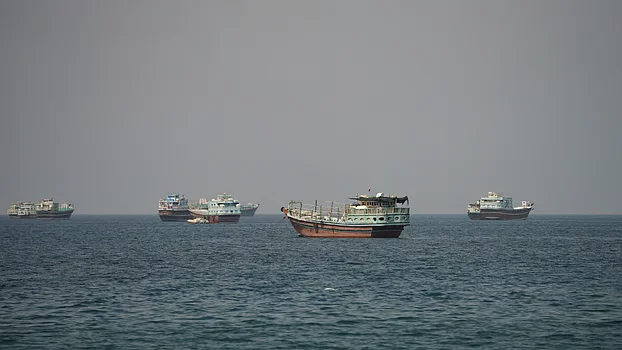
Vessels at the Strait of Hormuz, as seen from Musandam, Oman, on 6 September 2026 REUTERS
Iran’s top diplomat insisted on Sunday that there would be no military solution to the United States’ war against the Islamic republic, with talks on ending the conflict apparently at an impasse.
A campaign of heavy bombardment failed to bring a decisive close to the war launched by the US and Israel in late February, and Washington in recent weeks has dialled back military operations in favour of economic pressure.
The main point of contention remains Iran’s attempt to blockade the Strait of Hormuz, a vital conduit for Gulf oil and gas where a UK maritime agency reported on Sunday another tanker was struck by an unknown projectile.
“If our enemies again choose the path of military confrontation, our response will be stronger than before, and we will defend ourselves with even more force,” Iranian Foreign Minister Abbas Araghchi said at a gathering of foreign ambassadors.
“There is no military solution, nor any solution based on new sanctions,” he continued, adding “only negotiations based on justice and fairness” could end the conflict.
The two sides agreed a memorandum of understanding in June that spelled out a framework for a permanent resolution, but Iranian attacks on vessels in the Hormuz prompted a return to US military operations.
Iran has sought to impose its control over the vital shipping lane since the start of the war, striking vessels that attempt to transit without its authorisation.
The US has imposed its own counterblockade of Iranian ports, and has also struck vessels it accuses of violating it.
On Sunday, the British maritime security agency UKMTO said a tanker in the Hormuz “reported being struck by an unknown projectile, causing damage to the engine room”, though the crew were reported safe and no environmental impact was recorded.
The agency did not specify the date of the incident, the vessel’s origin or destination, or whether it was an oil tanker or LNG carrier.
In Iran, oil minister Mohsen Paknejad has resigned, the president’s office said on Sunday, as the US maintains a blockade on the country’s oil exports.
In a news bulletin on the minister’s resignation, state television ran an interview with an official from the Iranian presidential office who said Paknejad initially offered to quit a while ago “due to personal issues” but this was rejected.
Iranian President Masoud Pezeshkian had asked Paknejad to continue in his post but was now accepting his departure as the minister had insisted on leaving, the official added.
Paknejad has been replaced by Hamid Bovard, the chief executive of the National Iranian Oil Company, the presidency said.
Focused on Hormuz
Iranian and US officials last week held indirect talks on the sidelines of the UN General Assembly, with Tehran saying it presented seven conditions for reopening the strait.
Iran has demanded, among other things, a ceasefire across the Middle East, the unfreezing of its assets abroad, the lifting of sanctions on its oil sector and an end to the US naval blockade.
Trump, however, rejected the proposal, while leaving the door open both to further talks or renewed military operations.
Iranian Deputy Foreign Minister Kazem Gharibabadi said Sunday that the US had expressed its views on the proposal and said they were being reviewed.
“The Americans, through intermediaries, have also conveyed their views on this proposal, and these views are currently being examined inside the country through the relevant channels and procedures,” he told reporters, according to state news agency IRNA.
“Whenever the final position of the Islamic Republic of Iran is ready, appropriate steps will be taken accordingly. At the same time, the Islamic Republic of Iran is also preparing itself for any other possible scenario.”
Iranian foreign ministry spokesman Esmaeil Baqaei on Sunday characterised the latest US counterproposal as being “in line with their previous proposals concerning nuclear issues”.
“We have clearly indicated that we are focusing on the issue of the Strait of Hormuz,” he said, adding that reopening the waterway required “an end to the disruptions to Iranian commercial maritime traffic and the lifting of sanctions”.
The United States and Israel have said the war is necessary to prevent Iran from acquiring nuclear weapons—a goal it has long denied pursuing—though the focus soon shifted to reopening the Hormuz after its closure sent shockwaves through world energy markets.
The United States has not struck Iran since September 1, but it has recently pursued a fresh military buildup in the region.
AFP
Tehran
Vessels at the Strait of Hormuz, as seen from Musandam, Oman, on 6 September 2026 REUTERS
Iran’s top diplomat insisted on Sunday that there would be no military solution to the United States’ war against the Islamic republic, with talks on ending the conflict apparently at an impasse.
A campaign of heavy bombardment failed to bring a decisive close to the war launched by the US and Israel in late February, and Washington in recent weeks has dialled back military operations in favour of economic pressure.
The main point of contention remains Iran’s attempt to blockade the Strait of Hormuz, a vital conduit for Gulf oil and gas where a UK maritime agency reported on Sunday another tanker was struck by an unknown projectile.
“If our enemies again choose the path of military confrontation, our response will be stronger than before, and we will defend ourselves with even more force,” Iranian Foreign Minister Abbas Araghchi said at a gathering of foreign ambassadors.
“There is no military solution, nor any solution based on new sanctions,” he continued, adding “only negotiations based on justice and fairness” could end the conflict.
The two sides agreed a memorandum of understanding in June that spelled out a framework for a permanent resolution, but Iranian attacks on vessels in the Hormuz prompted a return to US military operations.
Iran has sought to impose its control over the vital shipping lane since the start of the war, striking vessels that attempt to transit without its authorisation.
The US has imposed its own counterblockade of Iranian ports, and has also struck vessels it accuses of violating it.
On Sunday, the British maritime security agency UKMTO said a tanker in the Hormuz “reported being struck by an unknown projectile, causing damage to the engine room”, though the crew were reported safe and no environmental impact was recorded.
The agency did not specify the date of the incident, the vessel’s origin or destination, or whether it was an oil tanker or LNG carrier.
In Iran, oil minister Mohsen Paknejad has resigned, the president’s office said on Sunday, as the US maintains a blockade on the country’s oil exports.
In a news bulletin on the minister’s resignation, state television ran an interview with an official from the Iranian presidential office who said Paknejad initially offered to quit a while ago “due to personal issues” but this was rejected.
Iranian President Masoud Pezeshkian had asked Paknejad to continue in his post but was now accepting his departure as the minister had insisted on leaving, the official added.
Paknejad has been replaced by Hamid Bovard, the chief executive of the National Iranian Oil Company, the presidency said.
Focused on Hormuz
Iranian and US officials last week held indirect talks on the sidelines of the UN General Assembly, with Tehran saying it presented seven conditions for reopening the strait.
Iran has demanded, among other things, a ceasefire across the Middle East, the unfreezing of its assets abroad, the lifting of sanctions on its oil sector and an end to the US naval blockade.
Trump, however, rejected the proposal, while leaving the door open both to further talks or renewed military operations.
Iranian Deputy Foreign Minister Kazem Gharibabadi said Sunday that the US had expressed its views on the proposal and said they were being reviewed.
“The Americans, through intermediaries, have also conveyed their views on this proposal, and these views are currently being examined inside the country through the relevant channels and procedures,” he told reporters, according to state news agency IRNA.
“Whenever the final position of the Islamic Republic of Iran is ready, appropriate steps will be taken accordingly. At the same time, the Islamic Republic of Iran is also preparing itself for any other possible scenario.”
Iranian foreign ministry spokesman Esmaeil Baqaei on Sunday characterised the latest US counterproposal as being “in line with their previous proposals concerning nuclear issues”.
“We have clearly indicated that we are focusing on the issue of the Strait of Hormuz,” he said, adding that reopening the waterway required “an end to the disruptions to Iranian commercial maritime traffic and the lifting of sanctions”.
The United States and Israel have said the war is necessary to prevent Iran from acquiring nuclear weapons—a goal it has long denied pursuing—though the focus soon shifted to reopening the Hormuz after its closure sent shockwaves through world energy markets.
The United States has not struck Iran since September 1, but it has recently pursued a fresh military buildup in the region.