| Global Defense, OSINT & Geopolitics Wire

[🇧🇩] Banking Industry in Bangladesh

[🇧🇩] Banking Industry in Bangladesh
452
23K
More threads by Saif

G Bangladesh Defense

Bangladesh Bank governor’s unfiltered remarks: A cause for concern?

1740612055168.webp

Ahsan H Mansur. File photo/Collected

Public confidence is the foundation of any banking system. In Bangladesh, that confidence has been steadily eroded over the past 16 years under the Awami League-led government, with the sector plagued by financial scandals, irregularities, and unchecked mismanagement. Against this backdrop, the interim government appointed economist Ahsan H Mansur as governor of Bangladesh Bank last year, replacing former bureaucrat Abdur Rouf Talukder.

Mansur's appointment was widely seen as a much-needed corrective measure for a sector struggling with structural weaknesses. His tenure has been marked by bold reforms, including the restructuring of 11 banks, many linked to the controversial S Alam Group. However, his direct and unfiltered public statements about the fragile state of the banking industry have sparked intense debate -- raising a critical question: Is the governor inadvertently fuelling panic among depositors?

The controversy began last September when Mansur declared in a press conference that at least 10 commercial banks were on the verge of bankruptcy. This blunt assessment sent shockwaves through the financial sector, triggering widespread speculation and fear. Reports soon surfaced of anxious depositors rushing to banks to withdraw their savings, while many demanded the names of the supposedly failing institutions.

Several high-ranking bank executives, speaking anonymously, warned that such public statements -- however well-intentioned -- could have disastrous consequences. In a sector already reeling from a crisis of confidence, even a hint of instability can worsen the very problem regulators are trying to fix.

"Mansur is a knowledgeable and well-intentioned governor, but given the sector's sensitivity, he should exercise extreme caution in his public remarks," one banking executive cautioned.

The debate over Mansur's communication style escalated further yesterday during a virtual session on "Macroeconomic Policy and Governance in the Banking Sector", held on the final day of the "Recommendations by the Task Force on Re-strategising the Economy" conference.

During the session, Mansur reiterated his concerns about struggling banks bluntly: "We are working to support struggling banks, but not all will survive." While he did highlight some progress -- mentioning that Islami Bank Bangladesh and United Commercial Bank had recovered -- his words once again cast doubt over the fate of the rest.

His remarks drew swift and sharp criticism. National Bank Chairman Abdul Awal Mintoo did not hold back, calling on Mansur to curb his rhetoric.

"Constantly discussing the closure of banks is counterproductive. If shutting down banks was the solution, what about the larger economic fallout?" Mintoo said.

He also took issue with Mansur's rigid stance on monetary policy, particularly his opposition to money printing: "He keeps saying he won't print money. But is that an absolute position? Is that always a viable solution?"

Task Force member Monzur Hossain echoed these concerns, calling for greater discretion in the central bank's public messaging. Regulatory bodies must carefully evaluate what information should be disclosed publicly and what should remain internal, he argued.

Mansur's commitment to reform is undeniable, but his approach to public communication is proving increasingly risky. Banking systems are inherently fragile. When the central bank governor himself repeatedly casts doubt on the survival of financial institutions, it risks adding to the crisis, where fear alone can push banks into deeper distress.

Reforms are necessary. Transparency is vital. But in a sector as sensitive as banking, words carry weight. Bangladesh Bank's leadership must refine its communication strategy to prevent unnecessary panic.​
 

True extent of bad loans emerges
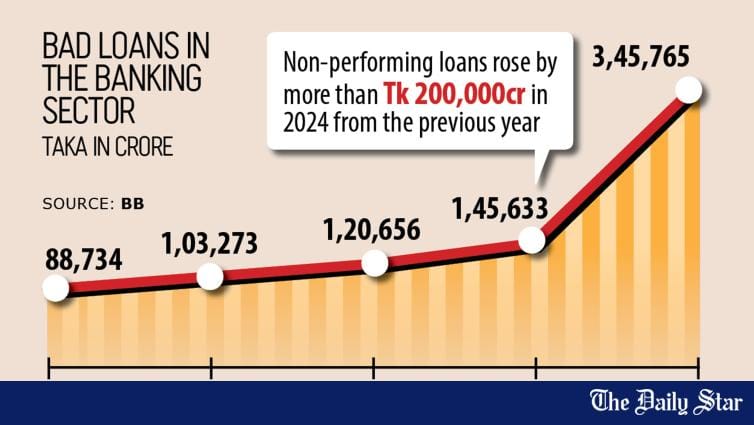
NPLs hit record Tk 3,45,765cr in 2024

1740613607199.webp


Defaulted loans in the country's banking sector reached a record Tk 3,45,765 crore at the end of 2024 as toxic loans increased sharply following the political changeover in August last year.

At the end of last year, total outstanding loans stood at Tk 17,11,402 crore, 20.20 percent of which have turned sour, according to the latest data from the Bangladesh Bank, which was released through a press conference for the first time.

However, distressed assets -- which include written-off loans, rescheduled loans and loans tied up in the Money Loan Court -- stood at Tk 6,68,598 crore.

At the end of September last year, bad loans stood at Tk 2,82,977 crore. In the following three months, the tally increased by Tk 60,788 crore.

This means defaulted loans increased by a staggering Tk 2,00,132 crore in 2024.

Defaulted loans have increased sharply since the political changeover, as the true picture of the sector, concealed during the Awami League government's 16-year regime, has now come to light, The Daily Star has learnt from bankers.

In a statement, the central bank said that defaulted loans increased due to a decline in new loan disbursements and loan renewals, as well as the rescheduling of the maturity period of term loans by the central bank.

Some loans became defaulted following central bank inspections and the vacating of court-issued stay orders related to loan classification.

Bad loans also increased due to the reclassification of rescheduled loans after non-payment of instalments, the statement added.

The growing trend of bad loans could not be arrested as those loans were concealed under the previous regime but have now come to light, said BB Governor Ahsan H Mansur at the press conference yesterday.

Mansur was appointed the central bank governor on August 13 last year.

Some large borrowers, including S Alam Group and Beximco Group, defaulted heavily after the Awami League's fall, pushing the total to an unprecedented level.

The defaulted loan ratio of state-run banks stood at 42.83 percent, while that of private sector banks was 15.60 percent, BB data showed.

Bad loans have increased sharply in some Shariah-based banks controlled by the controversial business conglomerate S Alam Group and in some other banks where Awami League-affiliated businesses had influence, said central bank officials.

Janata had the highest volume of bad loans in the banking sector at the end of last year: as much as 66.8 percent of the bank's total outstanding loans have turned bad.

Of the Tk 67,300 crore of Janata's defaulted loans, about Tk 23,000 crore is of Beximco's, which were classified in the last quarter of 2024.

S Alam Group is another major defaulter, with its defaulted loans at Janata Bank reaching Tk 10,200 crore. It was followed by AnonTex Group (Tk 7,800 crore) and Crescent Group (Tk 3,800 crore).

Not only have bad loans increased, but loan disbursements also rose sharply during the previous regime.

The focus should now be on recovering the money by selling collateral, said Syed Mahbubur Rahman, managing director of Mutual Trust Bank.

"We have to learn from previous mistakes and avoid repeating them. There must be a willingness to fix the banking sector as intention is the key factor. For that to happen, long-term reforms are needed," he added.

Ensuring proper loan sanctioning, enforcing single borrower exposure limits, halting loan rescheduling and appointing administrators at troubled banks are necessary for the ailing sector, said Fahmida Khatun, executive director of the Centre for Policy Dialogue, at a recent event.

She also emphasised protecting central bank independence, ending bank bailouts through recapitalisation and a licence freeze for new banks.​
 

End the legacy of banking plunder
New data reveals how far the rot of bad loans reached under Awami regime

1740788107427.webp

VISUAL: STAR

It is quite telling that defaulted loans in the banking sector reached a record Tk 3,45,756 crore by the end of 2024, as per the latest data from Bangladesh Bank. A major factor behind this rise is the long-overdue exposure of financial corruption and cover-ups under the former regime. For years, as non-performing loans (NPLs) continued to rise, we repeatedly pointed out how the Awami League government was using various state and non-state entities to obscure the true extent of NPLs through accounting manipulation. Financial fraud was concealed through deceptive tactics, and the lack of transparency made it difficult to assess the true condition of our banks, even though the public had long suspected the severity of the crisis.

The interim authorities deserve credit for bringing the truth to light. However, this may have been the easier part. The real challenge lies in reversing this trend and recovering as much of the lost money as possible, whether through selling collateral or other means. The situation has been particularly complicated by the massive defaults of some borrowers, such as S Alam Group and Beximco Group, following Awami League's departure. As a result, total defaulted loans have reached an unprecedented level. According to the central bank, the defaulted loan ratio for state-run banks stood at 42.83 percent, while that of private sector banks was 15.60 percent.

Among state banks, Janata had the highest volume of bad loans at the end of last year, with as much as 66.8 percent of its total outstanding loans classified as non-performing. Of Janata's Tk 67,300 crore in defaulted loans, approximately Tk 23,000 crore belongs to Beximco, which was classified as defaulted in the last quarter of 2024. Meanwhile, S Alam Group's defaulted loans at Janata Bank reached Tk 10,200 crore.

Across the sector, similar looting by oligarchs connected to the fallen regime has left a number of banks extremely vulnerable. Even more concerning is the risk that legitimate businesses, struggling as they are in a slow economy, may find it difficult to repay their loans, further worsening the NPL crisis. Under these circumstances, it is crucial for the authorities to send the right signals to help restore confidence in the sector.

The authorities must work diligently to ensure that banks recover risky loans and that stolen funds parked abroad are reclaimed through diplomatic efforts. They also must restore oversight mechanisms and regulatory institutions that have become dysfunctional, ensuring they serve the interests of the nation rather than political elites. They also must hold to account those responsible for the crisis—including corrupt bankers, policymakers, and borrowers—so that such reckless mismanagement is not repeated again.​
 

Banking reform must be carried through
FE
Published :
Feb 28, 2025 22:40
Updated :
Feb 28, 2025 22:40

1740792720656.webp


There is no gainsaying the necessity of recovering the banking sector that has been left in ruins through mismanagement and outright looting by the henchmen of the previous dictatorial regime. Against this backdrop, the Bangladesh Bank (BB) governor was spot on when he could not rule out the possibility that some ailing banks now on life-support might face closure. His assertion is incontestable since those sick banks are purely a drain on the public exchequer.

The sooner those banks are given a decent burial the better for the economy even though the idea might be unpalatable to the owners of such sick banks. Notably, the BB governor reportedly expressed his view at a conference titled 'Recommendations by the Task force on Re-strategizing the Economy'. The task forces and the reform measures they have initiated to revive the banking and other sectors of the economy are the undertakings made incumbent on the interim government by the student-led mass uprising. So, there is no question of going back on the reform initiatives such as restructuring of the weak banks in consultations with the government and other stakeholders as told by the governor of the central bank at the conference in question.

When it comes to the issue of reforming banks, it is common sense that the task falls in the domain of experts in the field who are to fulfil the mission of the task force. In that case, it is only expected of the entire banking sector and politicians that they would be supportive of the ongoing reform work now in progress in the sector under consideration. It is reassuring to know that some of the malfunctioning banks undergoing restructuring under the present administration of the central bank including, for instance, the Islami Bank Bangladesh and United Commercial Bank, could finally be recovered and are now reportedly performing well. So, it is encouraging for the owners of other troubled banks.

On this score, a 'draft of bank-resolution ordinance' aiming at resolving the issue of sick banks has already been prepared which would take necessary measures including liquidation, merger and recapitalisation of the ailing banks. While welcoming the move to formulate a legal approach to decide the fate of the banks in serious liquidity crisis or overburdened with non-performing loans, it is also important to develop a system by which depositors could be protected in case any bank goes bankrupt. At this point, a disclosure by the central bank governor that work on framing of a deposit insurance act is ongoing is unquestionably a move in the right direction. It is a move long time coming in the interest of the bank depositors who happened to be the actual victims of the failing banks. While protecting the depositors with insurance coverage, the authorities concerned should also think of taking penal measures against such bank directors or owners who wilfully allowed their banks to go bankrupt. To avoid such undesirable outcome, experts concerned may also think of incorporating the idea of increasing the number of independent directors at the banks as well as prohibiting bank owners becoming chairperson of the banks concerned.

As banks play a key role in the economy by providing financial services and creating credit, its proper functioning should be assured through the ongoing reforms. Let this vital task now in progress continue unhindered.​
 

Banking sector in freefall
Can the interim government pull the brakes?
CAF Dowlah
Published :
Mar 03, 2025 22:12
Updated :
Mar 03, 2025 22:12

1741050655819.webp

A bank staff is counting notes Photo : FE/Files

Bangladesh is on the brink of a full-scale banking crisis, exacerbated by economic stagnation and political upheaval following the collapse of the Sheikh Hasina regime. At the heart of this crisis lies a banking sector plagued by skyrocketing non-performing loans (NPLs) and pervasive financial mismanagement.

Last week, Bangladesh Bank disclosed a sharp increase in classified loans, surging from Tk 2.45 trillion in September to Tk 3.45 trillion in December 2024. Consequently, the NPL ratio jumped from 16.9 per cent to an alarming 20.2 per cent within just three months. In global finance, an NPL ratio exceeding 10 per cent signals severe distress, often necessitating immediate regulatory intervention.

A SECTOR ON THE VERGE OF COLLAPSE: Most of the country's 62 scheduled banks-including six state-owned commercial banks, three specialized banks, and 43 private banks-are in crisis. State-owned banks now report an unprecedented 42.8 per cent NPL ratio, while private banks struggle at 15.6 per cent - clearly far beyond acceptable thresholds.

As of December 2024, Janata Bank held the highest soured loan ratio among the state-owned banks, with 66.8 per cent of its total loans classified as defaults. Some of its largest defaulters included top business conglomerates like Beximco and S Alam Group.

High NPL ratios erode bank earnings, destabilise balance sheets, and weaken financial institutions' ability to meet depositor demands-classic precursors to systemic financial collapse. The 2007-2008 global financial crisis followed a similar trajectory of unchecked bad loans.

Worse still, Bangladesh Bank governor Ahsan Mansur warned last week that the NPL ratio could soon reach 35 per cent, attributing the crisis to widespread corruption and systemic looting over the past 15 years. Citing combined loans of Tk 2.5 trillion issued to S Alam Group and Beximco, he remarked, "Nowhere else have so many banks been looted at once." He further warned that with 12 banks under audit following board dissolutions, the true extent of NPLs may be even higher and that some banks may not survive.

THE MAGNITUDE OF THE CRISIS: When Sheikh Hasina assumed power in 2009, NPLs stood at Tk 224.82 billion. By September 2024-immediately after her removal-this figure had skyrocketed past Tk 2.84 trillion, excluding Tk 640 billion in written-off loans. Trillions more were rescheduled or restructured to obscure the crisis's actual scale. The International Monetary Fund (IMF) estimates that over a quarter of all disbursed loans-more than Tk 5 trillion-are in distress.

Bangladesh has long maintained one of South Asia's highest NPL ratios. Between 2012 and 2021, Bangladesh's NPL ratio averaged 8.16 per cent, second only to Pakistan's 10.32 per cent. By comparison, India and Sri Lanka had lower rates of 7 per cent and 3.94 per cent, respectively. Sri Lanka's NPL ratio in 2022, however, rose to 12 per cent amid a prolonged political crisis.

Moreover, the Hasina regime encouraged loan defaulting by manipulating classification guidelines to mask the true scale of bad loans. Previously, loans were categorised as "classified" if principal or interest remained unpaid, even if not overdue, and a loan was formally recognised as a "default loan" after six months of non-payment. However, in 2019, the Hasina government weakened this standard by granting borrowers an additional six-month grace period following an initial three-month overdue period-effectively delaying default classification until nine months of non-payment.

A LEGACY OF CORRUPTION AND MISMANAGEMENT: Bangladesh's banking sector has long been a breeding ground for corruption, attracting unscrupulous actors who amassed immense wealth at taxpayers' expense. While the problem has escalated to unprecedented proportions in recent years, its roots can be traced back to the immediate aftermath of liberation war, when the entire banking system was nationalised and placed under inept administrative and political control.

Over the decades, nationalised banks were systematically mismanaged for political gain, rewarding loyal cronies along the way. The introduction of private-sector banking since the 1980s did little to curb corruption, as politically connected businessmen continued treating banks as personal cash reserves rather than institutions of financial responsibility.

During Hasina's 16-year rule, banks were plundered by politically connected elites, exacerbating capital flight through illicit mechanisms such as hundi, over-invoicing, and trade mis-invoicing. Reports estimate that Bangladesh loses $3.1 billion annually to illicit financial flows.

A White Paper released by the Interim Government estimates that under Hasina's tenure, an average of $16 billion was siphoned off annually. At its unveiling, Professor Yunus lamented, "Our blood curdles to know how they plundered the economy. The saddest part is they looted the economy openly, and most of us lacked the courage to confront it."

BANGLADESH BANK'S RESPONSE: Taking charge of the financial sector in deep troubles, governor Mansur last November mandated that all overdue loans be classified as NPLs after three months instead of six. This policy, set to take effect in April 2025, aligns with IMF standards under the conditions of Bangladesh's $4.7 billion loan agreement. As part of this deal, he also committed Bangladesh Bank to reduce NPLs to 8 per cent by June 2026.

However, the contradiction at the heart of this policy is glaring: shortening the NPL classification period will inevitably inflate the reported NPL ratio. How, then, does Bangladesh Bank intend to cut NPLs from over 20 per cent to 8 per cent within such a short window? The target appears not just unrealistic but outright delusional. The authorities are thus clearly setting themselves up for inevitable failure-risking further damage to an already fragile banking sector.

In the meantime, Bangladesh Bank has aggressively restructured over a dozen struggling banks, including those tied to the scandal-ridden S Alam Group. In a recent virtual session, central bank governor warned that 10 more commercial banks were on the brink of collapse and that some may fail. While such transparency is a welcome departure from past denialism, without concrete, pragmatic solutions to restore stability, these warnings may fuel panic rather than confidence in a banking sector already on the verge of collapse.

Reports indicate that Bangladesh Bank is considering establishing bridge banks-temporary entities to take over failing institutions-along with a Bank Restructuring and Resolution Fund, supported by government contributions and international lenders. While these measures aim to stabilise the sector, they raise serious concerns. Bridge banks offer only a short-term fix, often plagued by inefficiencies and weak depositor confidence, which could worsen instability. Meanwhile, reliance on government funds and external aid risks depleting public resources, increasing debt, and exposing the country to restrictive lender conditions. Rather than providing lasting solutions, these initiatives may merely postpone an inevitable financial reckoning.

REFORM OR RUIN: Bangladesh's banking sector has devolved from mere inefficiency into a hub of corruption, money laundering, and financial fraud. What was once a state-controlled system designed to serve the public has been hijacked by political elites, prioritising their own interests over economic stability. Rampant mismanagement and regulatory complacency have turned the sector into a liability rather than an asset for the nation.

Restoring credibility demands more than superficial reforms-it requires a complete overhaul, strict accountability, and a decisive break from the entrenched culture of financial exploitation. Without bold action, the sector risks sinking further into dysfunction and systemic collapse. Here are some suggestions that policy makers may consider.

First, without reducing NPLs, improving banks' capital adequacy is impossible. Over a decade, state-owned banks have consistently failed to meet minimum capital requirements, with NPL ratios averaging over 20 per cent. Specialised banks, in particular, remain critically undercapitalised. Yet, instead of enforcing discipline, Bangladesh Bank has repeatedly bailed out these failing institutions-at taxpayers' expense and under political directives.

This cycle of barefaced financial misgovernance has not strengthened the banking sector; it has entrenched its weakness. The time for half-measures is over. The state must stop propping up insolvent banks and let market forces determine their fate. A failing bank should fail-prolonging its existence through endless bailouts only deepens systemic inefficiency and corruption.

Second, privatisation of perenniaally losing state-owned banks is an unavoidable imperative to eliminate political patronage and entrenched corruption and mismanagement. It is, understantably, an ambitious task that the interim government may not have the capacity to fully implement, but it can certainly initiate. A logical starting point would be Janata Bank, which is sinking fast under the weight of corruption, mismanagement and bad loans.

Third, while full-scale privatisation may be beyond the scope of the interim government, at the very least, it can insist on professionalising bank management, severing it from the grip of bureaucratic incompetence and partisan loyalty. This requires accountability-holding those responsible for the financial collapse to criminal justice, whether their crimes stem from negligence, favoritism, or outright embezzlement. Unfortuntely, the interim government has so far shown little inclination to pursue such a course.

Fourth, the Interim Government must urgently overhaul Bangladesh Bank. A politicised and compromised regulator cannot fix the system it helped destroy. The institution needs a complete reset-governed by an independent board of proven experts, each overseeing critical policy areas, under a respected, impartial chairman. Leadership must be earned through merit and expertise, not bureaucratic inertia or political patronage. Without this fundamental restructuring, any attempt at financial reform will be nothing more than a facade, perpetuating the same dysfunction that brought the sector to the brink of collapse.

Ultimately, Bangladesh's financial recovery hinges on a fundamental transformation: a banking system that serves the people, not the powerful elites.Without this seismic shift, the nation's economy will remain shackled to the very predators who drove it to the edge of collapse.

Dr CF Dowlah is a retired professor of Economics and Law in the United States. Currently he serves as Chair, Bangladesh Institute of Policy Studies (BIPS).​