 Bangladesh Defense

Saif
Senior Member
- Joined
- Jan 24, 2024
- Messages
- 22,417
- Likes
- 9,875
- Nation

- Axis Group


Carry out thorough reforms in banking sector
Bankers and experts on Wednesday underlined the need for comprehensive reforms within the country's banking sector. They urged both the government and international bodies like ICC and WTO to come forward to provide solutions. They came up with the observations at a dialogue titled "Global Financ
Carry out thorough reforms in banking sector
Demand experts at ICC dialogue
FE REPORT
Published :
May 01, 2025 08:34
Updated :
May 01, 2025 08:34
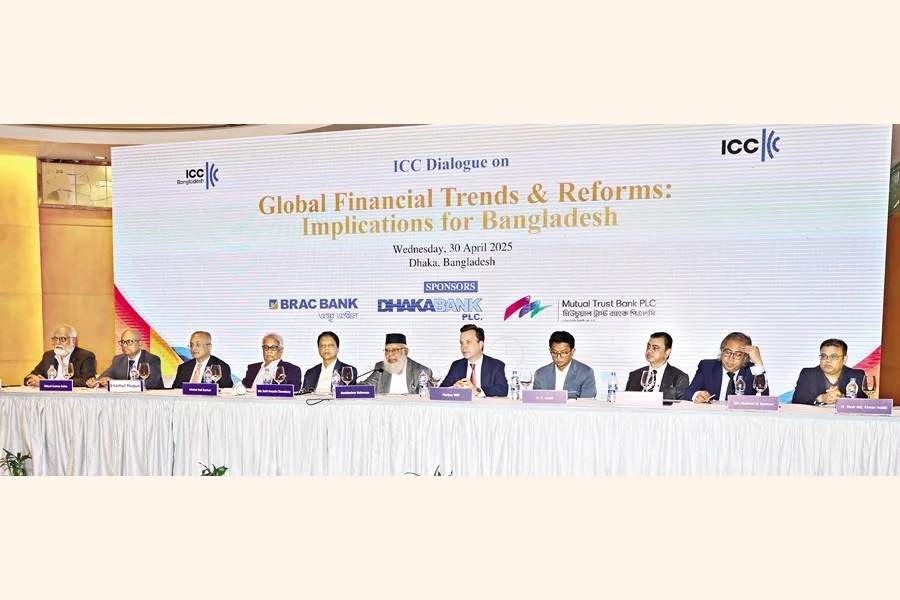
ICC Bangladesh President Mahbubur Rahman (centre) moderated the ICC Dialogue on ‘Global Financial Trends & Reforms : Implications for Bangladesh’ held in Dhaka on Wednesday. It was attended by Bangladesh Bank Deputy Governor Md. Zakir Hossain Chowdhury (5th from left) as Chief Guest and ICC Global Banking Commission Chairman Florian Witt (5th from right) was the Keynote Speaker. Also seen in the picture as panel speakers are (L-R) : ICCB Secretary General Ataur Rahman; ADB Lead Investment Officer Bidyut Kumar Saha; Standard Chartered MD Enamul Huque; BAB Chairman Abdul Hai Sarker; ICCB Vice President A. K. Azad; ABB Chairman & MD of BRAC Bank Selim R F Hussain; HSBC CEO Md. Mahbub Ur Rahman and Professor of BIBM Dr. Shah Md Ahsan Habib. — FE Photo
Bankers and experts on Wednesday underlined the need for comprehensive reforms within the country's banking sector.
They urged both the government and international bodies like ICC and WTO to come forward to provide solutions.
They came up with the observations at a dialogue titled "Global Financial Trends and Reforms: Implications for Bangladesh" organised by International Chamber of Commerce, Bangladesh (ICCB) at a city hotel.
Speaking on the occasion, President of ICC Bangladesh Mahbubur Rahman, who moderated the event, said that the full implementation of additional US tariffs could significantly strain the nation's banking system by reducing export earnings, tightening foreign currency liquidity, and escalating non-performing loans, particularly in trade-reliant sectors.
"It is therefore imperative for Bangladesh to adopt resilient financial strategies and regulatory reforms that safeguard economic stability in the face of these external shocks." He said despite the economy's resilience in many areas, structural weaknesses within the financial sector remain a critical challenge.
"This underscores the urgent need for comprehensive banking reforms, enhanced regulatory oversight and strategic policy interventions to bolster financial sector confidence and ensure sustainable economic growth in the coming years." He said the recent Bangladesh Development Update report by World Bank warned of a deepening crisis in the country's banking sector, citing long-standing structural weaknesses, rising non-performing loans (NPLs), and governance challenges.
He said the report flags that gross NPLs have doubled to over Tk 2.9 trillion, with nearly half of these concentrated in nine state-owned banks. "Capital shortages, slow adoption of international standards and a fragile legal and institutional framework for loan recovery are among the systemic issues urgently needing reform." Mr Rahman said if these issues are left unaddressed, it may undermine both financial stability and investors' confidence.
"The interim government's recent reform initiatives, in coordination with the Bangladesh Bank, are beginning to uncover the full extent of these risks," he said adding that the message is clear: reform is not optional; it is essential.
ICC Vice-President AK Azad urged International Chamber of Commerce (ICC) and World Trade Organisation (WTO) to pay attention to the aftermath of implementation of US tariffs to countries like Bangladesh. He also underscored the need for ICC and WTO interference for the settlement of insurance claim for the damaged factories during political turmoil. He urged the central bank to open the exchange rate.
Florian Witt, Chair of the ICC Global Banking Commission, in his keynote, echoed the call for transformative action within Bangladesh's banking sector. He specifically advocated for the revitalization of state-owned banks through strategic recapitalization and aggressive NPL reduction.
Witt also proposed a framework that encourages bank mergers to create larger, more resilient banking groups. Addressing the challenges faced by Islamic and troubled private sector banks, he emphasised the necessity of thorough forensic audits to inform potential mergers, recapitalization efforts, and the bolstering of Tier-1 capital. A key recommendation included the adoption of international standards for NPL categorization. While acknowledging potential challenges, Witt also offered a forward-looking perspective, suggesting that the future of banking lies significantly in the Global South.
Deputy Governor of Bangladesh Bank Md. Zakir Hossain Chowdhury, who was present as the chief guest, said Bangladesh Bank has taken a lot of reform activities recently, but time hasn't come yet to evaluate the result of the reform. He said Bangladesh Bank always consult with stakeholders, private sectors and development partners.
Chairman of Bangladesh Association of Banks and Chairman of Dhaka Bank PLC Abdul Hai Sarker said if all the stakeholders work together, Bangladesh can cope up with changes coming.
Chairman of Association of Bankers Bangladesh (ABB) Selim R F Hussain said Globalisation 2.0 is going to be very different from what it was earlier as many geopolitical changes are happening across the world. There is something that cannot be influenced by small countries like Bangladesh; they can only try to respond to them.
"It will be important for us to get together as a group with all the relevant stakeholders and respond to this various changes that are happening," Coordination across the various regulators and ministries needs to be far faster than they are currently.
Managing Director of Standard Chartered Bank Bangladesh Enamul Huque said Bangladesh should look for time-befitting ways to cope with the global economic situation challenged by the tariff imposed by Trump administration. Bangladesh should focus more on high valued apparel items like manmade fiber (MMF), he said.
Chief Executive Officer of The Hongkong and Shanghai Banking Corporation Ltd. Md. Mahbub Ur Rahman said global supply chain is going through changes including notable growth in south-south trading. "Global context is shifting, the market is being shifted, and so is the supply chain," he said adding that this trend is opening up new markets. Regarding letter of credit (LC) opening in the country, he said many businesses in Bangladesh import their merchandise through LC whereas exports are done based on contracts instead of LC. "How can we strike the balance?" he asked.
He also said Bangladesh should address issues like developing more infrastructure, supply chain reconfiguration, and logistics facilitation in the country for strengthening its trade competitiveness with other countries.
Professor of Bangladesh Institute of Bank Management (BIBM) Dr. Shah Md Ahsan Habib said problems lying in Bangladesh's banking sector are unique. "That's why it is not possible to directly follow the practices of developed countries. Our level of financial literacy and our understanding on risk are relatively low," he said. Despite this many banks and businesses are doing fantastic jobs, even their activities are replicable, he added.
Lead Investment Officer, Private Sector Operations Department, Bangladesh Resident Mission Asian Development Bank Bidyut Kumar Saha said many of the vulnerabilities of the banking sector are rooted within the country. "So irrespective of any global development in the financial sector or anything else, the ongoing reform efforts by the government and the central bank need to be carried out in full force," he said. ADB is happy to be working with the government and other stakeholders to this effect, he said.
ICCB Secretary General Ataur Rahman also spoke at the dialogue.
Demand experts at ICC dialogue
FE REPORT
Published :
May 01, 2025 08:34
Updated :
May 01, 2025 08:34
ICC Bangladesh President Mahbubur Rahman (centre) moderated the ICC Dialogue on ‘Global Financial Trends & Reforms : Implications for Bangladesh’ held in Dhaka on Wednesday. It was attended by Bangladesh Bank Deputy Governor Md. Zakir Hossain Chowdhury (5th from left) as Chief Guest and ICC Global Banking Commission Chairman Florian Witt (5th from right) was the Keynote Speaker. Also seen in the picture as panel speakers are (L-R) : ICCB Secretary General Ataur Rahman; ADB Lead Investment Officer Bidyut Kumar Saha; Standard Chartered MD Enamul Huque; BAB Chairman Abdul Hai Sarker; ICCB Vice President A. K. Azad; ABB Chairman & MD of BRAC Bank Selim R F Hussain; HSBC CEO Md. Mahbub Ur Rahman and Professor of BIBM Dr. Shah Md Ahsan Habib. — FE Photo
Bankers and experts on Wednesday underlined the need for comprehensive reforms within the country's banking sector.
They urged both the government and international bodies like ICC and WTO to come forward to provide solutions.
They came up with the observations at a dialogue titled "Global Financial Trends and Reforms: Implications for Bangladesh" organised by International Chamber of Commerce, Bangladesh (ICCB) at a city hotel.
Speaking on the occasion, President of ICC Bangladesh Mahbubur Rahman, who moderated the event, said that the full implementation of additional US tariffs could significantly strain the nation's banking system by reducing export earnings, tightening foreign currency liquidity, and escalating non-performing loans, particularly in trade-reliant sectors.
"It is therefore imperative for Bangladesh to adopt resilient financial strategies and regulatory reforms that safeguard economic stability in the face of these external shocks." He said despite the economy's resilience in many areas, structural weaknesses within the financial sector remain a critical challenge.
"This underscores the urgent need for comprehensive banking reforms, enhanced regulatory oversight and strategic policy interventions to bolster financial sector confidence and ensure sustainable economic growth in the coming years." He said the recent Bangladesh Development Update report by World Bank warned of a deepening crisis in the country's banking sector, citing long-standing structural weaknesses, rising non-performing loans (NPLs), and governance challenges.
He said the report flags that gross NPLs have doubled to over Tk 2.9 trillion, with nearly half of these concentrated in nine state-owned banks. "Capital shortages, slow adoption of international standards and a fragile legal and institutional framework for loan recovery are among the systemic issues urgently needing reform." Mr Rahman said if these issues are left unaddressed, it may undermine both financial stability and investors' confidence.
"The interim government's recent reform initiatives, in coordination with the Bangladesh Bank, are beginning to uncover the full extent of these risks," he said adding that the message is clear: reform is not optional; it is essential.
ICC Vice-President AK Azad urged International Chamber of Commerce (ICC) and World Trade Organisation (WTO) to pay attention to the aftermath of implementation of US tariffs to countries like Bangladesh. He also underscored the need for ICC and WTO interference for the settlement of insurance claim for the damaged factories during political turmoil. He urged the central bank to open the exchange rate.
Florian Witt, Chair of the ICC Global Banking Commission, in his keynote, echoed the call for transformative action within Bangladesh's banking sector. He specifically advocated for the revitalization of state-owned banks through strategic recapitalization and aggressive NPL reduction.
Witt also proposed a framework that encourages bank mergers to create larger, more resilient banking groups. Addressing the challenges faced by Islamic and troubled private sector banks, he emphasised the necessity of thorough forensic audits to inform potential mergers, recapitalization efforts, and the bolstering of Tier-1 capital. A key recommendation included the adoption of international standards for NPL categorization. While acknowledging potential challenges, Witt also offered a forward-looking perspective, suggesting that the future of banking lies significantly in the Global South.
Deputy Governor of Bangladesh Bank Md. Zakir Hossain Chowdhury, who was present as the chief guest, said Bangladesh Bank has taken a lot of reform activities recently, but time hasn't come yet to evaluate the result of the reform. He said Bangladesh Bank always consult with stakeholders, private sectors and development partners.
Chairman of Bangladesh Association of Banks and Chairman of Dhaka Bank PLC Abdul Hai Sarker said if all the stakeholders work together, Bangladesh can cope up with changes coming.
Chairman of Association of Bankers Bangladesh (ABB) Selim R F Hussain said Globalisation 2.0 is going to be very different from what it was earlier as many geopolitical changes are happening across the world. There is something that cannot be influenced by small countries like Bangladesh; they can only try to respond to them.
"It will be important for us to get together as a group with all the relevant stakeholders and respond to this various changes that are happening," Coordination across the various regulators and ministries needs to be far faster than they are currently.
Managing Director of Standard Chartered Bank Bangladesh Enamul Huque said Bangladesh should look for time-befitting ways to cope with the global economic situation challenged by the tariff imposed by Trump administration. Bangladesh should focus more on high valued apparel items like manmade fiber (MMF), he said.
Chief Executive Officer of The Hongkong and Shanghai Banking Corporation Ltd. Md. Mahbub Ur Rahman said global supply chain is going through changes including notable growth in south-south trading. "Global context is shifting, the market is being shifted, and so is the supply chain," he said adding that this trend is opening up new markets. Regarding letter of credit (LC) opening in the country, he said many businesses in Bangladesh import their merchandise through LC whereas exports are done based on contracts instead of LC. "How can we strike the balance?" he asked.
He also said Bangladesh should address issues like developing more infrastructure, supply chain reconfiguration, and logistics facilitation in the country for strengthening its trade competitiveness with other countries.
Professor of Bangladesh Institute of Bank Management (BIBM) Dr. Shah Md Ahsan Habib said problems lying in Bangladesh's banking sector are unique. "That's why it is not possible to directly follow the practices of developed countries. Our level of financial literacy and our understanding on risk are relatively low," he said. Despite this many banks and businesses are doing fantastic jobs, even their activities are replicable, he added.
Lead Investment Officer, Private Sector Operations Department, Bangladesh Resident Mission Asian Development Bank Bidyut Kumar Saha said many of the vulnerabilities of the banking sector are rooted within the country. "So irrespective of any global development in the financial sector or anything else, the ongoing reform efforts by the government and the central bank need to be carried out in full force," he said. ADB is happy to be working with the government and other stakeholders to this effect, he said.
ICCB Secretary General Ataur Rahman also spoke at the dialogue.


