| Global Defense, OSINT & Geopolitics Wire

[🇧🇩] Banking Industry in Bangladesh

[🇧🇩] Banking Industry in Bangladesh
452
23K
More threads by Saif

G Bangladesh Defense

Fast-tracking credit to performing businesses
It is necessary to support growth, reduce NPLs


Syed Md Aminul Karim and Md Ariful Islam
Published :
Aug 08, 2025 22:21
Updated :
Aug 08, 2025 22:21

1754699673947.webp


In today's challenging economic landscape, access to timely and appropriate credit has become a critical factor for survival and growth. Yet, in Bangladesh, many fundamentally sound businesses are being denied financing due to a structural rigidity in our credit classification system, one that fails to distinguish between a failing company and its flourishing sister concerns within the same group.

Although Bangladesh Bank's BRPD Circular No. 07 (April 2024) was a welcome policy shift, permitting loans to performing concerns within a group even if another entity is classified, provided the default is not willful and certain conditions are met. The process it mandates remains cumbersome, lengthy, and underutilised. This bureaucratic complexity discourages banks from using the provision. As a result, banks hesitate to proceed, businesses are denied timely credit, and the country loses valuable momentum in industrial recovery and job creation.

THE REAL PROBLEM: ONE BLACK MARK, MANY VICTIMS: The current credit assessment model in Bangladesh still operates on a group-based classification, which means if one company in a corporate group becomes classified, all other sister concerns-regardless of their individual performance-are often treated as high-risk or ineligible for financing.

This system not only restricts liquidity to viable businesses but also creates a vicious cycle: promising enterprises are choked off from working capital, which ultimately pushes them toward distress-adding further to the country's ballooning non-performing loan (NPL) portfolio.

RECENT ICRR CHANGES MAY INTENSIFY PRESSURE: Bangladesh Bank has not extended the relaxed Internal Credit Risk Rating (ICRR) guidelines beyond December 2024. While these relaxed standards had helped businesses qualify for credit during tough times, the return to the stricter scoring model from January 2025 will further narrow borrower eligibility. This dual pressure-from group-based CIB constraints and tightened credit risk ratings-is likely to slow credit growth, increase rejection rates, and may raise NPLs as financially strained but viable firms are pushed into default. Bangladesh Bank should consider extending the ICRR flexibility until the economy gains momentum and stabilizes.

WHAT WE CAN LEARN FROM THE WORLD: Globally, countries like India, Malaysia, the Philippines, South Africa, Nigeria, and even Nepal are evolving towards entity-based credit assessment models. These allow banks to evaluate and lend to businesses based on their own financial strength, rather than group association alone-unless legal or financial guarantees directly tie them to a defaulter.

In contrast, Bangladesh remains one of the few countries where central bank approval is mandatory to lend to a performing concern within a group that has a defaulting member. While this ensures control, it causes serious delays and discourages lending-even when there is low risk.

A SMARTER FRAMEWORK: FASTER LENDING WITH ACCOUNTABILITY: What is needed now is a fast-track lending framework-one that allows banks to lend to low-risk, well-performing group concerns without waiting for BB approval, subject to strict safeguards:

Risk-Based Segmentation: Classify performing group concerns as Green (low risk), Amber (moderate), or Red (high risk).

Bank-Level Autonomy: Let banks approve Green-category loans up to a threshold (e.g., BDT 50 crore) with post-disclosure to BB, not prior approval.

Enhanced Monitoring: Require banks to impose strict end-use covenants, utilize digital fund tracking, and conduct quarterly reviews.

Digital Portal for BB-Bank Communication: Create an e-approval system for BB review and oversight, reducing paperwork and delay.

Incentives and Penalties: Encourage ethical lending by rewarding compliant banks and penalizing misuse or negligence.

ETHICS AND REALITY: BRIDGING THE TRUST GAP: It is true that ethical business practices in Bangladesh are still evolving, and concerns over fund diversion are legitimate. But a blanket restriction on all group-linked financing does not solve the problem-it merely punishes genuine entrepreneurs while leaving loopholes for habitual defaulters.

If performing business owners-those who create jobs, export goods, and build industries-are not supported now, the long-term cost to the economy will be far greater than any single bad loan.

Bangladesh Bank must lead this transformation by adopting a balanced approach that enables trust, enforces discipline, and supports growth.

To reduce NPLs, accelerate industrial recovery, and rebuild credit confidence, Bangladesh must shift from bureaucratic control to smart regulation. A well-designed, risk-based fast-track lending framework-alongside thoughtful ICRR flexibility-can deliver both credit discipline and credit access.

Now is the time for reform that works in practice, not just on paper. Let us empower banks to lend responsibly and enable performing businesses to thrive again.

Dr. Md Ariful Islam is a banker and economic researcher. Dr. Syed Md Aminul Karim is a former Member of the National Board of Revenue (NBR)​
 

Bangladesh’s banking sector pulled back from the brink: BB governor

UNB
Published :
Aug 10, 2025 12:51
Updated :
Aug 10, 2025 12:51

1754872714697.webp


Bangladesh’s banking sector has managed to pull back from the brink over the past year, Bangladesh Bank Governor Ahsan H Mansur said on Sunday, crediting a series of measures taken since he assumed office.

Speaking at a seminar titled 'Interim Government’s 365 Days' organised by Centre for Policy Dialogue (CPD), the governor said the sector was “right at the edge of the cliff” when the interim government took office in August last year.

“Our two main challenges were to stabilise the macroeconomy and reform the financial sector. Reforms cannot be done in a year, but we have started them in every area,” Mansur said.

Upon taking charge, he held meetings with international financial institutions to maintain lines of credit.

“We assured them that we would repay every penny we owed, and we did. Our situation did not turn like Sri Lanka or Pakistan,” he said.

According to him, the biggest support in debt repayment came from remittance inflows alongside export earnings over the past year.

On inflation, the governor said controlling it was a major challenge.

Since August 14 last year, Bangladesh Bank has not sold a single dollar from reserves, instead buying dollars at Tk 122 despite pressures to adjust the rate.

Inflation has since fallen below 10%, and Mansur expects it to drop below 5% in the future.

While the balance of payments is now in surplus, the economy is still lagging in attracting investments, he noted.

“Before elections, big investors will not come, but we have already prepared the ground to encourage investment after the polls,” he added.

On why no banking commission was formed, Mansur said it would have delayed urgent decisions, taking six to nine months to produce a report. Instead, three separate taskforces have been formed to reform the banking sector, central bank operations, and recover laundered money.

Recovering funds siphoned abroad is proving the most challenging, he said, as it requires coordination with 8–10 ministries.

Major legal reforms are also underway, including extensive amendments to the Bank Companies Act, fundamental changes to the Money Laundering Act — adding asset recovery provisions — and broad revisions to the Bangladesh Bank Order to enhance the central bank’s accountability and autonomy.

Amendments will also be made to the Deposit Insurance Act and the Money Loan Court Act to resolve long-pending loan default cases.

The central bank also plans to amend the Bangladesh Bank Resolution Ordinance to allow it to acquire any bank facing liquidity crises due to irregularities. “No more leniency. If a bank cannot operate properly, Bangladesh Bank will take it over,” Mansur warned.

He added that a single body will be created for “360-degree monitoring” of all banks to tackle irregularities in a coordinated manner.

The governor further stressed initiatives to make Bangladesh a cashless economy, including the promotion of QR codes, wider credit card usage, expansion of nano-loans, banking education for school students, Tk 200 student bank accounts, housing reforms, revenue department restructuring, and lowering smartphone prices to expand digital banking coverage.​
 

Discriminatory bank financing in Bangladesh

Haradhan Sarker
Published :
Aug 12, 2025 22:56
Updated :
Aug 12, 2025 22:56

1755044175658.webp


Who does not aspire after a discrimination-free economy or society? Restoring rights inevitably requires a movement. Since inception of collective right-consciousness , the victims have fought against rights violation. From time to time, agitations spring up spontaneously as we observed an anti-discrimination student movement as one of the most powerful catalysts of July Uprising 2024 led by students and masses in Bangladesh. Discrimination has numerous types and forms -- political, economic, religious, racial, ethnic, gender, administrative, and so on. Many discriminations remain disguised and generally subtle. New and unimaginable forms of discrimination also emerge. However, we should unveil every possible type of discrimination lying in every stage of society and economy. Present discussion would be concerned with a type of economic discriminations particularly in loans and advances disbursed by the banks in Bangladesh.

Discrimination in the field of economic management leads to a rise in economic inequalities. Banks have a critical role in facilitating economic growth in terms of income and wealth of their borrowers. In the context of increasing emphasis upon corporate social responsibility (CSR) , banks as lenders should prioritise the interest of the majority of borrowing people belonging to cottage, micro, small and medium categories rather than large ones. This approach to lending is ethical and beneficial not only for the economy but also for the lending banks.

Disbursement and recovery of loans and advances constitute one of the most important functions of a bank. The cruel fact is that large firms or borrowers managed to reap most of the facilities offered under government stimulus packages during COVID period whereas the people and firms under CMSME categories were deprived of their due and justified benefits. An unholy nexus of bank owners-directors, government policy-makers and the then ruling politicians forced discriminatory banking .

Discrimination is a man-made injustice. It may be created intentionally, unintentionally and also unconsciously. Whatever be the manner of creating or continuing discrimination, it is always unacceptable and subject to elimination. It is also true that eliminating discrimination hardly occurs without a strong movement. Longstanding discrimination often becomes a custom that is silently accepted as a fate . Resistance to change such fate comes from the beneficiary group. Thus it is an ethical as well a great challenge as to whether and how to end discrimination.

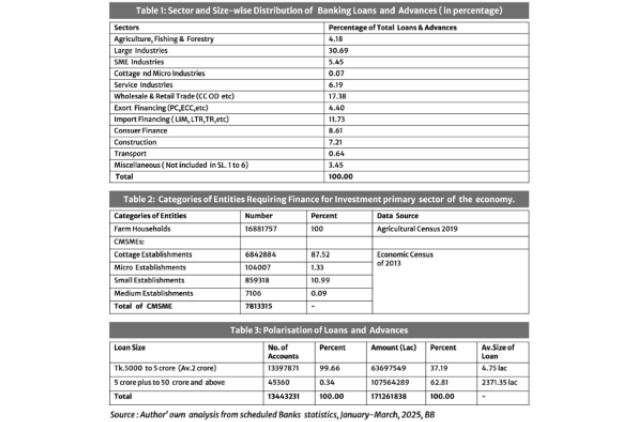
According to information obtained from BB's Scheduled Banks Statistics (January-March 2025), Table 1 reveals that as the primary sector contributing 10.94 per cent of gross domestic product (GDP), agriculture, fishing & forestry receives only 4.18 per cent of total bank loans and advances .This is quite inadequate against the sector's actual requirements. Besides, the share of finance held by farm borrowers of more than Tk 1 crore to 50 crore and above is 1.16 per cent. As a result, the actual percentage for farmers below the loan size of Tk. 5000 to 1 crore reduces to 3.02 (i.e. 4.18 per cent minus 1.16 per cent). Most of the farm households have to depend on informal fund to the extent of more than 90 per cent of their needs at a much higher cost . Borrowers under cottage and SME categories receive only 5.52 per cent of total loans and advances. Available data on banking finance are not well designed. So, the real position of CMSME financing cannot be analysed and justified in specific terms. We are totally unaware of any updated and inclusive statistics on financing CMSMEs along with the number of entrepreneurs/borrowers based on their nature and size. Consequently, categorical financing needs and priorities cannot be ascertained. An attempt has been made to present some past statistics about size-based economic establishments, and farm households which are to be assessed as preferential entities.

This Table furnishes data from which we can guess a rough scenario regarding the number of probable finance-seeking people and organizations that largely belong to CMSME categories. It is seen from the table that more than 78 lac CMSME establishments are recorded. Their actual number might have rather escalated over the time span of 12 years from 2013. Regrettably, we fail to collect the current number of borrowing accounts and other relevant data under CMSME .The number of accounts under agriculture, fishing and forestry are 63.35 lac against 1.69 crore of farm households. Only 37.49 per cent of farm households have been financed with very insignificant amounts.

Table 3 shows that the banking industry has more than 13 million accounts for loans and advances. We cannot directly conclude that the number of borrowers would be exactly equal to the number of accounts. Due to having more than one accounts maintained by many borrowers, the actual number of borrowers may be around 10 million. Whatever be the real number, 99.66 per cent account holders have access to only 37.19 per cent of total loans and advances while only 0.34 per cent account holders share 62.81 per cent of total loans and advances. Economic activities create income and wealth usually to the extent of investment outlay made by the investors. Household Income and Expenditure Surveys 2016 and 2022 reveal that investible surplus of the majority of households is insignificant. That is why, they need debt financing. CMSMEs' inaccessibility to and inadequacy of debt fund is triggered by discriminatory allocation of banks' loans and advances. Awfully it is observed that average size of loans and advances taken by few account holders ( only 45,360) is 499.23 times the average size of borrowing by more than 13.39 million account holders. Are the lending banks liable for such a discrimination ? It is primarily the lack of clear philosophy and principle of good governance at the national level and secondarily the lack of good corporate governance at the level of lending banks.

Hard truth is that we are yet to develop the appropriate framework of good governance to be implemented by the government . Most important at this critical juncture of time is that there must be a broad-based political consensus particularly on the fundamental philosophy and principles that would underpin the foundation of good governance system for our country. As a sub-system, the model of corporate governance in banking will have to be developed. Corporate stakeholder responsibility should be preferred over corporate social responsibility in order to meet expectations of all organic stakeholders of the banking industry. Then, discriminatory banking will end as an in-built component of stakeholders-based banking governance.

Haradhan Sarker, PhD, is ex-Financial Analyst, Sonali Bank & retired Professor of Management.​
 

BB INTERVENTIONS WORK BOTH WAYS
Forex robust, bank liquidity eases


JUBAIR HASAN
Published :
Aug 12, 2025 10:25
Updated :
Aug 12, 2025 10:25

1755044459504.webp


Bangladesh Bank intervention to bring stability in foreign-exchange market proves a boon for both -- the central bank builds up forex stock and commercial banks quench their liquidity thirst in trying times.

In a latest intervention made Sunday, the BB purchased $83 million from eleven commercial banks at rates ranging from Tk 121.47 and Tk 121.50 a dollar to stabilise the country's forex market and injected around Tk 10 billion.

The central bank has so far been bought $622 million from the commercial banks since July 13 under the prevailing free-floating exchange regime.

For the dollar buys, the banking regulator paid over Tk 75.57 billion to the banks at a time when commercial lenders largely depend on central bank's lending facility against repo to meet their local-currency obligations amid poor deposit and lending growth.

Apart from forex-market stabilisation, such regular intervention by the banking regulator to keep the exchange rate within the undisclosed band of the crawling-peg system also helps in bolstering the country's foreign-currency reserves.

Seeking anonymity, a BB official said the inflow of foreign currencies continues to grow on back of remarkable growth of remittance and export receipts in recent months while the pressure of import has yet to get momentum, which leaves a good portion of unused foreign currencies in the banks.

As a matter of fact, the official notes, the exchange rate on the interbank spot market falls and moving around the floor rate of the undisclosed band under the existing crawling-peg system.

"That's why the BB continues to intervene and purchase the US dollar from the market," the official said, adding that the BB in the last five biddings bought a total of $622 million from the market.

The central banker mentions that the intervention normally comes to prevent the downfall of taka-dollar exchange rate and to bolster the foreign-currency reserves in line with the prescription of the IMF (International Monetary Fund) under its $5.50-billion lending package to stabilise the country's macroeconomic situation.

According to BB statistics, the gross foreign-exchange reserves rose to $30.25 billion and $25.23 billion in accordance with BB and IMF's BPM6 calculations as on August 10, 2025. The figures were $29.80 billion and $24.78 billion respectively by the end of July last.

Managing Director and Chief Executive Officer of Mutual Trust Bank PLC (MTB) Syed Mahbubur Rahman says the banks managed to get the liquidity through selling the US dollars amid liquidity tightness because of low deposit growth and investment opportunities under the persisting economic sluggishness.

"And the liquidity that comes from the sale of the American greenback also makes contribution to reducing the government borrowing costs from the banks through the continuous fall in the yield on government securities market," the experienced banker explains.

According to the auction of treasury bills, the cut-off yield in 91 days, 182 days and 364 days dropped to 10.19 per cent, 10.39 per cent and 10.49 per cent respectively on Sunday from 10.45 per cent, 10.81 per cent and 10.57 per cent recorded on July 20 last.​
 

BFIU seeks bank records of ex-Bangladesh Bank governors, deputies

UNB
Published: 13 Aug 2025, 22: 45

1755137126364.webp

Atiur Rahman, Fazle Kabir and Abdur Rouf Talukder

The Bangladesh Financial Intelligence Unit (BFIU) has sought bank account details of three former governors and six former deputy governors of the Bangladesh Bank.

The move comes following a request from the Anti-Corruption Commission (ACC) as part of an investigation into allegations of corruption and mismanagement in the banking sector.

The three former governors are Atiur Rahman, Fazle Kabir and Abdur Rouf Talukder, all of whom served during the 15-and-a-half-year rule of the Awami League government.

The allegations suggest that the country's banking sector was systematically weakened during their tenure.

The six deputy governors whose bank accounts have been subpoenaed are Sitangshu Kumar Sur Chowdhury (SK Sur), Masud Biswas, SM Moniruzzaman, Abu Hena Mohammad Razee Hasan, Kazi Saidur Rahman and Abu Farah Mohammad Naser.

Allegations against former governors

Atiur Rahman's tenure was allegedly marked by a weak regulatory oversight, which is said to have enabled financial scandals such as the Hall-Mark and Basic Bank loan scams.

He is also accused of being a 'mastermind' behind the cover-up of the 2016 Bangladesh Bank reserve heist, an event that ultimately led to his resignation.

During his time as governor, Fazle Kabir allegedly approved the controversial takeover of Islami Bank Bangladesh and Social Islami Bank by the S Alam Group.

According to the information, he allegedly approved these takeovers in the dead of night, paving the way for large-scale looting at the banks.

He is also accused of relaxing loan policies to conceal default loans, keeping interest rates artificially low at 9 per cent and introducing methods for loan defaulters to get off with minimal payments.

Serving as governor for two years, Abdur Rouf Talukder is said to have made numerous controversial decisions. He resigned from a secret location after the fall of the Awami League government.

The report claims that his tenure saw the continuation of fraudulent loan distribution and that he failed to address irregularities, with allegations that he became an accomplice to the businesspeople involved.

He reportedly issued a new policy offering significant concessions to loan defaulters and allegedly had new money printed to provide funds to S Alam Group banks.

According to sources, the three former governors have largely remained out of the public eye since the change in government.

Atiur is believed to have left the country following the fall of the Hasina government, although his passport has been 'blocked' over his alleged link to the reserve heist.

Fazle Kabir is believed to still be in Bangladesh but has not appeared in public, while Abdur Rouf Talukder reportedly went into hiding after 5 August, though he is also thought to remain in the country.

Deputy governors also under scrutiny

Among the former deputy governors, SK Sur Chowdhury and Masud Biswas, the latter a former chief of the BFIU, are now behind bars on charges of amassing wealth beyond their known sources of income.

The report also makes serious allegations against the others, accusing SM Moniruzzaman of halting bank inspections during his tenure; former BFIU chief Razee Hasan of failing to act against money laundering under his watch; Kazi Saidur Rahman of triggering turmoil in the foreign currency market; and Abu Farah Mohammad Naser of crippling the banking sector by excessively relaxing loan policies.​