[🇧🇩] Budget For 2026-2027

[🇧🇩] Budget For 2026-2027
77
827
More threads by Saif

G Bangladesh Defense

A budget built on recovery and reform, but can it deliver?
12 June 2026, 08:00 AM

Fahmida Khatun
1781481441068.webp

VISUAL: ANWAR SOHEL

The finance minister presented the proposed national budget for FY2026-27 in parliament yesterday, at a time when the economy is seeking not only growth but also stability, confidence and direction. The new budget attempts to balance two objectives that are often difficult to reconcile: restoring macroeconomic stability while reviving growth, investment, and employment. Its central philosophy appears to be economic stabilisation, institutional rebuilding, and investment-led recovery. In many ways, this approach reflects the broad themes of the BNP’s election manifesto, which emphasised economic democratisation, employment generation, institutional reform, private-sector-led growth, and governance improvement.

Are the budget priorities right?
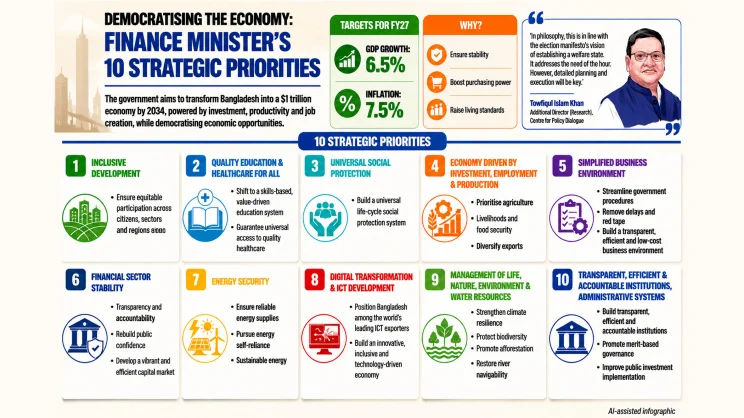
The budget rightly prioritises macroeconomic stability, investment, employment, health, education, social protection, energy security, and financial sector reform. Given the current challenges, inflation control should remain the foremost objective to protect household welfare and restore economic confidence. Reviving private investment and creating jobs is essential for sustainable growth, while restoring stability in the banking sector is critical for financing economic activities. Reliable energy supply is necessary to support industrial expansion and competitiveness. Strengthening social protection is equally important, as poverty and vulnerability have increased amid prolonged inflationary pressures.

Assessing the macroeconomic framework

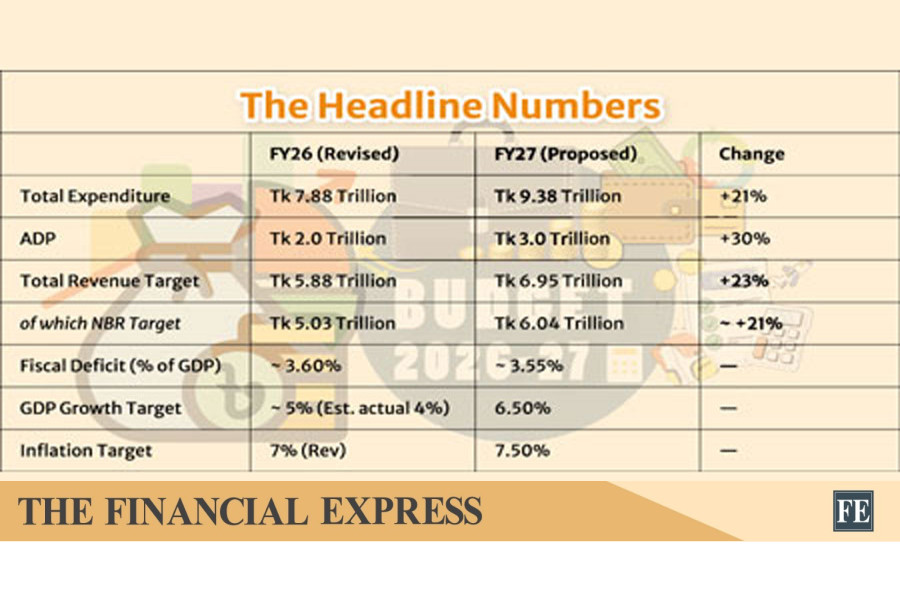
The budget targets a GDP growth of 6.5 percent and inflation of 7.5 percent in the upcoming fiscal year. The growth target is ambitious, but not impossible. Achieving that will require a substantial acceleration in private investment, industrial production, and exports. Considering the current investment trends, weaknesses in the banking sector, and energy constraints, achieving this target will be challenging.

The inflation target represents an improvement from the current levels but is still relatively high. For inflation to shrink meaningfully, several conditions must be met. For example, stable exchange rates, improved food supply chains, adequate energy supply, prudent monetary policy, productive use of fiscal allocation, and favourable international commodity prices are critical for reducing inflation. In fact, any external shock, such as a spike in global energy prices, could jeopardise this target.

The budget projects a total revenue collection of Tk 6,95,000 crore, including Tk 6,04,000 crore from the National Board of Revenue (NBR). This represents a substantial increase compared with the current collections. Historically, revenue mobilisation has been one of the country’s weakest policy areas. Bangladesh’s tax-GDP ratio also remains among the lowest in Asia. Therefore, while the revenue targets are desirable, their feasibility remains uncertain unless major improvement in tax administration, compliance, and enforcement is achieved. The proposed budget of Tk 9,38,000 crore represents a significant expansion compared to the revised budget of the outgoing year. Given the huge need of a growing economy with a large population, increased public expenditure is necessary. However, how much of this allocation will be implemented and the quality of that expenditure remain critical issues.

The fiscal deficit is projected at 3.55 percent of GDP, which remains broadly manageable by international standards. Financing the budget deficit remains a significant challenge for FY2027. Although the government plans a slight reduction in bank borrowing relative to the revised FY2026 budget, it still aims to borrow Tk 1,12,000 crore from banks. Since it also aims to enhance private investment by creating an agreeable environment, excessive dependency on bank borrowing can crowd out private credit, raise borrowing costs, and hamper investment and job creation. To reduce reliance on the banks, the government should focus on increasing revenue through tax reforms, broadening the tax base, reducing exemptions, improving project execution to minimise waste, and securing more concessional external funding. Developing a more mature bond market and exploring other long-term financing options are essential for sustainable deficit management.

Tax reductions and increases
The government has proposed a number of tax and customs reforms aimed at reducing the cost of doing business and encouraging investment. Several measures are intended to facilitate exports, improve customs procedures, and reduce compliance burdens. The budget proposes expanding duty-free import facilities for export-oriented industries, reducing procedural complexities, streamlining VAT compliance, and improving digital tax administration.

These measures are broadly justified. Exporters in Bangladesh face increasingly competitive pressure from peer countries. Reducing compliance costs and improving trade facilitation can enhance competitiveness without significantly reducing government revenue.

However, some tax increases have also been proposed to strengthen revenue mobilisation and reduce fiscal pressures. The rationale behind these measures is understandable given the government’s ambitious expenditure commitment and the need to maintain fiscal discipline. Whether these measures will reduce the cost of living is less certain. Most of the reforms appear more focused on improving the business environment than directly lowering consumer prices. Indirect benefits may emerge over time through increased investment and employment, but immediate relief for households may be limited.

Investment and job creation
A major focus of the budget is investment-led growth. The government aims to increase the total investment and eventually raise it to 40 percent of GDP by FY2030-31. The budget also highlights export diversification, industrial expansion, and support for entrepreneurship. The challenge is keeping investment targets consistent with employment objectives. Bangladesh needs to create millions of jobs in the coming decade to absorb new entrants to the labour market. Investment alone does not automatically generate employment. The composition and quality of investment matter, too.

The budget places considerable emphasis on manufacturing, SMEs, agriculture, information technology, and skills development. These sectors have greater employment-generating potential than capital-intensive industries. Nevertheless, a more explicit employment strategy with measurable job creation targets and monitoring mechanisms would have strengthened the budget.

Health, education, and social protection
One of the most notable features of the proposed budget is the significant increase in allocations for education and health. Education allocation has been increased to 1.79 percent of GDP, which was 1.41 percent of GDP in the revised FY2026 budget. Health allocation has doubled as a share of GDP. Given the weaknesses exposed by the pandemic, as well as ongoing concerns regarding access, quality, and affordability of healthcare, this increase is justified.

The budget also raises social protection spending, acknowledging growing poverty and vulnerability in the country. The social security budget accounts for 2.11 percent of GDP, up from 1.98 percent of the revised outgoing budget. Family Card accounts for 10.05 percent of the social safety net allocation in FY2027. The key challenge is effective use of these allocations. Persistent targeting errors, leakages and administrative inefficiencies often limit impact. While the budget emphasises inclusive and universal social protection, its success will depend on strengthening beneficiary databases, expanding digital delivery systems, integrating social registries, and improving monitoring to ensure that benefits reach the intended recipients efficiently and transparently.

Another issue we should note is that higher allocations alone cannot guarantee better outcomes. Weak implementation, governance failures, procurement inefficiencies, and corruption can undermine the effectiveness of public spending. Therefore, improving the quality of expenditure is as important as increasing allocations. The government’s emphasis on value for money, accountability, and returns on investment is welcome, but success will ultimately depend on effective implementation.
1781481553406.webp


Reform agenda and governance

The proposed budget correctly recognises that governance reform is essential for economic recovery. Several reform initiatives have been proposed, including separation of tax policy from tax administration, digitalisation of revenue systems, banking sector restructuring, strengthening financial sector governance, regulatory simplification, improved public investment management, and greater institutional accountability. These reforms are positive steps forward, but the main challenge is their implementation. Reshaping institutions is far harder than proposing reform measures. Success depends on political will, administrative capacity, and sustained effort over the coming years.

The budget acknowledges the necessity of export diversification, competitiveness enhancement, skills development, and trade facilitation. These are all relevant for the post-LDC environment. However, the budget could have set out a more explicit LDC graduation strategy. Key issues like the erosion of trade preferences, compliance with emerging environmental standards, productivity enhancement, logistics reform, and export market diversification deserve greater attention.

Dr Fahmida Khatun is an economist and executive director at the Centre for Policy Dialogue (CPD).​
 

Measuring justice in budget FY27

Matiur Rahman

Published :
Jun 15, 2026 00:12
Updated :
Jun 15, 2026 00:12

1781590320032.webp


National budgets are usually discussed in the language of economics. Analysts focus on revenue collection, fiscal deficits, inflation management, and growth targets. Yet a budget is much more than a financial document. It is also a social contract. It reveals how a state prioritises competing needs, allocates resources among different groups, and imagines the future of its citizens. From a sociological perspective, therefore, a budget is not merely about counting money; it is about measuring justice.

The proposed national budget for fiscal year 2026–27, amounting to Tk 9.38 trillion, is the largest in Bangladesh’s history. The government has set a GDP growth target of 6.5 per cent and aims to bring inflation down to 7.5 per cent. Total expenditure is projected to increase by 19 per cent, while development spending is expected to rise by an impressive 47 per cent to Tk 3.16 trillion. Revenue collection has been targeted at Tk 6.95 trillion, and the budget projects a fiscal deficit of Tk 2.43 trillion, equivalent to 3.6 per cent of GDP. Presenting the budget in parliament, Finance Minister Amir Khosru Mahmud Chowdhury described it as a “Journey Towards a Democratic, Humane and Inclusive Economy.” These figures undoubtedly reflect ambition. However, the sociological question is whether this ambition will translate into greater social justice and improved well-being for ordinary citizens.

The timing of this budget is particularly significant. Bangladesh is confronting a combination of economic pressures that directly affect the everyday lives of its people. Inflation remains stubbornly high despite repeated policy interventions. According to the latest data released by the Bangladesh Bureau of Statistics, point-to-point inflation rose to 9.42 per cent in May 2026, the highest level in sixteen months. Food inflation climbed to 9.06 per cent, while non-food inflation reached 9.71 per cent. Even more concerning is the fact that inflation in rural areas stood at 9.48 per cent, higher than in urban areas. These figures indicate that the burden of rising prices is falling disproportionately on lower-income households and rural communities.

For economists, inflation is a macroeconomic indicator. For sociologists, it is a lived reality. It determines whether families can afford nutritious food, healthcare, education, transportation, and housing. When inflation consistently outpaces wage growth, social vulnerability increases. The World Bank recently observed that the wages of low-income workers in Bangladesh have not kept pace with rising prices, resulting in declining purchasing power. In practical terms, this means that millions of people are working just as hard as before but are able to buy less with their earnings. Such a situation inevitably widens social inequalities and deepens feelings of economic insecurity.

The poverty situation further reinforces this concern. For decades, Bangladesh was celebrated as one of the world’s most successful poverty reduction stories. Between 2010 and 2022, according to the World Bank, approximately 34 million people escaped poverty. However, recent trends suggest a troubling reversal. The World Bank estimates that the national poverty rate increased from 18.7 per cent in 2022 to 21.4 per cent in 2025, pushing an additional 1.4 million people below the poverty line. The institution attributes this deterioration largely to persistent inflation, weak income growth among vulnerable groups, and broader economic instability.

These statistics challenge a long-standing assumption that economic growth automatically improves social welfare. Bangladesh averaged approximately 6 per cent GDP growth over the past decade, a remarkable achievement by international standards. Yet the World Bank now warns that the country faces weak growth, elevated poverty, high inflation, and financial sector stress simultaneously. Growth alone, therefore, cannot guarantee social progress. The quality and distribution of growth matter as much as growth itself.

This brings us to the issue of inequality, arguably the most important sociological lens through which the budget should be examined. Inequality is often discussed in terms of income, but its social dimensions are far broader. It encompasses disparities in access to education, healthcare, technology, information, employment opportunities, and political influence. A child born into an affluent family in Dhaka begins life with advantages that remain inaccessible to many children in rural or marginalised communities. Such disparities are reproduced through institutions and social structures, creating unequal life chances long before individuals enter the labour market.

The World Bank’s Poverty and Equity Assessment notes that after 2016, Bangladesh’s pattern of growth became less inclusive, with income growth increasingly favouring wealthier households. This finding should concern policymakers because rising inequality can undermine social cohesion even when average incomes increase. When economic opportunities appear concentrated among a small segment of society, public trust in institutions weakens, and social frustrations intensify.

Employment generation represents another critical challenge. Bangladesh’s demographic profile offers tremendous potential, but only if productive jobs can be created. A large youth population is entering the labour market each year with expectations of stable employment and upward mobility. Yet, the recent economic slowdown has raised concerns regarding the capacity of the economy to absorb new entrants. According to Reuters, economic growth slowed from 5.78 per cent in fiscal year 2022–23 to 4.22 per cent in 2023–24 and an estimated 3.49 per cent in the outgoing fiscal year. Such a decline inevitably affects job creation prospects.

Recognising this challenge, Bangladesh Bank recently announced a Tk 600 billion stimulus package aimed at supporting businesses and creating approximately 250,000 jobs. While this initiative is encouraging, it also highlights the magnitude of the employment challenge confronting the country. Employment is not merely an economic issue; it is a social issue tied to dignity, identity, and citizenship. Sociological research consistently demonstrates that prolonged unemployment or underemployment contributes to social alienation, declining self-esteem, and weakened social integration. Young people need more than jobs; they need meaningful opportunities to participate in society.

The budget’s emphasis on development expenditure deserves attention in this context. The planned increase of development spending to Tk 3.16 trillion signals a commitment to infrastructure, investment, and economic expansion. Major transport projects, including metro rail development and urban infrastructure initiatives, are expected to receive substantial allocations. Infrastructure can undoubtedly stimulate economic activity and improve connectivity. However, sociology reminds us that roads, bridges, and railways are means rather than ends. Development should ultimately be evaluated by its impact on human well-being rather than the volume of concrete poured or kilometres constructed.

Human development requires sustained investment in education and healthcare. These sectors are not simply components of social expenditure; they are foundations of social mobility. Access to quality education enables individuals to acquire skills and improve their life prospects. Effective healthcare protects families from catastrophic expenditures that often push vulnerable households into poverty. If Bangladesh is serious about building an inclusive economy, investment in human capabilities must remain as important as investment in physical infrastructure.

Another crucial dimension concerns social protection. The World Bank estimates that nearly 62 million Bangladeshis remain vulnerable to falling back into poverty when confronted with illness, natural disasters, or economic shocks. This figure is particularly significant because vulnerability extends far beyond those officially classified as poor. A large segment of the population exists only one crisis away from economic hardship. Social safety net programmes, therefore, represent not charity but social insurance. They protect citizens against risks that individuals cannot manage alone.

Climate vulnerability adds further urgency to this discussion. Bangladesh remains among the countries most exposed to climate-related risks. Floods, cyclones, salinity intrusion, river erosion, and extreme temperatures disproportionately affect poorer communities because they possess fewer resources for adaptation and recovery. Climate resilience is therefore not simply an environmental issue; it is fundamentally a social justice issue. Future budgets will increasingly be judged by their ability to protect vulnerable populations from climate-related disruptions.

At a deeper level, the FY2026–27 budget raises important questions about the relationship between the state and its citizens. Revenue collection is expected to reach Tk 6.95 trillion despite ongoing challenges in tax administration. Yet taxation is sustainable only when citizens perceive public institutions as fair and accountable. People are more willing to contribute when they believe public resources are being used effectively to improve collective welfare. Trust, therefore, is as important as taxation in sustaining a functioning social contract.

Ultimately, the success of Bangladesh’s largest-ever budget will not be determined solely by whether growth reaches 6.5 per cent or inflation falls to 7.5 per cent. It will be judged by whether ordinary citizens experience tangible improvements in their lives. Do families feel more economically secure? Do young people find decent employment? Do poor households gain greater access to healthcare and education? Do vulnerable communities receive protection from economic and environmental shocks? Do citizens perceive public institutions as fair and responsive?

These are not merely economic questions. They are questions of social justice. Budgets count taka, but societies measure fairness, dignity, and opportunity. The true significance of Budget 2026–27 lies not in its historic size but in its capacity to transform public resources into human well-being. If it succeeds in reducing inequalities, strengthening social protection, expanding opportunities, and restoring public confidence, it will represent more than a fiscal plan. It will represent a meaningful step toward a more inclusive and equitable Bangladesh.

Dr. Matiur Rahman is a researcher and development professional.​
 

Budget: a diagnosis deferred

KAS Murshid

Published :
Jun 15, 2026 23:23
Updated :
Jun 15, 2026 23:23

1781590663713.webp


Before the budget speech, there was an expectation, encouraged by the finance minister’s pre-budget remarks, that the government would offer a candid accounting of the fiscal inheritance: a banking sector carrying the world’s highest non-performing loan ratio, private-sector credit growth near a multi-year low, inflation stuck above 9 per cent, and revenue collections running far below target. That accounting did not materialise.

Instead, the budget for the fiscal year 2026-27 was framed around forward-looking intentions. The finance minister acknowledged “challenges” in general terms but chose not to present a detailed public autopsy of FY2025-26. For a government fewer than four months old, the political logic is understandable. But the analytical gap is real: without a clear-eyed diagnosis of what went wrong, and what structural constraints remain, the budget’s promises risk floating free of the conditions they must operate within.

The deficit of 3.55 per cent of gross domestic product (GDP) is below the conventional 5 per cent threshold — an improvement on paper. Whether it holds depends on two things: whether revenues are collected and whether expenditure is contained. The budget was more confident about the former than circumstances warrant.

The National Board of Revenue (NBR) would need to increase 50 per cent of its actual tax collections, not its stated target, but what it has actually been collecting, to hit the FY27 revenue goal of Tk 6.04 trillion. In a country where the revenue authority has never met its target, this is the number on which the entire fiscal framework rests.

What Genuinely Changed: The most significant move in the budget is the focus on the heath sector as allocation rises by over 95 per cent to Tk 694.09 billion, 1 per cent of GDP, the highest ever in absolute terms and as a share of national income. Bangladesh has chronically underinvested in health relative to its income and population. A near-doubling of the allocation is directionally right. The test, as always, is execution: the health sector has a poor track record of spending what it is allocated. The real story will be in the utilisation rate six months from now.

Education gets a second record allocation as proposed spending rises 57 per cent to approximately 2 per cent of gross domestic product (GDP), which is also a record.

Two consecutive record allocations to health and education, if actually spent, would mark a genuine structural shift in Bangladesh’s public investment priorities. Whether the Ministry of Education can absorb and deploy a 57 per cent budget increase in a single year is a separate and harder question.

In the energy sector, there is a serious renewable push, with a tariff question unresolved. The budget sets a target of raising renewable energy’s share of total generation to 20 per cent by 2030. To get there, it introduces a zero-duty regime on imports of solar generation equipment and a 5 per cent rebate on consumers’ solar electricity bills. The incentive architecture is coherent: zero import cost on the supply side, a direct price signal on the demand side.

The zero-duty window is sensibly designed — Bangladesh has no domestic solar manufacturing base worth protecting, so tariff barriers on panels have been a pure tax on adoption. What the budget does not address is grid capacity: intermittent solar at scale requires storage and grid management investment that was not announced.

Notably, the BERC tariff decision is still pending. Energy pricing is the single largest constraint on Bangladesh’s industrial competitiveness, and leaving the tariff question unaddressed means the budget’s growth assumptions rest on a foundation that hasn’t been laid.

Subsidies in agriculture are frozen at Tk 170 billion, unchanged from the prior year. In a context of elevated input costs and stagnant farm incomes, this is a meaningful and unannounced policy choice: farmers will not feel relief from this budget. The Tk 79.46 billion development allocation for cold storage, rural infrastructure, and crop insurance pilots holds more promise, but delivery depends on implementation capacity that has historically lagged.

Information Technology (IT), artificial intelligence (AI), and the creative economy get a number of perks in the budget. Tax holidays for software and IT-enabled services are extended to 2030. Tk 5.0 billion crore fund for AI, electronics, and IT entrepreneurship has been confirmed. The creative economy target (0.5 million high-value jobs in content creation, gaming, and animation) is more credible than it might first appear. Bangladesh already has a substantial freelancing base and genuine comparative advantages in a young, digitally literate population. The question is whether training pipelines, intellectual property frameworks, and payment infrastructure will follow the headline number.

The RMG corporate tax structure remains unchanged. The bonded warehouse facility has been extended to non-RMG export sectors. Tk 50 billion SME credit guarantee fund is confirmed operational, and the Export Development Fund has been expanded to $5 billion, the most operationally ready of the budget’s commercial incentives.

The Bottlenecks: The revenue-to-expenditure pipeline. The NBR must increase actual collections by roughly 50 per cent to hit its target. The budget proposes digital filing reforms but does not address the structural obstacles: a narrow tax base, powerful constituencies that resist taxation, and a legal culture that treats tax payment as negotiable. When revenues fall short, expenditure will be cut and history suggests the Annual Development Programme (ADP) will bear the heaviest burden. A 30 per cent larger ADP, in that context, is a promise the implementing ministries will struggle to honour given persistent land acquisition delays, procurement bottlenecks, and capacity constraints.

Banking, credit, and investment. No bank recapitalisation was announced, despite the International Monetary Fund (IMF)’s characterisation of the sector’s vulnerabilities as “systemic.” Non-Performing Loans (NPLs) stand at 30.60 per cent of total advances. Credit growth is below 5 per cent. The budget extends incentives to exporters and MSMEs, but does not address the fundamentals constraining investment — energy reliability, contract enforcement, and regulatory complexity. The 6.5 per cent growth target requires a private investment recovery that the banking sector, in its current state, cannot finance.

Bottom Line: This is a budget of genuine ambition on health and education, with real money behind priorities that have been underfunded for decades. But the ambition rests on a fiscal framework that requires revenue performance without historical precedent, expenditure execution without institutional reform, and private-sector growth without banking-sector repair. The promises will be measured not by the speech, but by the utilisation rates IMED publishes in the months ahead.

The writer is former director general of Bangladesh Institute of Development Studies (BIDS). The piece is excerpted from The Dhaka Brief​
 

Budget bears deregulation roadmap to ease businesses’ burdens
PM's adviser Titumir says amid critical views on budgetary measures
FE REPORT

Published :
Jun 18, 2026 10:41
Updated :
Jun 18, 2026 10:41

1781758307679.webp


Government policymakers are pursuing a "new model" centred on inclusive investment, says Prime Minister's Adviser on Finance and Planning Dr Rashed Al Mahmud Titumir amid critical views on the new budget.

He hopes this government strategy, backed by stipulated recovery measures, will help in overcoming the current economic challenges facing the country.

"Investment first, investment for all, and an economy for all - this is the model we must move towards," he told a post-budget review meet held Wednesday in Dhaka.

He also highlights a three-pronged revenue-management strategy based on "recovery, restoration and restructuring", saying that the approach would help revitalise the economy and strengthen public finances.

The Prime Minister's Adviser welcomes criticism of the proposed budget and the government activities, arguing that constructive scrutiny would help ensure the transparency that had been missing over the past more than 17 years.

"We do not want to hear words of praise as happened in the past. They listened only to praises, drove the country into crisis and then fled," he told his audience.

Dr Titumir made the remarks at the budget discussion jointly organised by the Metropolitan Chamber of Commerce and Industry, Dhaka (MCCI), local think-tank Policy Research Institute of Bangladesh (PRI) and Standard Chartered Bank at Gulshan in the capital.

The event was chaired by MCCI President Kamran T Rahman and attended by Standard Chartered Bangladesh CEO Naser Ejaz Bijoy, PRI Chairman Dr. Zaidi Sattar, PRI Research Director Dr. Bazlul H. Khandaker, PRI Director Ahmed Ahsan and MCCI Director Hasan Mahmud, among others.

The adviser makes it clear that investors are primarily looking for policy continuity and predictability.

"This has been reflected in the budget. For the first time, a five-year tax structure has been outlined. Such an initiative has never been undertaken before," he says.

He adds that the budget also contains a roadmap for deregulation and measures to ease regulatory burdens on businesses.

On financing, he says the central bank has already announced a Tk 600-billion stimulus package to support investment and economic activity.

Dr Titumir notes with optimism that the combined measures would help accelerate private investment and economic recovery.

He places particular emphasis on building an effective revenue administration and governance framework, arguing that raising tax rates alone would not be sufficient without addressing institutional weaknesses.

"It is not enough to increase tax rates or expand the tax base. Good governance and the elimination of systemic inefficiencies are equally important."

He hints that monthly action plans and performance milestones have been set for three revenue-related taskforces with progress reviewed on a regular basis.

He also says initiatives have been taken to improve transparency in revenue administration by addressing inconsistencies in the presentation of tax-collection data.

To strengthen transparency and accountability, the government is introducing dashboard-based monitoring systems for development projects and moving towards an open-data policy to support evidence-based policymaking and research.

Despite the introduction of the government's integrated budget and accounting system (iBAS++), challenges such as tax exemptions, tax evasion and tax fraud continue to persist, largely due to what he describes as a legacy of poor administrative practices.

To address these issues, specialised taskforces are being established in income tax, customs and VAT administrations, with monthly monitoring mechanisms already in place.

Business leaders, however, aired concerns over implementation challenges associated with the budget.

President of MCCI Kamran T Rahman notes that the National Board of Revenue (NBR) achieved only 65 per cent of its revised revenue target through April of FY2025-26.

Given the ambitious revenue goals ahead, he warns that taxpayers could face "increased pressure and potential harassment at the field level".

Standard Chartered Bangladesh CEO Naser Ejaz Bijoy suggests inflation-backed bond might be considered following higher inflation in the country with a gap of 3.0 to 4.0 per cent with inflation rate.

He says higher bank borrowing might create crowding-out effect in the economy.

"The biggest challenge is implementation," he says.

He has identified inflation as a major concern, arguing that the budget could have provided clearer guidance on how price pressures would be brought under control.

He also calls for more specific measures to combat corruption and a more detailed roadmap for banking-sector reforms.

PRI Chairman Dr Zaidi Sattar told the meet that the economy had experienced a form of "growth trauma" over the past five years.

While the interim government had managed to restore a degree of macroeconomic stability, he argues, the banking sector remained the economy's most significant vulnerability.

Dr Sattar feels that the budget should have outlined more urgent measures to address weaknesses in the financial sector.

"If the banking-sector crisis is not resolved, it could become most fragile part of Bangladesh's economy.

The country will not be able to emerge fully from its current economic difficulties without fixing the banking system," he asserts.

He has stressed that restoring the health of the banking sector should be treated as the country's foremost economic priority.​
 

Budget should not finance government alone

Mohd Akhtaruzzaman

Published :
Jun 18, 2026 00:19
Updated :
Jun 18, 2026 00:19

1781758481595.webp


Every year, governments proudly present national budgets, often describing them as roadmaps for development and prosperity. A government budget, in its simplest form, is a financial plan that determines how public resources will be collected and allocated to meet national priorities. In theory, it should be the most powerful instrument for nation-building. In practice, however, many budget systems have gradually become exercises in revenue extraction, expenditure management, and deficit financing rather than engines of wealth creation. When budgets lack a clear national mission, measurable outcomes, and accountability, they risk becoming vehicles for waste, inefficiency, rent-seeking, and corruption. The real question is therefore not how much money a government collects or spends, but whether its budget genuinely expands national productive capacity, strengthens state capability, and improves the lives of its citizens.

Yet a more fundamental question is rarely asked: What is the real purpose of a national budget?

Is the budget merely a mechanism for collecting revenue and financing government expenditure? Or has the tax system gradually become more focused on extracting resources from economic activity than on expanding the nation’s productive capacity?

Are citizens and businesses paying taxes primarily to sustain government consumption, or are those taxes being transformed into investments that generate future wealth, productivity, and national strength?

These questions go to the heart of a larger debate: Should a budget simply manage the present, or should it actively build the future?

Or should it serve as the principal instrument for building a stronger, wealthier, and more capable nation? Should the national budget be judged not by the amount of money it spends, but by the productive capacity it creates? Should it merely finance today’s administration, or should it build tomorrow’s prosperity? A truly strategic budget should transform human potential into human capital, savings into investment, and investment into sustained economic growth. It should expand national productivity, strengthen competitiveness, create opportunities for future generations, and enhance the State’s capacity to meet emerging challenges. The true measure of a budget is not the size of its expenditure, but the strength, resilience, and prosperity of the nation it leaves behind.

For decades, many governments around the world have followed a revenue-driven budgeting model. Under this approach, the budget process begins by estimating how much revenue can be collected through taxes, fees, duties, and other sources. Government expenditures are then planned within the limits of those projected revenues. When planned expenditure exceeds available revenues, the gap is financed through domestic or external borrowing. Consequently, budget debates often revolve around tax collection, expenditure control, deficits, and debt management rather than the more fundamental question of how public resources can expand national productive capacity and create long-term wealth. In such a system, governments risk becoming managers of revenue and expenditure rather than architects of national prosperity.

While this model keeps government functioning, it often fails to answer a more important question: How does a nation become wealthier over time?

The true purpose of a pro-people budget is not simply to finance the day-to-day operations of government, pay salaries, maintain offices, or meet recurring expenditures. While these functions are necessary, they do not by themselves create future wealth. A truly strategic budget must invest in the productive potential of the nation and expand the country’s ability to generate income, employment, innovation, and economic growth.

Bangladesh today stands at a historic crossroads. We possess one of the world’s largest youth populations, a strategic location at the gateway of the Bay of Bengal, a growing industrial base, and significant opportunities in regional and global markets. At the same time, we face mounting challenges from technological disruption, climate vulnerability, employment pressures, and intense international competition.

In this context, the greatest national asset of Bangladesh is neither land nor natural resources. It is our people.

Therefore, the first responsibility of the State should be to transform every capable citizen into productive human capital. Education, technical skills, workforce development, research, innovation, and public health should no longer be viewed merely as social expenditure. They should be recognized as productive national investments.

A modern budget philosophy should begin with a different sequence:

Human Capital ? Productivity ? Income ? Consumption ? Revenue ? Productive Investment ? Higher Productivity

In other words, wealth creation should precede revenue expansion.

This philosophy also requires a rethinking of taxation. Instead of heavily taxing income and productive investment, greater emphasis can be placed on progressive consumption taxation. Essential goods and services should bear the lowest tax burden, while luxury and discretionary consumption should contribute more. Such a system rewards work, encourages savings, supports entrepreneurship, and promotes productive investment.

Equally important is how public money is spent. Governments often devote substantial resources to recurrent expenditure while productive investments struggle for adequate funding. A more balanced approach would require development expenditure to equal or exceed government operating expenditure. Furthermore, most of the development spending should be directed toward projects that increase future productivity and national income.

Development expenditure should be judged not by the amount spent, but by the productive capacity it creates. Priority shall be given to investments that expand national income, strengthen competitiveness, and enhance state capability. Infrastructure, energy, technology, and workforce development should receive preference because they generate long-term economic returns. Every major project must demonstrate measurable economic, social, or strategic value. The purpose of development spending is not merely to build assets, but to create wealth, generate employment, strengthen national resilience, and increase the productive power of the Republic.

Economic growth alone is insufficient. National resilience must be a core objective of budget policy. Food, energy, water, cyber, and climate security are not separate policy concerns; they are fundamental pillars of national power and long-term prosperity.

Every major public investment must demonstrate measurable economic, social, or strategic value before receiving funding. Project approval, continuation, and future resource allocation shall be based on clearly defined performance criteria, including economic return, productivity gains, employment generation, and contribution to national competitiveness. Public resources shall be invested based on outcomes achieved, not merely money spent.

The ultimate purpose of a national budget is not to maximise government expenditure, but to maximize national capability. Success shall be measured by the nation’s ability to increase productivity, create employment, expand exports, strengthen institutions, improve living standards, and enhance resilience. A budget must therefore be treated as a nation-building instrument that transforms human potential into human capital, human capital into economic strength, economic strength into state capacity, and state capacity into enduring national prosperity and power.

The nations that will lead the twenty-first century will not be those that tax the most or spend the most, but those that invest most wisely and decisively in their people, productivity, and future. The time for managing scarcity has passed; the time for building national capability has arrived. Bangladesh must act with urgency to transform its growing youth population into skilled human capital, its savings into productive investment, and its potential into economic strength. The choices made today will determine whether future generations inherit a stronger, wealthier, and more resilient nation.

A nation’s budget ultimately reveals what it values. If Bangladesh values its people, productivity, and future, then its budget must be designed to develop all three.

The choice before Bangladesh is not between higher taxes and lower taxes, nor between larger budgets and smaller budgets. The real choice is whether we continue to manage the present or boldly invest in the future. History rewards nations that invest in their people before circumstances force them to. Bangladesh possesses the youth, the potential, and the moment. The future will not wait. Neither should we.

Maj (retd) Mohd Akhtaruzzaman, Ex Member of Parliament & Parliamentary Standing Committee on Finance – 1991-1996​
 

Budget signals shift to ‘new economic model’

Centres on investment and job, Titumir says

Star Business Report

1781762262654.webp


The proposed national budget for FY2026-27 marks a shift towards a “new economic model” centred on investment, employment and public trust, said Rashed Al Mahmud Titumir, the prime minister’s adviser on planning and economic affairs, yesterday.

Outlining the government’s broader economic strategy, he said restoring investor confidence, reducing regulatory bottlenecks and ensuring reliable energy supplies are essential measures to revive investment.

Speaking at a post-budget dialogue, Titumir said Bangladesh had overcome previous economic crises through home-grown solutions rather than textbook prescriptions.

Business leaders present at the event identified weaknesses in the banking sector, investor confidence, revenue mobilisation and implementation challenges as key hurdles to achieving the country’s growth targets.

The Metropolitan Chamber of Commerce and Industry (MCCI), Dhaka, the Policy Research Institute of Bangladesh (PRI) and Standard Chartered Bangladesh jointly organised the event in Dhaka.

Investors need policy continuity, deregulation, access to finance, energy security and improved connectivity, Titumir said, describing the proposed five-year policy outlook as an important signal to businesses.

The Tk 60,000 crore support package should be performance-based, unlike earlier stimulus programmes that often failed to deliver the intended outcomes, he said.

On energy, he said Bangladesh would pursue a diversified energy mix, including renewable energy and nuclear power, while expanding onshore and offshore gas exploration.

He also called for greater investment in education and healthcare, saying skill mismatches and weak primary healthcare services remain major constraints.

The government plans to raise education spending to 5 percent of gross domestic product (GDP) and health spending to 2 percent, he said, adding that it intends to recruit 5,000 doctors and up to 1 lakh health workers.

Bangladesh’s banking sector could become the biggest obstacle to economic recovery unless urgent reforms are undertaken, PRI Chairman Zaidi Sattar warned yesterday, arguing that stronger banks are essential to restoring investment and sustaining growth.

He described the budget as a “useful stabilisation and confidence budget” that appropriately prioritises macroeconomic stability, fiscal discipline, expenditure efficiency and debt management.

While the government’s diagnosis of the economy’s key challenges is broadly accurate, the proposed remedies remain insufficient, Sattar said.

He noted that achieving the targeted 6.5 percent growth rate would require a substantial increase in investment, which is unlikely without comprehensive banking sector reforms.

Sattar called for independent asset quality reviews, bank-specific resolution plans, stronger governance, recapitalisation linked to restructuring and tougher action against wilful defaulters.

Echoing concerns over growth and implementation, Naser Ezaz Bijoy, CEO of Standard Chartered Bangladesh, said the proposed budget seeks to balance macroeconomic stability with growth, but its success will depend on effective execution.

He described the budget as broadly business-friendly and praised the government for avoiding measures that could have undermined business activity despite difficult economic conditions.

However, he warned that the ambitious revenue target would be difficult to achieve. With revenue collection likely to fall short of this year’s target, aggressive collection efforts could place greater pressure on existing taxpayers.

Bijoy also cautioned against excessive bank borrowing to finance the budget deficit, saying it could worsen liquidity shortages, crowd out private-sector credit and push up interest rates.

He called for a clearer roadmap to curb inflation and accelerate reforms in banking, tax administration and governance. Gas shortages, he said, remain a major constraint on investment and industrial expansion.

MCCI President Kamran T Rahman said the proposed Tk 9.38 lakh crore budget comes at a critical time as Bangladesh seeks to revive growth, attract investment, generate employment and rein in inflation.

While welcoming measures to modernise tax administration and simplify business procedures, he expressed concern over the ambitious revenue target of Tk 6.95 lakh crore.

With revenue collection reaching only 65 percent of the revised target through April, he warned that undue pressure to meet the target could burden existing taxpayers.

Instead, he called for broadening the tax base and strengthening implementation capacity.

Hasan Mahmud, chairman of MCCI’s Tariff and Taxation Committee, said the proposed budget leaves several key concerns unresolved.

He criticised the unchanged minimum turnover tax, saying it imposes a burden on businesses regardless of profitability.

He also warned that higher personal tax rates and reduced tax rebates on investments would increase pressure on salaried taxpayers and discourage savings.​
 

Latest Posts

Back