| Global Defense, OSINT & Geopolitics Wire

[🇧🇩] China is a Time Tested Friend and a Strategic Partner of Bangladesh

[🇧🇩] China is a Time Tested Friend and a Strategic Partner of Bangladesh
369
19K
More threads by Saif

G Bangladesh Defense

BD, China set to launch new strategic diplomacy
Meeting discusses megaprojects like corridor, economic blocs, flurries of visits from China
1788477503853.webp


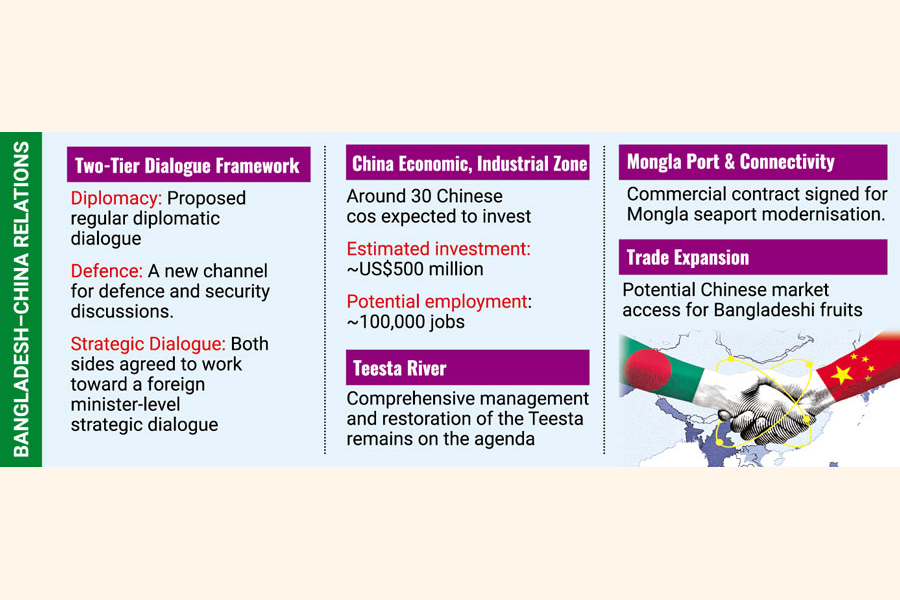
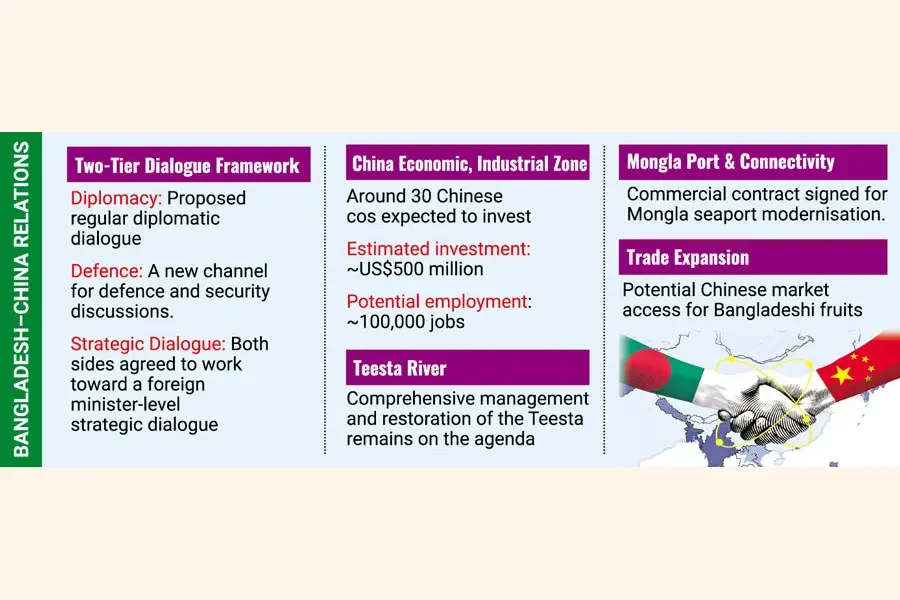
Bangladesh and China prepare to launch a new two-tier diplomacy and defence dialogue that signals a further deepening of ties between Dhaka and Beijing following Prime Minister Tarique Rahman's recent visit.

The proposed model of dialogue was discussed Sunday during a meeting between Bangladesh state minister for foreign affairs Humaiun Kabir and Chinese ambassador in Bangladesh Yao Wen at the foreign ministry in Dhaka.

The two sides also agreed to work towards launching a foreign minister-level strategic dialogue, as Bangladesh seeks to give greater institutional depth to its relationship with its largest trading partner and a major development and infrastructure partner.

Kabir described China as a "trusted friend and valued strategic partner" and reaffirmed Bangladesh's commitment to the one-China principle. He said Dhaka was pleased with the renewed momentum in bilateral relations and the elevation of ties to what the two governments describe as a "China-Bangladesh Community with a Shared Future".

The developments follow Rahman's recent visit to China, during which the two countries advanced cooperation on infrastructure, trade and investment.

Yao briefed Kabir on the outcomes of the prime minister's China visit, including the groundbreaking of the China Economic and Industrial Zone (CEIZ), the signing of a commercial contract for the modernisation of Mongla seaport and possible Chinese cooperation in establishing a Mongla export-processing zone.

According to the Chinese side, the CEIZ is expected to attract about 30 Chinese companies and investment of roughly $500m, with the potential to create an estimated 100,000 jobs for Bangladeshis.

The proposed diplomacy and defence dialogue could add a new dimension to a relationship that has traditionally been driven by trade, infrastructure and development cooperation. Bangladesh has increasingly sought to diversify its economic and strategic partnerships while maintaining its longstanding diplomatic principle of balancing relations among major powers.

The two sides also discussed the long-running issue of the Teesta river, with cooperation on the comprehensive management and restoration of the river again featuring in their talks.

For Dhaka, the Teesta remains one of the most politically sensitive issues in its relationship with India. Bangladesh has for years sought a comprehensive agreement on the sharing and management of the river, while China has previously offered to participate in a major water-management project in the Teesta basin.

The meeting also covered the possible export of Bangladeshi jackfruit and guava to the Chinese market, the proposed China-Bangladesh-Myanmar economic corridor and cooperation over the Rohingya crisis.

The Rohingya issue remains a major concern for Bangladesh, which hosts more than a million refugees who fled violence and persecution in Myanmar. Dhaka has repeatedly sought greater international pressure on Myanmar to create conditions for a safe, voluntary and sustainable repatriation of the refugees.

China has played a significant diplomatic role in efforts to facilitate Rohingya repatriation, although repeated attempts to begin large-scale returns have so far failed.

The meeting comes as Bangladesh and China prepare for a series of high-level exchanges.

Yao has said senior Chinese officials are expected to visit Bangladesh, including the vice-president of China International Development Cooperation Agency, the minister of the International Department of the Central Committee of the Communist Party of China and the executive vice-governor of Yunnan province.

The Chinese ambassador also invited Kabir to visit China in October.

The flurry of planned exchanges suggests that Rahman's China visit could mark the beginning of a more structured phase in Bangladesh-China relations, extending cooperation beyond major infrastructure projects into diplomacy, defence, investment and regional connectivity.

For Beijing, Bangladesh occupies an important position in its broader economic and strategic engagement with South Asia and the Bay of Bengal. For Dhaka, closer engagement with China offers access to investment, infrastructure financing and a vast export market at a time when Bangladesh is seeking new sources of trade and economic growth.

The proposed strategic and defence dialogues will, therefore, be closely watched in the region, particularly as Bangladesh seeks to deepen relations with China while navigating its longstanding ties with India and growing engagement with other major powers.​
 

Boosting Dhaka-Beeijing Ties: CIDCA vice-chair due on Sep 13


1788477939012.webp


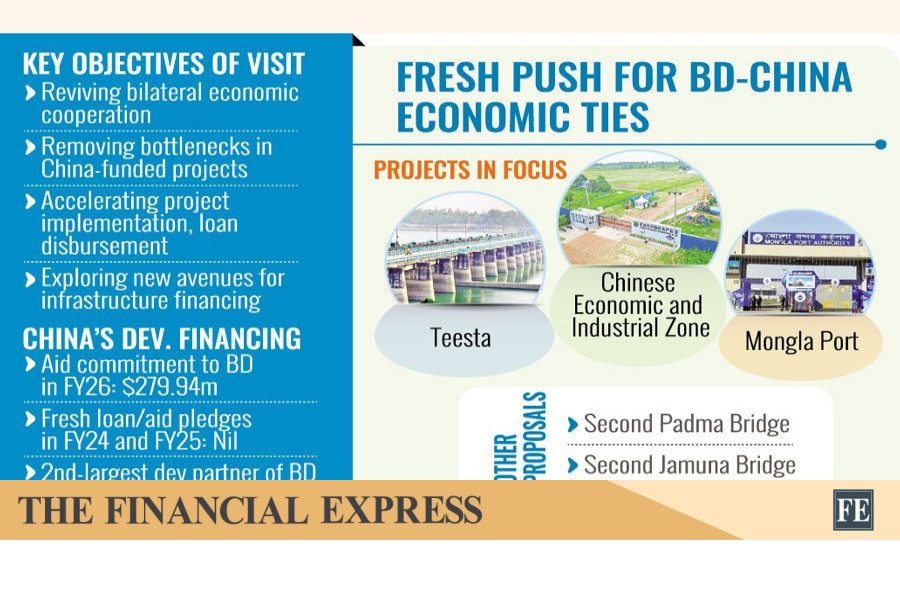
Bangladesh-China economic ties are going to get a big boost as a high-up of China International Development Cooperation Agency (CIDCA) will visit Bangladesh this month to strengthen cooperation and remove bottlenecks in major development initiatives, officials say.

Hu Zhangliang, vice-chairman of CIDCA, is scheduled to arrive in Bangladesh on September 13, and the visit may help advance the Teesta Barrage and other China-funded projects in the pipeline, Ministry of Finance (MoF) officials say.

The high-level visit aims to revitalise bilateral economic dynamics between the two nations.

While China stands as Bangladesh's second-largest bilateral donor, fund disbursements have slowed over the last couple of years, a senior ministry official says.

According to reports from the Economic Relations Division (ERD), Dhaka did not receive fresh loan or aid pledges from Beijing in FY24 and FY25.

Now there is progress, with China making $279.94 million worth of aid commitment in FY26.

The ministry official says Hu's upcoming trip signals an effort to re-engage and accelerate implementation frameworks.

A major focus of the visit will be a high-stakes tripartite project review involving Chinese delegates, Bangladeshi authorities, and implementing agencies.

This session is specifically structured to identify and eliminate bureaucratic and operational obstacles that have slowed down China-funded infrastructure projects across the country, says a senior ERD official.

To gauge real-time progress, Hu will conduct on-site inspections of several key ongoing projects.

The highly-anticipated Teesta River Comprehensive Management and Restoration Project is expected to dominate bilateral discussions, says another finance ministry official.

Beijing has repeatedly expressed a strong interest in financing and investing in the Teesta water management framework to mitigate riverbank erosion and enhance northern irrigation.

Both nations are currently working to finalise feasibility details and address structural adjustments.

Besides, Mongla port development, Chinese special economic zone, and some new proposals, such as the second Padma and Jamuna bridges, are expected to get priority from the Bangladesh side, say officials.

During his stay in Dhaka, Hu is scheduled to hold critical meetings with Finance Minister Amir Khosru Mahmud Chowdhury alongside the ERD secretary.

These discussions will explore fresh avenues for sustainable financial partnerships, infrastructure financing, and smoother credit disbursement models to ensure a more structured phase in Bangladesh-China economic relations.

Meanwhile, during Prime Minister Tarique Rahman's China visit on June 22-26, a total of 17 bilateral instruments - including agreements, memorandums of understanding (MoUs), a joint action plan, and an agricultural trade protocol - covering cooperation in development, investment, trade, ports, industrial zones, media, education, vocational training, green development, and export promotion were signed.

The agreements include development cooperation, expansion and modernisation of Mongla Port facilities, development of Chinese Economic and Industrial Zone (CEIZ) and China-Bangladesh Mongla Port Economic Zone, implementation of Global Development Initiative, investment cooperation, vocational education, Chinese language education, and media cooperation involving China Media Group (CMG), Xinhua News Agency, Bangladesh Sangbad Sangstha, Bangladesh Television, and the Ministry of Information and Broadcasting.

Earlier, Bangladesh requested China to expedite development assistance for 27 priority projects originally agreed upon during Chinese President Xi Jinping's historic visit to Dhaka in October 2016 during former prime minister Sheikh Hasina's regime.

The initial agreement involved a $20 billion foreign aid package intended to fund mega infrastructure, energy, and communication projects.

In the meantime, a lot changed over the last 10 years and Bangladesh's development priority also changed.

That is why the priority project list has been updated, and financial support will be requested from Beijing.

Some fresh priority projects have been included in the list and the prime minister will seek support for those during his visits from Tuesday, the finance ministry official says.​
 

Bangladeshis need to learn Chinese language


1789192988741.webp

Bangladeshi students play a game of Chinese characters during a celebration of the United Nations Chinese Language Day in Dhaka, Bangladesh, on April 25, 2024 —Xinhua Photo

Fourteen years ago, on 21 September 2012, I wrote an article titled "Motivation to Learn Chinese Language." I argued then that the ability to speak Bengali, English and Chinese simultaneously could become a valuable combination for Bangladeshis in education, employment, business and international engagement. At that time, however, no newspaper agreed to publish the article, either in English or Bengali.

I mention this today not as a complaint, but because the situation has changed remarkably. The idea that seemed premature in 2012 is now becoming increasingly relevant to Bangladesh's education, skills development and employment policies.

My own journey with Chinese began much earlier. In 1988, while serving in the Bangladesh Army, I went to China to study the Chinese language. Since my retirement in 2008, I have devoted much of my time to promoting Chinese-language education and Bangladesh-China relations. I have personally taught Chinese to more than 3,500 learners from Bangladesh and other countries. Over the years, I have seen many of my learners obtain employment using Chinese, often with better remuneration; others have used the language successfully in business and other professions, while many have gone to China for higher studies too. These experiences have convinced me that Chinese is not merely an additional language-it can be a practical career skill, especially for Bangladeshi people.

The global picture supports this experience. Chinese is now one of the world's most widely learned foreign languages. More than 200 million people worldwide have been reported to be learning Chinese, and it has been incorporated into the education systems of dozens of countries. The HSK Chinese-proficiency testing network now extends across a large part of the world. This is no longer a language learned only by diplomats, China specialists or scholars; it is increasingly being learned for education, employment, business and communication.

For Bangladesh, the opportunity is particularly important.

China is already one of Bangladesh's most important economic and development partners. Chinese companies are involved in infrastructure, power, construction, manufacturing, telecommunications, transport and other sectors. As these activities expand, the demand for Bangladeshis who can communicate effectively in Chinese is also increasing.

I was fortunate to be present at the National Skills Development Authority (NSDA) validation workshop on Chinese-language competency standards and the Course Accreditation Document on 25 August 2026, where I personally heard Chinese Ambassador to Bangladesh H E Yao Wen speak. His message was especially significant. He said that more than 100,000 Bangladeshis are learning Chinese and emphasised that Chinese-language ability should be combined with technical and vocational skills. He further pointed out that skilled Bangladeshis with Chinese-language proficiency could work not only in Chinese companies in Bangladesh but also in Chinese projects in other countries.

This opens a much bigger horizon.

Bangladesh is one of the world's major suppliers of manpower. We should now aim to send abroad not only workers, but skilled workers who possess an additional international language. A Bangladeshi technician, engineer, electrician, construction supervisor, IT professional, hospitality worker or business executive who can communicate in Chinese can potentially compete for opportunities associated with Chinese enterprises in Bangladesh and overseas.

This has a natural connection with China's Belt and Road Initiative (BRI) and China's growing international economic engagement. Wherever Chinese companies work on infrastructure, industry, logistics or other projects, communication between Chinese and local professionals is essential. Chinese-speaking Bangladeshi professionals could therefore become part of a much larger international employment market.

Bangladesh could even aspire to become a regional hub for Chinese-language and skills training for overseas employment.

There is now strong official momentum behind this idea. During Prime Minister Tarique Rahman's visit to China in June 2026, Bangladesh and China signed agreements covering a range of areas, including education and vocational cooperation. Mandarin was prioritised as a third language in Bangladesh, alongside an increased emphasis on technical and vocational education. The visit also opened new avenues for cooperation in healthcare and other sectors.

Education Minister Dr A N M Ehsanul Hoque Milon has also repeatedly emphasised the importance of third-language education and developing students into globally competitive skilled citizens. Speaking at the China-Bangladesh Education Cooperation Forum in May, he stressed that third-language education should help Bangladesh face the challenges of globalization and that Chinese education could open international employment opportunities.

These developments represent a major change from 2012. What was then largely an idea advocated by individuals has now begun to receive serious policy attention.

Bangladesh also does not have to start from zero. Chinese-language education has been promoted for years by universities, Confucius Institutes and classrooms, private academies and community organisations. Among the private and voluntary initiatives, Zhong Meng Chinese Academy (ZMCA) has been providing Chinese education through residential, offline and online programmes, while Yi Dai Yi Lu Chinese Academy and other institutions have also contributed to the spread of Chinese learning. We Speak Chinese Club Bangladesh Limited (WSCC) has been promoting Chinese-language learning, people-to-people contact, interpretation, educational programmes and China-related activities. Its members have also helped learners with employment, business and higher studies in China.

These initiatives deserve encouragement, but Bangladesh needs a much larger and better-coordinated national effort. The experiences of our Asian neighbours are instructive. India has introduced Mandarin in selected schools and universities and continues to maintain Chinese-language programmes despite the complexities of its relationship with China. Pakistan has developed Chinese-language programmes through universities and Confucius Institutes, including degree and professional courses. Sri Lanka has expanded Chinese teaching and teacher training in schools, while Nepal and Myanmar have increasingly linked Chinese learning with tourism, industry and employment. Thailand has long developed Chinese-language education connected with business and higher education.

The Western experience also deserves attention. For many years, universities and schools in the United States, Britain, Australia and other Western countries actively encouraged Mandarin because of China's growing economic and global importance. Enrolment patterns have changed in some institutions in recent years for a variety of geopolitical, demographic and institutional reasons. But this does not alter the basic value of Chinese. The important lesson for Bangladesh is that language education becomes sustainable when it is connected to real educational, professional and economic opportunities.

Another emerging area is medical tourism. As medical cooperation between Bangladesh and China expands, more Bangladeshis may travel to China for specialised treatment. Chinese-speaking Bangladeshi doctors, nurses, medical coordinators, interpreters and tourism professionals could play an increasingly important role. The easier communication becomes, the more comfortable and efficient medical travel can be.

Some people still believe that Chinese is too difficult to learn. I do not agree. When I first studied Chinese in the 1980s, learning resources were limited. Today, the situation is completely different. The internet, smartphones, online classes, digital dictionaries, Pinyin, video lessons, social media and communication platforms have made Chinese much more accessible. Modern learners can hear native speakers, practise pronunciation, communicate with Chinese people and access learning materials from almost anywhere. Learning Mandarin is still a serious commitment, but it is certainly more accessible today than it was decades ago.

What should Bangladesh do?

Chinese should be properly incorporated into the country's third-language strategy, with students allowed to connect language learning with their future careers. Chinese should also be taught alongside professional skills-Chinese plus engineering, Chinese plus construction, Chinese plus tourism, Chinese plus healthcare, Chinese plus IT and Chinese plus business.

We urgently need more trained Bangladeshi Chinese-language teachers, recognised certification, modern teaching materials, scholarships, exchange programmes and opportunities for language immersion in China. China can support Bangladesh through teachers, teacher-training programmes, scholarships, digital resources, language laboratories, curriculum development and cooperation between Chinese universities and Bangladeshi educational and technical institutions.

Most importantly, Chinese learning should lead somewhere: to a job, a scholarship, a business opportunity, a professional qualification or a meaningful connection with China. Learning Chinese will not replace English, nor should it. Rather, it can complement Bengali and English and give Bangladeshis another powerful window to the world.

The question for Bangladesh is no longer whether we should learn Chinese. The question is whether we are prepared to act now-or wait another fourteen years.

Lt Col (Retd) Md Shahadat Hossain, psc, MBA, MDS is a Graduate in Chinese Language, Beijing Language and Culture University; Adjunct Professor, Institute of Professional Language (IPL), Bangladesh Maritime University.​
 

Bangladesh, China’s Yunnan seek to boost trade


1789962942353.webp


A visiting delegation from China's Yunnan Province met with Bangladeshi officials and business leaders in Dhaka on Sunday to explore avenues for expanding bilateral trade, investment, and broader economic cooperation between Bangladesh and Yunnan.

Mohammad Hasan Arif, Vice Chairman and Chief Executive (Additional Secretary) of the Export Promotion Bureau (EPB), presided over the meeting.

The discussions focused on strengthening existing trade ties, creating new market opportunities, establishing business connections, and expanding mutual trade prospects between Bangladesh and Yunnan Province, reports UNB.

Led by the Department of Commerce of Yunnan Province, the Chinese delegation comprised government officials, entrepreneurs, and business leaders representing various sectors.

The meeting emphasized facilitating direct communication and business partnerships between Yunnan-based enterprises and Bangladeshi government agencies, trade associations, and private sector stakeholders.

Members of the Yunnan delegation expressed keen interest in conducting market research, appointing local agents and distributors, exploring import-export opportunities in agricultural and agro-based products, utilizing logistics services, and gaining insights into Bangladesh’s commercial infrastructure, including Chittagong Port.

The Yunnan Department of Commerce proposed several initiatives, including assessing market demand in Bangladesh for construction materials, engineering products, and agricultural machinery. Their proposals also highlighted visiting local trade exhibitions and commercial markets, building distribution and logistics networks, and expanding exports of agricultural and light industrial goods.

Additionally, the meeting explored creating stronger trade linkages between Yunnan’s product offerings and Bangladeshi textiles and specialized agricultural products.

EPB Vice Chairman Mohammad Hasan Arif underscored the need to complement government-level cooperation with robust Business-to-Business (B2B) interactions, market integration, and strategic commercial partnerships to make economic ties between Bangladesh and Yunnan more dynamic and fruitful.

Both sides agreed to maintain continuous communication across sectors of mutual interest to establish effective commercial links between the business communities of Bangladesh and Yunnan Province.​
 

Bangladesh eyes further expansion of cooperation with China: Moyeen Khan
United News of Bangladesh. Dhaka 24 September, 2026, 09:56

1790223781973.webp

Minister Abdul Moyeen Khan speaks at a reception in Dhaka on Wednesday evening marking the 77th anniversary of the founding of the People’s Republic of China. | Photo: Courtesy

Local government, rural development and cooperatives minister Abdul Moyeen Khan has said Bangladesh-China relations have come a long way and are now poised for further expansion across trade, investment, infrastructure, energy, technology and people-to-people contacts.

‘Our ties span trade, development, infrastructure, energy and industry, and, last but not the least, people-to-people contact,’ he said.

The minister made the remarks as the chief guest at a reception in Dhaka on Wednesday evening marking the 77th anniversary of the founding of the People’s Republic of China.

Chinese ambassador to Bangladesh Yao Wen delivered the welcome remarks at the reception, which was attended by senior political leaders from both the ruling and opposition parties, ministers, senior government officials, diplomats stationed in Dhaka, business leaders, civil society representatives and senior journalists.

The LGRD minister said Bangladesh looks to the next decade with the expectation of further expanding cooperation with China.

‘Bangladesh looks forward to the next decade of further expansion of our cooperation - not only in the area of trade and commerce, but also in the area of friendship and culture,’ he said.

The minister emphasised that future partnerships should not only deliver large-scale infrastructure but also empower people and strengthen small businesses.

‘Small traders can be the best ambassadors between two countries,’ he added.

Recalling prime minister Tarique Rahman’s recent visit to China, Moyeen said the visit had opened the way for transformative projects and described it as a milestone in bilateral relations.

‘The substantive discussions that were held in China and the forward-looking proposals that emerged from those discussions make us happy. That visit was a milestone in our bilateral relationship,’ he said.

Moyeen said Bangladesh looks forward to elevating its partnership with China and building a shared future for the younger generations of the two countries.

‘But between the two countries, we have travelled a long way towards where we are today, and I think this friendship has to be built by taking into account modern times, our technology, our diplomacy and our politics,’ he said.

Moyeen also praised China’s development experience over the past 77 years, saying it offers an important example of transformation in the modern world.

‘China has provided one of the most striking examples of development in our modern history,’ he said, referring to the country’s transformation despite its enormous population and the level of economic development from which it started.

He said Bangladesh, with its limited land and large population, shares an important development priority with China - improving the lives of people who are less privileged.

‘Our priority is also the same: that we want to uplift the rights of the people in society who are not so privileged,’ Moyeen Khan said, while noting that the political philosophies of the two countries may be different.

The minister said Bangladesh remains eager to learn from China’s experience in infrastructure development, technology, innovation and large-scale urbanisation.

‘At the same time, we believe that government-to-government cooperation must provide opportunities and create opportunities for more and more people,’ he said.

The minister stressed the importance of greater exchanges among students, businesspeople, journalists and professionals, saying such contacts can help deepen mutual understanding and widen the scope of future cooperation.

‘People-to-people contact, exchanges of students as well as businesspeople can change the pace of our countries,’ he said.

He also thanked Chinese ambassador Yao Wen for his role in advancing Bangladesh-China friendship and promoting cooperation in trade, investment, infrastructure, energy, healthcare and people-to-people exchanges.

‘I would like to recognise the Ambassador personally for his tireless work in advancing the friendship between the two countries,’ Moyeen said.

Moyeen extended Bangladesh’s best wishes to the government and people of China for continued peace, prosperity and wellbeing.

‘May the friendship between Bangladesh and China continue to flourish, bringing greater progress to our peoples in both countries, and lasting stability to our friendship in this region and in the globe,’ he said.

Recalling a well-known saying, he concluded, ‘please go as far as China if you want knowledge.’

The minister also congratulated the Chinese government and people on the 77th anniversary of the founding of the People’s Republic of China.​