| Global Defense, OSINT & Geopolitics Wire

[đŸ‡§đŸ‡©] Corruption Watch

[đŸ‡§đŸ‡©] Corruption Watch
411
20K
More threads by Saif

G Bangladesh Defense

Government halts flats-for-July martyrs project over inflated cost, corruption claims

bdnews24.com
Published :
Jul 28, 2025 00:24
Updated :
Jul 28, 2025 00:24

1753658363321.webp


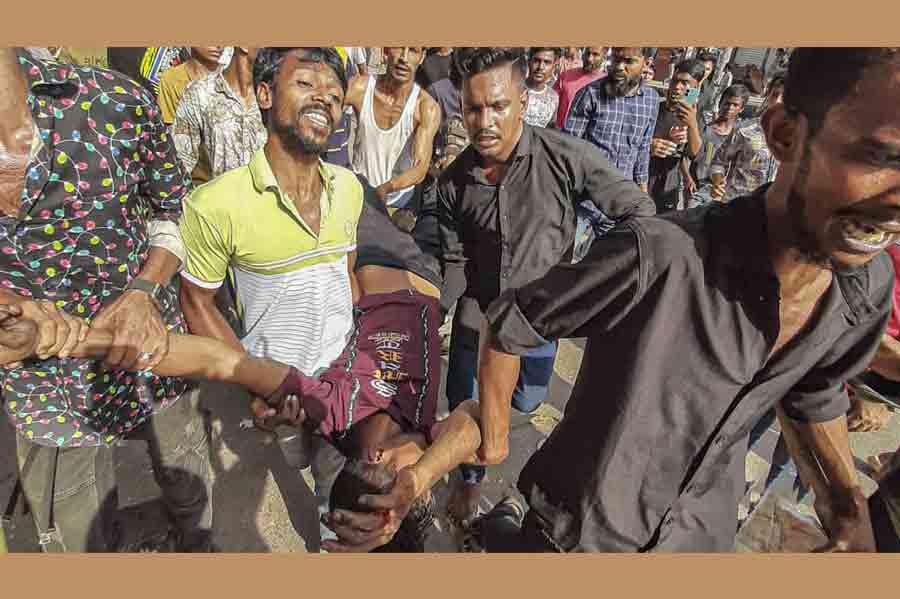
The government has turned down a housing project for the families of those killed during the student-led anti-discrimination protests in July last year, amid concerns over inflated costs and allegations of corruption.

On Sunday, at the first Executive Committee of the National Economic Council (ECNEC) meeting of fiscal year 2025–26, the project failed to gain approval.

“It should be properly cost-evaluated before any decision,” said Planning Advisor Wahiduddin Mahmud at a post-meeting press conference.

The project was submitted by the Ministry of Housing and Public Works. It proposed building 804 flats of 1,355 sq ft each on government land in Mirpur, with a budget of Tk 7.61 billion, to be completed between July 2025 and June 2029.

“This was a well-intentioned proposal, but we didn’t approve it because we believe the cost must be assessed more carefully before the tendering process,” Wahiduddin said.

The project had earlier come under scrutiny during a Jun 16 evaluation by the Planning Commission’s Project Evaluation Committee (PEC), which flagged implementation challenges.

Subsequent media reports revealed inflated expenditure estimates and possible irregularities.

Wahiduddin further noted the lack of clarity surrounding multiple aid efforts for the same families.

“When different ministries start offering varied forms of support, overlaps and gaps become difficult to track,” he said. He stressed the need for a comprehensive and coordinated approach, bringing together all housing, stipend, and disability aid schemes for the victims’ families under one umbrella.

“There are also larger questions,” he added. “Why Mirpur? Why only Dhaka? What about families living in rural areas or other cities? The matter of inheritance will also arise when allocating permanent flats. These require deeper planning.”

Ultimately, the Ministry of Liberation War Affairs will be tasked with coordinating these efforts, he confirmed.

DHAKA UNIVERSITY PROJECT

Despite the rejected flats proposal, ECNEC approved 12 projects worth Tk 81.49 billion, including a major initiative for Dhaka University’s infrastructure overhaul.

The Tk 28.4 billion five-year plan for the university includes:

Six academic buildings
Five male and four female dormitories accommodating 7,700 students
Two residential buildings for teachers and officers
A stadium, DUCSU building, and other administrative facilities
Reflecting on his own student and teaching days, Wahiduddin said: “Though income levels have improved, housing conditions in the university have worsened.”

Given the university’s space constraints, some old structures will be demolished to make room for high-rise buildings while preserving heritage sites like Salimullah Muslim Hall and Curzon Hall.

OTHER PROJECTS

Tk 2.78 billion: Revised road construction along Karnafuli river (Kalurghat Bridge to Chaktai Canal), up by Tk 4.69 billion
Tk 6.5 billion: Establishment and reconstruction of 20 fire stations nationwide
Tk 7.57 billion: Upgraded logistics and maintenance facilities for the Coast Guard
Tk 13.43 billion: Rural sanitation and canal excavation in Chattogram, cost reduced by Tk 1.94 billion
Tk 17.91 billion: Railway maintenance and rehabilitation in the eastern zone
Tk 2.34 billion: Mirpur cantonment officers' mess and bachelor quarters, cost up by Tk 754.5 million
Tk 3.95 billion: Women’s income-generating training (second phase)
Tk 1.6 billion: Expansion of museum and infrastructure at Folk and Crafts Foundation
Tk 1 billion: Tuber crop research strengthening
Tk 7.7 billion: Smart pre-paid metering project under BPDB, cost increased by Tk 1.5 billion​
 

Former BTRC top officials accused of Tk 90.1 billion telecom forgery

FE ONLINE REPORT
Published :
Dec 03, 2025 18:48
Updated :
Dec 03, 2025 18:48

1764810515776.webp


A group of former senior officials of the Bangladesh Telecommunication Regulatory Commission (BTRC) have been accused of causing a staggering Tk 90.1 billion loss to the state through deliberate misuse of power, illegal decisions, and revenue manipulation in favour of private International Gateway (IGW) operators.

According to an official briefing, six former BTRC executives—former chairmen Sunil Kanti Bose and Dr Shahjahan Mahmud, former vice chairman Brig Gen (Retd) Md Ahsan Habib Khan, and former commissioners Md Jahurul Haque, Md Rezaul Kader, and Md Aminul Hasan—have been named in a corruption and money laundering case approved by the authorities.

The plaintiff in the case and the investigation officer is Md Jalal Uddin Ahmed, Director of the ACC’s Khulna Divisional Office.

The Anti Corruption Commission (ACC) investigators said the alleged financial forgery took place between October 2015 and January 2018, during which these officials continued a set of “temporary and experimental” call termination rates and revenue-sharing arrangements long after their legal expiry.

In 2014, IGW operators were allowed to bring international incoming calls at a discounted and experimental termination rate of US$ 0.015 per minute, replacing the standard rate of $ 0.03.

Similarly, the government’s revenue share was lowered from 51.75 per cent to 40per cent, while IGW operators’ share was raised from 13.25 per cent to 20 per cent for a trial period of one year.

However, instead of restoring the original rates after September 2015, the accused officials illegally extended the lower rates for another 28 months, without any approval from the government, violating the Telecommunication Act, guidelines, and government directives.

Officials say these decisions were taken with “dishonest intent,” benefitting IGW operators at the expense of the national exchequer.

As a result, the government incurred losses in three major areas those include revenue sharing loss worth Tk 3.83 billion; allowing IGW operators to continue importing calls at a reduced rate led to an additional loss of Tk 29.41 billion while failing to ensure that the government-set call rates were applied to incoming international calls, Bangladesh was deprived of approximately US$ 72.1 million, equivalent to Tk 56.85 billion.

Altogether, the total damage stands at Tk 90.1 billion, marking one of the largest alleged financial frauds involving a regulatory body in recent years.

Authorities said the former officials abused their regulatory powers to favour private operators, amounting to “criminal breach of trust and misuse of authority.” The case has been approved under Sections 409 and 418 of the Penal Code, Section 5(2) of the Prevention of Corruption Act 1947, and Sections 4(2) and 4(3) of the Anti-Money Laundering Act 2012.

Legal experts say the scale of financial damage makes the case highly significant, with the possibility of further investigations into whether any IGW owners colluded with the accused.

Officials said further action will be taken after completing the investigation and identifying all beneficiaries involved in the alleged forgery.​
 

The link between power and the magic wand of wealth
Badiul Alam Majumdar
Published: 07 Dec 2025, 19: 38

1765155854199.webp


It is now almost certain that in the first half of February next year, the 13th National Parliament and the Constitution Reform Council elections will be held. At the same time, a referendum will take place on several important reforms included in the July National Charter. For a large portion of citizens, this is undoubtedly good news. However, many remain concerned about who will form the next Parliament and the Constitution Reform Council. There is also apprehension that the upcoming Parliament or Reform Council may include numerous controversial figures who could use power as a 'magic wand' to acquire wealth.

Our past experiences are not reassuring. As an example, consider a previous instance. Many readers may recall that in June 2008, elections were held for four old city corporations—Barishal, Khulna, Rajshahi, and Sylhet. For the first time, candidates were required to submit affidavits along with their nomination papers, detailing their educational qualifications, profession, sources of income, past and present legal cases, and the assets and liabilities of both themselves and their dependents. This was made mandatory following persistent efforts by “Shujan—Citizens for Good Governance” and under the guidance of the High Court. The purpose of submitting and publishing these details was to empower voters with information so they could make informed choices and vote for honest and qualified candidates.

In all these elections, candidates nominated by the Awami League were victorious—Shawkat Hossain Hiron in Barishal, Talukdar Abdul Khalek in Khulna, AHM Khairuzzaman Liton in Rajshahi, and Badruddin Ahmed Kamran in Sylhet. Candidates nominated by the BNP were defeated: Ahsan Habib Kamal in Barishal, Md Moniruzzaman in Khulna, Mohammad Mosaddek Hossain in Rajshahi, and Salauddin Rimon in Sylhet.

Five years later, on 15 June 2013, elections were held again in these city corporations. All candidates nominated by the BNP and Awami League in 2008 contested again in 2013, although in Sylhet, the BNP nominated Ariful Haque Chowdhury. In the 2013 elections, all BNP-nominated candidates won. Once again, candidates were required to submit seven types of information through affidavits along with their nomination papers.
From the information submitted with the nomination papers, it is evident that all eight mayoral candidates—both winners and losers in the two elections—were businessmen. However, Talukdar Abdul Khalek became a businessman only after being elected; in his 2008 affidavit, he had listed his profession as “currently no business.”

The affidavit data further shows that the incomes of all four outgoing mayors and their dependents increased significantly during their time in office. In Khulna, Talukdar Abdul Khalek and his dependents’ income rose from Tk 3,62,000 to Tk 5,32,66,977, an increase of 14,615 per cent. In Barishal, Shawkat Hossain Hiron and his dependents’ income increased from Tk 5,80,250 to Tk 3,49,11,030, or 5,916 per cent.

In Rajshahi, AHM Khairuzzaman Liton and his dependents’ income rose from Tk 2,44,000 to Tk 57,75,772, or 2,308 per cent. In Sylhet, Badruddin Ahmed Kamran and his dependents’ income rose from Tk 2,10,000 to Tk 15,49,988, or 638 per cent—the relatively lower increase is because his personal income received as ‘honourarium’ was not declared in the affidavit. Overall, the average income of the four mayors and their dependents rose from Tk 3,49,063 to Tk 2,39,00,981, or 6,747 per cent.

On the other hand, among the three main candidates who were defeated in the 2008 elections, two saw an increase in income along with their dependents, while one saw a decrease. In Barishal, Ahsan Habib Kamal’s income increased from Tk 7,08,000 in 2008 to Tk 9,30,000 in 2013, or 31 per cent. In Khulna, Md Moniruzzaman’s income decreased from Tk 8,36,000 to Tk 2,00,000, a drop of 76 per cent. In Rajshahi, Mosaddek Hossain’s income increased from Tk 1,68,000 to Tk 1,92,000, or 14 per cent. Collectively, the income of these three defeated mayoral candidates fell by 23 per cent over five years. This indicates a correlation between election victory and income growth.

Looking at assets, the same trend is observed. The immovable and movable assets of Barishal Mayor Shawkat Hossain Hiron and his dependents increased from Tk 2,08,53,26 to Tk 10,94,39,150, a 5,148 per cent rise over five years. Khulna’s Talukdar Abdul Khalek’s assets rose from Tk 1,85,97,550 to Tk 10,08,41,292, or 442 per cent.

In Rajshahi, Khairuzzaman Liton’s assets grew from Tk 96,75,000 to Tk 1,94,47,198, a 133 per cent increase. Sylhet’s Kamran’s assets rose from Tk 2,14,78,290 to Tk 5,00,62,624, also a 133 per cent increase. The total assets of the four outgoing mayors and their dependents increased from Tk 1,29,59,041 to Tk 6,99,47,566, or 440 per cent. It is worth noting that the outgoing mayors had relatively low liabilities, which contributed to the large increase in their net assets.

The affidavit data shows that among the three main candidates who were defeated in the 2008 elections, the assets of two and their dependents increased, while one saw a decrease. In Barishal, Ahsan Habib Kamal’s assets decreased from Tk 1,04,11,650 in 2008 to Tk 27,73,000 in 2013, a decline of 73 per cent. In Khulna, Moniruzzaman’s assets rose from Tk 16,13,100 to Tk 30,55,537, an increase of 89 per cent.

Rajshahi, Mosaddek Hossain’s assets increased from Tk 1,68,000 to Tk 1,92,000, or 14 per cent. Overall, over five years, the total assets of the mayoral candidates and their dependents who were defeated in 2007 in the three cities—Khulna, Barishal, and Rajshahi—declined by 41 per cent. This indicates that asset growth is closely linked to electoral victory. It is noteworthy that in the 15 June 2013 elections, all outgoing mayors were defeated, while the three candidates who lost in 2008 were elected. Additionally, Ariful Haque Chowdhury won in Sylhet.

Political parties must undertake reforms, particularly ensuring transparency in candidate selection, ending nomination-related trade and undue financial influence
This analysis makes it clear that there is a significant correlation between political power and the accumulation of income and assets, although questions remain regarding the reliability of the information provided by competing candidates. Winning candidates assumed office and this power acted like a “magic wand,” enabling them and their dependents to substantially increase their income and assets. In contrast, the defeated candidates did not benefit similarly. This raises an important question—has our politics, which is meant to serve as a means of public service, increasingly become a profitable business? Does it create opportunities for individuals to acquire personal wealth rather than serve the public?

Furthermore, more recent affidavit data from parliamentary election candidates clearly illustrates the link between power and asset accumulation, which will be discussed in a subsequent article. This underscores the urgent need to establish new frameworks of transparency and accountability for elected representatives.

At the same time, political parties must undertake reforms, particularly ensuring transparency in candidate selection, ending nomination-related trade and undue financial influence. It is also crucial for the Election Commission to revise the affidavit forms provided to candidates and rigorously verify the completeness and reliability of the information submitted. Some changes to the affidavit forms have already been implemented.

* Dr. Badiul Alam Majumdar is secretary of Shushashoner Jonno Nagorik-SHUJAN (Citizens for Good Governance).​
 

Extortion, corruption continue riding on lack of govt will

THE remark by the chief of Transparency International Bangladesh that the interim government has failed to put checks on corruption, land grabbing and extortion is worrying. The executive director of the anti-corruption agency has also said that various groups are engaged in partisan activities, land grabbing and extortion by abusing political and administrative powers, noting that corruption has occurred even within the government, which is concerning. The situation calls on the government authorities to put in greater efforts to deal with such issues that harm democratic governance and stand as a barrier to a society free of corruption. The agency chief has said that there was an opportunity during the tenure of the interim government to take a strong stand against corruption and there is no denying that the government has failed in this regard. The chief, who headed the anti-corruption reforms commission set up on October 3, 2024, which submitted its recommendations to the government on January 15, made the remarks at a press conference at which he recommended the inclusion of a set of 52 issues in the manifestos of political parties aimed at ensuring steps against corruption.

Transparency International Bangladesh also called on political parties to make public their positions on the use of money, muscle and religion in politics and to spell out their commitments in their manifestos in view of the next general election, scheduled for February. He made the call, noting that the debris of corruption that has accumulated over 54 years, especially during the past decade and a half when the authoritarian Awami League governed the country, cannot be cleared overnight. He has hoped that political parties would seize the opportunity that arose after the overthrow of the Awami League government, which changed the political landscape and would largely shape future outcomes. The issues will ultimately fall on political parties after the general elections. But the interim government has failed to show the will to stop menaces such as corruption, extortion and land grabbing. Leaders and activists of the Bangladesh Nationalist Party have largely been blamed, and rightly so, for such incidents. The BNP leadership has punished many of its leaders and activists and asked the police to arrest anyone involved in such incidents. Yet the situation has not improved much because of the lack of will on part of the government. Leaders and activists of some other political parties are also reported to have been engaged in such menaces, but the finger has almost always been pointed at the Bangladesh Nationalist Party, which has, rightly, made the headlines time and again for such misdeeds.

It is, therefore, time that the interim government acted decisively to stop corruption, extortion, land grabbing and the abuse of political and administrative powers without regard to the political affiliation of the offenders.​
 

Finance adviser attributes rise in millionaire bank accounts to ‘hidden money’

bdnews24.com
Published :
Dec 09, 2025 21:48
Updated :
Dec 09, 2025 21:48

1765327433328.webp


Finance Adviser Salehuddin Ahmed has said the Bangladesh Bank’s report showing a rise in millionaire bank accounts is due to “money hidden at home for a long time” now being deposited.

He made these comments after a meeting of the Advisery Council Committee on Government Procurement at the Secretariat on Tuesday.

His remarks follow a report published on Sunday, which noted an increase of 5,974 millionaire bank accounts in the second quarter and a further 734 in the third quarter of this year.

On why the number of millionaire bank accounts is surging despite expectations of reduced corruption, he said: “This could be because money that was hidden away inside homes for a long time is now being deposited in banks. It is not that people have no money.”

Salehuddin said other government work, including procurement, will continue even after the schedule is announced. However, work that “influences” the election will be stopped.

“Five banks will merge, nine NBFIs (leasing companies) will merge. Those will not be stopped.”​