Neither east, nor west
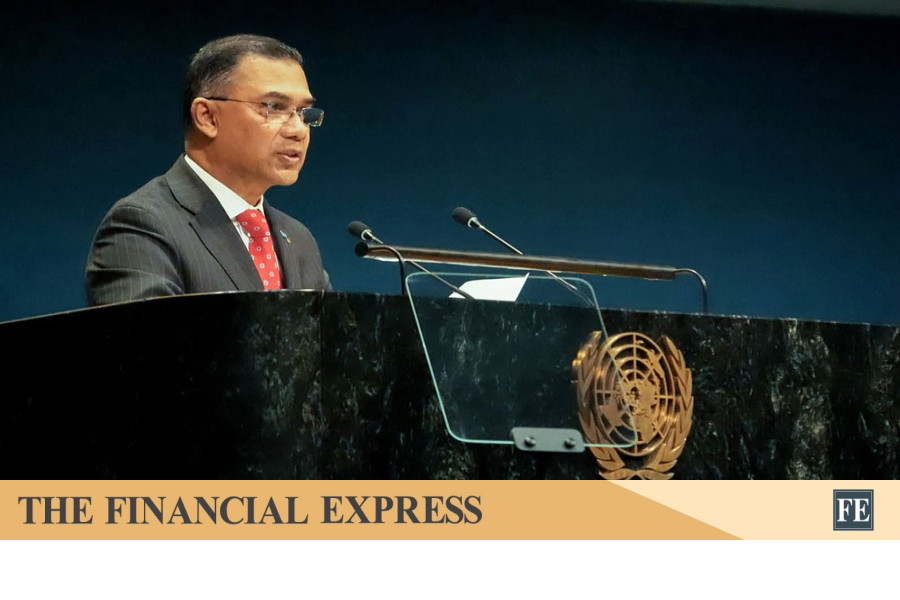
Prime Minister Tarique Rahman addresses the 81st session of the United Nations General Assembly (UNGA) on September 26, 2026 —BSS Photo
It seems that Bangladesh is about to enter a new era in its foreign policy formation process. The term "Bangladesh First," used by Prime Minister Tarique Rahman, has now become the key to diplomatic relations where national interests precede those of the other country, sovereign equality replaces dependency, economic diplomacy goes hand in hand with political diplomacy, and diversification takes precedence over exclusivity.
The doctrine should not, however, be misunderstood as isolationism, nationalism turned inward, or hostility toward Bangladesh's neighbours. The emerging doctrine is not simply about asking which country Bangladesh supports. It attempts to change the question itself: What relationship, agreement, investment, strategic partnership or diplomatic position best advances Bangladesh's interests while preserving its freedom of action?
FRIENDSHIP TO STRATEGIC AUTONOMY: Bangladesh's diplomacy has always operated under an unavoidable geopolitical reality. It is geographically surrounded on three sides by India, sits beside Myanmar, faces the Bay of Bengal, depends heavily on international trade, has extensive economic relations with China, maintains important commercial and strategic relations with the United States and Europe, and has deep labour, energy and financial connections with the Gulf and Southeast Asia.
Geography cannot be changed. Dependency, however, can be managed. The government's official formulation emphasises multilateralism, mutual respect, mutual interest, non-interference and strategic autonomy rather than a country-centric foreign policy.
Strategic autonomy does not mean maintaining equal distance from every country. Nor does it require neutrality on every international question. It means retaining sufficient diplomatic, economic and strategic space to make decisions according to Bangladesh's interests rather than because another state expects, pressures or compels Dhaka to act in a particular way.
For a medium-sized state located at the intersection of South and Southeast Asia and the Indo-Pacific, that distinction matters enormously.
SOVEREIGNTY AS A WORKING PRINCIPLE: "Bangladesh First" places sovereignty near the centre of foreign policy. The BNP's 2026 manifesto declared independence, sovereignty, national interest, national security and citizens' welfare to be foreign-policy priorities while calling for relations based on equality, fairness and mutual respect. The important test will be how these principles operate in practice. Sovereignty in 21st century diplomacy involves more than protecting borders. It includes control over strategic infrastructure, energy security, water resources, maritime interests, supply chains, data and technology, defence choices and the terms under which foreign investment enters the economy.
It also implies that relations with bigger countries should be judged on the basis of reciprocity.
In relation to Bangladesh, a sovereignty-based doctrine would call for checking the balance of advantages created through bilateral agreements, whether infrastructure projects improve the country's capacity, if the debt burden remains sustainable, and whether cooperation in the sphere of security ensures the country's independence of decision-making. The idea is clear even if it is difficult to implement it: partnership should increase rather than diminish the country's options.
INDIA & GEOGRAPHY WITHOUT SUBORDINATION: No test of "Bangladesh First" will be more consequential than relations with India. The two countries are bound by geography, history, rivers, trade, transportation, energy, security and extensive human connections. A stable and constructive Bangladesh-India relationship is therefore not a diplomatic luxury; it is a structural necessity for both countries. But geographic proximity does not eliminate the importance of sovereign equality. Dhaka's challenge is to build a relationship with New Delhi in which cooperation does not require political deference and disagreement does not automatically become hostility.
The "Bangladesh First" does not mean anti-India. It can instead mean insisting that Bangladesh-India relations be conducted as relations between two sovereign states, with legitimate interests on both sides. Water sharing, border management, connectivity, trade imbalances, energy, transit, security and unresolved political questions should consequently be negotiated through institutional diplomacy and reciprocity not through either reflexive confrontation or automatic accommodation.
CHINA & THE OPPORTUNITY WITHOUT DEPENDENCY: China offers a different strategic equation. During PM Rahman's visit to China in June 2026, both countries held high-level talks. Bangladesh has many benefits from its relationship with Beijing: infrastructure funding, industrial investment, technology transfer, manufacturing cooperation, etc. But the logic of "Bangladesh First" requires an important safeguard. Reducing excessive dependence on one country cannot mean creating excessive dependence on another.
Bangladesh could pursue closer relations with China while developing its relationship with India, the US, Japan, Europe, Southeast Asia, and the Gulf. Strategic autonomy comes not from shifting patrons, but from increasing choice.
ECONOMIC DIPLOMACY BECOMES FOREIGN POLICY: Perhaps the most significant feature of "Bangladesh First" is its emphasis on economic diplomacy. The government has identified national interest, economic diplomacy, strategic autonomy, balanced engagement and national security as central priorities, with particular attention to exports, investment, energy security, connectivity, migrant workers, overseas students and the Bangladeshi diaspora. This represents an important conceptual shift.
An ambassador should increasingly be measured not only by political access but also by the ability to open markets, attract investment, protect migrant workers, facilitate technology transfer, promote tourism, strengthen energy security and create opportunities for Bangladeshi businesses. The changing nature of Bangladesh's relationship with the United States (US) illustrates this economic angle. The two countries agreed to establish a reciprocal trade arrangement for market access in textiles/apparel, energy, agriculture, investment finance, and logistics in 2026.
Similarly, Bangladesh has pursued energy cooperation with Washington, while discussions with the United Arab Emirates (UAE) have focused on trade, energy, infrastructure, investment, labour mobility and a potential Comprehensive Economic Partnership Agreement (RCEP).
The logic is unmistakable: foreign policy must produce measurable economic value for Bangladesh.
MALAYSIA, ASEAN & THE SEARCH FOR NEW DIPLOMATIC SPACE: PM Rahman's decision to make Malaysia the first destination of his first overseas tour was also symbolically significant. In Putrajaya, the agenda included Bangladeshi migrant workers, recruitment costs, the Rohingya crisis, ASEAN engagement and Bangladesh's interest in joining the Regional Comprehensive Economic Partnership. These are not merely ceremonial diplomatic issues. They concern employment, remittances, trade diversification and Bangladesh's long-term integration with the rapidly growing economies of Southeast Asia.
A successful "Bangladesh First" policy therefore cannot remain trapped within the traditional India-China binary. Japan, South Korea, Malaysia, Indonesia, Singapore, Türkiye, Saudi Arabia, the UAE, the European Union, the United Kingdom and other partners offer different combinations of capital, technology, markets, energy, education and diplomatic cooperation.
THE REAL TEST IS IMPLEMENTATION: The greatest challenge confronting "Bangladesh First" is therefore not rhetorical but institutional. A doctrine becomes meaningful only when translated into negotiating capacity, professional diplomacy, economic analysis, policy coordination and institutional continuity. Bangladesh will need stronger expertise in trade negotiation, maritime affairs, energy diplomacy, technology governance, international law, climate diplomacy and strategic studies. Major international agreements should be evaluated against transparent national-interest criteria: What does Bangladesh gain? What obligations does it assume? Are the benefits reciprocal? What are the long-term strategic consequences? Most importantly, foreign policy should increasingly become a policy of the state rather than merely of the government of the day.
For too long, discussion of Bangladesh's foreign relations has often been framed through somebody else's strategic map: Is Dhaka closer to Delhi or Beijing? Is it moving toward Washington or away from it? Which great-power camp will Bangladesh eventually choose?
Those questions begin from the priorities of other capitals. A genuinely sovereign foreign policy begins from Dhaka. It asks instead: What strengthens Bangladesh's sovereignty? What expands prosperity? What protects its citizens? What secures its energy and maritime interests? What opens markets? What brings technology and productive investment? And what preserves Bangladesh's ability to make tomorrow's decisions independently?
If "Bangladesh First" develops along those lines, it will not require Bangladesh to turn away from the world. It would rather require Bangladesh to engage more countries, more confidently, more pragmatically and from a clearer understanding of its own interests.
The ultimate measure of the doctrine, therefore, will not be whether Bangladesh stands with India, China, America or any other power. It will be whether Bangladesh can stand with all who offer equitable partnership while standing firmly on its own feet.
Dr Serajul I Bhuiyan is Professor and Former Chair Department of Journalism and Mass Communications, Savannah State University.
 Bangladesh Defense