| Global Defense, OSINT & Geopolitics Wire

[🇧🇩] Monitoring the political activities of BNP

[🇧🇩] Monitoring the political activities of BNP
467
23K
More threads by Saif

G Bangladesh Defense

Hasina can never be forgiven, says Fakhrul

UNB
Published :
Jul 20, 2025 17:17
Updated :
Jul 20, 2025 17:17

1753056569343.webp


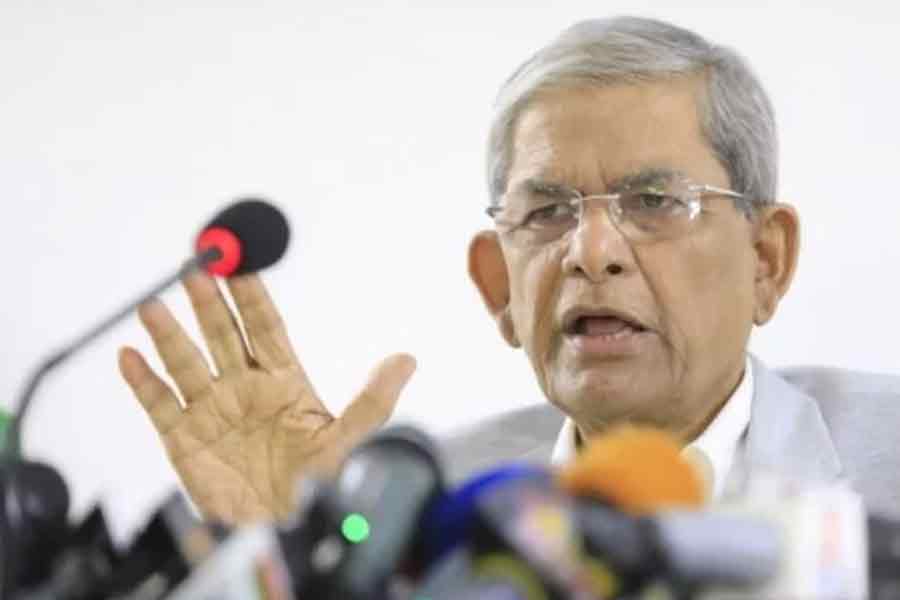
BNP Secretary General Mirza Fakhrul Islam Alamgir on Sunday said deposed autocratic ruler Sheikh Hasina can never be forgiven for the killings and brutalities during the July Mass Uprising, calling her a ‘disgrace to humanity and to all mothers’.

“Hasina will never be forgiven. Hasina is a disgrace to humanity, a disgrace to mothers,” he said while addressing a programme titled, ‘The Mass Uprising 2024 – National Unity and Democratic Journey – Evergreen Memories’.

Jatiyatabadi Krishak Dal and ‘Amra BNP Poribar’ jointly organised the programme on the grave premises of late president and BNP founder Ziaur Rahman at Sher-e-Bangla Nagar, where saplings of neem trees were planted in memory of martyrs of the July Mass Uprising.

Recalling a grieving mother’s cries, Fakhrul spoke emotionally about the loss of her son in the movement.

“She dreamt of a future through her son. They took him away. He was shot, then dumped in a van along with others — alive or dead, no one checked. Later, the bodies were set on fire. Think about it—we are citizens of an independent country,” he said.

The BNP leader said they fought the war of 1971 for an independent country. “The police and administration of this country, who were meant to protect the people, whose salaries were paid with taxpayers’ money, burned and killed our children. What could be more cruel and inhuman than this?”

“Our first task is to bring them to justice. Second: to rehabilitate the families of the martyrs. Those who are injured and lost their eyes must be given proper treatment and support. If we fail, future generations will not forgive us,” he added.

Fakhrul also announced that BNP would create a fund for the families of those killed and injured in the movement.

“I said it yesterday (Saturday), and I say it again today -- there will be an election. Whether we are given power or not is another matter. We will raise a fund on behalf of our party, and with this fund, we will help these families as much as we can,” he said.

Fakhrul said he would talk to party acting chairman Tarique Rahman about creating the fund, though Tarique has already been helping the families of martyrs and injured through ‘Amra BNP Poribar’.

He said their party wants to build a truly liberal democratic new Bangladesh as per the desire of the martyrs.

“Our goal is to build a truly liberal democratic state. We want a new Bangladesh. We want change. We don’t want corruption. We don’t want bribery. We don’t want murder. We don’t want torture. We want to build a country where people can live safely, freely and peacefully,” the BNP leader said.​
 

BNP to prioritise elimination of child labour if voted to power: Fakhrul

BSS
Published :
Jul 26, 2025 19:26
Updated :
Jul 26, 2025 19:26

1753576144167.webp


Bangladesh Nationalist Party (BNP) Secretary General Mirza Fakhrul Islam Alamgir on Saturday said if elected by the people's vote, his party will attach the highest importance to the elimination of child labour across the country.

“BNP will focus on ending child labour and ensuring those children return to education and lead healthy lives,” he said while speaking at a programme joining virtually. ESDO organised the event at the Zainul Abedin Hall in Thakurgaon’s Gobindanagar.

Fakhrul Islam acknowledged the challenges of eradicating child labour in Bangladesh due to the country’s economic conditions, but praised ESDO’s grassroots initiative in Thakurgaon.

“Despite the difficulty, ESDO has taken commendable steps, and I thank them. Their achievement deserves national recognition,” he said, adding “I believe this success can be replicated nationwide to eliminate child labour.”

The event, aimed at showcasing ESDO’s field-level experiences in child labour prevention, was presided over by ESDO Executive Director Dr. Muhammad Shahid Uz Zaman.

Other notable speakers included Labour and Employment Secretary AHM Shafiquzzaman, Cabinet Division (Coordination and Reform) Secretary Zaheda Parveen, Divisional Commissioner, Rangpur, Shahidul Islam and Joint Convenor, National Child Labour Monitoring Committee Advocate Salma Ali also spoke.​
 

Interview: Mirza Fakhrul Islam Alamgir

"I'm worried over rise of right-wing forces in politics"

One year has passed since the fall of the autocratic Sheikh Hasina government through a student-people's mass uprising. Since then, various political developments have been unfolding in the country. In this context, BNP Secretary General Mirza Fakhrul Islam Alamgir spoke to Prothom Alo about the July mass uprising and related events before and after it. The interview was conducted by Prothom Alo special correspondent Selim Zahid.

Prothom Alo : Prothom Alo: How are you doing?

Mirza Fakhrul Islam Alamgir:
Physically, I’m not doing very well. Mentally, I’m distressed by the current political situation in the country.

Prothom Alo : You were abroad for quite some time for medical treatment and have now returned. There has been a lot of discussion and debate around reform and elections. Some people are saying that you are not as visible in your previous role as you had been over the past several years.

Mirza Fakhrul Islam Alamgir:
That’s not true. As you know, I was abroad for quite some time after 5 August. Later, I also visited my daughter and stayed there for a while. After returning, I went to London and stayed there for a considerable time. Then, upon coming back, I developed an eye condition, which kept me sidelined. That’s the reason — there’s no other cause.

Besides, the BNP is a large party. Within the party, responsibilities are divided. For example, you may not be seeing me involved directly in the reform discussions. But I did attend the first meeting of the National Consensus Commission on reform. After that, although I may not have been present in subsequent committee meetings formed under our reform commission, those committees were created by our party. Members are speaking and working as per the guidance of the party’s Standing Committee.

Prothom Alo : Around this time last year, the student movement had taken over the streets. On 5 August, the autocratic government fell. What has the BNP learned from the July mass uprising?

Mirza Fakhrul Islam Alamgir:
For the BNP, this lesson is not new. People of this region have been fighting against ruling classes since the Mughal and British eras. And for the past 15–16 years, we have been leading the movement against fascists.

Let me say something I’ve repeated many times — in public rallies too — that without the active involvement of the youth, this movement cannot succeed. I’m sure you remember. Later, when the quota reform movement began and students stepped forward, some people asked why we didn’t join then. We didn’t directly join the quota movement for valid reasons — because students could have questioned why we were getting involved. That’s happened before. So instead, we supported them. We instructed our student wing, the Chhatra Dal, to take part in the movement — and they did. That gave it momentum. At that time, we were in communication with student leaders, and even our party chairman (Tarique Rahman) was in touch.

Later, when the movement shifted toward anti-government protests, we were in constant communication. All our top leaders had been arrested. Only Abbas Bhai (Mirza Abbas) and I were still outside. I held daily press conferences at our Gulshan office and consistently said that we must be part of this movement. Every day, the leaders who remained active took part in protests. We were leading the movement against the Awami League.

1753579087762.webp

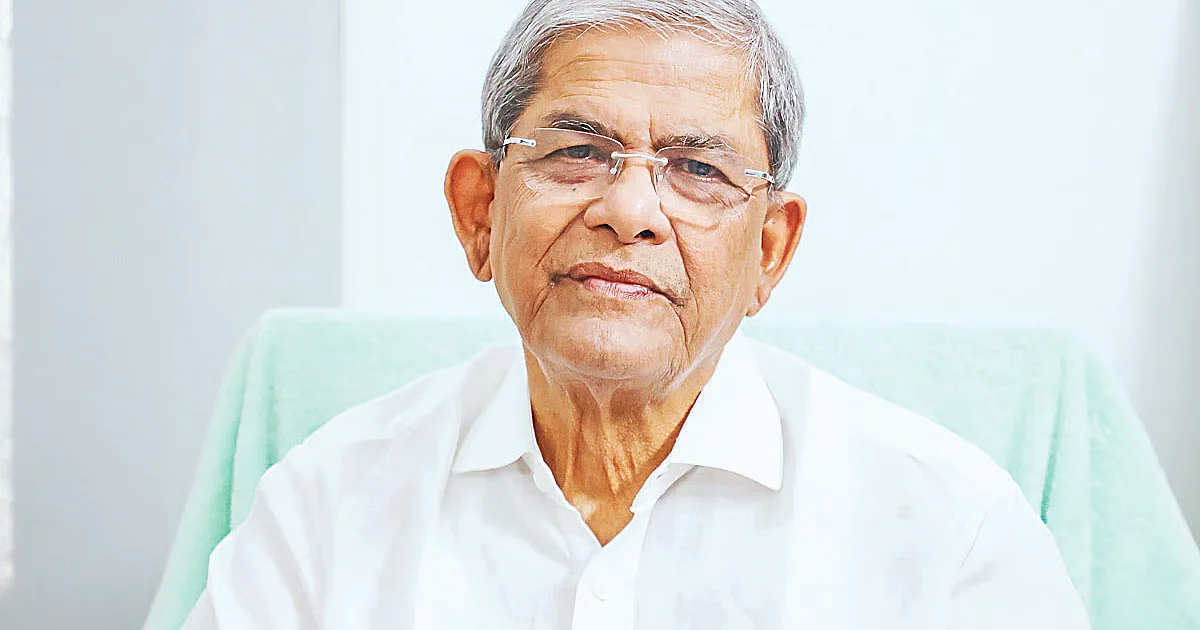
BNP Secretary General Mirza Fakhrul Islam Alamgir File photo

Prothom Alo : You’ve spoken of the BNP’s long struggle against the Awami League, and you also emphasised the youth’s role. But now, as we mark one year since the mass uprising, we’re seeing serious divisions among the parties that took part in it. Why is that?

Mirza Fakhrul Islam Alamgir:
There are reasons for this. We are a political party with long-standing experience — in movements, in elections, and in governance. We have responsibilities when it comes to forming a government and running the country. As you know, the reform proposal — who brought it forward? It was we. In 2016, we declared our “Vision 2030.” These experience-based ideas we bring forward — the new parties are struggling to accept them.

And those who are speaking the loudest — many are older political parties — are also attacking the BNP. I think this is a tactic. They believe that by criticising the BNP, they can secure a spot in Parliament as the main opposition. When elections approach, this sort of positioning happens. Now that the government is neutral — and I have to say that — they have started speaking against BNP. I don’t see this as a major problem. If we continue talking through the National Consensus Commission, these issues will be resolved — the reform matters will be settled. All of this can be worked out within a month.

Prothom Alo : Do you think this division is making it easier for the ousted authoritarian Awami League to return?

Mirza Fakhrul Islam Alamgir:
Absolutely not. I believe common sense and goodwill will prevail among everyone. This division won’t reach a point of no return, nor will it create a path for the return of the fascist Awami League. But yes, everyone must remain vigilant, and all sides have to play their part to ensure that we don’t get to that point.

1753579108153.webp

BNP Secretary General Mirza Fakhrul Islam Alamgir File photo

Prothom Alo : There is a lot of debate surrounding the issue of reforms, and political parties are blaming each other. Yet it was the BNP that first proposed a 27-point reform agenda, which was later expanded to 31 points. However, there seems to be disagreement on some constitutional reform issues, particularly regarding the balance of power. Why is that?

Mirza Fakhrul Islam Alamgir:
The disagreements are mainly about proposals coming from the commission and from other parties. Apart from a few issues, we’ve reached consensus on most points. But there are some matters we believe are not practical or feasible. For example, there’s an ongoing objection about holding direct elections for women's seats. If a female candidate has to cover three constituencies, that seems impossible to us.

Another issue is the election to the upper house (second chamber), which some want to be based on proportional representation (PR). We believe that, based on our experience, it should follow the previous system. These matters can be resolved through dialogue.

Prothom Alo : In this context, some parties are saying they will not participate in elections without full reforms. The BNP has said it will go forward with reforms where consensus exists for now, and that key constitutional reforms will be undertaken by the elected government later. However, some argue that the mass uprising wasn’t just for an election or a change of power. How do you view this?

Mirza Fakhrul Islam Alamgir:
There is a mistaken narrative being pushed — that the movement was solely about changing power or that the BNP moved just for that purpose. But we were the first to speak about changing the structure of the state. So how can anyone accuse us of being unwilling to pursue change?

Some individuals and a few media outlets — very few, actually — simply don’t like the BNP, and the reason is purely political. BNP is a fully nationalist and liberal democratic party. We believe in the power of the people and their mandate. A parliament elected by the people should govern the country, pass laws, and amend the Constitution. Reforms should come through parliament. Now, if someone tries to forcefully impose things outside of this process, it won’t be acceptable to the public.

Prothom Alo : Your 31-point agenda includes a promise to form a national government. But after the change in power on 5 August, leaders of the anti-discrimination student movement proposed forming a national government led by Professor Muhammad Yunus, with BNP as part of it. Why didn’t the BNP agree?

Mirza Fakhrul Islam Alamgir:
After 5 August, either on that very day or the day after, we did not meet any of the leaders from the anti-discrimination student movement. We never received such a proposal. It did not come from the students; it may have come from other quarters. But the students themselves did not make such a proposal for forming a national government.

Prothom Alo : Then why didn’t the BNP accept the proposal that came from other quarters?

Mirza Fakhrul Islam Alamgir:
Based on our experience, in a situation where decisions need to be made every moment, forming a national government wouldn't have worked. I still believe such a government wouldn’t have lasted even seven days. Everyone would have had their own agenda. It wouldn’t have held together.

Prothom Alo : You’ve said that the murder of scrap trader Lal Chand (Sohag) in Old Dhaka is being used by certain quarters as a pretext to disrupt the election environment. Why do you think that?

Mirza Fakhrul Islam Alamgir:
I think that because if you closely observe the situation across the country, you’ll notice that killings have suddenly increased. We’ve received reports that certain groups are trying to disrupt or delay the election — they don’t want it to take place. Why are people forgetting that the ousted fascist Hasina is currently in India, sitting silently? She’s doing everything she can to create instability in Bangladesh.

Dr. Yunus knows this very well, and so do the intelligence agencies. There are plans for a major incident. They are trying to ruin the political situation in Bangladesh. That’s why we all must proceed with caution.

What happened in Mitford was absolutely horrific. But think about it — is this the first time such an incident has happened? Now BNP is being accused. But the victim was also connected to BNP. The party only acknowledges those who are active members. In past incidents like this, we have taken swift disciplinary action.

I say this because it looks like a deliberate setup — a plot to create a situation that would disrupt the election and prevent the return of a democratic environment.

Prothom Alo : So far, your party has taken organisational action against nearly 7,000 leaders and workers. Even so, why can’t the party control its criminally inclined members?

Mirza Fakhrul Islam Alamgir:
Let me clarify — is everyone in BNP? Criminals and extortionists are a separate group. They join parties when it suits them. From the beginning, there’s been a trend of people trying to exploit the shelter of the ruling party to commit wrongdoing. But we are not in government — we only have the possibility of going into government. These things should be under state control — this is the failure of the government, not ours. We are not in power.
We are clearly saying: whoever is found to be involved in wrongdoing, take action against them. We support it.

To be continued...............​
 

Attachments

  • 1753579007666.webp
    1753579007666.webp
    36.1 KB · Views: 93
  • 1753579007276.webp
    1753579007276.webp
    111 KB · Views: 84
  • 1753579137558.webp
    1753579137558.webp
    15.8 KB · Views: 75
Prothom Alo : Following the murder of Lal Chand, some indecent slogans about BNP and Tarique Rahman have been seen on social media. What do you think is the purpose behind this?

Mirza Fakhrul Islam Alamgir:
It proves that Tarique Rahman has now emerged as the number one political figure in Bangladesh. He is seen as the future leader. Public opinion has been formed in this regard, especially after the meeting between Tarique Rahman and the Chief Adviser, and the rare joint statement that followed. It clearly upset and infuriated certain opposition quarters. Those who do not want to see a stable government or a democratic transition in Bangladesh are using these moments as opportunities. Just look at the slogans being chanted—they are clearly intended to malign him personally. These have no place in civilised discourse. Can such slogans come from a political party with a mission?

View attachment 20659
BNP Acting Chairman Tarique Rahman File photo

Prothom Alo: How much impact do you think this will have?

Mirza Fakhrul Islam Alamgir:
It will pass.

Prothom Alo: You mentioned the London meeting. But no details have been disclosed from the BNP side. There are speculations and doubts about it in different circles.
Mirza Fakhrul Islam Alamgir:
There is no reason for doubt. Two top leaders sat together to discuss the country's future. They may have discussed how to resolve future crises—the economic situation, the political climate, social conditions, and the debt burden from various mega projects. It’s only natural that two top leaders would discuss about the country when they meet. They also discussed when a logical timeframe for the election would be. The meeting took place in a very cordial atmosphere. Our leader has shown that he is a statesman—he held the right meeting at the right time and played the role a statesman should play for the nation.

Prothom Alo: You recently said at an event that the election must be held in February. Is there any uncertainty regarding the election?

Mirza Fakhrul Islam Alamgir:
Certainly. Given the current developments, a certain group is trying hard… even they are openly declaring that they won’t allow the election to take place. That creates doubt, of course.

Prothom Alo: Suppose the election is held on time, but the Awami League is not on the field because its political activities have been banned. That would leave BNP as the only major party in the race. Wouldn’t that make the election one-sided?
Mirza Fakhrul Islam Alamgir:
Why? There is a large opposition bloc. Jamaat-e-Islami is there, NCP is there, and the neo national leader, the Pir of Charmonai, is also there. What’s the problem? If they participate and the people vote for them, they’ll win. If they form the government, I will accept it.

Prothom Alo: But none of these parties have been proven as major political forces in elections.
Mirza Fakhrul Islam Alamgir:
Jamaat-e-Islami was in Parliament, right? Anyway, those who come forward will form alliances and grow larger.

Prothom Alo: Does this mean that after the end of the Awami League’s long authoritarian rule, we are going to see a rise of the right-wing in national politics? Some analysts have suggested this. What’s your view?
Mirza Fakhrul Islam Alamgir:
I see that too—and I’m concerned. I’ve always wanted to see Bangladesh as a truly liberal democratic state, where democracy is the highest principle. If political forces rise that openly declare they do not believe in democracy and try to impose their ideologies by force—that is undoubtedly an alarming situation. Some of these parties even oppose women’s empowerment—not just political empowerment, but even social inclusion. If such parties rise in the country, there would be no alternative than backsliding.

Prothom Alo: You often used to say during the Awami League regime that suppressing dissent and denying democratic rights could lead to a rise in extremism. After the shift in power on 5 August, we are now seeing early signs of such a rise. Who do you hold responsible?
Mirza Fakhrul Islam Alamgir:
The full responsibility lies with the Awami League. Sheikh Hasina is the number one person to blame. We repeatedly warned her and the government not to completely eliminate a centrist democratic party like the BNP. If you do, there will inevitably be a rise in the far-right—and no one will be able to stop it. That’s exactly what we are now seeing.

Prothom Alo: You also used to say that the Awami League has hollowed out the economy. Now the current government is taking action against 11 business groups accused of looting banks and financial institutions during that time. What would the BNP do about them if it comes to power?
Mirza Fakhrul Islam Alamgir:
We will 100 per cent take punitive action against them. Those who destroyed the economy and laundered the nation's wealth abroad—those who looted banks and siphoned off funds—can never be forgiven. We must recover that money. That would be one of our major tasks if elected. The banking sector is somewhat under control now, but we need to make sure it becomes fully stable. A proper system should be in place so that any genuine businessperson can access financial services without hassle.

View attachment 20655
BNP secretary general Mirza Fakhrul Islam Alamgir speaks to journalists after a meeting with the United Nations Secretary-General António Guterres in Dhaka on 15 March 2025.Suvra Kanti Das

Prothom Alo: Mirza Fakhrul Islam AlamgirYou talk about elections almost daily. What kind of preparations is BNP making for the polls?

Mirza Fakhrul Islam Alamgir:
We are going directly to the people, which is our ultimate ground. We are presenting our 31-point agenda to the public. If elected, we will implement these. Our top priority will be creating employment opportunities for the unemployed and developing a skilled workforce.

Prothom Alo: Is there any concrete homework being done on this?
Mirza Fakhrul Islam Alamgir:
Absolutely. A lot of work is underway. Our teams are working diligently.

Prothom Alo: Is the candidate selection process ongoing?
Mirza Fakhrul Islam Alamgir:
We are conducting surveys and gathering input. We’ll give the highest priority to those favored by our grassroots leaders. Surveys are being carried out, and final interviews will be held by our nomination board.

Prothom Alo: How many seats will be allocated to allies from the simultaneous movement?
Mirza Fakhrul Islam Alamgir:
We haven’t finalised that discussion yet. But we want all partners in the simultaneous movement to stay with us, and we will be sincere in ensuring that.

Prothom Alo: In the National Consensus Commission's dialogue on reforms, some allied parties expressed disagreement with the BNP. How do you see this?
Mirza Fakhrul Islam Alamgir:
That’s part of democratic practice. Some parties believe in Marxism or socialism. Even while drafting the 31-point agenda, they said they didn’t agree on every issue. That’s okay. We united against Awami League’s fascism and agreed to form a government together. Our sincerity has never been in question—we’ve proven it, and we continue to prove it.

Prothom Alo: If BNP is elected and forms a government, what kind of governance will it offer the nation?
Mirza Fakhrul Islam Alamgir:
It would be unrealistic to describe in detail what kind of government it will be at this moment. But one thing is clear—our first priorities will be creating employment and stabilising the economy. At the same time, we will work to strengthen the political structure. The reforms proposed by the National Consensus Commission, along with the remaining necessary ones, will be brought before the people. Our aim is to truly transform Bangladesh into a modern democratic state.

View attachment 20656
Dhaka city north and south units of the BNP organise a rally in protest against continuous conspiratorial lies and negative propaganda about BNP acting chairman Tarique Rahman and on demand of exemplary punishment for the brutal killing near Mitford Hospital Prothom Alo

Prothom Alo: Given the current global crisis and shifting geopolitical landscape, how prepared is BNP to deal with these challenges, especially when your top leader Khaleda Zia is seriously ill and the second-in-command, Tarique Rahman, remains abroad?
Mirza Fakhrul Islam Alamgir:
Our leader is very much present in spirit. We have faced no crisis so far. We’ve always had the full support and guidance of Begum Khaleda Zia. Tarique Rahman has been leading the party from London, and we have operated under his direction. There is no crisis in this regard.

Prothom Alo: There have been several recent incidents—the violence in Gopalganj, the tragic aircraft crash at Milestone School, and the student protests and vandalism at the Secretariat. Following these, the Chief Adviser held meetings with political parties. How do you view the overall situation?
Mirza Fakhrul Islam Alamgir:
Some of these incidents suggest a deliberate attempt by a fascist force to destabilise the country and create chaos. Unfortunately, due to the government's inexperience and weakness, these crises have intensified.

The Gopalganj incident, in particular, seems premeditated. The failure of state intelligence agencies is evident there. The crash at Milestone School was a heartbreaking tragedy. The government’s response after the incident could have been more visible and effective. It would have been better if the advisers had visited the site and taken more initiative. The Secretariat unrest also indicates the failure of law enforcement and intelligence agencies.

Overall, I don’t see anything positive. On top of that, the new US tariffs on Bangladeshi exports signal a looming crisis. The government should have responded quickly and engaged with the business community. Tariff hikes will impact multiple sectors. We believe the solution lies in holding elections promptly and forming an elected government with a public mandate. That would be in the best interest of the nation.

Prothom Alo: How crucial is Tarique Rahman’s physical presence during this time?
Mirza Fakhrul Islam Alamgir:
Extremely crucial.

Prothom Alo: Then why hasn’t he returned yet? You often say he will come soon. Is there a timeline?
Mirza Fakhrul Islam Alamgir:
No timeline has been set yet. One of his legal cases is still pending. Once that case reaches a conclusion, we hope he’ll return soon.

Prothom Alo: Which case is that?
Mirza Fakhrul Islam AlamgirI:
t’s probably the 21 August grenade attack case.

Prothom Alo: Thank you for your time.
Mirza Fakhrul Islam Alamgir:
Thank you too.​
 

Curbing executive power will disrupt governance: Salahuddin Ahmed
The BNP leader stated that his party was extending full cooperation with the initiatives of the interim government in the move to amend the constitution to ensure that autocracy or fascism can never return to the country.

Staff Correspondent Dhaka
Published: 28 Jul 2025, 21: 40

1753751378172.webp

BNP standing committee member Salahuddin Ahmed talks to the media on 28 July 2025 Prothom Alo

Bangladesh Nationalist Party (BNP) standing committee member Salahuddin Ahmed has warned that weakening the executive branch’s authority would upset the balance required to govern the state effectively.

He made the remark on Monday during the 20th day of the second phase of the National Consensus Commission’s dialogue with political parties, held at the Foreign Service Academy in Dhaka.

Salahuddin temporarily walked out of the dialogue but later rejoined the discussion.

The BNP leader stated that his party was extending full cooperation with the initiatives of the interim government in the move to amend the constitution to ensure that autocracy or fascism can never return to the country.

“It was we who proposed that no one should serve more than 10 years as prime minister, and that proposal has been accepted. We also proposed that a neutral search committee, comprising representatives from the ruling party, the opposition, and the judiciary, be formed to appoint the election commission. This has also been accepted,” he stated.

The BNP did not participate in discussions on the Commission’s proposals regarding appointments to the Public Service Commission, Anti-Corruption Commission, Comptroller and Auditor General, and the Ombudsman.

Salahuddin further said, “We have also proposed that if the caretaker government system is reinstated, any amendment passed later by parliament must go to a referendum before being approved by the president. The acceptance of this proposal is a major step toward ensuring political stability in the country’s future.”

Despite this progress, the BNP standing committee member expressed concerns over proposals to curtail the executive’s authority.

“The executive branch must be accountable—both to parliament and to the people. But if it is given responsibility and accountability without the authority to act, then it will not be sufficient for effective governance,” he observed.

He cautioned that tying the hands of the executive in appointing constitutional and statutory bodies could hinder future governance. “To meet public expectations, the executive must be empowered, not weakened.”

The BNP representative stressed that their party was participating in the dialogue with constructive intent. But he also noted that choosing not to participate, or expressing dissent where there is fundamental disagreement, is also a part of democratic expression.

Salahuddin Ahmed expressed, “No one has claimed that unanimity on every issue will be established. Dissent and differing opinions are part of the democratic struggle.”

He further said, “We do not believe anyone should be forced into consensus through a note of dissent. True consensus means moving forward together. There also remains the question, without the BNP’s participation, how can national consensus be truly established?”

He concluded by affirming that BNP will continue to engage in future rounds of the dialogue and remain open to meaningful discussion.

BNP walks out

The BNP did not participate in discussions on the Commission’s proposals regarding appointments to the Public Service Commission, Anti-Corruption Commission, Comptroller and Auditor General, and the Ombudsman.

National Consensus Commission’s vice-chair Professor Ali Riaz introduced the topic for discussion after 11:30 am. At that time, Salahuddin Ahmed stated that the BNP would not join that portion of the discussion.

Ali Riaz later said, “The BNP has conveyed they will not participate in this discussion. I cannot decide that there won’t be any discussion if a political party does not participate.”

Today’s session included participation from 30 political parties, including BNP, Jamaat-e-Islami, NCP, Islami Andolan Bangladesh, Communist Party of Bangladesh (CPB), and Ganosamhati Andolan.

Ali Riaz chaired the session that was moderated by Monir Haider, special assistant to the Chief Adviser.

Badiul Alam Majumdar, Emdadul Haque, Sofor Raj Hossain, Iftekharuzzaman, and Ayub Miah joined the discussion.​