
 Bangladesh Defense
Saif
Senior Member
- Jan 24, 2024
- 21,435
- 9,743
- Nation

- Residence
- Axis Group

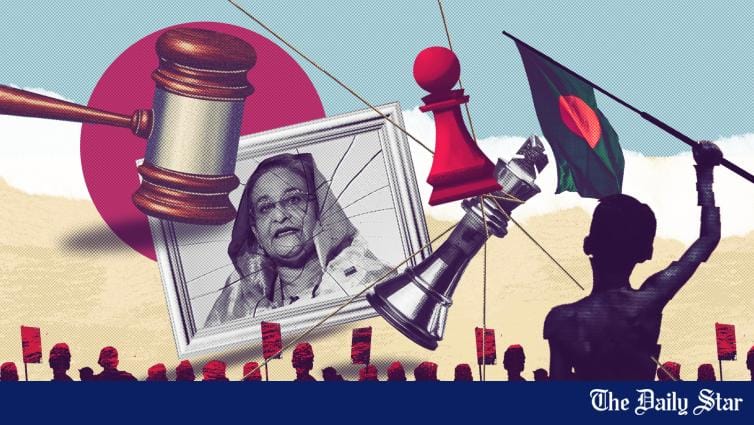
Before Hasina lost in the court of law, she had lost in the court of the people
Her reputation lies in ruins and her political career buried under a mountain of debris of self-righteous arrogance, misgovernance, and impunity
Before Hasina lost in the court of law, she had lost in the court of the people

VISUAL: ANWAR SOHEL
Let legal experts discuss the strengths and weaknesses of the ICT trial and verdict. Our focus will be on the fact that Sheikh Hasina's political demise had already occurred, and the "guilty verdict" was pronounced by the people, especially the younger generation, much earlier, during the tumultuous days of July-August 2024.
The future is always unpredictable, but as of now, her reputation lies in ruins and her political career buried under a mountain of debris of self-righteous arrogance, misgovernance, and impunity. Whatever may be Awami League's narrative about the national or international conspiracy behind Sheikh Hasina's fall, the fact is that the "death sentence" by the ICT was brought on by her own cruel suppression of political dissent, abuse of the law, corruption, partisan administration, bank looting, money laundering, suppression of independent media houses and corruption of the compliant ones, and finally, the killing of 1,400 citizens including children to stay in power during the last few weeks of her rule. Over the years, enforced disappearance and extra-judicial killings became the hallmark of her regime. Yes, there were some vital infrastructural developments, increase in per capita income, and growth in many social indicators, but the credit for them was swept aside by her destruction of democracy and overwhelming dictatorial rule.
Google News LinkFor all latest news, follow The Daily Star's Google News channel.
Eventually, Hasina's public acceptance totally collapsed, and hatred for her skyrocketed and the "death sentence" in the people's court was passed due to the killings on the streets, as mentioned above. What distinguishes her rule from that of many dictators and autocrats is that very few of them killed so many unarmed protesters in so short a time.
It is to Sheikh Hasina's credit that she was able to revive, reorganise, rejuvenate, and re-inspire Awami League (AL) to win elections in 1996 after 21 years out of power. Her first stint in office, especially the signing of the Chittagong Hill Tracts Accord (which she herself did not implement) and the Ganges Water Sharing Treaty, marked a new beginning for AL. But over the years, she effectively demolished her own party as she destroyed the police, the bureaucracy, the judiciary, etc—transforming it from a political powerhouse into an apparatus of extortion, corruption, and violence, and replacing ideology with sycophancy, principles with praise for the leader, and service to the people with service to themselves. Every nomination was for sale, most promotions within the party ranks came for a bribe, and every development project was treated as their plaything. BUET student Abrar Fahad's torture and murder by Chhatra League was testimony to how the AL's student body was turned into a murderous gang.
She did not take well either of her electoral defeats in 1991 and 2001. Her view that AL could never be defeated in a free and fair election, but only through rigged ones, partly made her reject these results, inventing the term "subtle-rigging." This marked the beginning of the arrogance and myopia that led her towards ignoring the truth and making massive blunders. A miraculous escape from a near-fatal attempt on her life in August 2004, in which 24 AL workers and leaders were killed, with no credible attempt by the then BNP government to investigate the grenade attack and punish the perpetrators, probably convinced Hasina that she would always be vulnerable as an opposition politician, and thus she may have decided never to give up power if and when she regained it. This, in our view, killed the prospect of democracy in Bangladesh.
Hasina regained power in a free and fair election in 2008, abolished the caretaker system in 2011, and then manipulated all the following elections held in 2014, 2018 and 2024. As her manipulations succeeded, she grew over-confident and felt that all her political allies were her pawns, all opponents manipulatable, and all dissenting voices easily suppressed. She became entrapped in the mindset of never admitting any mistakes, which resulted in her becoming supremely arrogant. During a meeting with editors in 2013, I heard her say: "In spite of so many attempts on my life, Allah has kept me alive for the purpose of carrying out His will. So, you all may write anything you like. I don't care." She felt she was divinely guided and, as such, had nothing to worry about. Thus, she plunged deeper into isolation on the one hand and became further intolerant on the other, both of which distanced her from the people and her party.
Changing the constitution to do away with the caretaker government system to oversee elections gave the first clear signal of Hasina's intention to take over the process of holding national elections. It was crystal clear that the 2014 election was openly and shamelessly manipulated. We have written before—but it deserves to be repeated—that out of 300 seats in parliament, 153 had only one contestant as others withdrew "voluntarily." The Election Commission, therefore, declared "elected" the only contestant there was, who happened to belong to the AL. Thus, in the 2014 election, before a single vote was cast, AL gained the majority in parliament to form a government. It was the most blatant, undemocratic, and immoral tinkering with elections ever. Could that have happened without the sitting prime minister (PM) and the party chief's direct involvement?
The fact that Sheikh Hasina's government was able to get away with such electoral frauds—marking a failure on the part of the BNP to make an effective protest—gave her and her sycophants a dangerous but ultimately illusory confidence that led them to repeat this manipulation in the 2018 and 2024 elections, thereby digging its own grave, into which it fell in July-August 2024.
The Covid pandemic during 2020-2022 isolated her from her party and the people. The day-to-day functioning of the administration became an unthinking ritual. This was followed by the ostentatious observance of Bangabandhu's birth centenary, which greatly offended the conscientious section of civil society and the public in general. It became clear that people's urgent needs had no place in the PM's mind; instead, creating an infallible personality cult was where her government placed all its attention and resources.
Hasina totally misread the national psyche, which is fundamentally averse to individual cultism. Dubious authors wrote thousands of books that the government bought at exorbitant prices, which, in fact, became a way of siphoning off public money to corrupt bureaucrats, teachers and so-called professionals, all of whom were in an undeclared competition to curry favour with the AL leadership and, of course, make some money in the process. The birth centenary celebration did not produce a single well-researched or intellectually honest account of the leader of our independence movement, but instead flooded schools, colleges, universities and all institutions linked with education with substandard publications not worth even the paper they were written on. The hundreds of statues built—a culture previously almost non-existent in Bangladesh—greatly damaged Bangabandhu's reputation instead of increasing authentic learning about him, eventually becoming targets when the anti-government rebellion started. The first time I saw his statue near the PMO in Dhaka, the image of Saddam Hussein's being demolished and dragged through the street flashed through my mind, and I intuitively felt that our people would reject it at the first opportunity they would get.
This was followed by the 50th anniversary celebration of Bangladesh's liberation in 2021. Hasina celebrated this crucial occasion as a continuation of Bangabandhu's birth centenary. Freedom fighters were horrified to see how little tribute was paid to them and how their stories of sacrifice, bravery, and patriotism remained untold. The members of the armed forces who rebelled against the Pakistani rulers in 1971 and played the most crucial role in galvanising young freedom fighters into an effective fighting force hardly received any focus. The crucial role of declaring independence played by Major Ziaur Rahman was not even remotely mentioned, as was the role of Colonel M.A.G. Osmani (the chief of the Liberation War army) and other sector commanders. The significance and central role of the government-in-exile led by Tajuddin Ahmad did not receive much attention. Once again, everything converged on one man. Freedom fighters still alive, and the family members of those killed during the war, felt insulted.
Just to cite another example of arrogance and lack of foresight, Hasina forced every government office, every semi-government institution, universities both public and private, NGOs, banks, airports, etc, to open what was called a "Mujib corner" to display photos and books—mostly substandard ones—on him. If instead she had set up "Muktijoddha corners"—which would have been most appropriate at that moment—and filled them with books on the Liberation War, our people in general, and the younger generation in particular, would have been far better informed about that glorious moment in our history. The truth is that Hasina's government was in power for 15 consecutive years and did virtually nothing to raise public awareness about our freedom struggle; she turned it into Mujib worship that only served to create a sense of disgust and alienation.
By 2022, Hasina had reached the height of arrogance. "I know everything," "Every critic is an enemy," "Whatever I do is best for Bangladesh," and similar statements dominated the political discourse. The sycophancy reached such absurd levels that her party leaders and workers started to believe that there were no problems their leader could not solve and no challenges she could not tackle. This allowed conniving party henchmen to try to outdo one another with ever cruder assertions of the leader's infallibility, creating a bubble of absurdities in which Hasina and her courtiers lived.
Hasina and her government's handling of the students' stance against the government quota system for jobs clearly showed the dysfunctionality to which her party and her government had descended. At one stage, she suddenly declared all quotas abolished, which went against constitutional guarantees for quotas for the physically and mentally challenged and ethnic minorities. So, the higher court threw it out. Thus, the demand lingered. At this stage, she could have held a dialogue with the demonstrators and resolved it. In July 2024, things turned violent, and since July 16, killings on the streets in large numbers began. The Daily Star's reporters counted bodies in government and private hospitals. By August 1, 2024, they tallied 201 dead bodies and spoke to hundreds of families who lost their loved ones. We headlined death counts every day that we could verify.
Hasina denies that she gave orders to fire lethal weapons on demonstrators—despite a plethora of proof—but then why did she not stop it once it began occurring? Each day's newspapers showed how many were killed the day before. If she is speaking the truth about not giving orders to kill, then why didn't she issue an instant order to stop the carnage? There is no way one can believe that firing on the streets would occur day after day for several weeks, and the PM would not know. She knew, and she had given the order. So, her direct involvement—and the doctrine of "command responsibility"—brings these cruel crimes to the doorstep of the PM, who ran her government with an iron hand.
Legalities aside, those who lived through those crucial days, witnessed the tragic incidents, reported on them, wrote on them, or warned and alerted the government about them, feel convinced that as the head of government, Sheikh Hasina is guilty of crimes against her own people.
Mahfuz Anam is the editor and publisher of The Daily Star.
VISUAL: ANWAR SOHEL
Let legal experts discuss the strengths and weaknesses of the ICT trial and verdict. Our focus will be on the fact that Sheikh Hasina's political demise had already occurred, and the "guilty verdict" was pronounced by the people, especially the younger generation, much earlier, during the tumultuous days of July-August 2024.
The future is always unpredictable, but as of now, her reputation lies in ruins and her political career buried under a mountain of debris of self-righteous arrogance, misgovernance, and impunity. Whatever may be Awami League's narrative about the national or international conspiracy behind Sheikh Hasina's fall, the fact is that the "death sentence" by the ICT was brought on by her own cruel suppression of political dissent, abuse of the law, corruption, partisan administration, bank looting, money laundering, suppression of independent media houses and corruption of the compliant ones, and finally, the killing of 1,400 citizens including children to stay in power during the last few weeks of her rule. Over the years, enforced disappearance and extra-judicial killings became the hallmark of her regime. Yes, there were some vital infrastructural developments, increase in per capita income, and growth in many social indicators, but the credit for them was swept aside by her destruction of democracy and overwhelming dictatorial rule.
Google News LinkFor all latest news, follow The Daily Star's Google News channel.
Eventually, Hasina's public acceptance totally collapsed, and hatred for her skyrocketed and the "death sentence" in the people's court was passed due to the killings on the streets, as mentioned above. What distinguishes her rule from that of many dictators and autocrats is that very few of them killed so many unarmed protesters in so short a time.
It is to Sheikh Hasina's credit that she was able to revive, reorganise, rejuvenate, and re-inspire Awami League (AL) to win elections in 1996 after 21 years out of power. Her first stint in office, especially the signing of the Chittagong Hill Tracts Accord (which she herself did not implement) and the Ganges Water Sharing Treaty, marked a new beginning for AL. But over the years, she effectively demolished her own party as she destroyed the police, the bureaucracy, the judiciary, etc—transforming it from a political powerhouse into an apparatus of extortion, corruption, and violence, and replacing ideology with sycophancy, principles with praise for the leader, and service to the people with service to themselves. Every nomination was for sale, most promotions within the party ranks came for a bribe, and every development project was treated as their plaything. BUET student Abrar Fahad's torture and murder by Chhatra League was testimony to how the AL's student body was turned into a murderous gang.
She did not take well either of her electoral defeats in 1991 and 2001. Her view that AL could never be defeated in a free and fair election, but only through rigged ones, partly made her reject these results, inventing the term "subtle-rigging." This marked the beginning of the arrogance and myopia that led her towards ignoring the truth and making massive blunders. A miraculous escape from a near-fatal attempt on her life in August 2004, in which 24 AL workers and leaders were killed, with no credible attempt by the then BNP government to investigate the grenade attack and punish the perpetrators, probably convinced Hasina that she would always be vulnerable as an opposition politician, and thus she may have decided never to give up power if and when she regained it. This, in our view, killed the prospect of democracy in Bangladesh.
Hasina regained power in a free and fair election in 2008, abolished the caretaker system in 2011, and then manipulated all the following elections held in 2014, 2018 and 2024. As her manipulations succeeded, she grew over-confident and felt that all her political allies were her pawns, all opponents manipulatable, and all dissenting voices easily suppressed. She became entrapped in the mindset of never admitting any mistakes, which resulted in her becoming supremely arrogant. During a meeting with editors in 2013, I heard her say: "In spite of so many attempts on my life, Allah has kept me alive for the purpose of carrying out His will. So, you all may write anything you like. I don't care." She felt she was divinely guided and, as such, had nothing to worry about. Thus, she plunged deeper into isolation on the one hand and became further intolerant on the other, both of which distanced her from the people and her party.
Changing the constitution to do away with the caretaker government system to oversee elections gave the first clear signal of Hasina's intention to take over the process of holding national elections. It was crystal clear that the 2014 election was openly and shamelessly manipulated. We have written before—but it deserves to be repeated—that out of 300 seats in parliament, 153 had only one contestant as others withdrew "voluntarily." The Election Commission, therefore, declared "elected" the only contestant there was, who happened to belong to the AL. Thus, in the 2014 election, before a single vote was cast, AL gained the majority in parliament to form a government. It was the most blatant, undemocratic, and immoral tinkering with elections ever. Could that have happened without the sitting prime minister (PM) and the party chief's direct involvement?
The fact that Sheikh Hasina's government was able to get away with such electoral frauds—marking a failure on the part of the BNP to make an effective protest—gave her and her sycophants a dangerous but ultimately illusory confidence that led them to repeat this manipulation in the 2018 and 2024 elections, thereby digging its own grave, into which it fell in July-August 2024.
The Covid pandemic during 2020-2022 isolated her from her party and the people. The day-to-day functioning of the administration became an unthinking ritual. This was followed by the ostentatious observance of Bangabandhu's birth centenary, which greatly offended the conscientious section of civil society and the public in general. It became clear that people's urgent needs had no place in the PM's mind; instead, creating an infallible personality cult was where her government placed all its attention and resources.
Hasina totally misread the national psyche, which is fundamentally averse to individual cultism. Dubious authors wrote thousands of books that the government bought at exorbitant prices, which, in fact, became a way of siphoning off public money to corrupt bureaucrats, teachers and so-called professionals, all of whom were in an undeclared competition to curry favour with the AL leadership and, of course, make some money in the process. The birth centenary celebration did not produce a single well-researched or intellectually honest account of the leader of our independence movement, but instead flooded schools, colleges, universities and all institutions linked with education with substandard publications not worth even the paper they were written on. The hundreds of statues built—a culture previously almost non-existent in Bangladesh—greatly damaged Bangabandhu's reputation instead of increasing authentic learning about him, eventually becoming targets when the anti-government rebellion started. The first time I saw his statue near the PMO in Dhaka, the image of Saddam Hussein's being demolished and dragged through the street flashed through my mind, and I intuitively felt that our people would reject it at the first opportunity they would get.
This was followed by the 50th anniversary celebration of Bangladesh's liberation in 2021. Hasina celebrated this crucial occasion as a continuation of Bangabandhu's birth centenary. Freedom fighters were horrified to see how little tribute was paid to them and how their stories of sacrifice, bravery, and patriotism remained untold. The members of the armed forces who rebelled against the Pakistani rulers in 1971 and played the most crucial role in galvanising young freedom fighters into an effective fighting force hardly received any focus. The crucial role of declaring independence played by Major Ziaur Rahman was not even remotely mentioned, as was the role of Colonel M.A.G. Osmani (the chief of the Liberation War army) and other sector commanders. The significance and central role of the government-in-exile led by Tajuddin Ahmad did not receive much attention. Once again, everything converged on one man. Freedom fighters still alive, and the family members of those killed during the war, felt insulted.
Just to cite another example of arrogance and lack of foresight, Hasina forced every government office, every semi-government institution, universities both public and private, NGOs, banks, airports, etc, to open what was called a "Mujib corner" to display photos and books—mostly substandard ones—on him. If instead she had set up "Muktijoddha corners"—which would have been most appropriate at that moment—and filled them with books on the Liberation War, our people in general, and the younger generation in particular, would have been far better informed about that glorious moment in our history. The truth is that Hasina's government was in power for 15 consecutive years and did virtually nothing to raise public awareness about our freedom struggle; she turned it into Mujib worship that only served to create a sense of disgust and alienation.
By 2022, Hasina had reached the height of arrogance. "I know everything," "Every critic is an enemy," "Whatever I do is best for Bangladesh," and similar statements dominated the political discourse. The sycophancy reached such absurd levels that her party leaders and workers started to believe that there were no problems their leader could not solve and no challenges she could not tackle. This allowed conniving party henchmen to try to outdo one another with ever cruder assertions of the leader's infallibility, creating a bubble of absurdities in which Hasina and her courtiers lived.
Hasina and her government's handling of the students' stance against the government quota system for jobs clearly showed the dysfunctionality to which her party and her government had descended. At one stage, she suddenly declared all quotas abolished, which went against constitutional guarantees for quotas for the physically and mentally challenged and ethnic minorities. So, the higher court threw it out. Thus, the demand lingered. At this stage, she could have held a dialogue with the demonstrators and resolved it. In July 2024, things turned violent, and since July 16, killings on the streets in large numbers began. The Daily Star's reporters counted bodies in government and private hospitals. By August 1, 2024, they tallied 201 dead bodies and spoke to hundreds of families who lost their loved ones. We headlined death counts every day that we could verify.
Hasina denies that she gave orders to fire lethal weapons on demonstrators—despite a plethora of proof—but then why did she not stop it once it began occurring? Each day's newspapers showed how many were killed the day before. If she is speaking the truth about not giving orders to kill, then why didn't she issue an instant order to stop the carnage? There is no way one can believe that firing on the streets would occur day after day for several weeks, and the PM would not know. She knew, and she had given the order. So, her direct involvement—and the doctrine of "command responsibility"—brings these cruel crimes to the doorstep of the PM, who ran her government with an iron hand.
Legalities aside, those who lived through those crucial days, witnessed the tragic incidents, reported on them, wrote on them, or warned and alerted the government about them, feel convinced that as the head of government, Sheikh Hasina is guilty of crimes against her own people.
Mahfuz Anam is the editor and publisher of The Daily Star.


