Bangladesh Defense

Saif
Senior Member
- Joined
- Jan 24, 2024
- Messages
- 22,387
- Likes
- 9,875
- Nation

- Axis Group


Govt effectively operating under 'America First' policy: Anu Muhammad
BNP, despite coming to power with the slogan 'Bangladesh First', is actually prioritising the interests of the United States over those of the country, claimed Professor Anu Muhammad. He stated, "Current Prime Minister Tarique Rahman has always stated—Bangladesh First. That’s how he started...
 en.prothomalo.com
Govt effectively operating under 'America First' policy: Anu Muhammad
Staff Correspondent
Dhaka
Published: 02 May 2026, 20: 04
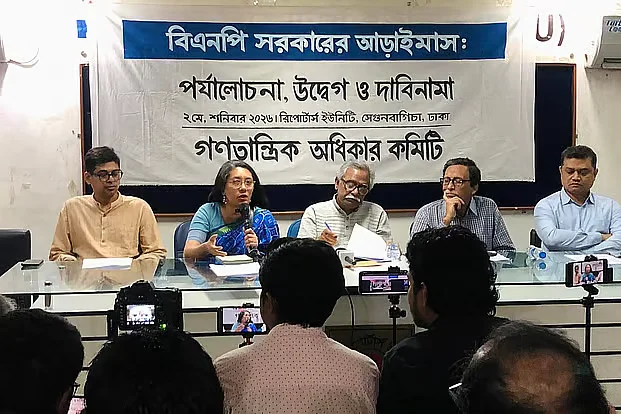
Speakers, including Anu Muhammad, at a discussion organised by the Committee for Democratic Rights at the Dhaka Reporters Unity on Saturday, presenting an evaluation of the BNP government’s two and a half months in office.Courtesy: Committee for Democratic Rights.
BNP, despite coming to power with the slogan 'Bangladesh First', is actually prioritising the interests of the United States over those of the country, claimed Professor Anu Muhammad.
He stated, "Current Prime Minister Tarique Rahman has always stated—Bangladesh First. That’s how he started, and on the first day of coming to Bangladesh, he said ‘Bangladesh First’. The agreement with the United States shows that the government is operating under the policy of 'United States First'."
Anu Muhammad made these remarks at a meeting organised by the Committee for Democratic Rights evaluating the two and a half months of the BNP government's work.
The meeting took place today, Saturday noon, at the Dhaka Reporters Unity, where he presided.
Referring to the trade agreement with the United States during the interim government and the subsequent deal to purchase 14 aircraft from the American company Boeing after BNP came to power, Anu Muhammad criticised both governments.
The former economics professor of Jahangirnagar University said that the interim government had begun implementing the agreement long before it was signed. During that time, a contract to import LNG from the United States was made. There were reports in the press that Petrobangla was unaware of the LNG imports. This agreement was made by the Chief Advisor's special assistant. At that time, there was also an understanding about purchasing aircraft that Biman was unaware of. Now, similar incidents are occurring during the time of the elected government.
He termed the trade agreement signed at the end of the interim government as an ‘unbelievable agreement against national interest''.
He claimed that besides the Chief Advisor at the time, Professor Muhammad Yunus, the then National Security Advisor Khalilur Rahman, and the Executive Chairman of the Board of Investment (BIDA), Ashik Chowdhury, were enthusiastic about signing the contract with the United States.
Referring to Khalilur Rahman being made the Foreign Minister in the BNP government and Ashik Chowdhury being retained in BIDA, Anu Muhammad said, action should be taken to investigate and punish those involved in the agreement. Instead, they have been given additional responsibilities.
Anu Muhammad demanded the publication of a white paper reviewing the activities of the interim government.
He criticised the current parties in Parliament for their silence on the trade agreement with the United States.
Anu Muhammad mentioned observing two tendencies in the current BNP government due to the activities of domestic and foreign lobbyists.
One is the amendment of production-sharing contracts in favour of companies, and the other is contemplating feasibility studies for open-pit coal mining.
Reminding of the agreement between the then BNP government and the protesting people following the Phulbari movement in 2006, he said, "It was stated in that agreement that there would be no open-pit mines in Bangladesh. While the rest of the world is moving away from coal, the Awami League government initiated import-oriented efforts by re-entering into coal. This government is walking the same path."
In 2006, locals took to the streets in protest over concerns of losing their homes due to initiatives to extract coal via open-pit methods in Dinajpur's Phulbari coal mine. The protest was supported by the left-leaning committee to Protect Oil, Gas, Natural Resources, and Power, of which Anu Muhammad was the member secretary.
The foreign company Asia Energy (now GCM) took an initiative for open-pit mining in Phulbari. On 26 August 2006, when the Committee to Protect Oil and Gas laid siege to Asia Energy's office in Phulbari, the law enforcement agencies fired, killing three people. The then BNP government quelled the situation by signing an agreement with the residents of Phulbari.
‘Efforts to establish control everywhere’
Anu Muhammad believes that like the Awami League, the current BNP government also wants to establish control over various state institutions.
He raised questions about whether aspects of revenge and retaliation are determining who will be arrested or taken away, held without trial, or detained under which law during the current government's time.
Criticising the use of the Anti-Terrorism Act to detain people, Anu Muhammad remarked that there are no signs of change in the law, judiciary, or anything else when compared to the use during Hasina's regime. The same continuity of culture is visible where ''when in power, we can do whatever we want''. The government is working to control everything, including the law and judiciary, to establish authority.
‘No immunity for the massacre during July uprising’
Referring to a statement by the Leader of the Opposition in National Parliament and Amir of Jamaat-e-Islami, Shafiqur Rahman, Anu Muhammad said that the leaders of the opposition party and Jamaat expressed anger that "why is there controversy over history, we have not come to hear tales of history..."
He stated that the Liberation War is not subject to stories and tales; it is a question of existence for Bangladesh. The Liberation War must be talked about. Progress cannot be made without resolving historical matters. The Liberation War, the 1990 and 24th uprisings, various people's struggles, and demands are crucial issues. Progress must be made through their examination, analysis, and discussion.
Opposing the suppression of these issues, Anu Muhammad said, everyone must fulfill and acknowledge their historical responsibilities; no one can be given immunity. Those involved in the genocide of 1971 and the 24th massacre—none will receive immunity. Everyone must take responsibility.
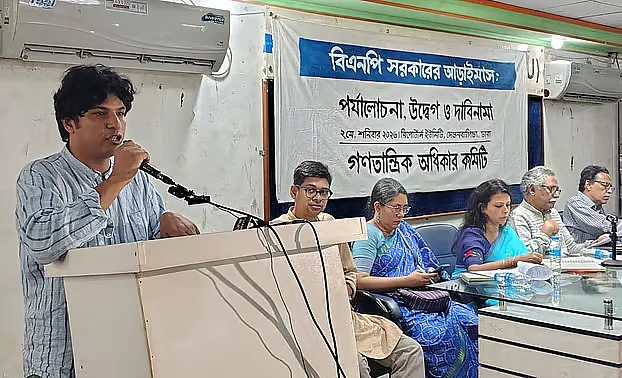
Speakers, including Anu Muhammad, at a discussion meeting organised by the Committee for Democratic Rights at the Dhaka Reporters Unity on Saturday, presenting an evaluation of the BNP government’s two and a half months in office.Committee for Democratic Rights Facebook page
13 points
At the beginning of the discussion titled ''Two and a Half Months of the BNP Government: Review, Concerns and Demands,'' Sajib Tanveer, a member of the Committee for Democratic Rights, and Shayedul Huq Nishan, President of the Democratic Students Council, read a concept paper.
It highlighted the committee's 13-point demand and recommendation regarding the ''mmediate actions'' needed by the government.
These demands by the Committee for Democratic Rights include—swift trials of individuals responsible for the July massacre and subsequent mob violence, murder, injury, vandalism, and arson; necessary democratic reforms in all areas, including the constitution, judiciary, and administration as per commitments; immediate measures to prevent attacks, vandalism, and destruction of religious places, shrines, archaeological heritage, sculptures, and various people's homes, and trial of those involved; necessary actions to lower the prices of essential goods and food products, including food, gas, electricity, and fuel oil; announcement of minimum national wages and formation of a commission to ensure nature- and farmer-friendly agricultural systems.
Additionally, formation of a commission to stop the commercialisation and mismanagement of education and to establish a unified education system; initiation of necessary reforms to establish healthcare and treatment as a constitutional right and ensure completely free medical services in public hospitals; announcement of a roadmap to withdraw military governance to create a democratic environment in the Chittagong Hill Tracts; assurance of equal property rights for women inherited by law and equal wages for equal work; formation of a specialised cell to prevent human trafficking and the oppression of Bangladeshi men and women abroad; and the publication of all agreements signed with India, the United States, China, Russia, the European Union, and Japan, alongside effective measures to nullify agreements against public interests.
Among others, writer and researcher Altaf Parvez, Professor Samina Luthfa of Dhaka University, Associate Professor Mosahida Sultana, Supreme Court lawyer Jyotirmoy Barua, and Manzur Al Matin spoke at the meeting.
Staff Correspondent
Dhaka
Published: 02 May 2026, 20: 04
Speakers, including Anu Muhammad, at a discussion organised by the Committee for Democratic Rights at the Dhaka Reporters Unity on Saturday, presenting an evaluation of the BNP government’s two and a half months in office.Courtesy: Committee for Democratic Rights.
BNP, despite coming to power with the slogan 'Bangladesh First', is actually prioritising the interests of the United States over those of the country, claimed Professor Anu Muhammad.
He stated, "Current Prime Minister Tarique Rahman has always stated—Bangladesh First. That’s how he started, and on the first day of coming to Bangladesh, he said ‘Bangladesh First’. The agreement with the United States shows that the government is operating under the policy of 'United States First'."
Anu Muhammad made these remarks at a meeting organised by the Committee for Democratic Rights evaluating the two and a half months of the BNP government's work.
The meeting took place today, Saturday noon, at the Dhaka Reporters Unity, where he presided.
Referring to the trade agreement with the United States during the interim government and the subsequent deal to purchase 14 aircraft from the American company Boeing after BNP came to power, Anu Muhammad criticised both governments.
The former economics professor of Jahangirnagar University said that the interim government had begun implementing the agreement long before it was signed. During that time, a contract to import LNG from the United States was made. There were reports in the press that Petrobangla was unaware of the LNG imports. This agreement was made by the Chief Advisor's special assistant. At that time, there was also an understanding about purchasing aircraft that Biman was unaware of. Now, similar incidents are occurring during the time of the elected government.
He termed the trade agreement signed at the end of the interim government as an ‘unbelievable agreement against national interest''.
He claimed that besides the Chief Advisor at the time, Professor Muhammad Yunus, the then National Security Advisor Khalilur Rahman, and the Executive Chairman of the Board of Investment (BIDA), Ashik Chowdhury, were enthusiastic about signing the contract with the United States.
Referring to Khalilur Rahman being made the Foreign Minister in the BNP government and Ashik Chowdhury being retained in BIDA, Anu Muhammad said, action should be taken to investigate and punish those involved in the agreement. Instead, they have been given additional responsibilities.
Anu Muhammad demanded the publication of a white paper reviewing the activities of the interim government.
He criticised the current parties in Parliament for their silence on the trade agreement with the United States.
Anu Muhammad mentioned observing two tendencies in the current BNP government due to the activities of domestic and foreign lobbyists.
One is the amendment of production-sharing contracts in favour of companies, and the other is contemplating feasibility studies for open-pit coal mining.
Reminding of the agreement between the then BNP government and the protesting people following the Phulbari movement in 2006, he said, "It was stated in that agreement that there would be no open-pit mines in Bangladesh. While the rest of the world is moving away from coal, the Awami League government initiated import-oriented efforts by re-entering into coal. This government is walking the same path."
In 2006, locals took to the streets in protest over concerns of losing their homes due to initiatives to extract coal via open-pit methods in Dinajpur's Phulbari coal mine. The protest was supported by the left-leaning committee to Protect Oil, Gas, Natural Resources, and Power, of which Anu Muhammad was the member secretary.
The foreign company Asia Energy (now GCM) took an initiative for open-pit mining in Phulbari. On 26 August 2006, when the Committee to Protect Oil and Gas laid siege to Asia Energy's office in Phulbari, the law enforcement agencies fired, killing three people. The then BNP government quelled the situation by signing an agreement with the residents of Phulbari.
‘Efforts to establish control everywhere’
Anu Muhammad believes that like the Awami League, the current BNP government also wants to establish control over various state institutions.
He raised questions about whether aspects of revenge and retaliation are determining who will be arrested or taken away, held without trial, or detained under which law during the current government's time.
Criticising the use of the Anti-Terrorism Act to detain people, Anu Muhammad remarked that there are no signs of change in the law, judiciary, or anything else when compared to the use during Hasina's regime. The same continuity of culture is visible where ''when in power, we can do whatever we want''. The government is working to control everything, including the law and judiciary, to establish authority.
‘No immunity for the massacre during July uprising’
Referring to a statement by the Leader of the Opposition in National Parliament and Amir of Jamaat-e-Islami, Shafiqur Rahman, Anu Muhammad said that the leaders of the opposition party and Jamaat expressed anger that "why is there controversy over history, we have not come to hear tales of history..."
He stated that the Liberation War is not subject to stories and tales; it is a question of existence for Bangladesh. The Liberation War must be talked about. Progress cannot be made without resolving historical matters. The Liberation War, the 1990 and 24th uprisings, various people's struggles, and demands are crucial issues. Progress must be made through their examination, analysis, and discussion.
Opposing the suppression of these issues, Anu Muhammad said, everyone must fulfill and acknowledge their historical responsibilities; no one can be given immunity. Those involved in the genocide of 1971 and the 24th massacre—none will receive immunity. Everyone must take responsibility.
Speakers, including Anu Muhammad, at a discussion meeting organised by the Committee for Democratic Rights at the Dhaka Reporters Unity on Saturday, presenting an evaluation of the BNP government’s two and a half months in office.Committee for Democratic Rights Facebook page
13 points
At the beginning of the discussion titled ''Two and a Half Months of the BNP Government: Review, Concerns and Demands,'' Sajib Tanveer, a member of the Committee for Democratic Rights, and Shayedul Huq Nishan, President of the Democratic Students Council, read a concept paper.
It highlighted the committee's 13-point demand and recommendation regarding the ''mmediate actions'' needed by the government.
These demands by the Committee for Democratic Rights include—swift trials of individuals responsible for the July massacre and subsequent mob violence, murder, injury, vandalism, and arson; necessary democratic reforms in all areas, including the constitution, judiciary, and administration as per commitments; immediate measures to prevent attacks, vandalism, and destruction of religious places, shrines, archaeological heritage, sculptures, and various people's homes, and trial of those involved; necessary actions to lower the prices of essential goods and food products, including food, gas, electricity, and fuel oil; announcement of minimum national wages and formation of a commission to ensure nature- and farmer-friendly agricultural systems.
Additionally, formation of a commission to stop the commercialisation and mismanagement of education and to establish a unified education system; initiation of necessary reforms to establish healthcare and treatment as a constitutional right and ensure completely free medical services in public hospitals; announcement of a roadmap to withdraw military governance to create a democratic environment in the Chittagong Hill Tracts; assurance of equal property rights for women inherited by law and equal wages for equal work; formation of a specialised cell to prevent human trafficking and the oppression of Bangladeshi men and women abroad; and the publication of all agreements signed with India, the United States, China, Russia, the European Union, and Japan, alongside effective measures to nullify agreements against public interests.
Among others, writer and researcher Altaf Parvez, Professor Samina Luthfa of Dhaka University, Associate Professor Mosahida Sultana, Supreme Court lawyer Jyotirmoy Barua, and Manzur Al Matin spoke at the meeting.