Home Watch Videos Wars Movies Login

[🇧🇩] Trump's Victory/Tariff/ Bangladesh

[🇧🇩] Trump's Victory/Tariff/ Bangladesh
216
6K
More threads by Saif

G Bangladesh Defense

Tariff weaponising by US, others concerning for Bangladesh: Rehman Sobhan
Staff Correspondent 25 February, 2025, 00:08

1740442370551.webp

Rehman Sobhan

Economist Rehman Sobhan on Monday said that the world of liberalisation and globalisation was now in retreat amid weaponising the tariff by powerful nations, causing concerns for Bangladesh.

‘Now tariffs and a whole variety of other economic and trade sanctions are being used as political instruments by particular countries which are really the powerful ones,’ he said while taking part in the first day of a two-day conference on the ‘Recommendations by the task force on re-strategising the economy’ in the capital Dhaka.

Arranged by the Centre for Policy Dialogue and the 12-member task force, the inaugural session titled ‘Strategic policy realignment to boost investment and achieve export’ was, among others, participated by commerce adviser Sk Bashir Uddin and former commerce minister Amir Khosru Mahmud Chowdhury.

Moderated by task force chief KAS Murshid, keynotes were presented by task force members Selim Raihan and Mohammad A Razzaque at the session with calls for implementing the task force’s recommendations aiming at further trade liberalisation.

Rehman Sobhan, however, said that bilateral deals with countries from the European Union countries to the United States to China to India were going to determine the new trading regime that had to be dealt with carefully by Bangladesh.

He observed that the US might put a 30 per cent tariff on China before cutting it to 10 per cent on the back of political deal.

He said that reform proposals should be based on ability of the government bodies to operationalise and activate those.

While highlighting the major reform proposals of the task force, Murshid identified the lack of implementation capacity as a major problem.

He was surprised when the commerce adviser during his speech said he was yet to receive a copy of the task force report.

The task force, formed on September 10 past year, submitted strategies to boost the economy and mobilise resources for equitable and sustainable development on January 30.

The commerce adviser criticised the ousted Awami League regime, saying that every sector of the economy had been criminalised in the past decade.

‘Unnecessary projects and money laundering caused a significant damage to the country’s economy,’ he said, adding that manufacturing raw materials for the readymade garment sector could ensure the much needed diversification of the sector.

Amir Khosru Mahmud Chowdhury said that he supported liberalisation of trade policy and easing doing business without which Bangladesh could not go forward.

‘We will go for deregulation,’ he said adding that the economic diplomacy should be given priority.

Economist Mustafizur Rahman and Foreign Investors’ Chamber of Commerce and Industry president Zaved Akhtar, among others, took part in the discussion.​
 
Analyze

Analyze Post

Add your ideas here:
Highlight Cite Respond

$29m USAID funding: Foreign ministry refutes Trump’s claim

1741045752101.webp


US President Donald Trump's allegation that USAID provided $29 million to an organisation owned by two persons in Bangladesh is not true, said the Ministry of Foreign Affairs yesterday.

"Such projects are executed under the Development Objective Assistance Agreement (DOAG) between Bangladesh and the US, ensuring no individual influence in the decision-making process," it said in a statement.

Addressing the White House Governors Working Session on February 20, Trump claimed that the $29 million USAID fund landed with an obscure firm that he said was "a little outfit" with just two employees.

"Two people! They're very happy. Very rich. They'll be on the cover of a top business magazine -- for being great scammers," quipped the US president.

At another event on February 21, Trump again accused the agency of funneling $29 million to prop up a "radical left communist" in Bangladesh – triggering question among public mind.

Following that, the foreign ministry investigated the matter and issued the statement.

It said a USAID-funded project in Bangladesh -- Strengthening Political Landscape (SPL) -- was implemented with a budget of $29 million.

During President Trump's first term, USAID selected Democracy International (DI), a US-registered organisation -- to implement the project. Multiple international organisations participated in a competitive bidding process, and USAID made its decision transparently. The contract was signed in March 2017, and DI subsequently began implementation. The project duration was later extended, with funds disbursed in phases.

Initially, SPL was a five-year project with a budget of $14 million. It was managed by USAID and co-funded by the UK's development agency DFID (now FCDO), which committed $10 million.

The project aimed to reduce political violence, foster peaceful coexistence among political parties, enhance their capacities, improve internal democratic practices, and promote representative leadership. DI also conducted survey activities in Bangladesh under the project.

The statement said USAID projects are subject to strict US government financial management policies, including rigorous auditing and record-keeping for years after completion. If necessary, re-audits are conducted.

The investigation confirms that DI implemented the SPL project in Bangladesh during President Trump's first term, and the claim that the project was awarded to a privately owned Bangladeshi organisation is false.​
 
Analyze

Analyze Post

Add your ideas here:
Highlight Cite Respond

Bangladesh faces 37% US tariff under new Trump trade policy

1743639987840.webp


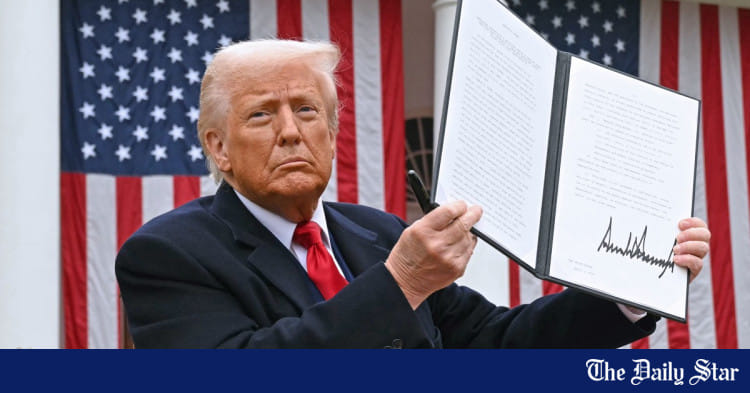
US President Donald Trump holds a signed executive order after delivering remarks on reciprocal tariffs during an event in the Rose Garden entitled "Make America Wealthy Again" at the White House in Washington, DC, on April 2, 2025. Photo: AFP

The United States has announced a 37 percent tariff on imports from Bangladesh as part of President Donald Trump's sweeping new "Reciprocal Tariffs" policy.

According to a chart published by the White House today, the US government claims Bangladesh effectively imposes a 74 percent tariff on American goods. In response, a 37 percent "discounted reciprocal tariff" will now be levied on Bangladeshi products entering the US market.

The move, part of Trump's "Liberation Day" initiative, aims to counter what his administration describes as unfair trade practices by countries that maintain high barriers against US exports. The policy introduces a baseline 10 percent tariff on all imports, with significantly higher rates applied to nations the administration says engage in currency manipulation, protectionism, or impose other non-tariff barriers.

The announcement is likely to have a major impact on Bangladesh, whose economy is heavily dependent on exports, particularly garments, to the US, its single largest export destination. Industry leaders in Dhaka have expressed concern that the steep tariff could undercut the country's competitive advantage.

India, another major South Asian trading partner, is also affected by the policy. The US has imposed a 26 percent reciprocal tariff on Indian goods, citing a 52 percent barrier on American exports to India.

Pakistan faces a 29 percent tariff under the policy, reflecting what the administration says is a 58 percent trade barrier against U.S. products.

The White House has defended the new tariff structure as a long-overdue corrective to what it views as decades of one-sided trade relationships. Critics, including economists and some trade groups, argue the policy could trigger retaliatory measures and raise costs for US businesses and families.

The 37 percent tariff places Bangladesh among the higher-penalised countries under the policy, just behind Cambodia (49 percent) and Sri Lanka (44 percent).

China, which has long been a target of US trade actions, will face a 34 percent tariff, while the European Union will see a 20 percent levy. Vietnam, another key player in the global trade landscape, will bear a 46 percent tariff on its exports to the US.​
 
Analyze

Analyze Post

Add your ideas here:
Highlight Cite Respond

Tariff issue will be resolved through talks
Yunus hopes

1743724810665.webp


Chief Adviser Prof Muhammad Yunus has expressed strong hope that there will be positive progress in resolving the tariff issue through talks with the US government.

"We are studying it. Since it is negotiable, we will negotiate, and I am sure we can craft out the best deal," said the Chief Adviser's Press Secretary Shafiqul Alam, quoting Prof Yunus.

Talking to BSS in Bangkok about the 37 percent tariff imposed by the US on Bangladeshi products, Shafiqul Alam said, "The whole issue is still at the early stages of discussion. We are reviewing it and we are hopeful that the steps we are taking will help make our relations with the US stronger in the coming days."

He said the interim government hopes that it will be able to move towards a solution that would be a win-win situation for both countries.

"We will do something that will protect the interests of both the US and Bangladesh," the press secretary said, adding that Bangladesh continues to communicate with the US to this end.

In the morning, Shafiqul said Bangladesh is reviewing its tariffs on products imported from the United States.

"The National Board of Revenue is identifying options to rationalise tariffs expeditiously, which is necessary to address the matter," he wrote on a Facebook post this morning.

Shafiqul said the United States is a close friend of Bangladesh and its largest single-country export destination.

The interim government has been working with the US since the Trump Administration took over to enhance trade and investment cooperation between the two countries, he said.

"Our ongoing work with the US government is expected to help address the tariff issue," the press secretary said.

The United States has recently announced a 37 percent tariff on goods imported from Bangladesh as part of US President Donald Trump's new "reciprocal tariff" policy.​
 
Analyze

Analyze Post

Add your ideas here:
Highlight Cite Respond

Govt prepares formal appeal to US over tariffs

1743724929466.webp

Photo: AFP

The government will shortly write to the United States Trade Representative (USTR), urging it to reduce what it describes as an irrational imposition of 37 percent reciprocal tariffs on Bangladeshi exports, a top official said yesterday.

The decision was taken at an urgent inter-ministerial meeting at the Secretariat within hours of US President Donald Trump's sweeping tariff announcement, according to Commerce Secretary Mahbubur Rahman.

Speaking to The Daily Star over the phone, he presented Bangladesh's rebuttal to the new US tariff measures.

"Our comprehensive analysis shows that American goods entering Bangladesh face an average tax incidence of merely 2.37 percent," the commerce secretary said.

"This minimal rate reflects our duty-free or near-zero tariff treatment to key US commodities including cotton, iron ore, soybean seeds and scrap metal. So, the imposition of such disproportionate reciprocal duties is not justified," Rahman said.

He added that the ministry has scheduled a high-priority meeting with Tracey Ann Jacobson, the chargé d'affaires at the US Embassy in Dhaka, on Sunday.

After the import tariff hike by the US on Wednesday, Shafiqul Alam, press secretary to the chief adviser, said that the authorities were evaluating options to adjust tariffs.

NBR Chairman Abdur Rahman Khan said revenue officials were examining which US products face duties, their respective rates, and their trade value.

Asked about Trump's claim that Bangladesh imposes a 74 percent tariff on American goods, the NBR chairman said they were verifying this figure.

"They may have cited only the highest-duty items. We are cross-checking the data," he added. "The US might have referenced either peak or average rates. We are now analysing the actual numbers."

Similarly, the commerce secretary identified several issues in the Trump administration's tariff methodology.

"Firstly, their calculations completely disregard Bangladesh's substantial imports of American services," he said.

"Secondly, they ignore the millions we pay annually in licensing fees to US technology firms and insurance providers. They have also excluded the digital service payments flowing to American platforms like Facebook, YouTube and Microsoft."

He told The Daily Star that the upcoming diplomatic engagement aims to formally communicate Bangladesh's objections.

While Rahman suggested the direct impact on Bangladesh's export volumes might prove manageable in the short term, there would be broader economic consequences.

"These measures will inevitably contribute to inflationary pressures that will reverberate through both our economies. American consumers will ultimately bear the cost through higher prices," he said.

Rahman added that President Trump himself indicated in his announcement that he remains open to bilateral negotiations with affected nations.

"We intend to pursue this opening vigorously and believe a more rational tariff adjustment can be achieved through constructive dialogue."

Commerce Adviser Sk Bashir Uddin, senior officials from the National Board of Revenue, representatives from major trade bodies, members of the Bangladesh Trade and Tariff Commission and policy specialists from various government agencies were present at the meeting.​
 
Analyze

Analyze Post

Add your ideas here:
Highlight Cite Respond

What does the US tariff offensive mean for Bangladesh?

1743725088693.webp

Shipping containers are stacked at the Port of Long Beach on March 4, 2025 in Long Beach, California. Photo: AFP

Bangladesh is set to come under fresh economic pressure as its exports to the United States are facing a 37 percent "reciprocal tariff" under the Trump administration's sweeping overhaul of global trade policy.

The measures mark President Donald Trump's most aggressive challenge yet to the post-World War II global trading order, drawing alarm from economists and industry leaders worldwide. Under the new plan, a minimum 10 percent tariff will apply to all US imports, while steeper, country-specific "reciprocal" tariffs will target around 60 nations, including Bangladesh. Previously, Bangladeshi goods entered the US market with an average duty of 15.62 percent.

"For countries like Bangladesh and other developing countries, this shift poses significant challenges, as they may face tougher economic conditions under such an uncertain regime," Professor Selim Raihan, executive director of the South Asian Network on Economic Modeling, wrote in a social media post.

Bangladesh's garment sector, a major export industry and critical employment source, is likely to bear the brunt of this policy. The United States has historically been a top export destination for Bangladeshi garments, and such a steep tariff could dramatically reduce competitiveness. The US accounts for 17-18 percent of Bangladesh's total global exports.

Bangladesh's exports to the US rose 1.1 percent year-on-year to $8.4 billion in 2024, driven largely by the country's dominant garment sector, according to USTR data. Bangladesh's imports from the US totalled $2.2 billion in 2024, a 1.5 percent decrease from the previous year. As a result, the US trade deficit with Bangladesh widened to $6.2 billion.

Raihan, who teaches economics at Dhaka University, highlighted the broader implications of the tariff measures. "The world has witnessed today an unprecedented shift in the global trading regime with the introduction of reciprocal tariffs by the Trump administration, signalling a potential end, or at least a significant transformation, of the Most Favoured Nation (MFN) principle that has long been a cornerstone of the GATT/WTO framework," he wrote.

The reciprocal tariff regime applies different rates to different countries and even product categories, making the global trading environment more fragmented and unpredictable. "This makes it increasingly difficult to determine the winners and losers among exporting countries in the US market, while contributing to a more volatile and unpredictable global trading environment," Raihan wrote.

On the eve of Trump's tariff announcement, major clothing retailers, including H&M, expressed concern. H&M CEO Daniel Erver noted that the tariffs will likely lead to increased prices for American consumers, signalling potential knock-on effects even within the US market.

The move is already roiling global markets and is expected to provoke retaliation from major trading partners, further destabilising an international trade system built on decades of lowering tariffs and reducing protectionism.

Experts agree that Bangladesh must respond strategically. Raihan stressed the need for proactive policymaking.

"To navigate this new landscape, Bangladesh must rethink its domestic trade policies, engage actively in the reformation of the global trade system, and enhance trade integration with key partners to secure its position in the evolving world trade order," he wrote.

Asian nations are in the line of fire. Vietnam is seeing a 46 percent tariff, White House documents showed. Other nations slapped with larger tariffs include Japan at 24 percent, South Korea at 25 percent, India at 26 percent, Cambodia at 49 percent and Taiwan at 32 percent.

China, the primary focus of Trump's trade agenda, will face a 34 percent reciprocal tariff, which stacks atop an existing 20 percent fentanyl-related duty and separate levies on categories like solar panels. That brings the effective tariff rate on many Chinese goods to well above 50 percent. Analysts at Bloomberg Economics warn this could result in up to a 90 percent decline in Chinese exports to the US by 2030.

During his 48-minute Rose Garden address, Trump underscored the aggressive nature of the policy by brandishing large visual boards displaying each nation's tariff rate, calling the measures overdue steps to rebalance global trade in favour of the United States.​
 
Analyze

Analyze Post

Add your ideas here:
Highlight Cite Respond
How will Trump's tariff impact Bangladesh?

 
Analyze

Analyze Post

Add your ideas here:
Highlight Cite Respond

Take steps to tackle new US tariffs
We must evolve with the changing global trade landscape

1743725694729.webp

VISUAL: STAR

We are deeply concerned by US President Donald Trump's reciprocal tariff policy announced on April 2 against all trading partners of the US, including Bangladesh. The policy comes as a shock to the world and signals a shift from the decades-long established global trading pattern. Under the new policy, a base 10 percent tariff will be applied to all foreign goods in the US, while goods from many countries will face higher rates depending on their trade imbalances with the US.

Ironically, it was the US that was the prime mover of the idea of open and free trade by reducing trade barriers through the 1947 General Agreement on Tariffs and Trade (GATT) treaty, which later evolved into the World Trade Organization (WTO) with 166 member nations. But Trump's latest move is a complete reversal of the US's previous position and strikes at the core of globalisation as opposed to protectionism. The policy adds an extra layer of uncertainty to the already complex global trade economy, which has been hit by geopolitical tensions and lingering inflation.

As the world prepares for this new economic reality, Bangladesh must undertake measures to protect its interests. The 37 percent reciprocal tariff the US imposed on Bangladeshi exports will undoubtedly strike the RMG sector hard, as the US has historically been the top destination for our garment products. Last year, $8.4 billion worth of goods were exported to the US and only $2.2 billion were imported from the country, indicating a trade balance in our favour. While some of our main competitors, including China and Vietnam, face higher tariffs than we do, others, such as India, face lower tariffs, which may give them a built-in advantage. This raises concerns about losing the US RMG market to Indian competitors.

However, the government has already made a positive move by initiating a review of tariffs on goods imported from the US. A thorough re-examination of the trade relationship with the US and a re-assessment of the tariff structure, including the removal of tariffs on a select number of US goods, will hopefully send a positive signal to the Trump administration. Experts suggested offering lower tariff offers through the Trade and Investment Cooperation Forum Agreement (Ticfa) to open the doors for further negotiation. However, Bangladesh needs to gear up its negotiation skills and strategies and strengthen ties with key partners through bilateral and multilateral agreements to face the increasingly unpredictable global trade regime. In the long run, Bangladesh needs to diversify both its markets and products and increase efficiency and productivity to retain its competitiveness in the global market. Trump's tariff policy is undoubtedly a shock, but we must not shy away from employing creative and innovative strategies in handling this matter.​
 
Analyze

Analyze Post

Add your ideas here:
Highlight Cite Respond

Members Online

Latest Posts

Back
 
G
O
 
H
O
M
E