India has passed a law prohibiting purchase of military equipment from neighboring countries. On the other hand, the same India is pressing her neighbors to buy military hardware from them. The real intention of India is making all its neighbors dependent on her so that they cannot challenge India militarily. India wants to neuter all her neighbors.
I pray to God that Hasina comes to her senses and stop future cooperation with India in the defense sector because it will kill our armed forces. India's sudden love for Bangladesh army is aimed at limiting defense cooperation between Bangladesh and China. India's defense products are of low quality so should be rejected by Bangladesh army.
The two nations are also exploring the prospect of an Indian role in maintaining Russian origin equipment, especially aircraft such as the Mi-17-1V helicopter, Antonov An-32 transport aircraft and MiG-29 jets. India also operates these aircraft and has facilities for their maintenance.
www.hindustantimes.com
India eyes Bangladesh as key market for military hardware
ByRezaul H Laskar and Rahul Singh, New Delhi
Jan 04, 2023 12:00 AM IST
The two nations are also exploring the prospect of an Indian role in maintaining Russian origin equipment, especially aircraft such as the Mi-17-1V helicopter, Antonov An-32 transport aircraft and MiG-29 jets. India also operates these aircraft and has facilities for their maintenance.
India is eyeing Bangladesh as a market for a range of military hardware, from specialist vehicles to helicopters, and maintenance of Russian origin equipment following the operationalisation of a $500 million line of credit for defence purchases, people familiar with the matter said.
That order came on the back of the Philippines ordering BrahMos missiles and Armenia buying Pinaka multi-barrel rocket launchers from India. (HT)
Among the items that Bangladesh has shown an interest in are specialist vehicles from Tata and Mahindra, Tejas combat aircraft and Dhruv light helicopter, the people said, seeking anonymity. Several vehicles have been provided by the two Indian firms to the Bangladesh Army for testing over an extended period of time in different terrains and seasons, including during military exercises, they added.
The two nations are also exploring the prospect of an Indian role in maintaining Russian origin equipment, especially aircraft such as the Mi-17-1V helicopter, Antonov An-32 transport aircraft and MiG-29 jets. India also operates these aircraft and has facilities for their maintenance.
During recent visits to India, Bangladesh Air Force personnel visited facilities where such aircraft are maintained, the people said. For instance, the Bangladesh Air Force chief, Air Chief Marshal Shaikh Abdul Hannan, toured facilities in Chandigarh and Mumbai during a visit to India in December 2021. Hannan also visited a helicopter unit in West Bengal during his latest visit to India in December.
“Bangladesh has purchased protective gear such as bulletproof jackets and helmets. Now both sides are looking at big ticket items,” one of the people said.
While India offered the $500 million line of credit for defence purchases to Bangladesh in 2019, it was operationalised in September 2022 with a contract for what was described at the time by foreign secretary Vinay Kwatra as a “modest amount”. Briefing the media after a visit to India by Bangladesh Prime Minister Sheikh Hasina, Kwatra had said this contract was “an important first step” that will open up the path for further engagement in defence.
During Hasina’s visit, she and Prime Minister Narendra Modi expressed satisfaction at the “intensification” of defence ties and agreed on early finalisation of projects under the line of credit for defence, a joint statement said. India also “welcomed the finalisation of initial procurement plans for vehicles for the Bangladesh Armed Forces”, the statement added.
These developments come at a time when India has sharpened its focus on getting a toehold in foreign markets, setting a target of defence exports of $5 billion by 2025, and put in place a raft of policy measures to boost indigenous defence manufacturing.
In November 2022, Indian defence firm Kalyani Strategic Systems Limited won an export order of $155.5 million for supplying artillery guns to a friendly foreign country, the first order by a local company for the weapon system.
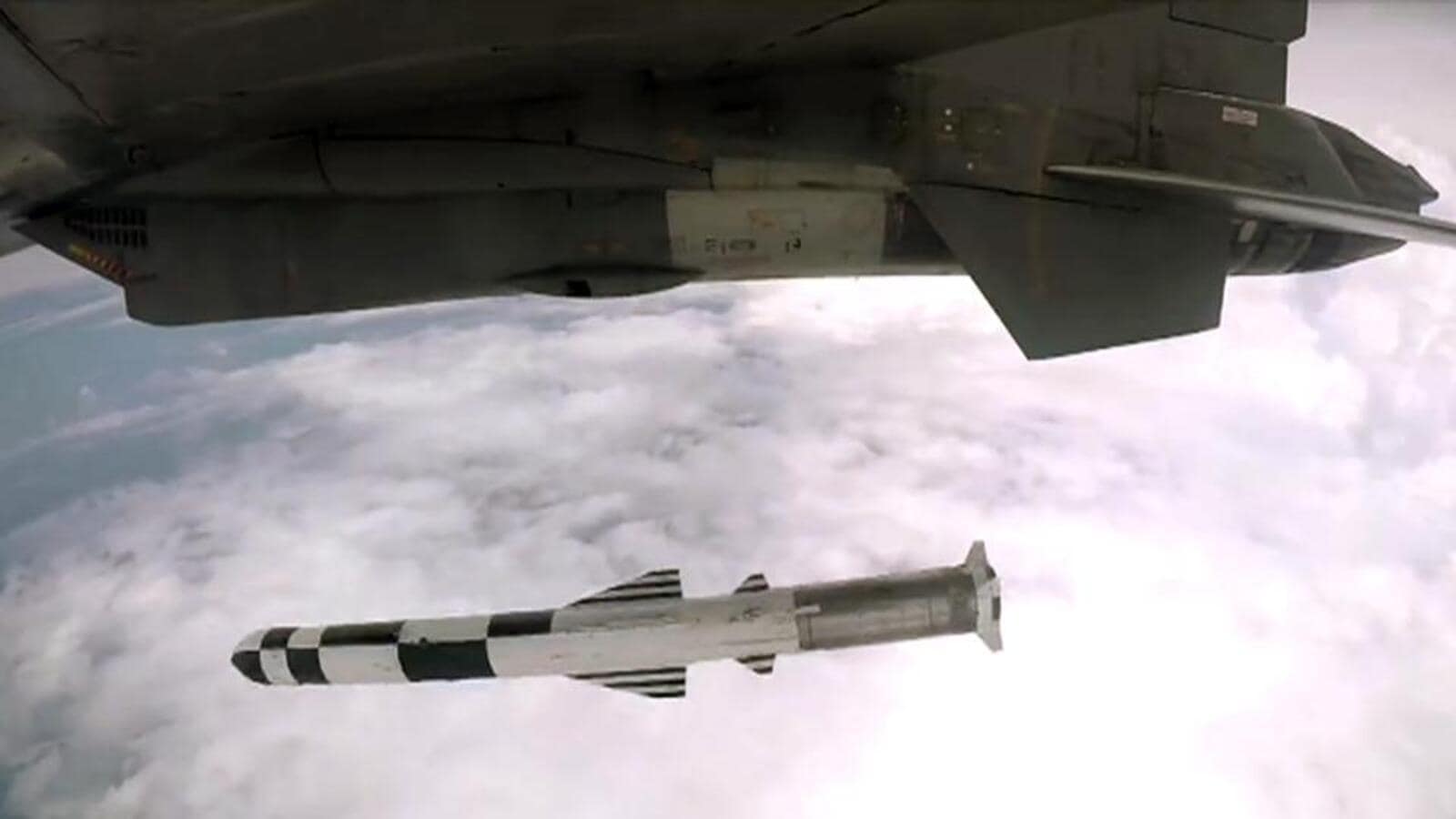
That order came on the back of the Philippines ordering BrahMos missiles and Armenia buying Pinaka multi-barrel rocket launchers from India. India has clocked defence exports of more than ₹30,000 crore since 2014, after the Narendra Modi government came to power.
India’s efforts also come at a time when China has been seeking to increase its role as a supplier of defence equipment, ranging from combat aircraft to warships and radars. In this context, the people noted that the Indian side has been pressing Bangladesh to implement a memorandum of understanding inked in 2019 for providing a coastal radar system for maritime security.
India’s defence exports reached their highest level during 2021-22, hitting ₹13,000 crore and the private sector accounting for 70% of exports. Military hardware exported by India includes missiles, the Dhruv light helicopter, offshore patrol vessels, protective gear, surveillance systems and radars. India has also imposed a phased import ban on 411 weapons and systems over the past two years to boost indigenous defence manufacturing. These weapons and platforms are to be indigenised over the next five to six years.
“India has a good strategy and action plan in place, backed by forward-looking policies, to ensure self-reliance in defence, and boost the country’s status as a net exporter of weapons in the coming years,” military affairs expert Lt Gen (retd) Vinod Bhatia earlier said.
The army chiefs of Bangladesh and India on Thursday discussed various issues pertaining to enhancing and strengthening interoperability, training, anti-terrorism collaboration and overall bilateral cooperation as part of the comprehensive strategic...
www.newagebd.net
Bangladesh, India army chiefs discuss strategic partnership
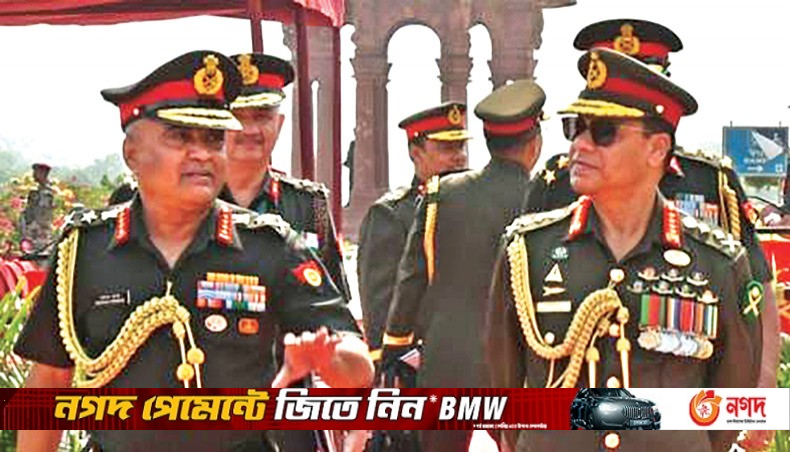
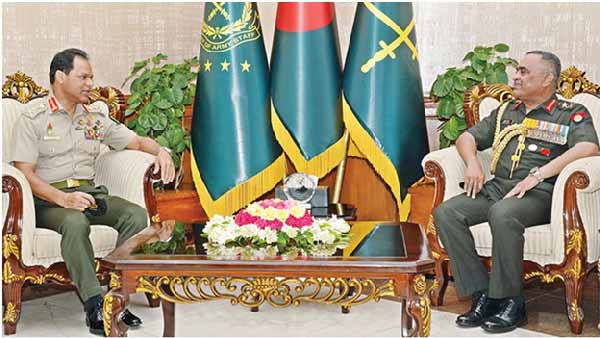
Bangladesh Army chief General SM Shafiuddin Ahmed and his Indian counterpart General Manoj Pande talk on bilateral cooperation in New Delhi on Thursday. — BSS photo
The army chiefs of Bangladesh and India on Thursday discussed various issues pertaining to enhancing and strengthening interoperability, training, anti-terrorism collaboration and overall bilateral cooperation as part of the comprehensive strategic partnership between the two nations.
The discussion took place in Delhi when Bangladesh Army chief General SM Shafiuddin Ahmed held meeting with his Indian counterpart General Manoj Pande, according to a press release of Indian defence ministry.
The Bangladesh army chief arrived in New Delhi on a three-day visit to India on Thursday to meet India’s senior military and civilian leadership where he is expected to discuss avenues for enhancing India-Bangladesh defence relations.
General Shafiuddin commenced his visit by paying tributes to the fallen heroes of the Indian Armed Forces by laying a wreath at the National War Memorial.
The visiting general was accorded a guard of honour at the South Block Lawns, said the release. General SM Shafiuddin Ahmed also called on General Anil Chauhan, chief of defence staff, Admiral R Hari Kumar, chief of naval staff, Air Marshal AP Singh, vice-chief of air staff, defence secretary and the foreign secretary.
He was also briefed on the Indian indigenous defence equipment manufacturing eco-system by the Department of Defence Production and the Army Design Bureau.
An Implementing Arrangement for UN Peacekeeping Operations and Training Cooperation between Centre for United Nations Peacekeeping (CUNPK), India and Bangladesh Institute of Peace Support Operations Training (BIPSOT), Bangladesh was signed between both Armies during the visit.
The visiting Bangladesh army chief is the reviewing officer for the passing out parade at Officers Training Academy, Chennai scheduled on April 29.
He will visit the Officers Training Academy Museum and interact with the cadets of the passing out course.
India and Bangladesh share the historical legacy of cooperation and support during the Liberation War of 1971.
The active engagement on the defence side includes high-level exchanges at the level of service chiefs, conduct of the inaugural annual defence dialogues by the defence secretaries, tri-services and service-specific staff talks.
Exchange visits of Bangladesh Mukti Jodhas and Indian war veterans take place every year in December to mark the Victory Day celebrations in Dhaka and Kolkata.
The army chiefs of Bangladesh and India on Thursday discussed various issues pertaining to enhancing and strengthening interoperability, training, anti-terrorism collaboration and overall bilateral cooperation as part of the comprehensive strategic...
www.newagebd.net
Bangladesh, India army chiefs discuss strategic partnership
Bangladesh Sangbad Sangstha . Dhaka | Published: 23:20, Apr 27,2023
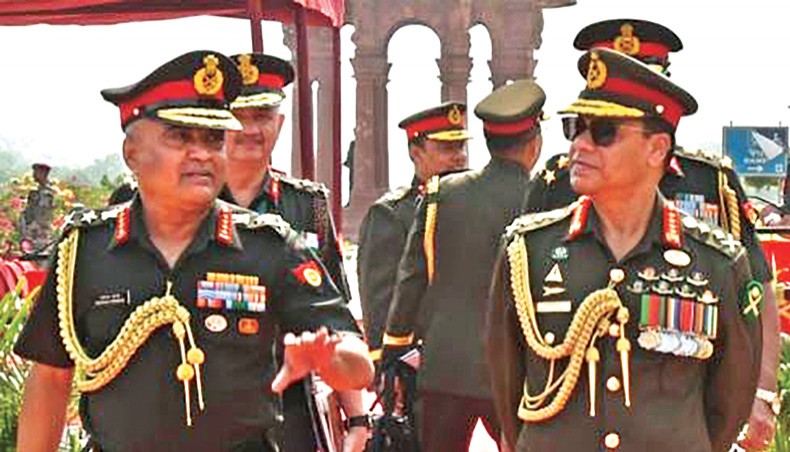
Bangladesh Army chief General SM Shafiuddin Ahmed and his Indian counterpart General Manoj Pande talk on bilateral cooperation in New Delhi on Thursday. — BSS photo
The army chiefs of Bangladesh and India on Thursday discussed various issues pertaining to enhancing and strengthening interoperability, training, anti-terrorism collaboration and overall bilateral cooperation as part of the comprehensive strategic partnership between the two nations.
The discussion took place in Delhi when Bangladesh Army chief General SM Shafiuddin Ahmed held meeting with his Indian counterpart General Manoj Pande, according to a press release of Indian defence ministry.
The Bangladesh army chief arrived in New Delhi on a three-day visit to India on Thursday to meet India’s senior military and civilian leadership where he is expected to discuss avenues for enhancing India-Bangladesh defence relations.
General Shafiuddin commenced his visit by paying tributes to the fallen heroes of the Indian Armed Forces by laying a wreath at the National War Memorial.
The visiting general was accorded a guard of honour at the South Block Lawns, said the release. General SM Shafiuddin Ahmed also called on General Anil Chauhan, chief of defence staff, Admiral R Hari Kumar, chief of naval staff, Air Marshal AP Singh, vice-chief of air staff, defence secretary and the foreign secretary.
He was also briefed on the Indian indigenous defence equipment manufacturing eco-system by the Department of Defence Production and the Army Design Bureau.
An Implementing Arrangement for UN Peacekeeping Operations and Training Cooperation between Centre for United Nations Peacekeeping (CUNPK), India and Bangladesh Institute of Peace Support Operations Training (BIPSOT), Bangladesh was signed between both Armies during the visit.
The visiting Bangladesh army chief is the reviewing officer for the passing out parade at Officers Training Academy, Chennai scheduled on April 29.
He will visit the Officers Training Academy Museum and interact with the cadets of the passing out course.
India and Bangladesh share the historical legacy of cooperation and support during the Liberation War of 1971.
The active engagement on the defence side includes high-level exchanges at the level of service chiefs, conduct of the inaugural annual defence dialogues by the defence secretaries, tri-services and service-specific staff talks.
Exchange visits of Bangladesh Mukti Jodhas and Indian war veterans take place every year in December to mark the Victory Day celebrations in Dhaka and Kolkata.
Lt Gen Sahni: Bangladeshis alone deserve credit for country’s independence
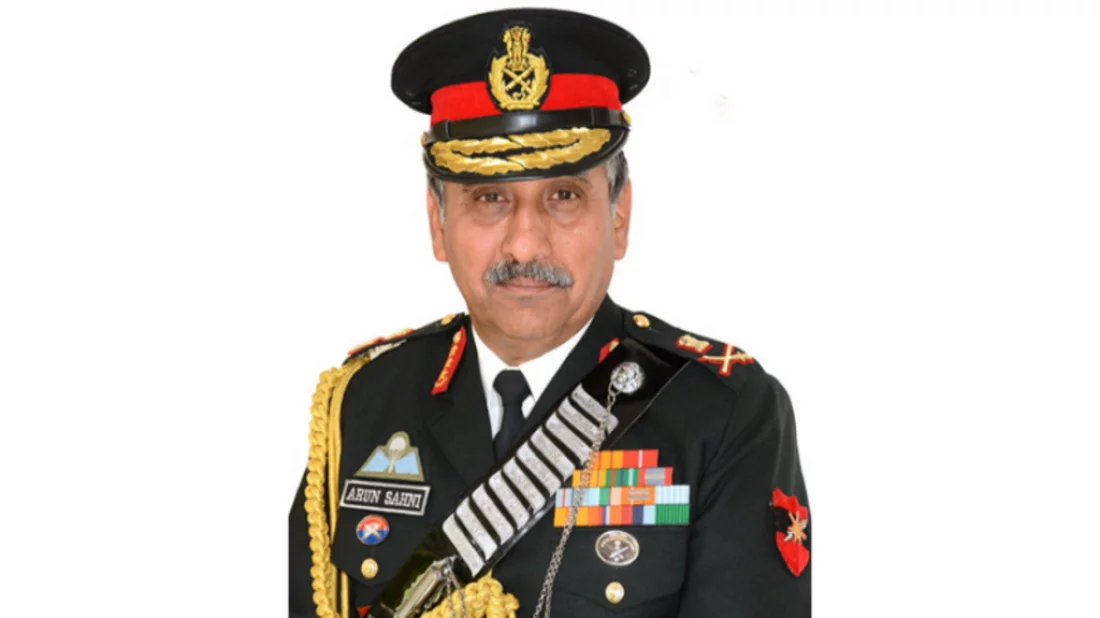
In this exclusive interview conducted by Ayanangsha Maitra for Dhaka Tribune for its Victory Day supplement, Lt Gen Arun Kumar Sahni, former General Officer Commanding-in-Chief of the South-Western Command of the Indian Army, talks about India’s role in the Liberation War of 1971, the possibility of an apology from Pakistan and Bangladesh’s geopolitical importance
Former General Officer Commanding-in-Chief of the South-Western Command of the Indian Army, Lt Gen Arun Kumar Sahni. Photo: Collected Ayanangsha Maitra
Publish : 16 Dec 2023, 10:00 AMUpdate : 18 Dec 2023, 11:47 AM
How would you look at the role of the Indian Army in 1971?
At the outset, I may state that the independence of Bangladesh was and will continue to be attributed to the sacrifices, determination and grit of the people of Bangladesh. It is they and they alone who deserve the credit for the independence of Bangladesh. Yes, India could not bear the atrocities and genocide perpetrated on the people of Bangladesh and responded positively to the clarion call given by the aggrieved local Bangalis and used all the instruments of national power to assist the government in exile and support the armed resistance movement.
It is in this context that the Indian Army took on the mandate of training the resistance movement that motivated local Bangalis who wanted to seek revenge on the Pakistan Army. The Indian Army not only trained the Mukti Bahini but organized it into an efficient guerrilla force. Selected Indian army officers and men thereafter fought with them, under their colours, to literally give what we in the army language call on-the-job training. The Mukti Bahini also became the eyes and ears for the military operations launched by the Indian Army to liberate erstwhile East Pakistan and carried out “fifth column” operations in support of the offensive, as per a planned design.
The Indian Army launched a multipronged offensive to liberate the country. The Air Force decimated Pakistan's air power in the initial few hours of the offensive. The naval blockade, in conjunction with the land offensive, ensured that the Pakistan Army had no option but to surrender. It is to the credit of the Indian Army that in spite of heavy casualties, even in the worst of situations it retained equanimity and conducted itself within the bounds of morality and ethics expected of soldiers. It also protected the Pakistani armed forces and senior military-civilian bureaucracy which had surrendered from the vengeance of the locals, who had really suffered under their tyranny. The magnitude of the victory of the Indian Army can be gauged by the fact that it led to the surrender of 90,000 Pakistani soldiers, the largest surrender of any armed forces after World War Two. A significant event was that the Indian Armed Forces were prepared to take on the powerful US Seventh Fleet that had threatened India to stop the war and set Pakistani soldiers free to escape back to West Pakistan.
It thereafter ensured peace and stability in the newly formed country of Bangladesh, till the government of Bangabandhu Sheikh Mujibur Rahman took charge. It is also again unparalleled in history that a victorious army and country handed over charge to a newly formed government, within weeks of its becoming independent and without any imposition. The army assisted in the repatriation of refugees from India back to their homeland and provided them with essential food and medical supplies.
What advantage(s) did the Indian Army have? Was topography in favour of India? Did Pakistan make a strategic miscalculation?
There are three geographical realities of which the first two were advantages and the last one was an impediment to the Indian Army. Firstly, erstwhile East Pakistan, now Bangladesh, is surrounded by the Indian state on its land frontiers and only has the Indian Ocean to its south. Secondly, the initial formation of Pakistan in two spatially separated landmasses–one to the west of India and the other in the centre of Eastern India–gave an advantage to isolate the two regions for undertaking operations in any one. The distance denied Pakistan the synergy of its combat resources. Thirdly, the riverine terrain and the road infrastructure did not permit cross-country movement in most places, which led to higher casualties on the attacker, ie, the Indian Army. It had to break the initial defensive deployment of the Pakistan Army in today’s Bangladesh by near frontal attacks.
The geography of East Pakistan allowed the Indian Army to undertake a multi-pronged offensive. It simultaneously launched three separate offensives from the east, west and north. The meagre air resources available to the adversary were destroyed in the first few hours, allowing our Air Force to attack Pakistani forces with impunity. The Navy imposed a naval blockade from the sea. Thus, the Pakistani forces were isolated in this sector, with no replenishment of war-waging materials/supplies from West Pakistan.
The multi-directional attack forced the adversary to redistribute its combat resources on all fronts concurrently. It also forced a decision dilemma on the use of its reserves, as the Indian Army continued to progress successfully on all its offensive thrusts. The breaking point was Heliborne operations that were undertaken after the first few days, which took the Indian Army to the portals of the capital Dhaka. It was once again only after the Second World War that an innovative propaganda campaign carried out by the Indian Army led to the early surrender of Pakistani soldiers. The Pakistani soldiers, as they kept retreating towards the capital Dhaka, were also stressed by the likely vengeance and wrath they would face from the Mukti Bahini for their atrocities. It also contributed to their eventual surrender.
Was it a strategic miscalculation? Yes and no. Yes, for they did not expect such a robust response from the Indian state. Also, after the military engagements of 1962 and 1965, they had convinced themselves of their superiority over the Indian Army. They also felt that the support of the US would not let them be dismembered. These were miscalculations for sure. And no, because the chain of events after their general election and the mandate in favour of a political party from East Pakistan led to the military subjugation of Bangalis. The atrocities and ruthless savagery had created a wedge between the people from these two parts of Pakistan and would have led to an eventual change.
Could you briefly elucidate how the Indian Army trained the Mukti Bahini and guerilla fighters?
Guerrilla warfare in the beginning requires mandatory training in basic soldierly skills. This means the individual has to be physically strong and conditioned, learn and gain proficiency in basic tactical skills of operating with stealth and safely in small numbers, unarmed combat, etc and finally in the use of soldierly aids like personal weapons – rifle, pistol, automatics, grenades and bayonet fighting for an eventuality of hand to hand engagement. Thereafter, methods to communicate with communication equipment or through day and night field signals and fundamentals of camouflage and concealment are also imparted to guerrillas.
This training requires anything up to three months of basic structured training.
Along with this, the individual has to learn and operate in small teams and gain knowledge of the enemy’s tactics. Thereafter, specialized skills of setting up ambush, stalking the enemy, use of explosives and mines, medical first aid, basic medical support actions, etc are taught.
After basic training, to hone the newly trained guerrilla fighter, he is put through - what in army terms is called on-the-job training. This is for a minimum of three to four weeks. During this, he is employed with trained professionals in mock tactical operations and thereafter exposed to the real thing with trained and experienced soldiers. A small team in guerrilla operations can comprise from two to three persons to about six to eight members.
The Indian Army carried this out in small camps in proximity to the borders and also participated jointly in actual guerrilla operations with the Mukti Bahini as part of on-the-job training. Some selected Mukti Bahini members were also put through formal army weapon and tactical courses at the Indian Army’s training establishments. These then became team leaders and tenanted senior leadership roles in the guerrilla force.
The US supported Pakistan and sent it arms. How would you describe Russia's support in the Liberation War?
Indira Gandhi as prime minister of India has to be given credit for her vision and sagacity in setting the stage for the launch of military operations in Bangladesh to liberate the country from the shackles of the Pakistan Army. Towards this, one of the greatest contributors to giving us the moral courage to undertake this operation, in spite of threats and warnings conveyed by the US, was the conclusion and signing of an Indo-Soviet security treaty, signed in the middle of 1971 and being applicable for 20 years. With the provision to be renewed on mutual consent, which, of course, was done subsequently.
Also, as you are aware, the Pakistan Army created a second front for India by launching operations from West Pakistan. This was to force India to divert its combat resources and attention from East Pakistan and hence stop the capitulation of its forces in that sector. The second front did delay the operations in the eastern sector, the erstwhile East Pakistan, but with the assistance of Russia, the erstwhile Soviet Union, India got the time it needed to reach its aim of liberation of Bangladesh.
The UN Security Council had moved a proposal which indicted India for having undertaken the offensive which internationally had been justified due to the deluge of refugees and a proactive foreign policy campaign by the Indian state. However, the US insistence on an immediate cessation of hostilities would have left the aim of liberating Bangladesh incomplete. The Soviet Union insisted and delayed any such resolution by the UN Security Council and thus gave India the time to carry out its operations. It also needs to be acknowledged that it was the backing of the Soviet Union and its orders to move its own submarines/carrier group towards the Indian Ocean/Bay of Bengal, which countervailed the threat posed by the US Seventh Fleet, that was the sword of Damocles on India, to stop operations immediately. Russian veto came once again to the assistance of India to ensure that Bangladesh was liberated.
Has General Headquarters Rawalpindi evolved and modernized the Pakistan Army in a great way? How would you comment on the Pakistan Army's budget, recent acquisition and worsening economy?
A response to this question is indeed complex and would take a lot of time. However, a quick reply would be captured by the famous saying that in the case of the Pakistan Army/deep state, it has a country at its behest, and not that Pakistan has an army. This implies that the penetration of the Pakistan Armed Forces/GHQ is indeed complete in the institution of Pakistan.
The Pakistan Army with quasi-military governmental organizations controls most of the economic activity within the country. It also appoints military leaders for various civil/public enterprises and has de-facto control. Thus, there is no shortage of funds faced by the Pakistan Armed Forces for equipping and to meet the requirements of weapons and warlike stores. However, its engagement and involvement in activities other than military, eg financial/economic activities, trying to play games with the US and China, and trying to control the Taliban regime in Afghanistan, leads to a diversion of focus from military training and functioning.
The Pakistan Armed Forces would be appropriately equipped, but the current state of the economy is having an impact on their operational effectiveness. The Pakistan Army’s commitment to internal security, involvement in the political turmoil and machinations within the country, the senior military leadership’s engagement in matters other than military, and the problems on its western borders with the Taliban in Afghanistan are all likely to have a detrimental impact on its combat capability.
There is no doubt that Pakistan’s economy is in a tailspin. Its fundamentals are too weak and will continue to force it to live on the largesse of its friends – Saudi Arabia or China – and by seeking support from international agencies like the IMF and World Bank. In the long term, it will impact the capabilities of the Pakistan Army to look at a limited confrontation with India.
Do you think Pakistan’s future leadership will apologize to Bangladesh for the 1971 massacre and genocide?
It is morally the right thing to do. But I do not think the current dispensation and the state of political and economic turmoil in Pakistan will see this happening in the near or mid-term. There is no doubt that the atrocities on Bangalis by Pakistan’s military and its establishment, in the events preceding the liberation of Bangladesh, from March 1971, were indeed shameful and warrant an apology by the Pakistan leadership.
The Bangladesh Army is on its way to achieving Forces Goal 2030. What would you say about its strength and operational capability?
As a senior military leader, I can say with confidence that the Bangladesh Army has matured and is capable of meeting the mandate that is set by its political leadership. I have had the pleasure of doing courses with some of the erstwhile senior military leaders of Bangladesh in India, and I can say with surety that they are professionally extremely competent and have the necessary balance required to meet their national vision and goals.
Military personnel from the Bangladesh Armed Forces in United Nations peacekeeping missions have performed with aplomb and have shown their mettle in tricky and complex situations.
How can defence cooperation be strengthened between the two neighbours? How can Bangladesh contribute more to regional security?
Defence engagement between the two neighbouring armed forces commenced sometime back with bilateral exercises for counter-terrorist and HADR (humanitarian assistance and disaster relief) situations. There are regular exchange visits, and officers train at each other’s training establishments at the tactical and operational levels.
Formal forums have been established and are functioning. There is the India-Bangladesh Annual Defence Dialogue, held between India’s defence secretary and the principal staff officer of the Bangladesh Armed Forces. The fourth edition of the talks took place in the latter half of 2022. Also, the second edition of India-Bangladesh Tri-services Staff Talks (TSST) concluded last year. The latter is to give shape to engagements under a bilateral defence cooperation mechanism for all three services and further strengthen bilateral defence engagements. It is a forum to strengthen regular talks at the strategic and operational levels between the Integrated Defence Staff headquarters and Bangladesh’s Armed Forces Division.
Towards capability development, India has extended a $500 million line of credit for defence goods.
The India-Bangladesh security and border management got a fillip in 2015 with the ratification of the India-Bangladesh Land Boundary Agreement. In addition, there are other bilateral agreements addressing security cooperation, including the Coordinated Border Management Plan signed in 2011.
It would be a fair assessment that this golden era in bilateral relations has solidified military-to-military ties. This augurs well for the stability of the subcontinent.
How do you look at the rise of Bangladesh? Could you please share with us the geo-political, geo-strategic and geo-economic interests of this riverine nation?
Bangladesh, due to its geography, will be an important player in the emerging geo-political and geo-strategic landscape. It is indeed heartening to see the economic and social development in the country, which augurs well for India and South Asia at large. There is no doubt that it will play a pivotal role in the emerging polycentric world order. A few quick points:
Bangladesh has ensured its financial and social security with a very innovative and indigenous approach. The current political regime has ensured that it balances its relations with both China and India with maturity and without antagonism. Its pre-eminent position in the Bay of Bengal is again being handled with great responsibility to ensure that the Indian Ocean does not become militarized. It is forward-looking and once again at the forefront of leading the fight against the onslaught of climate change. It will be at the frontline for tackling its negative impact in the coming decades. Therefore, plans towards mitigation and adaptation, which have been formulated in the Delta Plan 2100 and Mujib Plan 2030, are indeed laudatory and pathbreaking.
It is irrefutable that the growth and stability of the nations of South Asia are intrinsically linked to each other’s internal stability, social cohesion, and financial and economic well-being. Towards this, the development of Bangladesh and its warm relations with India have given the necessary impetus to regional groupings like Bimstec and BBIN. The extension of its port facilities to both the landlocked South Asian neighbours of Nepal and Bhutan and additional options to India increases the communication linkages towards Southeast Asia, which will facilitate greater integration with Southeast Asian economies.
I conclude on a heartening note that the positive state of India-Bangladesh relations is the right example to follow, where while meeting internal challenges there is a need to meet the external responsibilities with equanimity.
I sense a dirty strategic game is being played by India to move Bangladesh away from her trusted strategic partner--China. The Bangladesh army must remember China's contribution to the development of our defense forces since the 70s. India vigorously supported Shanti Bahini in Chittagong Hill Tracts to dismember Bangladesh. The border killings of Bangladeshis by Indian security forces is an unfriendly act which they have been conducting since the 70s. Bangladesh alone cannot counter India. She needs China to do that. So, Bangladesh army needs to limit its cooperation with the Indian army to exchange of training and to conduct counter terrorism exercises. India is our biggest security threat and China is our strategic partner.
A strategic calculation of Indian Army Chief’s Bangladesh visit
Dr Arpita Hazarika is a Gauhati University, Assam, India-based researcher.
June 8, 2023
Defense cooperation between India and Bangladesh has made significant progress in the last few years. It is depicted in the exchange of visits between the leaders of the two countries, as well as the conduct of training programs, joint exercises, and humanitarian assistance and disaster relief (HADR). India has always cherished its close ties with Bangladesh and at the same time works to strengthen its ties while contributing to Bangladesh’s development agenda. Bangladesh is an important partner under India’s flagship ‘Neighbourhood First’ policy. Cooperation between the two countries is extensive in all areas including trade and commerce, power and energy, transport and connectivity, science and technology, defense and security, maritime affairs, climate change and sustainable development.
Army Chief Gen Manoj Pande on Monday (June 05) embarked on a two-day visit to Bangladesh to hold talks with the top military brass of the neighbouring country to primarily explore ways to further expand bilateral defence and security ties. It is Gen Pande’s second visit to Bangladesh as Army chief. He visited the country in July last year on his first foreign visit after assuming charge of the top post.
”During the visit, the Army Chief will be meeting the senior military leadership of Bangladesh where he will discuss avenues for further enhancing Indo-Bangladesh defence relations,” the Army said.
Other engagements of the Army Chief include formal interactions with the Chief of Army Staff of the Bangladesh Army and the Principal Staff Officer of the Armed forces division. The Bangladesh Chief of Army Staff visited India in April this year and reviewed the passing out parade at the Officers Training Academy in Chennai. ”Frequent visits by senior military leaders and bilateral cooperation events such as joint military exercises contribute to enhancing military-to-military relations between both nations,” the Army said.
However, the army chief’s visit, most importantly, comes at a time when the United States is taking one step after another regarding Bangladesh. The latest step is the new visa policy ahead of the elections.
India is the major country of the subcontinent and India’s role in influencing the dynamics of politics in the subcontinent is important. But the US has been taking one step after another in relation to Bangladesh excluding India and these steps have now become a cause of discomfort for India.
Rising US and Western pressure may drive Bangladesh government closer to China because its veto in the United Nations can block adverse resolutions seeking to haul up Bangladesh. Thus, India might help Bangladesh on strategic point. If Bangladesh goes the Pakistan and Sri Lanka way, what’d be left for India in its neighbourhood?
India has no option without supporting Hasina regime in the region for various reasons. In the case of security of Northwest India and ensuring Indian strategic and business interest in Bangladesh, India needs Bangladesh’s Hasina regime. On the other hand, the Bangladesh government has recently formally set out the ‘Indo-Pacific Outlook’. Both parties can usher the ties and cooperation under this Indo-Pacific strategy. The visit is apparently part of the “outstanding” bilateral defense relationship between Bangladesh and India. The Chief of Army Staff’s visit could strengthen relations between the two armies at the bilateral level and act as a catalyst for improved coordination and cooperation between the two countries on various strategic issues.
The visit is apparently part of the “outstanding” bilateral defense relationship between Bangladesh and India. The Chief of Army Staff’s visit could strengthen relations between the two armies at the bilateral level and act as a catalyst for improved coordination and cooperation between the two countries on various strategic issues.
In South Asia, Bangladesh is an important ally of the India. The two nations work closely together on problems like climate change, counterterrorism, and regional security. This visit may serve to cement bilateral defense ties.
Defense cooperation between nations could strengthen bilateral ties. Both India and Bangladesh are essential to the region. Despite some bilateral issues, both countries are greatly interested in further solidifying their bilateral ties, which was made clear by this visit. This could assist in bolstering bilateral ties and reflecting better bilateral understanding. This visit is highly important for Bangladesh and India in the region. Bangladesh and the India must work together as reliable partners to address some shared issues. Through this visit, India and Bangladesh have further reinforced their defense ties.
Defense, security, and strategic connections between India and Bangladesh are expanding daily. Bangladesh is seen by India as an enduring strategic ally. In addition to giving 18 brand-new 120mm mortars to the Bangladesh Army in December 2020 as part of army-to-army cooperation, India has granted a $500 million line of credit to Bangladesh for defense procurement from India.
A 122-member group from Bangladesh’s tri-services also took part in the Republic Day parade in India in January 2021. From March 8–10, two Indian naval ships—INS Kulish and INS Sumedha—visited Bangladesh’s Mongla Port, making it the first naval visit India had made in the previous 50 years. Bangladesh is still India’s “closest neighbor,” and relations with it are at a “golden age.” India wants to strengthen its relationship with Bangladesh just as the US wants to engage with it more strategically. Of sure, both nations would benefit from the situation.
In an effort to improve bilateral defense cooperation, Bangladesh’s new army chief Gen S M Shafiuddin Ahmed and India’s new army chief General Manoj Pande spoke via video chat earlier this month.
It is believed that the two army commanders also discuss how the geopolitical landscape was changing and how that would affect regional security.
In recent years, India and Bangladesh’s defense and security relations have improved. The 50th anniversary of Bangladesh’s Liberation was in 2021. Both India and Bangladesh have highly trained, experienced military, and they work together to keep the Eastern region peaceful.
The Bangladeshi and Indian militaries are increasingly collaborating on defense. Through a variety of initiatives, such as joint training and drills and defense discussions, the two countries’ armed forces have been working together more and more.
Two defense agreements were signed between Bangladesh and India during Sheikh Hasina’s four-day trip to New Delhi in April 2017. These were the first such pacts inked by India and any of its neighbors. According to the accords, the troops of the two nations would engage in cooperative training and exercises.
In order to achieve self-sufficiency in defense manufacturing in Bangladesh, India will assist Bangladesh in setting up manufacturing and service facilities for the defense platforms that both nations currently possess.
Additionally, India will offer the Bangladesh military specialized training as well as technical and logistical support. India also gave a neighboring nation, Bangladesh, its first ever line of credit for defense-related purchases, in the amount of $500 million.
Additionally, the forces of the two nations have taken on a significant role in conducting training programs for dealing with counterterrorism challenges, natural catastrophes, and ensuring humanitarian assistance and disaster relief (HADR).
Defence and security are significant elements of India and Bangladesh’s bilateral relations, and the armed forces of the two nations cooperate and coordinate with one another on numerous levels.
On December 15, 2021, the defense issue came up during President Kovind’s meetings with Bangladesh’s top officials.
India has added an additional $500 million to its line of credit for defense products. Under this line of credit, a number of items have been identified and are being accelerated quickly; their processing is at a fair degree of sophistication. (In accordance with news reports)
India presented Bangladesh with a $500 million line of credit in 2019 to help the neighboring nation purchase defense equipment.
The Memorandum of Understanding aims to finance Bangladesh’s acquisition of defense equipment. In April 2017, India promised to provide Bangladesh with a US$ 500 million Line of Credit during Prime Minister Hasina’s visit to New Delhi.
India and Bangladesh have been providing the most soldiers to United Nations peacekeeping missions in terms of bilateral military cooperation. The two Armies’ collaboration has grown in the field of counterterrorism.
India’s determination to combat terrorism in all its manifestations was echoed by Bangladesh’s resolute stance against terrorism. India is aware of Bangladesh’s efforts to prevent terrorist organizations from using space to conduct activities against India. In response, India should keep up its efforts to stop any terrorist group from using its territory to harm Bangladeshi interests.
As a result of the insurgency’s current low point in North-East India, Indian PM, Chief Minister of Assam has thanked Bangladesh for its assistance and emphasized his wish to improve trade and connection between Bangladesh and North-East India.
To strengthen the defense and security facets of their alliance, Bangladesh and India can cooperate in the field of defense. The two nations should be dedicated to further developing the defense and security component of their partnership based on the needs expressed and each party’s ability to respond to them using different methods, including through capacity building and potential technology transfer. India can assist Bangladesh in achieving the goal of implementation of Bangladesh’s visionary military plan “Forces Goal 2030.”

 Bangladesh Defense