[🇧🇩] Bangladesh and European Union

[🇧🇩] Bangladesh and European Union
23
1K
More threads by Saif

G Bangladesh Defense

CA directs opening FTA talks with EU
FTA to attract more European investment to BD, boost exports to western markets: EuroCham chief


FE REPORT
Published :
Feb 02, 2026 00:32
Updated :
Feb 02, 2026 00:32

1769993345676.webp


Chief Adviser Prof Muhammad Yunus Sunday directed opening free-trade agreement (FTA) negotiations with the European Union forthwith to safeguard Bangladesh's trade preferences in its largest export market as the current duty-free access is set to expire.

The head of interim government stressed the urgency during a courtesy call by Nuria Lopez, Chairperson of the European Chamber of Commerce in Bangladesh (EuroCham), at the state guesthouse Jamuna in Dhaka.

Michael Miller, European Union's Ambassador in Bangladesh, took part in the meeting and discussion.

They discussed the need to accelerate European investment in Bangladesh, how to ensure smooth trade relations between Bangladesh and the EU, and the need for further reforms to improve the country's business climate.

They also discussed the upcoming elections and the deployment of international observers to monitor the polls.

Professor Yunus mentions that the Interim Government has recently concluded an Economic Partnership Agreement (EPA) with Japan, paving the way for duty-free access for more than 7,300 Bangladeshi products to the world's fourth-largest economy.

Bangladesh is preparing to hold similar negotiations with other countries, including the European Union, to ensure continued duty-free access for its products -- particularly readymade garments -- to the EU market for the foreseeable future, he told the EU side.

"The EPA with Japan has opened doors for us. It gives renewed hope for our exports. We definitely hope to sign an FTA with the EU to expand our market," the Chief Adviser said.

The EuroCham chairperson, Nuria Lopez, said Bangladesh needs to begin FTA negotiations urgently, as the country may lose its existing trade preferences in the EU -- its largest export destination -- after graduating from least-developed country (LDC) status.


She notes that an FTA would attract more European investment to Bangladesh, create jobs, and boost exports to advanced Western markets.

Lopez points out that India is signing an FTA with the EU, while Vietnam already has such an agreement, allowing both middle-income countries preferential access to the European market.

"We are advocating for an FTA. I will go to Europe to encourage private companies to invest in Bangladesh," she told the meet.

EU Ambassador Michael Miller said that the commercial relationship with Bangladesh would evolve after graduation but not before 2029.

He underlines EU's strong interest in bringing European investment and technology to Bangladesh -- an important market with a population of nearly 200 million. He also expresses EU readiness to organise an EU-Bangladesh Business Forum in 2026.

"We are looking for early political signals that EU companies will be encouraged to come and will enjoy a level playing field," he said during the

trade discussion.

The Chief Adviser also emphasised the relocation of factories to Bangladesh, noting that European firms can take advantage of the country's large pool of skilled labour at competitive costs.


"We are building a free-trade zone. Our aim is to turn Bangladesh into a manufacturing hub for global businesses. We want more European investment in Bangladesh," he told the EU side.

Professor Yunus expressed satisfaction over the EU decision to deploy a large contingent of election observers to Bangladesh for the upcoming general election and referendum.

"It is important that EU election observers are here. It is a huge vote of confidence in revitalising our democracy," he said, adding that the overall picture of the election campaign is "very positive."

Lamiya Morshed, SDG Coordinator and Senior Secretary of the government, was also present at the meeting.

Merchandise exports earned Bangladesh US$48.28 billion in the last fiscal year (2024-25) and the EU accounted for 44.29 per cent or $19.71 billion.

Bangladesh's exports are destined to face up to 12-percent duty after LDC graduation and its transition period till 2029.​
 

EU's changing apparel market and Bangladesh's export challenges
5 April 2026, 13:00 PM

Mostafiz Uddin

1775436203973.webp

FILE VISUAL: SHAIKH SULTANA JAHAN BADHON

Bangladesh’s garment industry has faced some serious challenges of late. In the first eight months of FY2025-26, the country’s ready-made garment exports fell 3.73 percent year on year to $25.79 billion, against $26.79 billion in the same period of the previous fiscal year. In the EU—Bangladesh’s biggest apparel market—garment exports slipped 1.03 percent to $7.83 billion in the July-November period, down from $7.92 billion in the same period of FY25, with the bloc accounting for over 48 percent of total RMG shipments in that period.

There are several obvious explanations for the slowdown. These include weak consumer demand in Europe, higher living costs, a cautious buying environment and, of course, geopolitical disruptions. Bangladesh’s own exporters and trade bodies have been making these points for months. But I believe there is another possibility worth examining—especially for suppliers serving mainstream fashion retail—and it is that part of the market has been shifting away from traditional wholesale import channels and towards direct-to-consumer cross-border e-commerce flows led by companies such as Shein and Temu. In other words, the global apparel trade may be increasingly influenced by a growing “parcel economy.” EU policymakers themselves now describe the surge in low-value e-commerce consignments as large enough to distort competition. The European Parliament said 5.8 billion low-value items valued under 150 euro entered the EU in 2025. It said that growth is linked to the rise of Chinese online retailers such as Shein and Temu, as 91 percent of those shipments came from China in 2024.

For Bangladesh, the EU is not just another market, it is the main market. The European Commission says total EU-Bangladesh goods trade reached 22.2 billion euro in 2024 and that almost 94 percent of EU imports from Bangladesh were textiles. It also notes that Bangladesh remains the largest beneficiary of the bloc’s Everything but Arms arrangement—providing duty-free, quota-free access to the EU single market for all products except arms and ammunition from Least Developed Countries (LDCs). So, any structural change in the way Europeans buy low-cost clothing matters directly for Bangladesh’s export machine.

The problem for traditional trade analysis is that the direct-to-consumer parcel boom does not show up neatly alongside the conventional bulk import model on which many sourcing economies depend. Even where goods are recorded for customs and VAT, the flow is highly fragmented, often entering as millions of small consignments rather than containerised wholesale orders to established retailers. Eurostat’s own quality reporting says that extra-EU trade statistics can exclude transactions below national statistical thresholds, which can be as high as 1,000 euro or 1,000kg in some member states. That does not mean all low-value e-commerce trade disappears from the data. But it does mean analysts should be cautious about assuming that traditional apparel import datasets capture the full competitive pressure now coming from the parcel economy in a comparable way.

For Bangladesh’s garment sector, the commercial effect could be significant even if the statistical picture is far from perfect. If EU consumers are spending more for ultra-fast, cross-border direct shipments, then traditional retailers may order less from their established sourcing bases or buy later and in smaller quantities. That would show up as pressure on Bangladesh’s export receipts without necessarily appearing in import datasets most commonly used by industry observers. It would also help explain why suppliers can feel the market weakening even when some official trade readings appear mixed or lagged. This is especially relevant in value fashion—where speed, price, and variety influence consumer decisions.

The good news for our exporters and European customers is that Brussels has now moved decisively to curb at least part of that distortion. In February 2026, the Council of the European Uniongave final approval to new customs duty rules for small parcels entering the EU. The measure abolishes the threshold-based customs duty relief for consignments valued under 150 euro. Until the wider EU customs data hub is operational in 2028, member states will apply an interim flat-rate customs duty of three euro on each item category in a small parcel sent directly to consumers, from 1 July 2026 to 1 July 2028. Once the new system is fully in place, normal customs tariffs will apply instead. Under the new proposal, online platforms are also set to become responsible for customs duties, product compliance, and paperwork on goods sold into the EU. Distance sellers and platforms shipping directly to EU consumers will be treated as the Importer of Record (IOR)—responsible for ensuring imported goods comply with all local laws, customs regulations, and documentation requirements in the destination country—shifting legal responsibility away from consumers and onto the seller or platform. They will be required to ensure that duties are paid and that goods comply with EU regulations. Operators that repeatedly fail to comply could face fines of one to six percent of the value of goods imported into the EU over the previous 12 months. The EU will also create a new EU Customs Authority in French city Lille and a central data hub, though the deal still needs final formal approval. While this will not end the small-parcel model and nor is it aimed specifically at fashion, EU institutions are being unusually explicit about the rationale. The council said the current duty-free treatment of such parcels leads to unfair competition for EU sellers. The European Commission has made the same point, saying the removal of the threshold is intended to level the playing field between direct imports of individual parcels and traditional retail imports of goods in bulk. For Bangladesh, that should be read as a positive.

Bangladesh’s garment industry has built its position around scale, compliance, established buyer relationships, and the ability to supply large programmes into mainstream retail. If Europe becomes less permissive towards lightly taxed or duty-sheltered parcel flows, some competitive pressure should shift back towards more conventional sourcing and import models. That would not solve our other challenges, from productivity and lead times to margin pressure and post-LDC trade planning. But it could remove part of the policy asymmetry that has favoured direct cross-border sellers. There is also a wider point for brands and retailers buying from Bangladesh. A more level customs framework in Europe is not just about protecting EU sellers. It is also about restoring fairer competition across supply chains. Suppliers investing in compliance, traceability, worker protections, and long-term manufacturing capacity have struggled to compete with business models built around millions of low-value parcels moving through a lighter-touch border regime. Brussels now appears to accept that this imbalance has gone too far.

Mostafiz Uddin is managing director of Denim Expert Limited. He is also the founder and CEO of Bangladesh Denim Expo and Bangladesh Apparel Exchange (BAE).​
 

Bangladesh, EU to sign PCA in Brussels Monday

UNB

Published :
Apr 19, 2026 20:46
Updated :
Apr 19, 2026 20:46

1776642012887.webp


Bangladesh and the European Union (EU) are set to sign the Partnership and Cooperation Agreement (PCA) on Monday in Brussels, Belgium as both sides aim to take the relationship to new heights, further institutionalising bilateral cooperation.

Once signed, the PCA will serve as the legal and political foundation for the strategic and long-term Bangladesh-EU relationship, said officials at the Ministry of Foreign Affairs on Sunday.

They said it will help strengthen relations between Bangladesh and the EU in many policy areas, from human rights and governance to trade, investment, environmental sustainability and climate change as well as food security, energy, transport and science, technology and innovation.

Moreover, the agreement will also be a significant milestone as Bangladesh moves towards becoming the first South Asian country to sign a PCA with the European Union.

The EU looks forward to the new Partnership and Cooperation Agreement with Bangladesh, which will be ‘initialled’ during the visit of the Foreign Minister to Brussels on April 20, enhancing cooperation across the board.

After attending the three-day Antalya Diplomacy Forum, the Foreign Minister and Prime Minister’s Foreign Affairs Adviser Humaiun Kobir left Turkey for Brussels, Belgium, on Sunday to attend the signing ceremony.

Secretary (Bilateral) of the Ministry of Foreign Affairs, Dr Md. Nazrul Islam will join.

On his way back home, the Foreign Minister is expected to make a stopover in Addis Ababa, Ethiopia and will return to Bangladesh on April 24, said a senior official.

The fifth round of negotiations between Bangladesh and the European Union on the framework agreement was held in January this year.

Through the negotiations, both sides finalised the text of the agreement.

The negotiations on the proposed PCA started with the explanatory meeting between Bangladesh and the EU in Dhaka in November 2024.

Since then, the two sides engaged in five rounds of discussions and several technical meetings in Dhaka and Brussels, both physically and virtually.

The fifth round on focused particularly on some key thematic areas of mutual interests between Bangladesh and European Union including legal and judicial cooperation, intellectual property rights, energy cooperation, fisheries, aquaculture & ocean governance, trade and investment, human rights, customs cooperation, etc.​
 

Bangladesh, European Union sign initial Partnership and Cooperation Agreement in Brussels

bdnews24.com
Published :
Apr 20, 2026 21:34
Updated :
Apr 20, 2026 21:34

1776728543455.webp


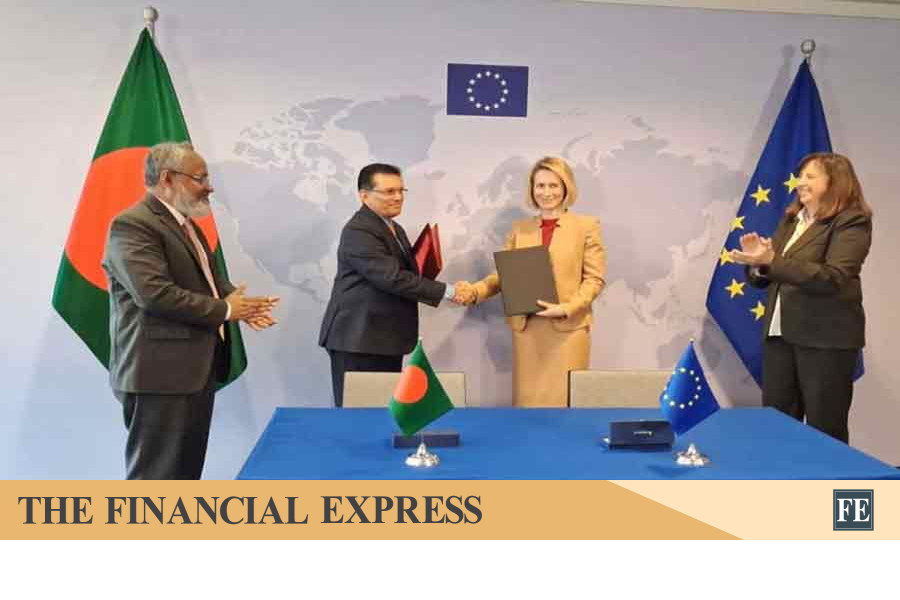
Bangladesh and the European Union (EU) have signed an initial Partnership and Cooperation Agreement (PCA), marking a definitive step toward a structured roadmap for collaboration in trade, investment, and governance.

The signing took place at the EU headquarters in Brussels on Monday, the foreign ministry said.

The ministry’s Secretary (East and West) Md Nazrul Islam signed the agreement on behalf of Bangladesh, while Paola Pampaloni, deputy managing director (Asia and Pacific), signed for the EU.

Foreign Minister Khalilur Rahman, Foreign Affairs Advisor to the Prime Minister Humaiun Kobir, and EU High Representative for Foreign Affairs and Security Policy Kaja Kallas were present.

Officials said Bangladesh is set to become the first South Asian country to enter into such an agreement with the European bloc.

An official said after the initial signing, the agreement will be translated into the languages of EU member states before the final signing.

Following five rounds of negotiations, Bangladesh and the EU finalised the PCA draft in January this year.

At the time, the foreign ministry said the PCA would serve as the legal and political foundation for a strategic and long-term Bangladesh-EU relationship once signed.

“Bangladesh and the European Union will help strengthen relations between Bangladesh and the EU in many policy areas, from human rights and governance to trade, investment, environmental sustainability and climate change as well as food security, energy, transport and science, technology and innovation.”

On the day of the signing, Khalil also held a separate meeting with Kallas.

According to a foreign ministry media statement, their discussions covered a wide range of areas, including political, economic, and development cooperation, with a focus on trade and investment, the Indo-Pacific partnership, migration, skills development, labour standards, and the Rohingya crisis.

Both sides highlighted Bangladesh’s post-LDC transition, the importance of preferential market access, and the launch of negotiations on a Free Trade Agreement (FTA) and Investment Protection Agreement (IPA).​
 

Can EU-Bangladesh partnership be taken to next level?

FE
Published :
Apr 22, 2026 23:43
Updated :
Apr 22, 2026 23:43

1776902704211.webp


The Partnership and Cooperation Agreement signed between Bangladesh and the European Union (EU) on Monday last has been hailed as a comprehensive strategic partnership. It is going to replace the earlier EU-Bangladesh Cooperation Agreement 2001 known for its emphasis on development and trade. So far the 2001 agreement has served this country well. Under the Everything But Arms (EBA) provision Bangladesh secured for its exportable goods duty-free and quota-free access to the EU market. But the EBA did not accommodate crucially important issues like investment, climate action, migration, energy, transport and maritime affairs. Now the new deal is going far beyond such apolitical affairs to include regular political dialogue, security and other strategic areas. Report has it that such engagements are necessary in the context of Bangladesh's growing geo-political importance and its strategic Indo-Pacific position.

Is Bangladesh a big player in the context of changing global geo-politics? It seems that the deal will involve Bangladesh's engagement in the shifting geo-political landscape. Drawing Bangladesh into such affairs should better be avoided. At a time when geo-politics tends to be more aggressive on the archaic principle "if you aren't with us, you're an enemy", the need for staying away from blocs is even overriding. If the country commits to one alliance, it may incur wrath of others. Already Bangladesh's unequal trade deal with the United States of America has come under scathing criticism. The country's interests should prevail over strategic agreements that drag it into the vortex of international politics.

So far as other areas of engagements are concerned, this nation will definitely benefit if cooperation is taken to its logical conclusion. As the largest trading partner and biggest export destination of Bangladesh, the EU has remained a steadfast partner of this country. Now that overseas aid is shrinking, every nation on the planet is looking forward to secure its commercial and economic interests. The EU is an exception in that the bloc collectively maintains its relations with other nations. That it attaches importance to partnership between it and Bangladesh is indeed gratifying. Now the question is, if the newly initialled agreement will continue to maintain the preferential treatment even after Bangladesh's graduation from its existing least developed country (LDC) status to a developing nation. This is more important than its strategic elevation. Then come the issues such as energy, migration, climate action etc., along with investment and technology transfer to meet the emerging challenges.

Waxing eloquent will not do. Bangladesh has its usual pressing problems on the domestic front. Additionally, it has sheltered approximately 1.2 million Rohingya refugees. With the donors tightening the grip on aid, the refugee camps in Cox's Bazar is turning into a flash point. Now that the US has drastically cut its aid for the Rohingya, the challenge of feeding the refugees is proving ever more daunting. The EU can increase its aid for the Rohingya before the seething discontent in camps blows up. Bangladesh has its own climate refugees who will grow in numbers with the climate getting ever more capricious. Collaboration and cooperation between this country and the EU on limiting the climatic fallouts will be welcome. Engagements in all such non-political but crucially important issues are more important than the politically strategic ones.​
 

Dhaka urged to fast-track EU FTA as investor concerns mount

FE ONLINE REPORT

Published :
Apr 29, 2026 19:35
Updated :
Apr 29, 2026 19:46

1777505355064.webp


A European business leader has called for urgent action to secure a free trade agreement (FTA) with the European Union, warning that delays could undermine Bangladesh’s investment outlook and export competitiveness ahead of its LDC graduation.

The concern was voiced at a policy dialogue jointly organised by the Metropolitan Chamber of Commerce and Industry, Dhaka and Policy Exchange Bangladesh in Gulshan, where speakers highlighted market access as a critical gap in the country’s economic strategy.

The event was attended by special guest Md Mahmud Hasan Khan, President of the Bangladesh Garment Manufacturers and Exporters Association (BGMEA).

Policy Exchange Bangladesh Chairman and CEO Dr M Masrur Reaz presented the keynote on Improving the Investment Climate: Why It's Critical for the New Government Priorities and the Upcoming National Budget.'

The programme began with a welcome address by MCCI Secretary General Farooq Ahmed. Panel speakers included EuroCham Chairperson Nuria López, corporate lawyer Barrister Margub Kabir, Head of Chambers at Margub Kabir & Associates, and Zinnia Huq, Chief Financial Officer (CFO) of Unilever Bangladesh.

Nuria Lopez, Chairperson of the European Union Chamber of Commerce in Bangladesh (EuroCham), stressed that the absence of an FTA with Bangladesh’s largest export destination is already weighing on investor confidence.

“Do we have a free trade agreement with our major customer at this moment — the European Union? No,” she said. “And we are in a region where Vietnam and India have already secured such agreements.”

She warned that without preferential access to the EU market, Bangladesh risks falling behind regional competitors that offer greater certainty to investors.

“We need to have, we must have, we must start right now an FTA,” Lopez said. “Because if we don’t have free trade access to our largest market, we don’t have a horizon to invest.”

Drawing on her own experience, Lopez said uncertainty over future market access is already affecting business decisions.

“I have recently started a new business in the agro-processing sector, but I am uncertain about the future. I do not know whether I will be able to export to Europe on equal terms with competitors from countries that already enjoy free market access,” she said.

She emphasised that predictability is key to attracting long-term investment, which Bangladesh currently lacks.

“We don’t have predictability. We don’t know what’s going to happen in the future,” she said, questioning whether the government has a clear and investor-friendly vision.

Lopez linked the urgency of an EU FTA directly to Bangladesh’s broader struggle to attract foreign direct investment (FDI).

“The root of the problem is Bangladesh does not attract foreign direct investment… We do not have the trust of the investor,” she said, adding that policy uncertainty and weak business conditions continue to erode confidence.

She argued that securing an FTA with the EU would send a strong signal to global investors about Bangladesh’s commitment to open markets and stable trade policy.

Without such a move, she cautioned, investors may continue to favour competing destinations in the region that already offer assured market access and clearer policy frameworks.

BGMEA President Mahmud Hasan Khan advised expanding export markets by pursuing bilateral agreements with countries such as South Africa, Brazil, and Turkey.

He noted that around 8 billion US dollars in new market opportunities have emerged in the ready-made garment sector, with further expansion possible in the future. However, he stressed that bilateral agreements with these countries are necessary, as export tariffs there remain high. “We are discussing this matter with the government,” he added.

Mahmud Hasan Khan also identified energy shortages as the biggest challenge facing businesses.

“For entrepreneurs, energy is a greater concern than financial constraints,” he said.

He added that interest rates of 13–14 per cent in Bangladesh are not conducive to starting or sustaining businesses and called for support from the central bank. He noted that the new governor has introduced initiatives—such as a new fund or GTF—to provide lower-cost financing and enable refinancing from the central bank.

However, he warned that without resolving energy and broader infrastructure issues, such financial support would have a limited impact.

In his keynote paper, Masrur Reaz stated that the new government has committed to creating 10 million new jobs within less than two years.

He said this would only be possible through increased investment, which in turn requires addressing existing challenges in the business environment. Beyond improving the business climate, he emphasised the need to resolve issues in the financial sector, infrastructure, energy, and policy continuity.

“Progress will not come from addressing one issue while leaving others unresolved,” he said.

In his welcome remarks, Farooq Ahmed noted that over the past 20 years, foreign direct investment (FDI) in Bangladesh has fluctuated between around 1 billion and 1.8 billion US dollars. Meanwhile, neighbouring countries have seen their FDI increase many times over.

He attributed this gap to significant structural weaknesses and limitations.

“Until we address these challenges and remove these barriers, no amount of discussion will lead to increased domestic or foreign investment,” he said.​
 

Bangladesh, EU renews commitment to deepen ties

Diplomatic Correspondent
Dhaka
Updated: 29 Apr 2026, 18: 26

1777506782905.webp


The fifth round of Bangladesh-EU Diplomatic Consultations was held today, Wednesday in Dhaka, marking a renewed commitment to deepening a long-standing and multifaceted partnership between Bangladesh and the European Union. Collected

The fifth round of Bangladesh-EU Diplomatic Consultations was held today, Wednesday at the State Guest House Padma in Dhaka, marking a renewed commitment to deepening a long-standing and multifaceted partnership between Bangladesh and the European Union.

Convened after a pause of nearly five years, the consultations provided an opportunity to review the breadth of bilateral cooperation of mutual interest, says a press release.

Co-chaired by the Foreign Secretary of Bangladesh, Asad Alam Siam and the Managing Director for Asia Pacific of the European External Action Service, Erik Kurzweil, the meeting reflected the growing strategic importance of EU–Bangladesh relations.

The meeting reviewed the current state of Bangladesh–EU relations and discussed avenues for further engagement across priority sectors.

Taking note of the evolving strategic and economic reality, Bangladesh underscored its interest in advancing a forward-looking partnership with the EU.


The discussions welcomed the recent initialling of the Partnership and Cooperation Agreement (PCA) and noted the expectation that, following completion of the respective internal processes, the Agreement would provide a structured and comprehensive framework for future cooperation.

1777506820850.webp

Asad Alam Siam and Erik Kurzweil shakes hands during the fifth round of Bangladesh-EU Diplomatic Consultations on Wednesday. Collected

The EU acknowledged Bangladesh’s successful conduct of the February 2026 parliamentary elections, referencing to the recent release of the final report of the EU Election Observation Mission.

Both sides exchanged views on democratic governance, human rights, and the rule of law.

Bangladesh expressed keenness to work more closely under the new Government, formed following a landslide mandate from the people of Bangladesh, infusing fresh dynamism into bilateral engagement to realise the untapped potential of the EU-Bangladesh bilateral relations.

Bangladesh highlighted the importance of preferential market access in underpinning its trade relations with the EU and outlined its perspective on ensuring continuity of such arrangements in the future, including through possible instruments such as a Free Trade Agreement and an Investment Protection Agreement.

Bangladesh expressed its interest in strengthening cooperation in research and innovation through broader participation in Horizon Europe and through joint initiatives aimed at knowledge exchange, technology transfer, and capacity building.

Two sides also discussed migration and skills development. Bangladesh outlined progress in labour reforms and emphasised the importance of expanding safe and regular migration pathways, alongside strengthened joint collaboration to combat human trafficking and irregular migration.

On climate change, Bangladesh reiterated its vulnerabilities and emphasised the importance of enhanced access to climate finance, technology transfer, and support for adaptation and resilience efforts, including under initiatives such as the EU’s Global Gateway.

The consultation included exchanges on regional and global developments including current Middle East crisis.

They reaffirmed mutual commitment to multilateralism and a rules-based international order.

Bangladesh reiterated the need for stronger and sustained international attention and support to resolve the Rohingya crisis.

The consultations concluded with the appreciation of the value of holding regular consultations to tap full potential of Bangladesh-EU relations.​
 

EU seeks balanced trade ties with Bangladesh
Staff Correspondent 06 May, 2026, 23:26

1778115433691.webp

Commerce minister Khandaker Abdul Muktadir and European Union ambassador to Bangladesh Michael Miller, among others, are present at a seminar hosted by the ministry and the BGMEA at a hotel in the capital on Wednesday. | Press release

The European Union stressed the need for a more balanced and forward-looking trade relationship with Bangladesh as the country approaches its graduation from the least developed country category.

EU ambassador to Bangladesh Michael Miller said that the country was approaching a critical milestone of LDC graduation and needed to establish a more ‘eye-to-eye’ commercial relationship with the EU, its largest economic partner.

He was speaking at a seminar titled ‘Accelerating Circular Transition in Bangladesh’s Textile Industry: Insights from SWITCH2CE Pilots’, jointly organised by the Ministry of Commerce and Bangladesh Garment Manufacturers and Exporters Association at a hotel in the capital.

‘We are carefully assessing Bangladesh’s request to negotiate a free trade agreement. Regardless of the timing of graduation, we encourage Bangladesh to plan ahead, using the available time to strengthen competitiveness, invest in circularity and eco-efficiency, and remove trade irritants, including discriminatory practices affecting European businesses,’ he added.

Regarding the circular economy, he said that it was a cornerstone of the EU’s growth strategy aimed at decoupling economic growth from resource use and achieving carbon neutrality by 2050.

‘In the words of European Commission president Ursula von der Leyen, we need to stop taking resources from the ground to create products that we use and then often discard into landfills,’ he added.

Instead, they should reuse them — changing the thinking, especially among the younger generation — to retain what is valuable within the economy, he added.

Responding to the EU ambassador’s speech on LDC graduation, commerce minister Khandaker Abdul Muktadir, in his speech as chief guest, said that after graduation, Bangladesh would have to cope with a new scenario.

‘The challenges we would face are clear; we could lose concessional loans and the preferential market access,’ he said, adding that the government was working to make the country more investable.

The current logistics cost-to-GDP ratio stands at around 16 per cent, which is significantly higher than the global standard of around 10 per cent.

The government is committed to bringing this down by assigning successful operators to operate terminals to enhance efficiency, he said.

‘We are also moving towards substantial deregulation and simplification of processes,’ he added.

Now a new investor needs 1-2 years to obtain necessary clearances, permits and licences from at least 25-26 different government entities, which would be addressed and eased, he added.

The government is working to make the one-stop service a truly effective one-stop platform, he continued.

Regarding the circular economy, he said that they would work to adapt to the evolving global landscape, as it was imperative that whatever the country produced — whether ready-made garments, pharmaceuticals, leather goods or jute products — was sustainable.

‘However, the current levels of pollution and carbon emissions are largely the result of industrialisation in developed countries. Developing nations are, in many ways, bearing the consequences of a situation that evolved over decades of global development,’ he added.

Developed countries have a primary responsibility to lead and support the transition towards a sustainable global ecosystem, he added.

According to the SWITCH2CE, Bangladesh generates between 4,00,000 and 5,77,000 tonnes of jhut each year, where only around 5 per cent is recycled domestically, with the majority of jhut exported.

In the panel discussion, the panellists said that Bangladesh had the potential to use jhut up to 20 per cent through adequate policy, technology and support.

Ziaur Rahman, regional country manager of H&M Group, said that chemical recycling required significant investment if recycled products were priced significantly higher, consumers were unlikely to accept them, being a major commercial feasibility.

He said that policy and incentive structures remained a major barrier as 70 to 80 per cent of textile waste was exported due to export incentives and local VAT but virgin cotton imports enjoyed zero-duty benefits.

‘Recycled materials are still treated as waste rather than as a resource, despite an estimated market potential of $4-5 billion,’ he added, stressing the need for adequate measures as circularity would evolve as a necessity rather than a choice.

Mehmet Hakim Tuzun, representative of Bestseller, said that the company was working to incorporate at least 20 per cent recycled content into its styles.

‘We are preparing to announce our 2030 target for textile-to-textile recycled content, expected to be around 15 to 20 per cent,’ he said, adding that broader participation from brands would significantly increase impact, as circularity requires shared commitment across the value chain.

Shams Mahmud, managing director of Shasha Denims, said that scaling-up was essential for any circular business model to succeed.

Circularity requires closer collaboration, he added, putting stress on higher prices from buyers, along with greater investment in research and development.

He also proposed creating a centralised platform where entrepreneurs could find information on financing, potential brand partnerships and circularity initiatives.

Panellists also said that advancing circularity in Bangladesh’s textile sector faced structural and operational barriers, particularly in energy, financing and policy alignment, urging stronger government support.

BGMEA president Mahmud Hasan Khan said that the textile industry was considered one of the very polluting and resource-heavy industries.

‘Bangladesh is one of the largest producers of textile scraps in the world, around 6,00,000 tonnes of pre-consumer textile waste are produced annually, of which only 5 per cent is recycled locally,’ he added.

He also said that the only way forward was to incorporate circularity into business models by improving skills and efficiency.

‘We have taken it upon ourselves to lead this transition. We believe that the skills and efficiencies of our industry must continue to improve to remain globally competitive and that circularity is not a trade-off against competitiveness but a precondition for it,’ he added.

Industry leaders, government officials, brands and buyers’ representatives also spoke at the event.​
 

Latest Posts

Back