Home Watch Videos Wars Login

[🇧🇩] Bangladesh and European Union

[🇧🇩] Bangladesh and European Union
16
1K
More threads by Saif

G Bangladesh Defense

Honeymoon period for interim govt truly over: ICG
ICG urges EU support for Bangladesh economy
Brussels-based nonprofit presents package dos for European Union

FE REPORT
Published :
Jan 31, 2025 00:38
Updated :
Jan 31, 2025 00:38

1738283948546.webp


An overwhelming support the interim government enjoyed in the immediate aftermath of Hasina's downfall has begun to wane and pressure to deliver concrete results mounts, International Crisis Group (ICG), an international agency, says and urges EU support for the Bangladesh economy.

"But while the euphoria that accompanied Hasina's ouster translated into widespread support at the outset of Yunus's administration, the honeymoon is now over. Popular pressure has mounted on the government to start delivering not just on the promised reforms but also on improvements to day-to-day governance," says a report of the ICG.

The ICG report, titled 'The Dilemmas of a Democratic Transition', was released Thursday with a slew of recommendations for the European Union to come up with an aid package for Bangladesh now on the cusp of transition through wide-scale reforms.

The report is incorporated into 'EU Watchlist' prepared by the ICG to identify where the European Union and its member-states can enhance prospects for peace and stability.

"The challenges are likely to grow in the coming year, as opposition parties, student leaders, Islamist groups and other key players jockey for electoral advantage," the Brussels-based crisis-management group alerts in the report.

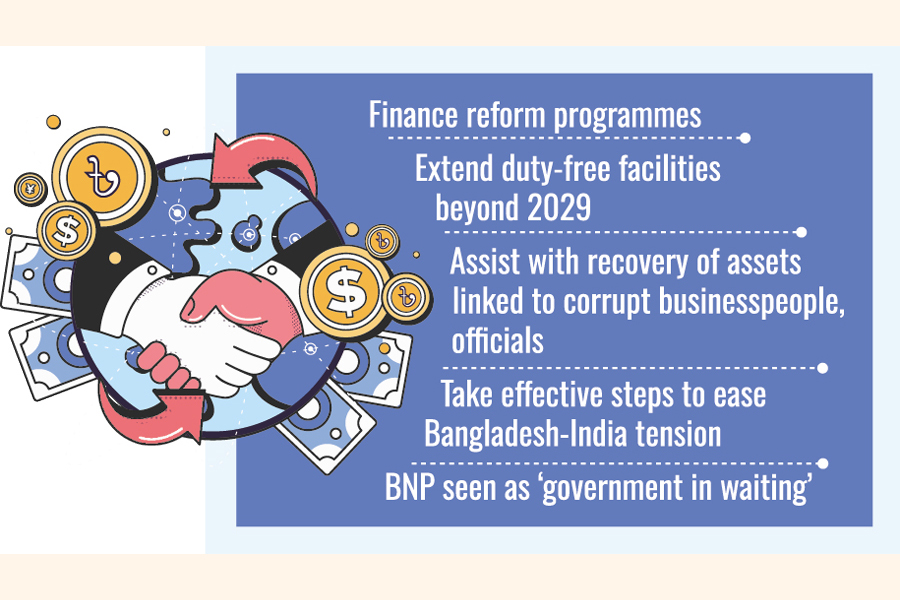
The ICG urges the EU to contribute to stabilising the national economy by using Europe's influence at international financial institutions to mobilise additional fiscal support for Bangladesh.

It also recommends that the EU help Bangladesh to create a more attractive environment for foreign investment, to support efforts to diversify the economy away from garment manufacturing, to assist with the recovery of assets linked to corrupt businesspeople and officials, and to continue negotiations with Dhaka on extending Bangladesh's preferential access to the European market beyond 2029.

In the geopolitical arena the ICG felt that the EU should take steps to limit tensions between Dhaka and New Delhi, including by quietly encouraging India, including through high-level engagements the EU is planning in 2025, to be more supportive of reform in Bangladesh.

"The EU should use its influence with both sides to overcome mistrust and shift relations onto a better footing." the report reads.

Free, fair and peaceful polls will be paramount for restoring the Bangladeshi people's faith in electoral politics, the ICG notes.

"To support Bangladesh, the EU and its member states should organise high-level visits and continue to emphasise support for the interim government's reforms in order to burnish the Yunus administration's public image domestically and weaken forces seeking to undermine its agenda," the report says, adding that the EU should also continue to pursue negotiations over a new Partnership and Cooperation Agreement.

"On 16 December, Dr Yunus said the vote would take place between December 2025 and June 2026, meaning that his administration would stay in office less than two years. The announcement has mostly, although not entirely, silenced the critics. But the prospect of polling day, even if it is distant, has also stirred up competition among the BNP, other political parties (such as the Islamist force Jamaat-e-Islami) and student leaders, who have now confirmed their plans to form a new political party," the report says narrating the present political landscape of the country.

However, it also points out that beyond the date, many of the details of the electoral process and the post-election period remain uncertain.

Preserving consensus among the various political forces at play will be "crucial for this process to succeed".

"With Hasina's AL banished to the political fringes, with its leaders in exile and its activists at home largely dormant, the BNP has become the country's largest political force. It is widely seen as the government in waiting," the report says, adding that many in Bangladesh are unnerved by this prospect for its tainted past when it ruled the country.

"When Yunus entered office, foreign-exchange reserves were dwindling, and food price inflation stood at almost 15 per cent. His actions, including installing competent officials at key institutions and ministries to improve policymaking and restore confidence, appear to have averted an economic crisis. But the economy has still taken a hit, due to political unrest and the uncertainty it has sown for businesses and investors," the Group mentions.

"Bangladeshis continue to suffer from stubbornly high inflation, particularly in the cost of food, while foreign-exchange shortages have contributed to widespread power cuts. The International Monetary Fund expects growth to rebound sharply and inflation to halve in the next fiscal year, but a buoyant economy will require reforms to encourage local and foreign investment, tackle corruption and red tape, and diversify into new sectors.

According to the report, "New Delhi's support for the ousted government made it deeply unpopular among Bangladeshis, and anti-Indian sentiment has grown since the uprising due to the perception that India is trying to undermine Yunus's government and engineer the AL's return."

It adds: "Indian authorities have not only sheltered Hasina in exile, but also made it difficult for Bangladeshis to get visas and, as noted above, regularly criticised Dhaka over minority and religious rights."

As such, Thomas Kean, Crisis Group's Senior Consultant on Myanmar and Bangladesh, concludes, "The honeymoon period for Bangladesh's interim government is now well and truly over. The political challenges are likely to increase this year as political parties and other key players negotiate over reforms and jockey for electoral advantage."​
 
Analyze

Analyze Post

Add your ideas here:
Highlight Cite Fact Check Respond

Proactive ties with EU stressed to tap GSP+ benefits
Bangladesh Sangbad Sangstha . Dhaka 24 February, 2025, 23:06

Experts at a conference on Monday laid emphasis on engaging proactively with the European Union to secure enhanced GSP+ benefits including duty-free access for garments.

They urged the authorities concerned to establish WTO-compatible export support mechanisms for providing support to the exporters in a compliant way.

They made the call at the inaugural session of the conference titled ‘Strategic Policy Realignment to Boost Investment and Achieve Export Diversification at the BRAC Centre Inn Auditorium in the city.

Centre for Policy Dialogue (CPD) organised the two-day conference on ‘Recommendations by the Task Force on Re-Strategizing the Economy’.

Commerce Adviser Sk Bashir Uddin attended the session as the chief guest while Former Commerce Minister and Chairman of the Sarina Group Amir Khosru Mahmud Chowdhury and CPD Chairman Professor Rehman Sobhan attended as special guests.

CPD distinguished fellow Professor Mustafizur Rahman, president of the Foreign Investors’ Chamber of Commerce and Industry Zaved Akhtar, deputy managing director of the Picard Bangladesh Limited Amrita Islam and team group managing director Abdullah Hill Rakib were distinguished discussants.

Chairman of the Taskforce on Re-strategizing the Economy KAS Murshid presided over the session while members of the Taskforce on Re-strategizing the Economy Selim Raihan and Mohammad A Razzaque delivered keynote speech.

In his speech, Sk Bashir Uddin highlighted the widespread corruption and money laundering in the banking sector and infrastructure development during the previous government’s tenure, which had put significant pressure on the macro-economy.

He underscored the need for diversification of the country’s export and increasing skilled workforce to strengthen the economy.

‘The entire economy of the country was corrupted in the past. Unnecessary projects and money laundering have caused great damage to the economy of this country. Corruption has occurred in the banking sector and various infrastructure construction projects,’ he said.

He said the main challenges now are ensuring continuous energy supply at fair prices, improving labour productivity, and enhancing logistics efficiency.

Initiatives should be taken to boost exports by increasing labor productivity, reducing production costs of products and increasing efficiency, he added.

Amir Khosru Mahmud Chowdhury laid emphasis on addressing whole macro-economic issues to bring back the country’s economy in a strong position.

He stressed that revenue should come from large-scale businesses in a developed private sector, not from VAT and other regulatory duties.

He also warned that without import liberalization, export incentives would not push exports beyond a certain limit.

Dr Mustafizur Rahman highlighted two contrasting examples of import liberalization–Singapore and Haiti.

‘While Singapore has strong export and institutional capacity, making liberal imports beneficial to its economy, Haiti presents the opposite scenario,’ he added.

He said that Bangladesh faces significant institutional capacity gaps in areas such as revenue collection, policy formulation, and implementation. ‘Without addressing these weaknesses, import liberalization could be risky,’ he said.

Dr Selim Raihan, also Executive Director of the South Asian Network on Economic Modeling (SANEM), said that Bangladesh witness lack of diversification both in industry and exports.

‘There could be three path ways to export and industrial diversification in Bangladesh. First one is garments. There have lots of scope to diversify garments exports. Second one is the labour incentive no-readymade garments. The third path way is to move into complex skill incentive export,’ he added.

Economist Razzaque, chairman of the Research and Policy Integration for Development, said the ready-made garment sector in Bangladesh has benefited from duty-free access to global markets, but this will no longer be available after LDC graduation.

He emphasized the urgent need to negotiate with the European Union to maintain this benefit even after December 2027.

He also pointed out Bangladesh’s failure to establish bilateral free trade agreements and called for swift action to sign an FTA with Japan.

To reduce the pressure on the macro-economy, Dr Razzaq stressed the need to rethink exports and remittances.

‘Currently, 30-40 per cent of the government’s incentives are going to companies producing goods for the local market. Moreover, 30 per cent of revenue comes from high tariffs on imports’, he said.

The economist said at present, 75 per cent of Bangladesh’s total exports depend on LDC benefits, which will no longer be available after graduation.

Razzaq highlighted that subsidies for exports will no longer be possible in post-graduation period.

He focused on securing an Free Trade Agreement (FTA) with Japan which can enhance Bangladesh’s trade policy credibility.

He urged the government to establish a ‘Chief Trade Negotiators Office’ to manage negotiations, coordinate policies and develop capacity.​
 
Analyze

Analyze Post

Add your ideas here:
Highlight Cite Fact Check Respond

EU, Bangladesh launch negotiation for partnership and cooperation agreement
Diplomatic CorrespondentDhaka
Published: 11 Apr 2025, 15: 15

1744416740074.webp

Deputy managing director of the EU’s Asia and Pacific Division at the European External Action Service, Paola Pampaloni and secretary (East) of the Ministry of Foreign Affairs, Md Nazrul Islam. Collected

About 25 years ago, Bangladesh had signed a cooperation agreement with the European Union (EU), which was basically about development cooperation. Now the two parties are going to sign a partnership and cooperation agreement (PCA) to elevate that cooperation to the next level.

With the goal of finalising the agreement, the first round of top level negotiations between Bangladesh and the EU kicked off at the EU headquarters in Brussels, Belgium on Thursday.

Bangladesh officials informed on this matter say that following a bargain the agreement might be finalised for signing within the next one and a half years. They hope that the PCA would be finalised for signing after negotiations by June 2026.

Officials from the foreign affairs ministry say that through signing a legally binding agreement would establish a framework would for Bangladesh’s cooperative relations with the EU.

Ministry officials said that Bangladesh and the EU joined a two-day official talk on the PCA in Brussels yesterday, Thursday. Secretary (East) of the Ministry of Foreign Affairs, Md Nazrul Islam led the Bangladesh delegation to the discussions while the EU side was led by Deputy Managing Director of the EU’s Asia and Pacific Division at the European External Action Service, Paola Pampaloni.

When asked, Nazrul Islam told Prothom Alo that the signing of this agreement will politically elevate Bangladesh’s cooperation with the EU. Once the agreement has been signed, the relations will be fortified even further on various subjects like economy, trade and investment alongside democracy, good governance, security and human rights.

This high-up official from the foreign ministry stated that Dhaka is optimistic about finalising the agreement for signing in June next year after finishing the negotiations. If this goes through, Bangladesh will be the first country in South Asia to have a partnership and cooperation agreement (PCA) with EU.

What’s PCA and how significant

According to the data provided on EU website, PCA is a legally binding agreement that establishes a framework for cooperation between EU and a partner country.

This includes different subjects including political dialogue, peace and security, good governance and human rights, trade, and financial assistance in the EU partner countries made through the partnership and cooperation agreement.

In other words, supporting the democratic and economic development falls under the radius of this cooperation. A powerful open market economy, ensuring the development of a favourable environment for trade and foreign investment and the matter of strengthening trade relations and cooperation in different sectors are also included in this.

PCA elements

There are about 35 sectors including trade, investments, economic cooperation, democracy, good governance, labour rights, inclusion, defence, cyber security, climate change, energy, fisheries, skilled immigration and agriculture under this agreement.

There was a primary discussion on PCA in Dhaka last November. The main discussions began this time. The cooperation agreement Bangladesh already has with the EU will be replaced by PCA in future when it has been signed. Notably, Bangladesh signed the cooperation agreement with EU back in 2001. That agreement included issues like economy, development, good governance and human rights.

Aspiration for political elevation

With the goal of expanding the scope of relations between Bangladesh and the EU, it was decided to launch fresh discussion into EU-Bangladesh Partnership and Cooperation Agreement on 25 October 2023. The then prime minister Sheikh Hasina and European Commission (EC) president Ursula von der Leyen were present in that meeting held in Brussels.

In that continuation, the first round of negotiations on the partnership and cooperation agreement was supposed to begin in September last year. However the EU had suspended the PCA agreement discussions considering the situation at hand centering the anti-discrimination student-public movement in Bangladesh. Later when the EU decided to sign a PCA with the interim government there was an informal discussion in Dhaka last November.​
 
Analyze

Analyze Post

Add your ideas here:
Highlight Cite Fact Check Respond

European firm LDC to expand operations in Bangladesh
Masud Milad Chattogram
Published: 24 May 2025, 10: 15

1748129897341.webp

Chattogram port Prothom Alo file photo

Louis Dreyfus Company (LDC), an Europe-based merchant and processor of agricultural goods, is planning to expand its operations in Bangladesh by importing products through its local office and supplying them directly to local small and medium-sized enterprises (SMEs), according to sources from its South and South-East Asia in Singapore.

The company took the expansion decision after three years of its operation in Bangladesh from 2022.

Established 174 years ago, LDC operates in more than 100 countries worldwide. It operates in Bangladesh under the name Louis Dreyfus Company Bangladesh Limited. Among the European agricultural commodity providers, it is the first firm to establish a direct operation in Bangladesh.

Now, Bangladesh imports agricultural and agro-processed products worth nearly USD 15 billion annually. The products include food for human consumption, animal feed, and raw materials for export-oriented industries. As demand continues to grow across these sectors, some international firms, including Agrocorp, Swiss Singapore, and ETG, have established offices in Bangladesh. LDC is now following suit by expanding its activities in line with market trends.

In an email conversation with Prothom Alo, Rubens Marques, head of LDC’s South and South-East Asia office, said small and medium-sized processing companies in Bangladesh cannot import large volumes. The LDC aims to ease up the agricultural supply chain for them by directly importing through the local office. In the aftermath, the consumers will get agricultural products at competitive prices throughout the year.

According to the National Board of Revenue (NBR), around 5,500 companies import agricultural products into Bangladesh. Large industrial groups import in bulk by chartering ships, but many small firms do not have this capacity. The LDC is planning to bridge this gap by importing through its local office and distributing within the country.

Globally, the LDC collects and processes agricultural products from key producing regions and exports them across the world. The company operates a full supply chain from sourcing and processing to transportation and delivery. In India, for example, LDC has been operating since 1997 and has an edible oil refinery and a coffee processing plant.

Bangladesh imported agricultural products worth USD 15.06 billion in 2024, where the LDC supplied around USD 1.33 billion. The products supplied by them include wheat, soybean seeds, canola seeds, unrefined sugar, soybean oil, maize, soy cake, cotton, and other commodities. The LDC sourced them from 19 countries, with 65 per cent coming from Brazil, Australia, and the United States. Major Bangladeshi conglomerates such as Meghna Group of Industries (MGI), City Group, TK Group, and Badsha Group are regular clients of the LDC.

When asked about the future plans in Bangladesh, Rubens Marques said his company is planning to increase product-specific supply to the local market, with an initial focus on food grains, oilseeds, and pulses.

Among the agricultural products, cotton is the most imported agricultural product for Bangladesh. According to NBR data, the country imported raw cotton worth USD 3.74 billion in the past year. It takes one to two months to import cotton from countries other than India. Hence, the LDC also has a plan to improve the supply of cotton.

Rubens Marques said they are carrying out a feasibility test on improving the cotton supply chain. The LDC wants to ensure that the capitals of textile factories are not stuck for a long time in the process of raw materials import.

The company considers Bangladesh as a strong and growing market for business, he added.​
 
Analyze

Analyze Post

Add your ideas here:
Highlight Cite Fact Check Respond

EU wants Bangladesh to import more to reduce trade gap

1764725949976.webp

Photo: Standard Chartered Bank

European businesses and diplomats have urged Bangladesh to increase imports from the European Union (EU) to help narrow the bloc's large trade deficit with the country.

The call comes as the issue has gained fresh relevance after Bangladesh committed to reducing its trade gap with the United States under the reciprocal tariff deal.

Speaking at a joint dialogue on business climate at the Bangladesh Investment Development Authority (Bida) office in Dhaka on Monday, they also called on Bangladesh to continue strong reforms in key areas, as they want to deepen trade ties with the country.

Officials and business representatives said EU companies were pushing for a more balanced trading relationship as Bangladesh has already promised the US administration that it would buy more American goods, including soybeans, wheat, aircraft, LNG and machinery, in exchange for comparatively lower reciprocal tariffs of 20 percent.

Against this backdrop, EU missions and businesses are seeking similar commitments from Bangladesh, arguing that imports of European machinery, chemicals and other products must rise if the existing imbalance is to be addressed.

As a bloc, the EU is Bangladesh's largest merchandise export destination. Total trade in goods stood at €22.2 billion in 2024, with an EU deficit of €17.5 billion, according to European Commission data.

Garments and textiles accounted for nearly 94 percent of the EU's imports from Bangladesh that year, while the bloc's exports to Bangladesh were led by machinery and appliances (35 percent) and chemical products (23 percent).

In services, total trade amounted to €2 billion in 2023, with the EU holding a surplus of €0.8 billion. Combined goods and services trade reached €23.9 billion in 2023.

At the dialogue, EuroCham Bangladesh Chairperson Nuria Lopez said European businesses and diplomatic missions shared a common goal of expanding foreign direct investment (FDI) flows and addressing the trade deficit as Bangladesh prepares to leave the least developed country (LDC) group next year.

She emphasised the need for reforms across customs, logistics, standards, regulatory enforcement and import procedures, pointing to case studies presented during the meeting.

Representatives of the EU private sector noted that regulatory predictability, transparency and digitalisation are essential if Bangladesh is to attract quality European investment and emerge as a competitive manufacturing hub, according to a EuroCham Bangladesh statement.

Several European envoys echoed these concerns.

Dutch Ambassador Joris van Bommel called for predictable, consistent and transparent regulation alongside a "modern image" of Bangladesh to unlock opportunities in water, agriculture and logistics.

Danish Ambassador Christian Brix Moller highlighted lessons from G2G and Public-Private Partnership (PPP) projects, stressing stronger governance safeguards, quicker resolution of regulatory delays and timely approvals.

Italian Ambassador Antonio Alessandro pointed to growth potential in sectors such as ceramics, leather and design, underscoring the importance of innovation, technology transfer and engaging small and medium enterprises.

Spanish Ambassador Gabriel Sistiaga Ochoa de Chinchetru described the EU as a reliable partner of Bangladesh and called for stability, rule of law, and fair competition to deepen ties.

Swedish Ambassador Nicolas Weeks referenced Sweden's deep links with Bangladesh's garment sector and its push for sustainable fashion, calling for clearer regulations.

French Ambassador Jean-Marc Séré-Charlet highlighted the long-term advantages of partnering with Europe and urged stronger action on good governance and profit repatriation to unlock untapped trade and FDI potential.

German Acting Ambassador Anja Kersten welcomed ongoing reforms but stressed consistent implementation, improved vocational training, an updated agreement for the avoidance of double taxation and efforts to strengthen Bangladesh's global image.

From the government side, Chittagong Port Authority Chairman Rear Admiral SM Moniruzzaman detailed ongoing modernisation initiatives, including digitalisation, the Bay Terminal and the Laldia project to accommodate larger vessels and support 24/7 operations.

Bida Executive Chairman Ashik Chowdhury said structural reforms, better investor grievance resolution and annual "result cards" were being prioritised, adding that Bangladesh aims to bring more European companies to set up local and regional operations.

Lutfey Siddiqi, special envoy on international affairs to the chief adviser, stressed the importance of a clear reform roadmap and early engagement with the EU ahead of Bangladesh's LDC graduation.​
 
Analyze

Analyze Post

Add your ideas here:
Highlight Cite Fact Check Respond

EU’s GSP+ The lifeline Bangladesh must win before 2029

1764983977979.webp

Photo: Rajib Raihan

For more than 20 years, Bangladesh has lived under a kind of economic sunshine in Europe. Garments stitched in the country's industrial belts entered European markets without any import tax under the EU's Everything But Arms (EBA) scheme. This access helped turn the South Asian country into one of the world's largest apparel exporters.

In four years, that duty-free facility will cease to exist. And what replaces it will determine whether Bangladesh can hold its place in the EU market or watch competitors pull ahead.

Bangladesh is set to graduate from least developed country (LDC) status in November 2026, a milestone signalling progress but also triggering the phasing-out of the duty-free treatment that underpins its export strength.

International studies, including warnings from the World Trade Organization, suggest Bangladesh could lose as much as $8 billion annually, around 14 percent of export earnings, once the benefit disappears.

The EU has granted a three-year transition, allowing Bangladesh to enjoy EBA benefits until November 2029. Beyond that, the path is narrow – to get access to the Generalised Scheme of Preferences Plus (GSP+), or sign a free trade agreement, which is much more complicated.

For a country where more than half of all exports go to the EU, and garments alone account for 92 percent of EU-bound shipments, this is not just about trade anymore. Much of the country's economic future now rests on how it navigates this uncharted territory.

1764984028883.webp


EBA-OWED SUCCESS

Bangladesh's journey in European markets stretches back more than 50 years. In the 1970s, it exported under the EU's GSP scheme, which offered developing nations reduced import taxes. Yet, the garment industry faced stiff restrictions under the Multi-Fibre Arrangement, which capped exports to Western markets.

The turning point came in 2001, when the EU launched the EBA scheme, granting LDCs duty-free access for all exports except weapons. Previously, Bangladesh's garments had entered Europe under basic preferences, still constrained by quotas.

The EBA lifted these limits almost overnight. It was effectively an open gate.
Factories expanded, investment poured in, and Europe became Bangladesh's largest and most reliable buyer.

Today, the EU accounts for 58 percent of Bangladesh's total exports and over 64 percent of its garment shipments, according to the Bangladesh Garment Manufacturers and Exporters Association (BGMEA). One in every three garments sold in Europe is made in Bangladesh.

This success also made Bangladesh the single largest beneficiary of LDC trade preferences globally, accounting for 67 percent of all LDC-duty-free exports. It is a position built over decades, but one that will soon become harder to defend.
Things will change drastically in the post-LDC era when Bangladesh will lose its access to the EBA scheme and will face steep tariffs.

1764984090000.webp


GSP+: THE POST-LDC LIFELINE

Economists and businesses say after November 2029, Bangladesh must either secure GSP+ or negotiate an Economic Partnership Agreement (EPA).
An EPA is a two-way deal. Bangladesh would receive duty-free access but must also reduce tariffs on certain European imports. It is a more complex, politically difficult route.

GSP+, by contrast, is conceptually similar to EBA. Most products can enter Europe at zero duty. But the scheme is far more demanding. The original GSP scheme is expected to come to an end in 2027. From 2028, the GSP+ could be Bangladesh's new lifeline.

Essentially, GSP+ is a contract under which the EU offers tariff-free access, but only to countries that can demonstrate full implementation of 32 international conventions covering human rights, labour standards, environmental protection, and governance – and, crucially, to prove that these rules are enforced.

Bangladesh has already ratified all the conventions and amended labour laws. Yet, ratification alone is insufficient. The EU will closely examine implementation – factory safety, worker rights, environmental compliance, governance, and overall accountability.

According to Mohammad Abdur Razzaque, chairman of Research Policy Integration for Development (RAPID), "We must implement them effectively to avoid any doubts about compliance. If needed, Bangladesh can seek EU support to strengthen its capacity."

On top of these conditions sits a safeguard mechanism. A country can only qualify for the scheme if its exports stay below 6 percent in any product category and below 37 percent of the EU's total imports.

Bangladesh has exceeded both limits. Apparel exports make up 22 percent of an EU product category and nearly 58 percent of its total imports. This places Bangladesh outside the eligibility threshold, meaning the country must negotiate special treatment.

In other words, Bangladesh is too successful to enter GSP+ under normal criteria. It must negotiate an exception.

1764984112021.webp


THE COST OF FAILURE

Businesses are anxious.

If Bangladesh fails to secure GSP+, its garments are likely to face EU tariffs of 9-12 percent, the standard most-favoured-nation rates, warned Newage Group Vice-Chairman Asif Ibrahim.

"This could result in $2-$3 billion in annual export losses, job cuts, and slower industrial growth. Competing countries with better market access could attract more orders, putting Bangladesh at a disadvantage.

"It may push the country to accelerate labour, governance, and environmental reforms, pursue free trade agreements, and diversify into higher-value sectors. Failing to obtain GSP+ would create serious challenges for exports, investment, and overall economic stability," he added.

Besides, the additional tariff would immediately make Bangladeshi exports more expensive than those from countries with trade deals, such as Vietnam, which will enjoy zero duty under its free trade agreement with the EU by 2029.

Shams Mahmud, managing director of Shasha Denims Ltd, warned, "The EU is our largest export destination as a trade bloc, and Bangladesh must continue serious negotiations to retain this market. Many factories could even face closure if preferential access is lost."

Abdul Hai Sarker, chairman and CEO of Purbani Group, added, "The overall economy could be in trouble if preferential trade with the EU is not maintained. Any conditions set by the EU should be taken seriously by the government to protect our market."

RAPID's Razzaque said, "If the LDC deferment is not granted, securing GSP+ immediately is imperative."

Negotiating Against the Clock

The government has begun initial discussions with the EU on both GSP+ and a possible EPA.

Commerce Secretary Mahbubur Rahman said, "We have sent a proposal to start negotiations for signing an EPA, and an inter-ministerial meeting has been held to gather opinions. We are moving forward with both GSP+ and EPA negotiations with the EU."

But industry leaders and experts argue that negotiations must accelerate.

"Bangladesh must launch intense negotiations, including seeking a waiver, without leaving it until the last minute. A dedicated working committee should be formed immediately," recommended Razzaque.

Others caution that lobbying for a waiver of the safeguard clause, the rule that currently disqualifies Bangladesh, is essential.

BGMEA president Mahmud Hasan Khan said, "If the 6 percent and 37 percent thresholds are not removed, the Bangladeshi garment sector will not benefit. We have raised this issue multiple times in buyers' forum meetings and also brought it to the attention of the government. EuroCham is also actively working on this issue."

He also stated that the association has been in talks with the government, international trade partners, and diplomats to extend the LDC transition period by at least six years, while also discussing GSP+ negotiations with the EU.

The European Union Chamber of Commerce in Bangladesh (EuroCham) Chairperson Nuria Lopez stressed the urgency of extending the LDC transition period and pushing for GSP+. "Continuing negotiations with the EU for GSP+ is more beneficial than signing an EPA."

Mostafa Abid Khan, former member of the Bangladesh Trade and Tariff Commission, said, "The new GSP+ rules are still in draft form, giving Bangladesh room to negotiate with the EU for relaxation or a waiver of the safeguard provisions. Bangladesh should start negotiations immediately, focusing on two options: obtaining GSP+ or signing an EPA.

"Negotiating an EPA may be easier and quicker, while GSP+ requires more time to meet all conditions. Once Bangladesh secures GSP+, it can enjoy trade benefits under the scheme until it reaches middle-income status, though there is a risk of losing the status as the country may become a middle-income country by 2032."​
 
Analyze

Analyze Post

Add your ideas here:
Highlight Cite Fact Check Respond

SAFEGUARDS IN GSP SEEM UNSAFE FOR BANGLADESH APPAREL
Garment exports to EU might lose duty-free access after graduation

BD apparel to face 12pc duty after post-LDC graduation transition time up to 2029

Monira Munni
Published :
Dec 18, 2025 00:28
Updated :
Dec 18, 2025 01:22

1766021132685.webp


Bangladeshi-made readymade garments might not get duty-free market access to the European Union (EU) under GSP-plus facility after its graduation and related transition period up to 2029, sources say.

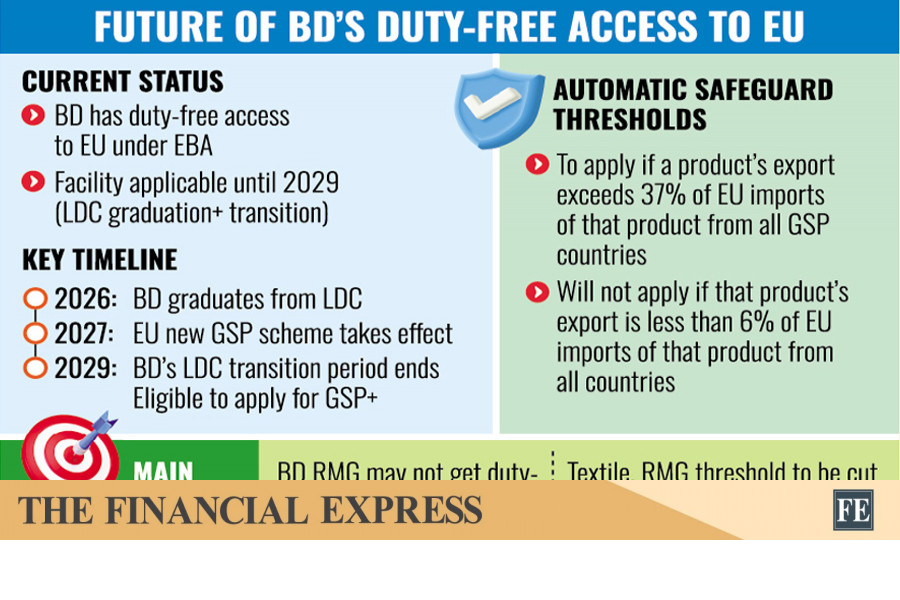
After the year 2029, Bangladesh will lose its duty-free market access to the EU under the current EBA or everything-but-arms facility and will eligible to apply for GSP-plus package deal, they say,

But locally made garment exports might not get the duty-free benefit under the EU's new GSP scheme.

The European Commission, its Council and Parliament on December 01 struck an agreement to revise the GSP scheme with effect from January 01, 2027 for ten years. The concessional-trade scheme, among others, confirms lower product-graduation thresholds, according to an EC statement available on its official website.

According to the proposed provision, the relevant threshold for Bangladeshi textile and garment exports to the EU - the main interest of Bangladesh - will be pared down to 37 per cent from the current 47.2 per cent after 2029 when Bangladesh's transition period would come to an end.

Asked about the latest trade paradigm, EU Ambassador and head of delegation to Dhaka Michael Miller through email communications responded that EBA beneficiaries such as Bangladesh are not subject to this threshold.

"The threshold applies only to standard GSP and GSP+ beneficiary countries."

Bangladesh will continue to benefit from the EBA scheme as long as it has LDC status, and, in addition, the benefits will also continue to be provided unilaterally by the EU during a 3-year transition period following the graduation, allowing them to prepare for the GSP or GSP+ requirements.

The EU will help Bangladesh meet GSP+ requirements throughout this period, through financing and the exchange of expertise, he says about the capacity-building assistance.

Explaining the threshold, the EU envoy says the automatic safeguards mechanism is not a novelty introduced by the new GSP Regulation, but an already existing tool and the European Commission has never activated the automatic safeguard mechanism because the relevant thresholds in the GSP Regulation have not been met so far.

More specifically, automatic safeguards would only kick in if a beneficiary country's export of a product meets the specified criteria such as exceeding 37 per cent of EU imports of the same products from all GSP-beneficiary countries.

The automatic safeguards will not apply if the beneficiary's exports of the relevant product do not exceed 6.0 per cent of EU imports of the same products from all countries -- whether or not they are GSP beneficiaries.

"At this point in time, it is not possible to foresee what the share of Bangladesh's exports will be when Bangladesh eventually graduates from the EBA arrangement," Mr Miller adds.

Responding to a query from The Financial Express, Dr MA Razzaque, chairman of Research and Policy Integration for Development (RAPID), has said if a country's share goes over 6.0per cent of total EU imports or 37 per cent of total GSP textile imports for three years in a row, safeguards can be applied, potentially removing duty-free access.

And Bangladesh's share is 24 per cent and around 47 per cent respectively, he mentions, apprehending the loss of the duty benefit which helped the country increase garment exports to the EU for last several years.

The EU as a bloc is Bangladesh's largest export destination, where RMG exports grew significantly over the past decade mainly because of the duty benefits, insiders say.


According to Eurostat data, Bangladesh's RMG exports to the EU were worth €11.54 billion in 2015, which climbed to €18.28 billion in 2024 in a remarkable 58.45-percent growth.

Due to the ramped-up US tariffs, Bangladesh's major competitors like China, Vietnam, India, and Cambodia are focusing on enhancing their EU market shares, insiders say.

Bangladeshi RMG will face 12-percent duty on the EU market after 2029, while it will gradually come down to zero for Vietnam by then because of the latter's free-trade agreement (FTA) with the 27-nation bloc, exposing products from Bangladesh to tough competition, they point out.

Talking to the FE, Fazlee Shamim Ehsan, executive president of Bangladesh Knitwear Manufacturers and Exporters Association (BKMEA), also echoes the view about same uneven competition as there would not be duty-free market access while Vietnam would achieve zero-rated duty.

He stresses diplomatic efforts from the government to withdraw the safeguard clauses and extension for the transition period for six years.

Mr Ehsan also notes that the industry also "must get ready by this time by enhancing its efficiency, productivity and diversification of both products and markets and reducing wastage rate".​
 
Analyze

Analyze Post

Add your ideas here:
Highlight Cite Fact Check Respond
Final round of talks on PCA begins in Dhaka tomorrow

Diplomatic CorrespondentDhaka
Updated: 06 Jan 2026, 22: 20

1767746967141.webp

Deputy managing director of the EU’s Asia and Pacific Division at the European External Action Service, Paola Pampaloni and secretary (East) of the Ministry of Foreign Affairs, Md Nazrul Islam. Collected

Talks to finalise the draft Partnership and Cooperation Agreement with the European Union are set to begin in Dhaka tomorrow, Wednesday.

Officials in Dhaka hope the two-day meeting will be the final round of negotiations ahead of signing the Partnership and Cooperation Agreement (PCA) by June.

Through the signing, Bangladesh expects a qualitative upgrade in its relations with the 27-member European bloc, the European Union.

Officials at the Ministry of Foreign Affairs said Paola Pampaloni, deputy managing director of the European External Action Service, arrived in Dhaka on Tuesday afternoon to attend the meeting scheduled to be held in the capital tomorrow.

She will lead the European Union side at the talks. The Bangladesh delegation will be led by Md Nazrul Islam, secretary (east and west) at the Ministry of Foreign Affairs.

Officials said that on Wednesday afternoon, delegations from both sides will meet for the fifth and final round of talks. They hope that after four rounds of discussions, the two-day meetings in Dhaka and Sylhet will finalise the draft PCA, which contains 83 clauses. After completing some formalities, preparations will be made to sign the agreement by June.


Officials at the Ministry of Foreign Affairs said that once the fifth and final round of talks nearly finalises the draft PCA, the European Union may take around two months to complete the administrative procedures.

Afterwards, it will be sent to Bangladesh. If everything proceeds smoothly, finalising the procedural matters could take several months after the formation of Bangladesh’s new government following the February elections.

In April last year, the first round of talks was held in Brussels to finalise the draft PCA. Subsequently, the second, third, and fourth rounds took place virtually in July and October.

Notably, Bangladesh is set to become the first South Asian country to sign a PCA with the EU. So far, within the broader Asian region, the EU has signed PCAs with Malaysia, Thailand, and Kazakhstan.

The proposed PCA with Bangladesh mentions cooperation in at least 35 areas, compared with 13, 15, and 19 sectors in the agreements with Malaysia, Thailand, and Kazakhstan respectively.

About 25 years ago, in 2001, Bangladesh and the EU signed a cooperation agreement focused primarily on development assistance. Through the new PCA, both sides aim to deepen that relationship, make it more multidimensional, and formally establish it on a political footing.

What is PCA and its significance

According to information published on the EU’s website, a PCA is a legally binding agreement that establishes a framework for cooperation between the EU and a partner country.

Through a Partnership and Cooperation Agreement, the EU engages with partner countries on political dialogue, peace and security, governance and human rights, trade, economy, and financial cooperation. In other words, it supports democratic and economic development. It also aims to ensure the development of a strong free-market economy and a conducive environment for business and foreign investment.

Strengthening trade relations and cooperation across various sectors is also part of its scope.

What the partnership agreement will include

Under the proposed PCA with Bangladesh, around 35 sectors are covered, including the rule of law, governance, human rights, labour rights, trade, investment, economic cooperation, connectivity, anti-money laundering, security, cyber security, climate change, energy, fisheries, skilled migration, and agriculture.

Once the PCA is signed, the existing cooperation agreement between Bangladesh and the EU will no longer be in effect. For context, Bangladesh signed a cooperation agreement with the EU in 2001, which covered areas such as the economy, development, governance, and human rights.

Aim of political advancement

To broaden the scope of relations between Bangladesh and the EU, a decision was taken on 25 October 2023 to begin discussions on a new EU-Bangladesh Partnership and Cooperation Agreement. The event in Brussels was attended by then-Prime Minister Sheikh Hasina and European Commission president Ursula von der Leyen.

Following this, the first round of PCA discussions was scheduled for September last year. However, considering the situation arising from the anti-discrimination student movement and mass uprising in Bangladesh, the EU had postponed the talks. Later, when the EU decided to sign the PCA with the interim government, informal discussions were held in Dhaka in November.​
 
Analyze

Analyze Post

Add your ideas here:
Highlight Cite Fact Check Respond

Members Online

Latest Posts

Back
 
G
O
 
H
O
M
E