| Global Defense, OSINT & Geopolitics Wire

Wars 2015 03/26 War Between Houthis and Saudi Arabia

Wars 2015 03/26 War Between Houthis and Saudi Arabia
13
306
More threads by Saif

G War Archive

Egypt’s entry into Yemen war makes situation ‘more difficult’: Iran

Agence France-Presse . Baghdad, Iraq

Iranian Foreign Minister Abbas Araghchi said on Wednesday that any interference in the Yemen war by Egypt or any other country would make the situation ‘more difficult’.

‘Egypt has sufficient experience to avoid entangling itself in such a highly complex conflict,’ said Iran’s top diplomat in an interview with Iraqi state broadcaster Al-Iraqiya aired on Tuesday.

‘We believe that any foreign presence or interference will only make resolving this issue more difficult,’ Araghchi noted.

He added that Egypt has said it ‘will not enter Yemen or engage in a war against Yemen’.

The decade-plus war between the Iran-backed Houthis and a Saudi-led coalition backing Yemen’s internationally recognised government reignited in July.

The Houthis seized much of Yemen’s Red Sea coastline in September and have since launched attacks on Saudi Arabia, including strikes on state oil giant Aramco and Riyadh’s international airport, where 13 people were killed on October 10.

Egypt’s parliament on Monday delayed a debate on President Abdel Fattah al-Sisi’s request to authorise military support for Saudi Arabia until next week.

Sisi had asked lawmakers to approve military support for Saudi Arabia if requested by the kingdom, which has come under near-daily attacks from Yemen’s Iran-backed Houthis.

Sisi said Egypt was not seeking to ‘confront or attack anyone’, adding: ‘We are speaking only about defence.’

Meanwhile, a ship was struck on Wednesday by an ‘unknown projectile’ off the coast of Oman, near the Strait of Hormuz, sparking a fire, a British maritime security agency said.

The tanker, 11 nautical miles off the town of Bukha, is ‘now at anchor’, the UKMTO reported.

‘All crew are reported as safe. There is no reported environmental impact at this time,’ it said.

The agency later reported another incident, which occurred on Tuesday off the coast of Iraq. A projectile hit a tanker 30 nautical miles from the town of Al Faw, causing no casualties or damage, the UKMTO said.

The Strait of Hormuz carried 20 per cent of the world’s oil and gas prior to the Middle East war, which erupted with US-Israeli strikes on Iran in late February.

Since then, Tehran has placed a chokehold on the shipping route and regularly targets ships that pass without its authorisation.

Washington has responded by maintaining a blockade on Iranian ports, and negotiations between the two countries are deadlocked.

Attacks on vessels attempting to cross the waterway have increased in recent days, as Washington escorts more ships through the strait and Tehran seeks to maintain control over their passage.​
 

KSA airport restrictions affect 141 flights, 21,933 passengers


1792797519501.webp


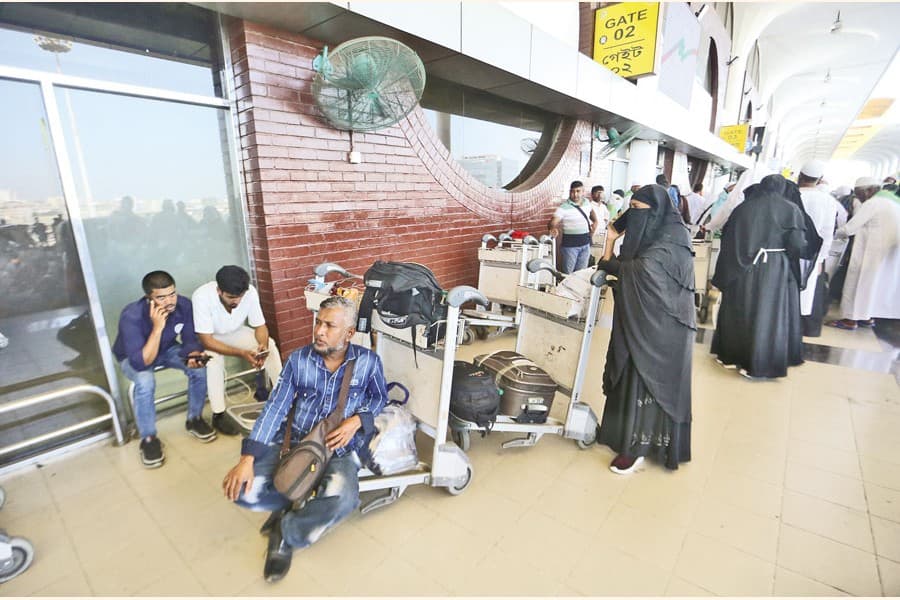
Operational restrictions at airports in Saudi Arabia have disrupted 141 flights carrying 21,933 passengers from Bangladesh, authorities said Friday.

According to Squadron Leader Sakib of ASM Flight Management, a total of 21,933 passengers have been affected so far, involving 66 direct flights and 75 transit flights.

Among direct flights, state-run Biman Bangladesh Airlines recorded the highest impact with 27 affected flights, followed by Saudia Airlines with 19, US-Bangla Airlines with 10, and Riyadh Airways with 10 flights.

In the transit flight category, Indigo Airlines suffered the most disruption with 29 affected flights. Other affected transit carriers include Emirates Airlines with 14 flights, Qatar Airways with nine, Fly Dubai with eight, Air India with seven, Salam Air with seven, and Egypt Air with one flight.​
 

Saudi missile plant expansion may produce more powerful missiles, study says

Reuters

Washington


1792799452598.webp

A satellite image shows the solid propellant motor plant in Al Duwadimi, Saudi Arabia, 12 December 2025.Reuters

Saudi Arabia appears to be expanding its ballistic missile factory to build larger solid-fuel missiles that could fly farther or carry heavier payloads, according to two US researchers who analyzed more than a year of commercial satellite images.

More capable missiles could help Saudi Arabia to deter attacks by Iran and make its military more self-reliant, while possibly strengthening its position in a deadly conflict with Yemen's Tehran-backed Houthi fighters.

But they risk fuelling a regional missile race and could deepen opposition in the US Congress to a US-Saudi civilian nuclear agreement that has already raised concerns about proliferation.

Satellite company Planet Labs, based in the US, took images of the al-Duwadimi complex about 125 miles (200 km) west of Riyadh between April 2025 and September 2026.

The two researchers, Sam Lair and Michael Duitsman of the Foreign Policy Research Institute, assessed that those images show a new building that houses casting pits — wells in which a mixture of fuel ingredients is poured into missile motor casings and allowed to harden.

The Saudi embassy and Information Ministry did not respond to requests for comment.

1792799490518.webp

A satellite image shows the solid propellant motor plant in Al Duwadimi, Saudi Arabia, 18 September 2026. Reuters

The building, flanked by what appear to be walls to protect nearby structures from accidental explosions, is at least twice as large as the one believed to house the plant’s existing casting pits, Lair and Duitsman said in their assessment. The Foreign Policy Research Institute (FPRI) is a non-partisan research organization in Philadelphia.

A second new building could be used to store fuel ingredients or finished missile components, they said.

The imagery "suggests that Saudi Arabia is expanding the infrastructure at the missile production complex, likely to produce larger missiles which could deliver larger payloads or reach longer ranges," they wrote.

Militaries favor solid-fuel missiles because they can be stored for long periods and launched more quickly than liquid-fuel systems.

Lair and Duitsman and experts from the London-based International Institute for Strategic Studies (IISS) and the CNA research and analysis organization told Reuters that the makeup of Saudi Arabia's missile force suggests that the al-Duwadimi complex relies on Chinese technology. Lair and Duitsman said that its characteristics also are similar to Chinese missile plants.

Saudi Arabia secretly acquired about 40 liquid-fuel DF-3 ballistic missiles from China in 1987, according to a 1991 declassified CIA estimate. It displayed two of them for the first time in an April 2014 military parade, according to a Youtube video and photographs of the event.

The FPRI team also recently identified from social media videos and photos what they assessed was the wreckage in Yemen of a Saudi-fired Chinese-designed DF-15 missile.

Lair said the kingdom may now be producing the solid-fuel DF-15, and that the expansion of a1-Dumadimi is likely for the production of the longer-range DF-21 or a similar missile.

Riyadh is believed to have turned to Beijing because Washington has long restricted exports of longer-range missile systems.

1792799538257.webp

A satellite image shows the solid propellant motor plant in Al Duwadimi, Saudi Arabia, 7 September 2025. Reuters

The Chinese embassy and defense ministry did not respond to requests for comment. The CIA declined to comment. The White House did not respond to a request for comment.

Missiles would alter the balance of power
Sascha Bruchmann, a research fellow at IISS, said longer-range missiles would allow Saudi Arabia to strike Iran without risking its US-supplied F-15 jet fighters against Iranian air defenses.

“You’d want a system to threaten whatever is holy to Tehran ... if you don’t have the political will to send an F-15 with JDAMs over Tehran,” said Bruchmann, referring to US-made satellite-guided bombs. “Iran has a lead because its missiles and drones can strike Saudi wherever it wants. The Saudis could close that capability gap a bit.”

Bruchmann, who reviewed the FPRI analysis at Reuters request, concurred that the expansion of al-Duwadimi could be for producing more powerful solid-fuel missiles.

Janes, the defense intelligence company, also reviewed it and said the buildings “may suggest an effort to expand production capability or support the development of longer-range missiles.”

Saudi Arabia's apparent pursuit of more powerful missiles comes as other Gulf powers are also seeking to expand their offensive and defensive arsenals, said Decker Eveleth, a CNA analyst who has been tracking the al-Duwadimi construction with commercial satellite imagery and concurred with the FPRI assessment.


1792799596881.webp

A satellite image shows the solid propellant motor plant in Al Duwadimi, Saudi Arabia, 7 September 2025. Reuters

“This is being replicated across the Middle East,” he said. “You see exactly the same thing happening in the UAE. You see the exact same thing happening in Turkey. Everybody is doing this now.”

The expansion of al-Duwadimi could have political consequences in the US by stiffening bipartisan congressional opposition to a US-Saudi agreement under which the US would help Riyadh establish uranium enrichment for power generation.

Opponents say that the deal lacks sufficient safeguards to prevent Riyadh from secretly building a nuclear weapon. The kingdom has denied any such plan.

Work began last year

The FPRI assessment said the Planet Labs imagery showed that the expansion at al-Duwadimi began in April 2025 with ground-clearing and digging for the suspected storage building. Work on the suspected casting-pit building began later that month or in early May, it said.

A December 12, 2025, photo showed what researchers assessed were two deep pits inside the building that had no roof yet.

A September 18, 2026, photo shows the roof still partly missing and "heavy duty blast diverting walls" on either side to prevent accidental explosions from damaging adjacent structures.

The walls, the researchers said, are somewhat similar to those depicted in imagery of US and Iranian missile plants and "further evidence the building is for casting solid propellant motors."

Finishing the roofs would not take long, the FPRI said, but installing casting equipment may take several months. The facility could be ready to start producing missiles as early as the end of the year.​
 

Saudi defence pact countries push for peace in Tehran as Houthis launch more attacks

Reuters
Karachi/Cairo


1793063952061.webp

Iranian President Masoud Pezeshkian meets with chief of Defence Forces of Pakistan, Field Marshal Asim Munir, Saudi Arabia's Defence Minister Prince Khalid bin Salman and Turkish intelligence chief, Ibrahim Kalin in Tehran, Iran, 26 October 2026. Reuters

Top officials from Saudi Arabia, Turkey and Pakistan met Iranian officials in Tehran on Monday in a bid to de-escalate the Middle East conflict, as Yemen's Houthis launched new attacks on Saudi Arabia and Egypt approved defence support for the Gulf kingdom.

The talks were the first high-level contact between Iran and the three nations — which signed the Mecca mutual defence pact in August — since a war that began with US and Israeli strikes on Iran also spread to Saudi Arabia and Yemen.

The Saudi Foreign Ministry said the visit was intended to open negotiating channels to "prevent the return of military escalation".

Saudi Arabia was represented by Defence Minister Prince Khalid bin Salman, younger brother of Crown Prince Mohammed bin Salman; Pakistan by army chief Field Marshal Asim Munir; and Turkey by intelligence chief Ibrahim Kalin, Saudi and Iranian officials said.

Iranian state media published pictures of Iranian President Masoud Pezeshkian, Foreign Minister Abbas Araqchi and Mohsen Rezaei, secretary of the Supreme National Security Council, attending the meetings. At the conclusion of the meetings, the four states agreed to continue talks with a view to strengthening cooperation, especially in peace and security, state media reported.

Pakistan and Qatar have led mediation efforts in the war. Qatari mediators were in Tehran on Sunday, an official told Reuters.

Earlier efforts helped produce an interim peace agreement in June but fighting between Iran and the United States soon resumed. Conflict then flared between the Iran-aligned Houthis and US ally Saudi Arabia, opening a new front.

US and Iran threaten new attacks

The wider fighting has restricted shipping through the energy chokepoint of the Strait of Hormuz, pushed up global oil and gas prices, left Gulf states facing missile and drone attacks, and caused a new humanitarian crisis in Yemen.

Tensions between Washington and Tehran have sharpened in recent days. President Donald Trump said on Friday the US may carry out another military operation against Iran. Iranian security officials told Reuters Tehran had drawn up detailed plans to attack Gulf undersea cables if the United States and Israel attack again.

The war, which earlier in the year also reignited fighting between Israel and the Iran-backed Lebanese Hezbollah militia, has eroded Trump's approval ratings ahead of the USmidterm elections that decide control of Congress.

Iranian Foreign Ministry spokesperson Esmaeil Baghaei said Monday's discussions would include "Israel’s expansionist policies, developments in the Palestinian territories and Lebanon, and the repercussions of US and Israeli military action against Iran".

Baghaei said the meeting, proposed when Munir visited Tehran last week, could be a first step towards establishing regional security mechanisms. A senior Pakistani security official said the focus of Monday's meeting was to build a regional non-aggression network. The agenda also included US-Iran talks, Houthi attacks on Saudi Arabia, the Strait of Hormuz and a US blockade of Iranian ports, the official said.

Another Pakistani official said Munir, with a go-ahead from Trump to try diplomacy, had presented Iran with a solution to the conflict. The current proposal would offer something to both the US and Iran, the official said, without giving details. The Mecca pact states and Qatar could act as guarantors if it was accepted, the official added.

An Iranian official had earlier said there would be no discussion of Iran's nuclear programme at Monday's meeting and the issue would not be addressed until Tehran's demands for ending the war were met. Those conditions include ending a US blockade of Iranian ports and lifting sanctions on Iranian oil exports. US Vice President JD Vance has said Iran must reduce nuclear enrichment to end the war.

Pakistan's military media office and Turkey's Foreign Ministry did not immediately respond to requests for comment.

Parliament approves Egyptian defence support for Saudis

Saudi Arabia has ⁠intensified strikes against the Houthis since they captured strategic areas along Yemen's Red Sea coast last month, advancing against Saudi-backed government forces. The Houthis have hit Saudi airports, ports and oil installations.

On Monday, the Houthis said they had attacked pumping stations on Saudi Arabia's East-West pipeline as well as Riyadh airport, which said it had resumed operations at two terminals a day earlier. There was no immediate Saudi confirmation of the Houthi attacks.

The parliament in Egypt, which has said it is considering joining the Mecca pact, on Monday authorised the Egyptian military to help defend Saudi Arabia, a major financial and political partner for Cairo.

The Mecca Joint Defence Agreement says signatories shall use "all necessary means" to eliminate threats to one another's territorial integrity, sovereignty or internationally recognised borders, according to a text seen by Reuters.

The pact's members held an emergency meeting in Riyadh this month and agreed to ensure the "rapid deployment" of military forces and capabilities in Saudi Arabia.

Efforts by Turkey’s parliament to ratify the agreement began last week and are still under way, while Pakistan approved the pact last week.​
 

How exposed is Bangladesh to a prolonged Saudi crisis?

Ahsan Habib


1793065454535.webp


Bangladesh is unlikely to see an immediate fall in remittances from Saudi Arabia even as Houthi attacks on the kingdom intensified from early October, but a slowdown in new migration could weigh on inflows in the years ahead.

Following the attacks, migration to Saudi Arabia, the largest destination for Bangladeshi workers, has already been disrupted. As of Sunday, 144 direct and transit flights had been affected by prolonged flight restrictions at Saudi airports, disrupting the travel plans of around 22,000 passengers.

But economists and manpower experts say remittance inflows are unlikely to be hit immediately because newly arrived migrant workers typically take about a year to start sending significant amounts of money home.

According to them, the longer-term impact will depend on the duration of the crisis, the performance of the Saudi economy and demand for labour, particularly in construction.

A prolonged crisis that damages the Saudi economy could slow job creation and reduce workers’ incomes. But the outcome is not necessarily negative for the kingdom’s economy.

If Houthi missile and drone attacks continue without damaging oilfields and refineries, higher global oil prices could boost Saudi revenues, potentially supporting investment and demand for foreign workers, according to Zahid Hussain, a former lead economist at the World Bank’s Dhaka office.

“But everything is uncertain so far,” he commented.

Remittances are a major source of foreign currency for Bangladesh, accounting for around 7.5 percent of gross domestic product, according to World Bank data. Their importance has grown amid volatility in global energy markets following the US-Israel’s war on Iran, which has sent shockwaves through sectors ranging from agriculture to the garment industry.

In the July-September quarter of the current fiscal year, Saudi Arabia remained Bangladesh’s largest source of remittances. Inflows from the kingdom rose to $1.65 billion, up from $1.23 billion in the same period of FY26, according to Bangladesh Bank data.

The kingdom accounted for 19.20 percent of Bangladesh’s total remittance inflows in the first quarter of FY27, compared with 16.26 percent a year earlier.

During the July-September quarter, overall remittances reached around $8.59 billion, with Gulf Cooperation Council (GCC) countries continuing to account for the bulk of transfers.

DIVERSIFYING OVERSEAS JOBS IS BECOMING URGENT

The latest disruption shows Bangladesh’s heavy reliance on a handful of overseas labour markets, leaving migrant workers and the economy exposed to regional crises.

Since FY2014-15, Saudi Arabia has employed around half of the 96 lakh Bangladeshis who went abroad for work. Workers in the kingdom have sent home an average of $5 billion a year.

The pressure on migration is already evident. Overseas employment fell 36 percent year-on-year to 134,000 in the July-August period this year, following a decline to around 969,000 workers in FY26, the lowest level in five years, according to Bureau of Manpower, Employment and Training data.

Tasneem Siddiqui, executive director of the Refugee and Migratory Movements Research Unit (RMMRU), a local think tank, said the crisis exposed the structural weaknesses of the country’s migration sector.

“Therefore, rather than relying on piecemeal decisions, we must completely overhaul and diversify the manpower market. Otherwise, one crisis after another will emerge, leaving us perpetually vulnerable,” said Tasneem, also a political science professor at Dhaka University.

She said the government needs a long-term strategy to develop skills suited to specific overseas markets and expand employment opportunities beyond traditional destinations.

“Long-term strategic planning is essential. Particularly, allocating a mere 0.08 percent of the budget for a $35 billion remittance sector is grossly insufficient to accomplish meaningful interventions,” she said.

Meanwhile, economist Zahid said Bangladesh should target countries facing ageing populations and labour shortages, including Japan and countries in eastern Europe, where demand for workers in nursing, caregiving and manufacturing could offer alternatives to Middle Eastern markets.

Google News LinkFor all latest news, follow The Daily Star's Google News channel.
Sayema Haque Bidisha, an economics professor at Dhaka University, also called for greater diversification of migration destinations, stronger diplomatic engagement and better support for expatriates through overseas missions.

She said Bangladesh needs to improve its international image by demonstrating that its workers can fill skilled jobs, rather than being seen primarily as a source of manual labour.

Shariful Hasan, associate director of BRAC’s Migration Programme and Youth Platform, said earlier this month that many Bangladeshi workers in Saudi Arabia depend on daily or weekly employment and that security concerns have reduced work opportunities.

PAKISTAN FACES GREATER EXPOSURE THAN INDIA

Bangladesh is not the only country with a significant reliance on remittances from Saudi Arabia.

Its neighbour India and Pakistan also depend on money sent home by their citizens working in the kingdom, although the potential impact varies.

Saudi Arabia is Pakistan’s largest source of remittances, contributing $9.78 billion in the last fiscal year, according to State Bank of Pakistan data.

Meanwhile, around 7 percent of India’s international remittance inflows originate from Saudi Arabia. The country receives about $8 billion annually from the kingdom, according to the Reserve Bank of India.

A prolonged crisis that affects employment and earnings in Saudi Arabia could therefore have a greater impact on Pakistan than on India, given Pakistan’s substantial reliance on the kingdom as a source of remittances.​