| Global Defense, OSINT & Geopolitics Wire

Wars 2026 02/28 Israel-Iran War 3.0

Wars 2026 02/28 Israel-Iran War 3.0
383
11K
More threads by RayKalm

G War Archive

Iran military warns will block Red Sea if US naval blockade continues

AFP
Tehran, Iran
Published: 15 Apr 2026, 19: 47
1776299284330.webp

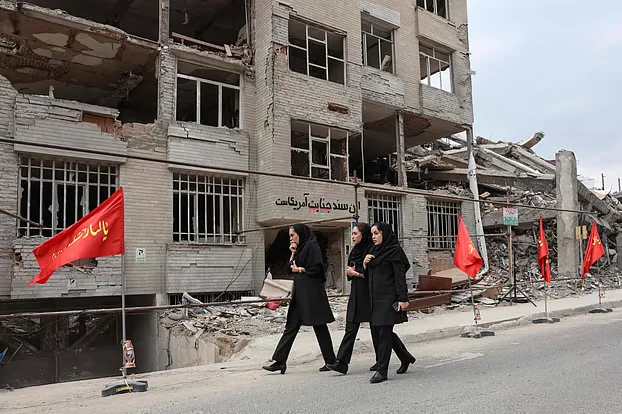
Iranian women walk past a residential building destroyed in a US-Israeli airstrike, in Tehran on April 13, 2026. AFP

Iran's military warned on Wednesday it would block trade through the Red Sea, along with the Gulf and Sea of Oman, if the US naval blockade on Iranian ports continues.

In a statement carried by Iranian state television, the head of the military's central command centre said if the US continues with its blockade and "creates insecurity for Iran''s commercial vessels and oil tankers", it will also constitute "a prelude" to violating the ceasefire.

"The powerful armed forces of the Islamic republic will not allow any exports or imports to continue in the Persian Gulf, the Sea of Oman, and the Red Sea," said Ali Abdollahi.

He added that Iran will "act decisively to defend its national sovereignty and its interests".

The United States has imposed a naval blockade on Iranian ports since Monday after US-Iran talks over the weekend in Pakistan failed to produce a deal to end the war.

But maritime tracking data on Tuesday indicated that several ships sailing from Iranian ports had crossed the Strait of Hormuz despite the blockade.

On Wednesday, Iran's Tasnim news agency quoted unnamed informed sources as saying that shipping from Iran''s southern ports had continued.

It added that Iranian "commercial vessels have set sail for various destinations around the world" during the past 24 hours.​
 

US threatens to resume strikes if Iran spurns peace offer

AFP
Washington, United States
Published: 16 Apr 2026, 21: 59

1776385850319.webp

US Secretary of Defense Pete HegsethReuters file photo

The United States threatened Thursday to resume air strikes on Iran and maintain a naval blockade of its ports if Tehran refuses to accept a deal to end the war that has engulfed the Middle East.

The warning came as the influential chief of Pakistan's armed forces visited Iran's peace negotiators in Tehran as part of his country's diplomatic efforts to arrange a new round of talks between the foes.

Iranian state television showed Pakistan's Field Marshal Asim Munir meeting Iran's speaker of parliament, Mohammad Bagher Ghalibaf, who led the Iranian delegation at the first US-Iran meeting in Pakistan last week, which ended without a deal.

"If Iran chooses poorly, then they will have a blockade and bombs dropping on infrastructure, power and energy," Defense Secretary Hegseth told a news conference at the Pentagon.

Earlier, White House Press Secretary Karoline Leavitt had told reporters that further talks "would very likely" be in the Pakistani capital.

"Those discussions are being had," Leavitt said, and "we feel good about the prospects of a deal."

But, despite Washington's expectation of renewed talks, the US warned it would maintain its blockade of Iranian ports and use the two-week window afforded by the temporary ceasefire to rearm its forces.

General Dan Caine, the top US military officer, said the naval blockade "applies to all ships, regardless of nationality, heading into or from Iranian ports."

"If you do not comply with this blockade, we will use force," he said.

''Historic crossroads''

Pakistani foreign ministry spokesman Tahir Andrabi said no date had been set for the next round of talks.

"Our role as a mediator and facilitator did not stop when the Islamabad talks, this last round, concluded -- it continued," he said.

US Vice President JD Vance, who led the first round of talks, has said Iran is being offered a "grand bargain" to end the six-week war with Israel and the United States and address the decades-old dispute over Tehran's nuclear programme.

Israel's defence minister Israel Katz said: "Iran is standing at a historic crossroads: one path is renouncing the ways of terror and nuclear armament... in line with the US proposal, the other leads to an abyss.

"If the Iranian regime chooses the second path, it will quickly discover there are even more painful targets than those we have already struck."

Shipping in the strait, through which one-fifth of the world's crude oil normally flows, has been disrupted by Iranian forces since the US-Israeli offensive began and is now the focus of the US blockade.

Washington has sought to turn the screws on Tehran with a blockade of its ports, with US Central Command claiming to have "completely halted economic trade going into and out of Iran by sea".

CENTCOM said it had already turned back 13 vessels that tried to sail out of Iranian ports.

Keeping up the pressure, the United States slapped fresh sanctions on Iran's oil industry Wednesday, which Treasury Secretary Scott Bessent said targeted "regime elites".

Unless Washington relents, Iran's armed forces "will not allow any exports or imports to continue in the Persian Gulf, the Sea of Oman and the Red Sea," said the head of the Iranian military's central command centre Ali Abdollahi.

The military advisor to Iran's supreme leader Mojtaba Khamenei also warned that Iran would sink American ships in the strait if the United States decides to "police" the key shipping channel.

"These ships of yours will be sunk by our first missiles," Mohsen Rezaei, a former commander-in-chief of Iran's Revolutionary Guards who was named as a military advisor by Khamenei last month, told state TV.

No nuclear weapons

Trump has insisted that any deal with Iran must permanently bar the Islamic Republic from acquiring a nuclear weapon.

He launched the war on 28 February, claiming that Tehran was rushing to complete an atomic bomb, an assertion not backed by the UN nuclear watchdog.

Washington has reportedly sought a 20-year suspension of Iran's uranium enrichment programme, while Tehran has proposed suspending nuclear activity for five years -- an offer US officials rejected.

Tehran insists its nuclear programme is for civilian purposes.

Its foreign ministry said Wednesday that Iran's right to enrich uranium was "indisputable", although the level of enrichment was "negotiable".​
 

Iran used Chinese spy satellite to target US bases, FT reports, Beijing denies story

Reuters
Published: 16 Apr 2026, 19: 42

1776386371846.webp


A damaged U.S. Boeing E-3 Sentry aircraft following an Iranian strike at Prince Sultan Air Base in Saudi Arabia on 29 March 2026 via social media. Reuters

Iran secretly acquired a Chinese spy satellite in late 2024 that has allowed it to target US military bases across the Middle East during the current war, the Financial Times reported on Wednesday, an account Beijing dismissed as untrue.

The TEE-01B satellite, built and launched by Chinese company Earth Eye Co, was acquired by the Islamic Revolutionary Guard Corps' Aerospace Force after it was launched into space from China, the report said, citing leaked Iranian military documents.

Iranian military commanders ⁠directed the satellite to monitor major US military sites, the newspaper said, citing time-stamped coordinate lists, satellite imagery and orbital analysis. The images were taken in March before and after drone and missile strikes on those locations, the Financial Times said.

As part of the deal, the IRGC received access to commercial ground stations operated by Emposat, a Beijing-based provider of satellite control and data services with a network extending across Asia, Latin America and other regions, according to the report.

The Chinese foreign ministry on Wednesday denied the report, calling it untrue.

"Recently, some forces have been keen on fabricating rumours and maliciously associating them to China," the ministry said in a statement to Reuters.

"China firmly opposes this kind of practice ⁠driven by ulterior motives," read the statement.

Reuters could not verify the report.

The White House, CIA and the Pentagon did not immediately respond to Reuters' requests for comment. Earth Eye Co and Emposat also did not immediately respond to Reuters queries.

The report said the White House did not comment on the relationship between Emposat and the IRGC, but a spokesperson referred to comments U.S. President ⁠Donald Trump made at the weekend when he warned that China would face "big problems" if it provided Iran with air defence systems.

When asked about the matter, the Chinese embassy in Washington told the newspaper: "We firmly oppose relevant parties spreading speculative and insinuative disinformation against ⁠China."

The satellite captured images of Prince Sultan Air Base in Saudi Arabia on March 13, 14 and 15, the report said.

On March 14, Trump confirmed U.S. planes at the base had been hit.

According to the report, the satellite also monitored ⁠the Muwaffaq Salti Air Base in Jordan and locations close to the U.S. Fifth Fleet naval base in Manama, Bahrain, and Erbil airport, Iraq, around the time of IRGC-claimed attacks on facilities in those areas.​
 

Significant differences remain between Iran-US, including on nuclear issues, senior Iranian official says

REUTERS

Published :
Apr 18, 2026 00:06
Updated :
Apr 18, 2026 00:06

1776470327318.webp


A satellite image shows the ship movement at the Strait of Hormuz on April 17, 2026, in Space. Photo : EUROPEAN UNION/COPERNICUS SENTINEL-2/Handout via REUTERS

Significant differences between Iran and the United States remain to reach a deal aimed at ending ‌the war, a senior Iranian official told Reuters on Friday, adding that keeping the Strait of Hormuz open is "conditional on U.S. adherence to the ⁠terms of ceasefire".

The official, who spoke on condition of anonymity, said "no agreement has been reached on the details of the nuclear issues," and serious negotiations are required to overcome differences.

He said Tehran hoped that a preliminary agreement could be reached in ‌the ⁠coming days with mediator Pakistan’s efforts, with the possibility of extending the ceasefire to "create space for more talks on lifting sanctions ⁠on Iran and securing compensation for war damages".

"In exchange, Iran will provide assurances to the international ⁠community about the peaceful nature of its nuclear programme," he said, adding ⁠that any other "narrative about the ongoing talks is a misrepresentation of the situation".​
 

Hormuz passage ‘completely open’ for rest of ceasefire: Iran FM

AFP
London
Published: 17 Apr 2026, 20: 15

1776472515804.webp

Cargo ships in the Gulf, near the Strait of Hormuz, as seen from northern Ras al-Khaimah, near the border with Oman’s Musandam governance, amid the US-Israeli conflict with Iran, in United Arab Emirates, 11 March, 2026. Reuters

Oil prices plunged more than 10 per cent on Friday after Iran said the Strait of Hormuz would be “completely open” for the rest of the ceasefire with the United States, and stock markets surged.

Iran’s Foreign Minister Abbas Araghchi said on X that “passage for all commercial vessels through Strait of Hormuz is declared completely open for the remaining period of ceasefire”.

The strategic waterway, through which one-fifth of the world’s crude oil normally flows, has been disrupted by Iran since the US-Israeli offensive began, sending oil prices to a peak of nearly $120 a barrel and threatening to disrupt the global economy.

Both the benchmark international contract Brent and its US equivalent WTI fell below $90 per barrel.

“This news is having an immediate impact on markets,” said Kathleen Brooks, research director at XTB.

Wall Street’s main stock indices jumped at the opening bell, with both the S&P 500 and the Nasdaq Composite building on record highs struck the previous evening.

“This is the biggest development so far during the ceasefire, and it gives hope that the war will end soon, and supply chains will return to some normality,” Brooks said.

It was not clear whether Araghchi was speaking of the 10-day truce agreed by Lebanon and Israel that went into effect at midnight or an earlier two-week truce between Iran and the United States that began on April 8.

But Araghchi’s declaration bolstered hopes for further peace talks and a renewal of the the ceasefire, despite US President Donald Trump saying that the US blockade of Iran’s ports remains in force.

French President Emmanuel Macron and UK Prime Minister Keir Starmer were chairing a meeting of allies Friday to consider sending a multinational force to ensure free-flowing trade in the Strait of Hormuz once the conflict ends.

1776472564879.webp

Iran’s Foreign Minister Abbas Araghchi speaks to the press during a visit to the shrine of slain Hezbollah leader Hassan Nasrallah in Beirut's southern suburbs on 8 January, 2026 File photo

David Morrison at Trade Nation noted that the speed and the magnitude of the rebound of the S&P 500 -- nearly 12 per cent in just over two weeks -- was reinforcing the rally.

“The sharpness of the move has caught many investors offside, particularly those who sold during the first few weeks of the war, either to flatten their exposure or go net short,” he said.

“Now these investors are having to pay up to re-establish their existing positions, or cover their shorts and suffer painful losses.”

He said the “fear of missing out” effect is also back as stock indices move into record territory, especially as the first-quarter reporting season is showing strong earnings growth.

European stocks were higher in afternoon trading, with both Frankfurt and Paris gaining two per cent.

Asian stock markets mostly closed lower, with Tokyo among the biggest losers after reaching a record high Thursday, and Taiwan’s TAIEX index dropped after hitting a market capitalisation of $4.14 trillion.

That put the index ahead of London’s benchmark FTSE 100 and made the TAIEX the world’s seventh-biggest index by value, according to Bloomberg data.

Key figures around 1330 GMT

Brent North Sea Crude: DOWN 9.9 per cent at $89.56 a barrel

West Texas Intermediate: DOWN 10.2 per cent at $81.88 a barrel

New York - Dow Jones: UP 1.3 per cent at 49,221.56 points

New York - S&P 500: UP 0.7 per cent at 7,092.15

New York - Nasdaq Composite: UP 0.9 per cent at 24,317.32

London - FTSE 100: UP 0.5 per cent at 10,64.51

Paris - CAC 40: UP 2.0 per cent at 8,427.69

Frankfurt - DAX: UP 2.2 per cent at 24,688.97

Tokyo - Nikkei 225: DOWN 1.8 per cent at 58,475.90 (close)

Hong Kong - Hang Seng Index: DOWN 0.9 per cent at 26,160.33 (close)

Shanghai - Composite: DOWN 0.1 per cent at 4,051.43 (close)

Euro/dollar: UP at $1.1833 from $1.1784 on Thursday

Pound/dollar: UP at $1.3579 from $1.3529

Dollar/yen: DOWN at 158.41 yen from 159.14 yen

Euro/pound: UP at 87.17 pence from 87.09 pence​