[🇧🇩] Agro exports from Bangladesh

[🇧🇩] Agro exports from Bangladesh
10
346
More threads by Bilal9

G Bangladesh Defense
I don't know if I fully agree on the viability of potatoes as a "profitable" crop. Unless you are value adding by processing and making fermented alcohol from it (i.e. Vodka). Which may not be useful for us. Of course there are potato chips etc. and other snacks.

Potatoes are one of the cheapest vegetables available - you go to India, they eat cheap potatoes exclusively and make all sorts of snacks from it (Ghugnee, Pani Puri, Pao Bhaji). A Bangladeshi snack called "Potata" is very profitable in India, because it is cheap.

1765911659821.webp


Thereby - profits from other specialty vegetables may be higher than from potatoes. Once a proper cold chain can be established, we can export far more profitable vegetables and make much more revenue.
 

Agro, vegetable exporters hit hard, seek market diversification

Freight charges on risky routes more than double

Jasim Uddin
Published :
Mar 26, 2026 00:37
Updated :
Mar 26, 2026 00:37

1774484732027.webp


Bangladesh's agro-processed food and vegetable exporters lament irreparable business losses as the ongoing Middle East war chokes key Gulf trade routes, halts shipments and drives up freight costs.

Industry insiders say exports to major destinations in the Arab world such as the UAE, Qatar, Bahrain and Kuwait have plummeted, following shipment delays and cancellations.

Facing mounting uncertainty, some leading agro-based food companies have begun restructuring operations to contain losses and maintain liquidity.

One such exporter has suspended product supply to the domestic market, too, amid fuel shortages and fears of power outages, while advising all business units to revise pricing and prioritise high-margin essential products.

Production of non-essential items is being scaled back, with a stronger focus on preserving raw materials and avoiding wastage during the ongoing logistical crisis.

The company has also instructed its units to accelerate the recovery of outstanding payments and rely on existing inventories to keep markets supplied until the situation stabilises.

Seeking anonymity, a senior official has said business-unit heads have been asked to reassess available raw materials and determine production priorities in line with market realities.

"Raw materials should be preserved rather than used for non-essential products. We are focusing only on basic items with better margins, while avoiding low-margin production given the severity of the crisis," the official said.

He added that unsold goods produced at earlier prices are being released quickly into the market to maintain cash flow, while distribution channels are being kept active using existing dealer stocks.

Industry insiders warn that prolonged disruption to Gulf trade routes could lead to significant export losses, particularly for perishable agro-and vegetable products unless alternative logistics and market-diversification measures are put in place quickly.

Talking to the FE, Proshanta Kumar Ghosh, DGM (Export) of ACI Foods Limited, said most carriers are now unwilling to accept containers that usually move through the Strait of Hormuz -- a hotspot in the US-Israel war against Iran -- forcing exporters to halt shipments or seek alternative routes.

"As a result, our key markets in the Gulf are now fully stocked," he said, adding that shipments via the Red Sea route through Jeddah are continuing, though under significant constraints.

Freight costs have more than doubled amid the disruption. The average cost of shipping a 20-foot container to Jeddah has surged to $5,000 from around $2,000.

"Even our previously negotiated rate of $1,900 per container is no longer being honoured, and we are now shipping at $5,000," he added.

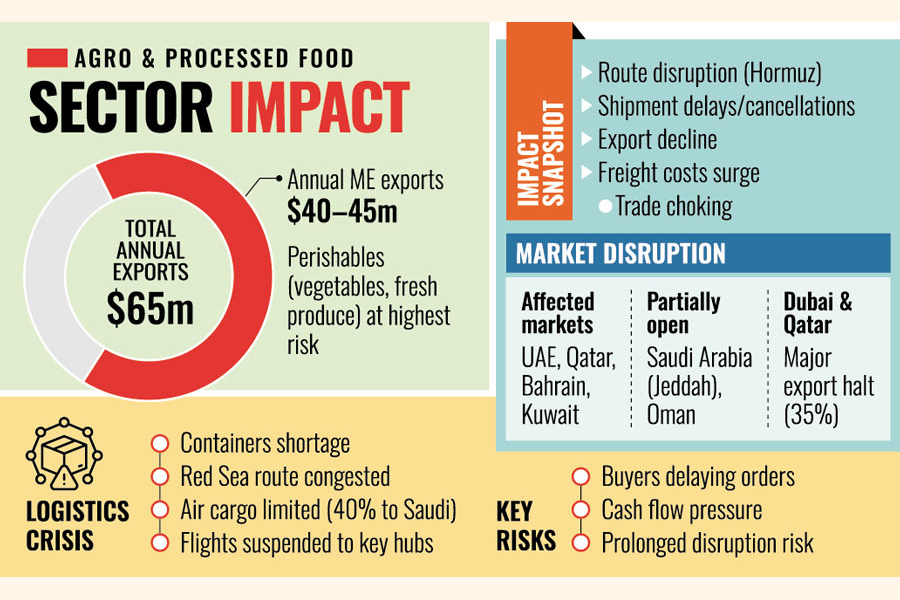
Exporters are also grappling with an acute shortage of containers as most shipments are being diverted to the Red Sea corridor, further straining logistics.

Buyers in the region have turned cautious, delaying import decisions due to uncertainty over supply chains and the potential escalation in the crisis, exporters said.

Kabir Ahmed, former president of BAFFA, says Bangladesh's general trade with the Gulf has effectively stalled due to the disruption to the Strait of Hormuz, a critical maritime route linking the region with global markets.

However, he notes that fuel shipments are continuing partially, while some trade with Saudi Arabia is being maintained through air freight -- accounting for up to 40 per cent of usual volumes -- as a limited number of airlines remain operational.

Air connectivity with Dubai, the UAE, Qatar, Oman and Bahrain has, however, remained largely suspended in recent days, further affecting bilateral trade, particularly for perishable items such as vegetables and fresh produce.

Eleash Mridha, Managing Director of PRAN Group, says export to Saudi Arabia is continuing through Jeddah airport, while shipments to Oman remained uninterrupted. However, exports to Dubai and Qatar -- two of the company's largest markets -- have been halted, accounting for nearly 35 per cent of its regional exports.

The disruption has been particularly challenging for vegetable exporters, as delays and logistical bottlenecks increase the risk of spoilage and financial losses.

According to industry estimates, Bangladesh exports agro- and processed-food products worth around $40-45 million annually to the Middle East, while the broader agro-sector earned about $65 million in the last fiscal year.

Stakeholders warn that if the disruption persists, it could have a prolonged impact on exporters, particularly those dealing in perishable and fast-moving consumer goods. They have urged support measures and market diversification to mitigate risks.​
 

Potato exports rise, but farmers struggle as prices plunge
Experts call for community cold storage, public procurement

Yasir Wardad

Published :
Apr 03, 2026 08:30
Updated :
Apr 03, 2026 08:30

1775261993063.webp


Bangladesh's potato exports are rising, but farmers continue to face losses as domestic prices remain at historic lows.

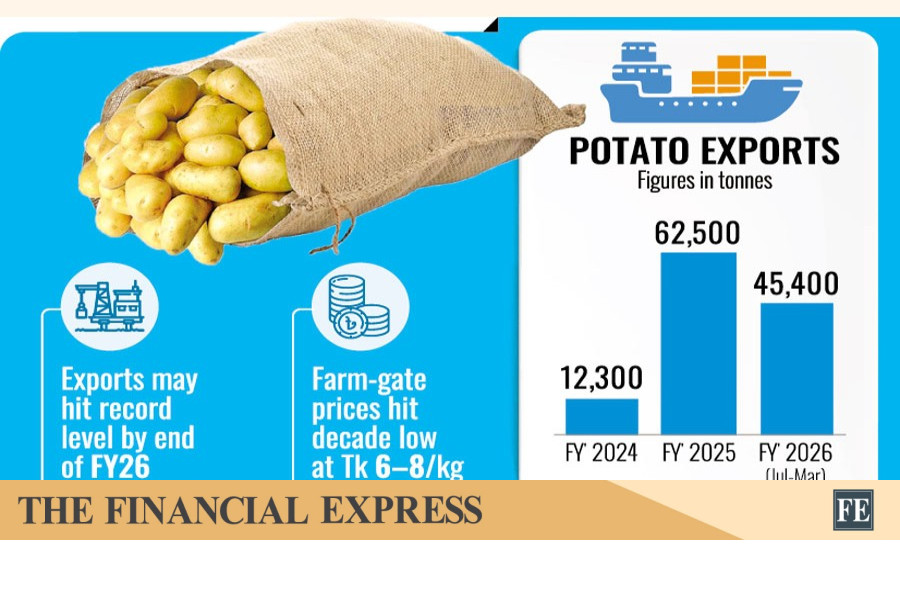
According to the Plant Quarantine Wing under the agriculture ministry, exports reached 45,400 tonnes during the July-March period of the current fiscal year (FY26), up from 34,600 tonnes in the same period last fiscal year.

The country exported a total of 62,500 tonnes of potatoes in FY2025, compared to just 12,300 tonnes in FY2024.

Deputy Director of the Plant Quarantine Wing AKM Mafidul Islam told The Financial Express that the April-June period is crucial for potato exports, and shipments this year could surpass the previous record of 0.1 million tonnes, driven by strong demand from Vietnam.

He said the quarantine process has been modernised and simplified, encouraging more exporters.

"We have worked hard to get Vietnam to accept Bangladeshi potatoes," he said. "Exports may surpass last year's 62,000 tonnes and could even set a new record."

However, the domestic market has seen little benefit from the export growth. Farm-gate prices have fallen to Tk 6.0-8.0 per kg, the lowest level in a decade, according to the Department of Agricultural Marketing.

In Dhaka, potatoes are selling at Tk 18-20 per kg, a six-year low, according to the Trading Corporation of Bangladesh.

Orun Kumar Ray, a farmer in Khansama of Dinajpur, said production costs have surged due to higher fertiliser and irrigation expenses, while prices have dropped further following last year's losses.

"The production cost in my area is at least Tk 15 per kg, while the maximum selling price is only Tk 8.0 per kg," he said.

"Big farmers who can store potatoes in cold storage may still earn some profit if prices rise in the coming months."

Dr Dilshad Zahan Ethen, head of the agribusiness and marketing department at Bangladesh Agricultural University (BAU), said the rise in exports is encouraging, especially with around one million tonnes of surplus potatoes available.

She said opening Eastern European markets could further boost shipments.

"But farmers need access to cold storage at the union level to preserve part of their produce," she said.

She urged the government to develop community-based cold storage facilities to strengthen farmers' bargaining power.

She also suggested that the government procure potatoes for its food rationing programme, similar to rice, to help stabilise prices.

"The peasantry has faced losses for two consecutive years," she warned, "which could discourage potato farming in the next season."

Potato production hit an all-time high of 11.57 million tonnes in FY25, and the government expects output to reach around 12 million tonnes in FY26 due to favourable weather.​
 

Latest Posts

Back