| Global Defense, OSINT & Geopolitics Wire

[🇧🇩] Automobile Industry of Bangladesh including parts

[🇧🇩] Automobile Industry of Bangladesh including parts
93
10K
More threads by Saif

G Bangladesh Defense

Toyota Tsusho to invest additional Tk 141cr in Bangladesh

Star Business Report

1793492278836.webp


Toyota Tsusho Corporation, the trading arm of Japanese carmaker Toyota Group, is investing an additional Tk 141 crore, or 1,815 million yen, in its Bangladesh subsidiary to expand and strengthen its automotive business here.

In a stock exchange disclosure dated October 30, Toyota Tsusho announced that it would inject the amount into Toyota Bangladesh Ltd, raising the subsidiary’s capital to Tk 604 crore (7,770 million yen).

The announcement came a day after Prime Minister Tarique Rahman visited Toyota’s Motomachi plant in Nagoya as part of his four-day visit to Japan. Earlier in October, a delegation led by Toyota Tsusho Vice Chairman Ichiro Kashitani met the PM in Dhaka and informed him of the company’s plan to establish a Toyota vehicle manufacturing plant in Bangladesh, according to a UNB report.

Toyota also informed the PM that it would begin work in 2027 to establish a hybrid electric vehicle manufacturing facility in an economic zone under the development vision of “With Bangladesh, for Bangladesh”, with full-scale production targeted for 2029, the report added.

In its stock exchange filing on October 30, Toyota Tsusho did not disclose specific plans for the additional investment but added that, following the investment, Toyota Bangladesh would become a specified subsidiary of Toyota Tsusho, as its capital would exceed 10 percent of the Japanese company’s capital.

Toyota Tsusho Asia Pacific Pte Ltd, a Singapore-based subsidiary of the Japanese group, holds 99 percent of Toyota Bangladesh, while Toyota Tsusho directly owns the remaining 1 percent.

Established in August 2025, Toyota Bangladesh serves as Toyota Tsusho’s base for expanding its mobility business in the country. Its operations cover the import, wholesale and retail of Toyota vehicles and spare parts, alongside after-sales services.

Toyota Bangladesh reported net sales of Tk 7.5 crore for the fiscal year ended March 31, 2026, while its loss attributable to owners of the parent stood at Tk 1.4 crore.

Its total assets stood at around Tk 90 crore, while consolidated equity was Tk 65 crore during the period, according to the disclosure.

Toyota Tsusho said the additional investment would have a negligible impact on its business performance and financial position for the fiscal year ending March 2027.

An official of Toyota Bangladesh said the company had selected Continental Works Limited in Dhaka and Carboy Private Limited in Chattogram to provide genuine spare parts, engine oil and after-sales services to Toyota customers here.

“Our company is investing in Bangladesh because of the market’s strong growth potential,” the official said, expressing confidence that demand for Toyota vehicles and related services would increase in the coming years.

The official added that services would not be limited to buyers of brand-new Toyota vehicles.Existing Toyota owners would also be able to access genuine spare parts, engine oil and servicing facilities through the selected partners.​
 

Auto policy fails to drive manufacturing growth

Jagaran Chakma


1794528527197.webp


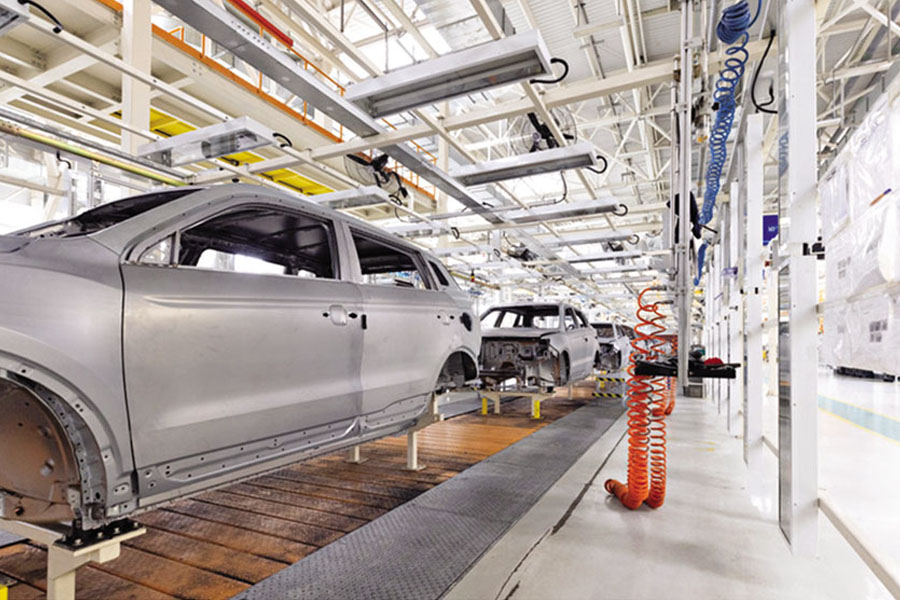
Five years after the launch of the country’s first automobile industry policy, the ambition of becoming a regional vehicle manufacturing hub by 2030 remains largely unfulfilled.

Introduced in September 2021, the policy aimed to reduce dependence on imported vehicles, promote electric transport and attract investment in local production through tax incentives, lower import duties and other benefits.

Since then, several local companies have started assembling vehicles in partnership with Japanese, South Korean and Chinese automakers. At least five companies, including state-owned Pragati Industries and private firms Fair Technology, Rancon and Meghna Group, are now assembling passenger cars.

Industry insiders estimate that around Tk 2,500 crore was invested in the first two and a half years after the policy’s launch. However, the extent to which this has increased production capacity and local sourcing of parts remains unclear.

They say a wide gap persists between the policy’s promises and its implementation.

Subrata Ranjan Das, managing director of ACI Motors, said the policy had set the right direction, but implementation had fallen short of expectations.

Investors need a stable duty structure, clear incentives and faster approvals, he said. The policy’s success should be measured by actual investment, local production and domestic value addition.

On electric mobility, Subrata said EVs would gain wider acceptance only if they became affordable. Reasonable prices, reliable charging facilities, battery warranties and access to financing are essential to encourage buyers.

He suggested initially focusing on two- and three-wheelers, city buses and commercial fleets, while promoting local production of batteries and other components.

However, economic pressures following the Covid-19 pandemic, political disruptions and global crises have slowed investment and market growth, making the 2030 target increasingly unrealistic. He called for a more practical roadmap focused on higher production, local suppliers, skilled workers and competitive costs.

Mir Masud Kabir, managing director of Bangladesh Auto Industries Ltd, said the government had held two rounds of discussions with stakeholders on the proposed Automobile Policy 2026–2031. However, concerns remained over the implementation of the existing policy.

He said the government aimed to raise EVs’ share of the market to 30 percent by 2030, but the broader automobile policy was still receiving insufficient attention.

Taskeen Ahmed, director of IFAD Autos PLC, said Bangladesh had made some progress in attracting private investment and setting up assembly plants, but actual investment, technology transfer and local production of vehicle parts remained limited.

Despite the slow progress, new investment plans by major international automakers have raised hopes for expanding local production.

Japan’s Toyota Tsusho Corporation plans to set up a hybrid electric vehicle manufacturing plant in an economic zone, with work expected to begin in 2027 and full-scale production targeted for 2029.

Meanwhile, local manufacturer Runner Automobiles PLC has partnered with Chinese EV maker BYD to produce electric cars in the country.

However, the EV industry faces several challenges, including a shortage of charging stations, energy supply constraints, limited financing, a lack of skilled workers and inadequate battery recycling facilities. Battery production also remains heavily dependent on imported cells and technology.

Taskeen called for an updated policy aligned with the proposed EV framework, setting clear targets for EV adoption, developing charging infrastructure, expanding battery production and increasing local manufacturing.

He also stressed the need to attract global automakers through joint ventures, technology transfers and strategic partnerships.

HIGH COSTS, COMPLEX RULES HOLD BACK INVESTMENT

Manufacturers say some existing policy conditions also make investment difficult.

Anisuzzaman Choudhury, executive director of Meghna Automobiles Ltd, which assembles Kia vehicles, said the policy offered significant duty benefits, particularly to EV assemblers, but some conditions were difficult for local investors to meet.

Under the policy, the import duty on completely knocked down (CKD) vehicles is 35 percent for painted bodies and 25 percent for unpainted bodies, provided manufacturers have industrial plants.

For EVs, the duty falls to 3 percent if both body manufacturing and painting are done locally. It is 15 percent if only painting is carried out locally.

However, setting up an industrial paint booth costs an estimated $3.5 million to $5 million, making it difficult for local assemblers to qualify for the lower rates, Anisuzzaman said.

As each assembler produces only around 300 to 500 vehicles a year and the domestic market is relatively small, he suggested allowing smaller, garage-type paint booths.

He also called for faster customs clearance, saying port delays and demurrage charges on shipments of 20 to 30 containers of CKD parts can wipe out manufacturers’ profits.

Meghna has invested around $20 million in its operations over the past five years, he said, adding that the policy needs to be adjusted to better support local entrepreneurs.

Abdul Mannan Khoshru, former president of the Bangladesh Reconditioned Vehicles Importers and Dealers Association (BARVIDA), questioned whether the policy was creating genuine manufacturing capacity.

He said there had been little visible progress in EV charging infrastructure or in building a viable domestic EV industry.

“So far, what we have seen is mostly vehicle assembly, not actual manufacturing,” Mannan said, questioning how much value these operations add to the domestic economy.

He also cautioned against using policy incentives to give selected manufacturers an advantage over existing businesses, particularly those involved in the reconditioned vehicle trade.​
 

Auto hub dream stuck in low gear

Five years after the government adopted its Automobile Industry Development Policy in September 2021, the ambition of turning Bangladesh into a regional automobile manufacturing hub by 2030 is running out of road. According to a recent report, at least five companies, including the state-owned Pragati Industries and private concerns such as Fair Technology, Rancon and Meghna Group, are now assembling passenger vehicles. According to an estimate, investment worth over US$ 200 million was made in the auto sector till early 2024. In that case, can we say that the presence of a few assembly plants mean that Bangladesh is on its way to becoming an automobile manufacturing nation? Not in the least.Buy Maps

For a net importer of automobiles, developing domestic production capacity is not merely a matter of industrial prestige. For, every imported vehicle requires foreign exchange, as do spare parts and fuels for conventional vehicles. Bangladesh can hardly remain dependent on imports forever for a growing transport sector. More importantly, automobile manufacturing can create employment in vehicle factories and smaller enterprises can supply components and render engineering services. Herein lies the industry's real potential. Notably, the 2021 policy did not lack ambitious provisions. It promised tariff concessions, tax benefits, encouragement for foreign investment, development of local parts, technical training and gradual increase in domestic value addition. It envisaged preference for locally manufactured vehicles in government purchases. Yet, industry people are complaining about unstable duty structures, delays in approvals and uncertainty regarding incentives. One wonders, why a policy framed precisely to remove the obstacles to industrial growth should itself become a source of confusion for investors. For businesses putting billions of taka into factories, an assurance that might change with the next budget is hardly an assurance. Consider the position of the local assemblers. Under the existing arrangements, higher duty benefits depend on the extent of manufacturing and painting done locally. That sounds reasonable, because incentives should reward real production rather than import of completely knocked-down vehicle kits. But setting up an industrial paint booth alone may cost between US$3.5 million and US$5.0 million, say some industry insiders. When individual assemblers produce only a few hundred cars annually, such an investment may be beyond their means. Add to that delays in customs clearance, demurrage charges and expensive bank loans. Unsurprisingly, the industry's progress has remained slow. Buy Maps

However, it is also not advisable that the vehicle assembling business should permanently remain a subsidised sector. Assembling imported parts is not manufacturing an automobile. The real test is whether local enterprises can gradually make bodies, cabins, wiring, batteries, electrical equipment, plastic mouldings and precision-engineered components to internationally acceptable standards. For this, the government should help establish common testing, painting and certification facilities for smaller manufacturers. Low-interest, long-term credit and predictable tax benefits should be provided on the basis of measurable increases in local value addition and employment generation. In this connection, the experience of the country's readymade garment industry is worth recalling. It began largely by depending on imported raw materials, machinery and foreign expertise. Over time, investment in spinning, knitting, accessories and other backward-linkage industries strengthened its productive base. The automobile industry would have to pass through a similar process, though its technological requirements are far more demanding. A modern car is not just a metal body on four wheels. It is an intricate combination of mechanical engineering, electronics, software and increasingly battery technology. So, without meaningful technology transfer from established international automakers, local manufacturing cannot go very far.

There are, fortunately, grounds for hope. Japan's Toyota Tsusho reportedly plans a hybrid vehicle plant, while Runner Automobiles has joined hands with China's BYD for electric car production. Existing initiatives by Pragati and other local concerns need similar encouragement. The government should offer foreign automakers industrial land, dependable utilities, reasonable tax holidays, speedy customs services and the freedom to repatriate legitimate profits. But concessions should be linked to training Bangladeshi engineers, developing local suppliers and eventually producing more than assembled vehicles. Otherwise, Bangladesh may end up providing a cheap market for foreign brands without acquiring the technology to stand on its own feet. The industry's future cannot be separated from the worldwide transition towards electric vehicles (EVs). The government is now contemplating a 30 per cent EV share in transport by 2030. Given the climate challenge and dependence on imported petroleum, the shift is welcome. But producing electric cars without ensuring their affordability would make them another luxury item for the well-off. The logical starting point should include electric buses, commercial fleets and two- and three-wheelers used by the working public. Domestic production of batteries, motors and charging equipment should be promoted alongside vehicles. But where will these vehicles get electricity from? Of 32 approved commercial charging stations, only nine were reportedly operational in June, though the government targets 1,200 by 2030. Worse, the power sector itself is struggling with fuel shortages, high generation costs and interruptions in supply. Simply replacing imported petrol with electricity generated from imported fossil fuels will not fully deliver the intended environmental or energy-security benefits. Charging stations, therefore, should be planned along highways, in cities and at public transport depots, with solar power and storage incorporated wherever feasible. Equally important are standards for battery safety, recycling, warranties and disposal, lest the green transition create another environmental problem.Buy Maps

At the recent UN climate conference, Bangladesh sought affordable long-term financing and fair trade benefits for green industrialisation. The appeal is pertinent to the automobile sector, too. However, external assistance alone cannot compensate for domestic policy indecision. The ministries of industries, finance and power, the revenue authority and the investment promotion agencies must act in concert. A realistic implementation timetable, with publicly verifiable targets for local parts, skills, charging facilities and vehicle production, is necessary. Otherwise, one department's promise will continue to be frustrated by another department's rules. Without a stable policy environment and a viable domestic parts industry, the dream of turning Bangladesh into a regional automobile manufacturing hub by 2030 will remain just that -- a dream. The government should concentrate less on declaring targets and more on removing obstacles between investors and the factory floor. For, it is automobiles made substantially in Bangladesh, not merely assembled here, that will finally testify to the success of its industrial policy.​
 

State minister urges Uber to introduce electric vehicles in Bangladesh


1795474815249.webp


State Minister urges Uber to introduce electric vehicles in Bangladesh on Monday called on Uber, a ride sharing company, to introduce electric vehicles (EVs) in its fleet in Bangladesh, saying the move would reduce operating costs, make rides more affordable, and help protect the environment.

He said electric vehicles could bring financial benefits to both ride-sharing companies and drivers by significantly reducing operational expenses, while allowing passengers to travel at lower fares.

The transition would also play an important role in reducing carbon emissions and ensuring environment-friendly transportation, he said, according to a PID handout.

The state minister made the remarks while addressing a programme marking the 10th anniversary of Uber's operations in Bangladesh at The Westin Dhaka in the capital's Gulshan area.

Stressing the need to modernise the country's transport system, he said the government was working to improve road infrastructure by widening and renovating roads to ensure safer, more convenient journeys.

He said Prime Minister Tarique Rahman had taken initiatives to strengthen road development activities across the country, including upgrading major highways to eight lanes.

To make the best use of modern road infrastructure and bring discipline to traffic management, ride-sharing companies must also keep pace with changing times, he added.

The state minister described Uber as a convenient transport service that had gained widespread popularity among people from different professions and social backgrounds.

He expressed hope that the company would pay special attention to ensuring quicker responses to ride requests, considering growing passenger demand, and making sure its drivers comply with traffic laws and road safety regulations.

State Minister for Road Transport and Bridges Habibur Rashid, speaking as a special guest, said the government was working to bring fundamental changes to the country's road and transport management systems.

Initiatives had already been taken to introduce electric vehicles on roads and implement modern traffic laws, he said, adding that the changes would enable technology-based transport services like Uber to provide better services to the public​