[🇧🇩] Banking Industry in Bangladesh

Quick Reply ✓ Posted!
[🇧🇩] Banking Industry in Bangladesh
446
21K
More threads by Saif

G Bangladesh Defense

Ever piling up NPL is responsible for liquidity crisis of banks: 'Terrible trio' cause banks to bleed
1 May 2024, 12:00 am
1714521368033.webp


Mega corporates accused of intimidating bankers
Anisur Rahman Khan

The banking sector is reportedly being dominated by three mega companies, which are allegedly mishandling bank assets, leading to a liquidity crisis and other financial irregularities.

Reports suggest that those who oppose the unjust demands of these companies face severe consequences, including humiliation and threats.

Both private and state-owned banks, including Janata, Rupali, Sonali, and Agrani, are grappling with significant liquidity issues. As part of the terms for a $4.7 billion loan from the International Monetary Fund (IMF), the government must reduce defaulted loans in state-owned banks.

Several high-ranking officials in the banking sector, speaking anonymously, have voiced concerns that these companies, with political backing, are exploiting bank assets, causing the sector to deteriorate rapidly.

They lament the lack of support from the central bank in pursuing legal action against these powerful entities.

One senior banker, requesting anonymity, emphasised the necessity of strict enforcement of laws against loan defaulters to enable banks to recover significant amounts of defaulted loans.

Failure to apply these laws rigorously is exacerbating the crisis facing financial institutions, he observed.

According to Bangladesh Bank data released recently, defaulted loans surged to Tk145,633 crore at the end of December 2023 from Tk120,656 crore at the end of December 2022 and Tk103,273 crore in the same period in 2021.

For example, the state-owned Rupali Bank has filed 3,217 cases against defaulted borrowers with the Artha Rin Adalat to recover over Tk 7,103 crore.

According to the Rupali Bank report, the total amount of the bank's default loans stood at Tk10,580 crore at the end of April 2023, and Tk7,103.08 crore of this massive default loan is stuck with 100 big borrowers.

According to multiple sources, the bank bears the burden of lending without proper scrutiny and investing in weak financial institutions to institute loans following its failure to recover the growing number of defaulted loans.

The Rupali Bank was lending to big businesses and individuals randomly but failed to recover loans on time, sources said.

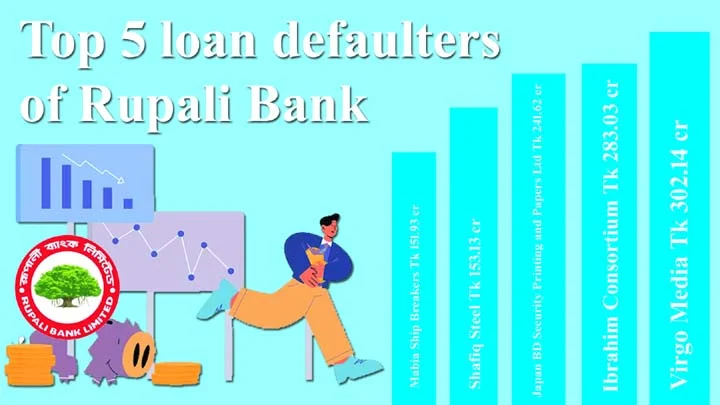
As per data of the Rupali Bank show that Virgo Media (Tk 302.14 crore), Ibrahim Consortium (Tk 283.03 crore),Japan Bangladesh Security Printing and Papers Ltd (Tk 241.62 crore), Messers Prize Club general Trading Ltd (Tk 112.38 crore), Bangladesh Auto Rickshaw Chalak Samaboy Samity Ltd (Tk 42.93 crore), DSL Sweater Ltd (Tk 59.79 crore), Shafiq Steel (Tk 153.13 crore), Mabia Ship Breakers (Tk 151.93 crore), Water Heaven Corporation, Crystal Steel and Ship Breakers Ltd (Tk 147.38 crore), Jaso Allocating (Tk 66.64 crore), ND Grioup (Tk 49.99 crore), Setu International (Tk 39.48 crore), Fahad Garments (Tk 38.65 crore), Mastex Industries Ltd (Tk 34.77 crore), Bangladesh Auto Tempo Porter Cab Somoboy Samity (Tk 31.07 crore), Legacy Footwear (Tk 30.71 crore), Nasrin Zaman Knitwears Ltd (Tk 30 crore) Islam Khan Jute Mills (Tk 21.95 crore), Memory World (Tk 92.13 crore), Benitex Industries Ltd (Tk 379.81 crore), M/S Beautiful Jacket (Tk 140.2 crore) and Messers Dream Knitting (Bd) Ltd (Tk 105 crore) in defaulted loans to Rupali Bank.

Besides, Chattogram-based Nurjahan Group, AA Knit Spin Limited, HR Spinning Mill, Chattogram SA Group, M Rahman Steel, Jaz Spinning, Panna Textile, HZ Agro, Himalaya Paper and Board, Western Engineering, and Chowdhury Leather are also on the list of loan defaulters with Rupali Bank.

"The respective managers in all branches across the country have to submit updated reports regarding cases filed against the loan defaulters every day. The bank authority is very serious about realising the defaulted loans," Md. Shahedur Rahman, General Manager of Rupali Bank, told The New Nation.

Md. Shahedur Rahman, who is also the Rupali Bank board secretary, said that they are continuously operating drives as per the directives of the Board of Directors of the Rupali Bank.

A top banker, preferring anonymity, said that some big companies rescheduled their huge loan payments just to pay a small amount of money.​
 

Stressed loans in banks to remain elevated: Moody's

The stressed loans in the banking sector of Bangladesh will remain elevated even after the central bank tightened the rules for classification of non-performing loans (NPLs), said Moody's Investors Service.

Last month, the Bangladesh Bank tightened its definition of overdue installments for fixed-term loans, reversing a relaxation of classification and provisioning rules since April 2019.

Fixed-term loans are currently classified as overdue six months after their expiry date and are subsequently classified as non-performing when overdue for a further three months, implying 270 days past due. Cottage, micro and small credits are classified as NPLs when past due/overdue for six months.

From September 30, a loan will be treated as overdue if an instalment on a term loan is not paid within three months of its due date, while from March 2025 an instalment payment late by even one day will be considered overdue.

The period for classifying past due/overdue loans as NPLs remains unchanged.

"We expect the revised guidelines to increase levels of NPLs and provisions, which will strain banks' profitability in the near term," Moody's said in a report yesterday.

The removal of forbearance measures will push banks to recognise loans to weak borrowers as non-performing in the long term and set aside adequate provisions, a long-term credit positive because it will improve their resilience in times of stress, it said.

The global credit ratings agency, however, expects NPLs to increase by 50 basis points until September 2024.

"We expect stressed loans, including performing loans with modified payment terms, as well as NPLs, to remain elevated."

This is because banks are likely to step up collection efforts on overdue loans to contain higher levels of slippage to non-performing, and may also take advantage of relatively lenient guidelines to restructure overdue loans to contain the impact on profitability.

The revised guidelines are an outcome of the central bank's initiatives related to Bangladesh's programme with the International Monetary Fund to strengthen loan classification and provisioning rules, eliminate forbearance measures and align with global best practices.​
 

A legal perspective
by Md Badrul Millat Ibne Hannan 05 May, 2024, 00:00

1714867330095.webp

| New Age

FOR quite a few days, the news of banks and financial institutions merger has created a stir in the banking industry. This merger and acquisition has proved the forecasting of economists and experts once again. Economists and experts had strongly opposed the approval of banks on political grounds. Business conglomerates with political clout have taken away these banks because of profit maximisation within a short time and for other reasons.

Experts assume that the banking sector is now on the brink of a disaster. Because the banking sector's total risky loans amounted to Tk 377,922 crore at the end of 2022, this development makes for an abstemious reading of the actual health of this vital sector of the economy. At the end of 2022, the banking sector's non-performing loans stood at Tk 120,649 crore, outstanding rescheduled loans at Tk 212,780 crore, and outstanding written-off loans at Tk 44,493 crore.

In the banking sector of our country, people commemorate the last three mergers and acquisitions, Bangladesh Shilpa Bank and Bangladesh Shilpa Rin Sangstha amalgamated, renaming Bangladesh Development Bank Ltd. It is now suffering from bad loans, which make up 42.46 per cent of its total loans. Here, mergers and acquisitions have failed.

On the other hand, in 2000, Standard Chartered Bank and ANZ Grindlays merged and named StanChat Grindlays Bank; after that, it was renamed Standard Chartered Bangladesh. In 2001, Bank Asia set a massive milestone by acquiring the business operations of the Bank of Nova Scotia (a renowned Canadian bank) in Dhaka, the first of its kind in the banking history of Bangladesh. It again repeated the performance by acquiring the Bangladesh operations of Muslim Commercial Bank Ltd, a renowned Pakistani bank. Although, Bank Asia launched its operations in 1999, it acquired these two banks within two years and pointed out to our eyes that if there is honesty, integrity, and capability, it is possible.

Recently, the Bangladesh Bank has issued a draft guideline for merger offering to the bidder banks, which will also be called transferee banks, to bid for the transferor bank, which is placed under moratorium and decided to be merged with another bank, with incentives including regulatory relaxation regarding minimum capital requirement provisioning, cash reserve ratio and statutory liquidity ratio requirements, liquidity coverage ratio, liquidity support, foreign exchange assistance, the option of Bangladesh Bank buying long-term bonds or debentures from the transferee bank at low rates, issuance of shares to raise capital, permission for subordinated bonds, tax incentives, and goodwill as an asset.

As per the regulatory duties of the central bank, it has categorised the scheduled banks into three categories: sound banks, stable banks, and distressed banks. Before going forward with the merger and acquisition agreement, the following cautions and considerations are to be re-conceived:

Non-performing loans: Merging banks need to carefully assess the non-performing loans of the weaker bank and develop strategies to address them effectively. Failure to address non-performing loans can impact the financial health of the merged entity.

Financial delinquency: Acquiring banks must evaluate the weaker bank's history of financial misconduct and take appropriate measures to mitigate any potential risks associated with such issues.

Employee homogenising: Merging banks need to contemplate the amalgamation of employees from both entities, ensuring a smooth transition and minimising any negative impact on the workforce.

Capital adequacy ratio: The capital adequacy ratio of the merged entity should be carefully assessed to secure compliance with regulatory requirements and maintain financial stability.

Dilution of earnings: Shareholders of the acquiring bank may experience diluted earnings after the merger, which could lead to possible legal issues.

Liquidity and capital management: Merging banks must carefully manage liquidity and capital to secure the smooth functioning of the merged entity and abstain from any adverse effects on customers and stakeholders.

Banking is the backbone of any economy, and the pursuit of mergers and acquisitions within this sector is a common occurrence worldwide. In Bangladesh, the financial sector has experienced a surge in merger and acquisition activities in recent decades, reflecting the industry's dynamic nature and the pursuit of growth and efficiency.

The terms 'merger', 'amalgamation' and 'acquisition' have not been defined under the Companies Act or Companies Rules. The term 'amalgamation', though not defined, is used in the Companies Act. In general, the following statutes are applicable to merger and acquisition transactions in Bangladesh: the Companies Act 1994, Section 228 and 229; the Securities and Exchange Ordinance 1969; the Securities and Exchange Commission Act 1993, (amendment May 1, 2021); the Bangladesh Bank Order 1972; the Bank Companies Act 1991, Section 49, Sub-section 1 (Ga), 76 (1), 77 (Ka), 77 (1), 77 (2), 77 (4), 77 (5), and 77 (16); the Financial Institutions Act 1993, (amendment 2023), Section 50; the Contract Act 1872; the Competition Act 2012; the Labour Act 2006 (amendment 2022); the Foreign Exchange Regulation Act 1947; and the Income Tax Ordinance.

Chronological steps such as proposal for merger, negotiations/bargaining, due diligence for the merger, disclosure and confidentiality, due diligence report submission, shareholders' and creditors' consent, scheme submission to the Bangladesh Bank, draft scheme examination, assets and liabilities valuation, transaction price, Bangladesh Bank approval, High court petition in regards to mergers and acquisitions and submission of certified copy of the High Court order to the Office of the Registrar of Joint Stock Companies And Firms need to be followed for a merger and acquisition completion.

Here are some international accounting standards and international financial reporting standards that are required since international rating agencies consider these standards based on the balance sheet and financial position, which reflect the overall scenario of the country.

International Financial Reporting Standard 3: Business Combination, which states merger and acquisition. IRFS 02: Share-Based Payment, IFRS 05: Non-Current Asset Held for Sale and Discontinued Operations, IFRS 07: Financial Instruments: Disclosure, IRFS 13: Fair Value Measurement, IAS 07: Statement of Cash Flows for Cash Generating Unit from Goodwill Valuation IAS 08: Accounting Policies, Changes in Accounting Estimates, and Errors, IAS 10: Enevts after the Reporting Period, IAS 12: Income Taxes, IAS 16: Property, Plant and Equipment, IAS 32: Financial Instrument: Presentation, IAS 36: Impairment of Assets, IAS 38: Intangible Assets, IAS 40: Investment Property and other related IFRS and IAS (if required).

Except for international financial reporting standards and international accounting standards, mergers and acquisitions will not convey mutual benefits to shareholders, depositors, or public trusts.

The i8nternational financial reporting standards and international accounting standards are a set of accounting rules for public companies with the goal of making company financial statements consistent, transparent, and easily comparable around the world. This helps for auditing, tax purposes, and investing.

As per the financial statements of some banks and financial institutes, the central bank is not fully following IFRS and IAS. As a result, commercial banks in mergers and acquisitions are not bound to follow these global standards in asset revaluation. The stronger banks undergoing mergers and acquisitions are to suck up weaker banks and NBFIs with high non-performing loans. So it is enormously sensitive in asset revaluation.

In this regard, the central bank can dictate the banks to follow the depicted IFRS and IAS. Asset revaluation at current market prices for mergers and acquisitions would create a catastrophic situation. If the current market price is higher than the original cost, there is a revaluation gain, which means the asset value has appreciated. So, to circumvent cataclysm and ensure shareholder and depositor rights, the Bangladesh Bank should fully embrace international standards in financial reporting.

Nevertheless, mergers and acquisitions devoid of IFRS and IAS can lead to difficulty in understanding financial stability when a strong bank proceeds with a weak bank's colossal NPL hardship. Likewise, by not following IFRS and IAS, investors and regulators may be in the dark about banks' health.

In mergers and acquisitions, there are matters of buying and selling, so every asset should be re-evaluated under international standards, which are dissimilar from general profit and loss accounts maintained by banks.​
 

Bangladesh Bank again dissolves National Bank board
The bank's sponsor director Khalilur Rahman made the new chairman

1714949766705.webp


Bangladesh Bank has once again dissolved the board of National Bank.

Today, the central bank informed the managing director of National Bank through a letter about the cancellation of the bank's existing board of directors.

The banking regulator also formed a new board of directors and set the bank's sponsor director Khalilur Rahman as the new chairman, the BB letter read.

Earlier on December 21 in 2023, the central bank issued an order to dissolve the then board of National Bank and formed a new board.

The banking regulator then made Syed Ferhat Anwar, a former professor of the Institute of Business Administration under Dhaka University, the new chairman of the bank.

The central bank then took the move after Parveen Haque Sikder, a director of the commercial bank, wrote to the Bangladesh Securities and Exchange Commission as she fears that the then board may manipulate the next election of the bank's board of directors.

This time, the banking watchdog removed most of the previous directors, including Syed Ferhat Anwar and Parveen Haque Sikder.​
 

Banks bag windfall from record interest spread
Spread between lending, deposit rates 5.11pc in March
JUBAIR HASAN
Published :
May 06, 2024 00:40
Updated :
May 06, 2024 00:40

1714952186627.webp


Interest calculating in SMART formula comes as a boon for banking as banks bag windfalls from a record spread between the rates they provide to depositors and take from borrowers.

Officials and bankers have said Bangladesh Bank's monetary-policy shift from monetary targeting to interest-rate targeting pays off for the country's commercial banks as they saw the widest spread in over nine years to March last.

Such leap between the difference of weighted average deposit and lending rates - called spread in banking parlance - gives some sort of respite to the banks which had witnessed their core incomes squeezing since the imposition of 9.0-percent lending cap in April 2020, according to sector-insiders.

According to data with the central bank, the weighted average spread rose to 5.11 per cent in March, up by 7 basis points from February's 5.04 per cent.

The official data showed the March spread figure as the highest probably since November 2014 when it was 5.12 per cent.

Seeking anonymity, a BB official said the spread started rising in July 2023 when the central bank introduced interest rate-related benchmark rate called SMART.

Now it rose to 5.11 per cent in March last as weighted average rates of deposits and lending were 5.20 per cent and 10.31 per cent respectively, according to the official.

The difference between lending and deposit rates was only 2.93 per cent in June last year before the SMART came into effect on the money market. Afterwards, it started increasing with the figure rising to 3.29 per cent, 3.33 per cent, 3.31 per cent, 3.34 per cent, 3.35 per cent, 4.66 per cent and 4.83 per cent in July, August, September, October, November and December in 2023 and January in 2024 respectively.

Managing director and chief executive officer of Mutual Trust Bank (MTB) Limited Syed Mahbubur Rahman says the banks have raised both deposit and lending rates in line with SMART rating paradigm, which is reflected in the spread situation.

Managing director and chief executive officer of Dhaka Bank Emranul Huq observes that the lending rate in banks keeps rising quickly because of significant increase in SMART rate every month since its introduction.

The deposit rate offered by the banks is also rising but the depositors get the gains once the tenure matures. On the other hand, the banks can charge increased rate from the fresh borrowers each month.

"That's why the spread is widening fast," the experienced banker says about the interest arithmetic.

Seeking anonymity, a top executive of a private bank said getting formal credits becomes extremely expensive, which is lessening the fund demands on the market.

On the other hand, there are banks having liquidity dearth in the existing contractionary monetary regime and they require credits to improve their balance sheet and offer higher rates to allure the depositors, he said.

"It means the difference between the weighted average rates of deposit and lending would come down in the coming few months," the banker hopes.​
 

PKDefense Forums: Country-by-Country Military Discussions

Log In Register Forums
Back