Bangladesh Defense

Saif
Senior Member
- Joined
- Jan 24, 2024
- Messages
- 22,417
- Likes
- 9,875
- Nation

- Axis Group


Next budget should focus on relief, not ambition
The country is going through a difficult period due to both domestic and global shocks, and the upcoming national budget must respond to those mounting economic pressures while pushing through essential reforms, according to economists and business leaders.
Next budget should focus on relief, not ambition
Economists and business leaders say FY27 budget should ease pressure on people, tackle economic challenges and deliver reforms
Star Business Report
The country is going through a difficult period due to both domestic and global shocks, and the upcoming national budget must respond to those mounting economic pressures while pushing through essential reforms, according to economists and business leaders.
Since confidence is weakening among both investors and the general public, they say expectations for the new budget are to bring relief rather than be overly ambitious.
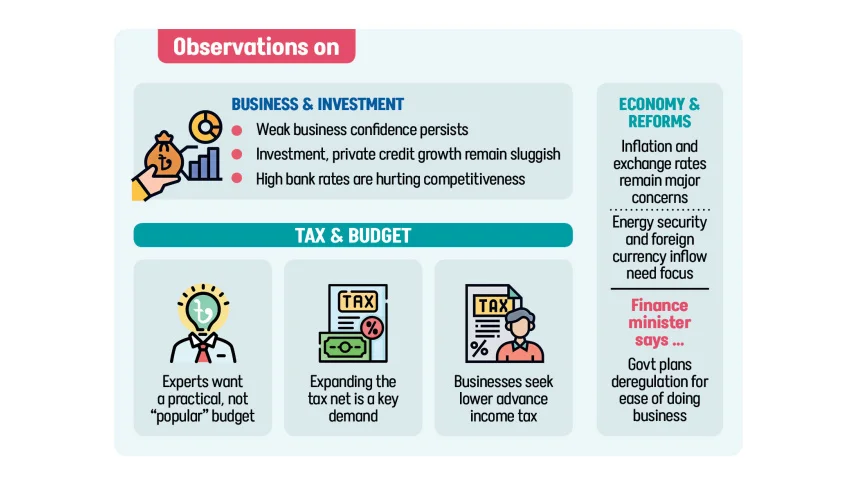
At a pre-budget roundtable at Pan Pacific Sonargaon Dhaka yesterday, economist Hossain Zillur Rahman said the next budget will have to address four key challenges: fragile business confidence, financial sector weakness, volatility in energy supply and weak budget implementation capacity.
Speaking at the event organised by Prothom Alo, Rahman, the executive chairman of Power and Participation Research Centre (PPRC), said Bangladesh is facing a prolonged period of economic strain and therefore needs a practical, implementable budget for the next fiscal year.
Rahman, who was an adviser of the caretaker government, also called for a special action framework involving stakeholders from different sectors, rather than relying solely on the bureaucracy, to address the crisis and help stabilise the economy within the next two years.
He said the plan should be strictly time-bound. Earlier initiatives such as the Delta Plan had failed to deliver due to implementation delays.
The economist also pointed to inefficiencies in public spending, especially in the health and education sectors. While allocations remain high, he said, weak execution has limited results.
Rahman urged the government to prioritise an implementable budget over a popular one.
He said sluggish investment is another major concern. Although the finance minister is operating under difficult circumstances, the problem still can be solved.
He further said the misuse of public resources continues in different forms. “Sometimes direct looting is taking place. Secondly, corruption is taking place through policy tools such as over-invoicing and under-invoicing.”
He also talked about administrative harassment and described it as remnants of the “licence raj”, saying such practices continue to enable corruption.
Shawkat Hossain, head of online at Prothom Alo, moderated the roundtable, while Editor Matiur Rahman was also present.
At the programme, Debapriya Bhattacharya, distinguished fellow at the Centre for Policy Dialogue (CPD), said expectations from the newly elected government are high.
He said the upcoming budget would have to strike a careful balance between public expectations and economic realities.
But it would not be realistic to expect too much from the finance minister, given that current challenges are caused by both domestic pressures and global economic uncertainty, said Bhattacharya.
He said controlling inflation should be a key priority in the next budget, alongside addressing pressures in the foreign exchange market and high interest rates.
He also noted that a budget deficit of around 4 percent would be acceptable.
Bhattacharya added that fiscal space does exist, pointing out that tax exemptions and subsidies currently amount to around 6 percent of GDP.
He cited tax exemptions of about Tk 25,000 crore and subsidies of Tk 4,646 crore in various sectors.
The economist also suggested offloading shares of publicly listed companies in the stock market to improve efficiency and broaden participation.
Simeen Rahman, chief executive officer of Transcom Group, said one of the biggest challenges facing businesses is the ongoing stress in the financial sector.
She said reforms are essential, but more importantly, the right reforms are needed, as many of the current challenges businesses are facing today have been inherited from previous administrations.
“The business community is affected every single day,” she said, urging the government to pursue reforms more aggressively despite the difficulties.
On the budget, she said the key challenge is to expand the tax base rather than increasing the burden on existing taxpayers.
She called for full digitisation and automation of the tax system to ensure transparency and efficiency, noting that the current tax-to-GDP ratio is around 6 percent and should be raised significantly.
She also advocated a uniform value-added tax (VAT) rate across sectors, saying differentiated rates create scope for manipulation.
On advance income tax (AIT), she said the current 5 percent deduction at the import stage is rarely refunded by the National Board of Revenue (NBR), effectively making it a permanent cost. She proposed reducing it to at least 3 percent.
She added that tax deducted at source, especially on institutional and corporate sales, is treated by the NBR as a final tax liability, creating an excessive burden on businesses. She suggested reducing the rate from 5 percent to 3 percent to provide relief.
M Masrur Reaz, chairman of Policy Exchange Bangladesh, said investment, employment and private sector credit growth remain weak. The government should prioritise economic recovery in the budget and focus on job creation.
Mohammad Hatem, president of Bangladesh Knitwear Manufacturers and Exporters Association (BKMEA), said exporters are not receiving refunds on advance income tax despite paying it upfront. He called for widening the tax net and improving the investment climate.
Md Mahbubur Rahman, chief executive officer of HSBC Bangladesh, said Bangladesh needs a clear policy to increase foreign currency inflows.
He added that this is an opportune time to attract investment from the Middle East and stressed the importance of improving energy security.
Md Golam Mowla, general secretary of the Moulvi Bazar Baboshayee Samity in Dhaka, said prices of imported spices such as cloves and cardamom, as well as fruits, remain high due to heavy import duties.
Selim Jahan, former director of UNDP, pointed to several key challenges including economic stabilisation, macroeconomic management and restoring dynamism. He said job creation and investment growth remain central concerns.
Mohammad Mustafa Haider, group director of TK Group, said Bangladesh is losing competitiveness to countries such as China, India and Vietnam due to high bank interest rates. He noted that loan repayment periods in Bangladesh are shorter than in many of these countries.
Imran Hassan, secretary general of the Bangladesh Restaurant Owners Association, said small local bakery units are being squeezed out as large corporate groups enter the market.
He said large firms are selling packaged rice at Tk 140 per kilogram while farmers receive only Tk 70.
He also said many small rice husking mills have shut down due to corporate expansion in the sector.
Finance Minister Amir Khosru Mahmud Chowdhury said the government plans to bring low-income groups such as shoemakers, potters, theatre people, artisans and painters under budgetary coverage.
He said non-governmental organisations and private sector actors will be engaged to support these groups.
The finance minister also said the government will pursue deregulation to improve the ease of doing business and activate the creative and sports economy in the next budget.
Economists and business leaders say FY27 budget should ease pressure on people, tackle economic challenges and deliver reforms
Star Business Report
The country is going through a difficult period due to both domestic and global shocks, and the upcoming national budget must respond to those mounting economic pressures while pushing through essential reforms, according to economists and business leaders.
Since confidence is weakening among both investors and the general public, they say expectations for the new budget are to bring relief rather than be overly ambitious.
At a pre-budget roundtable at Pan Pacific Sonargaon Dhaka yesterday, economist Hossain Zillur Rahman said the next budget will have to address four key challenges: fragile business confidence, financial sector weakness, volatility in energy supply and weak budget implementation capacity.
Speaking at the event organised by Prothom Alo, Rahman, the executive chairman of Power and Participation Research Centre (PPRC), said Bangladesh is facing a prolonged period of economic strain and therefore needs a practical, implementable budget for the next fiscal year.
Rahman, who was an adviser of the caretaker government, also called for a special action framework involving stakeholders from different sectors, rather than relying solely on the bureaucracy, to address the crisis and help stabilise the economy within the next two years.
He said the plan should be strictly time-bound. Earlier initiatives such as the Delta Plan had failed to deliver due to implementation delays.
The economist also pointed to inefficiencies in public spending, especially in the health and education sectors. While allocations remain high, he said, weak execution has limited results.
Rahman urged the government to prioritise an implementable budget over a popular one.
He said sluggish investment is another major concern. Although the finance minister is operating under difficult circumstances, the problem still can be solved.
He further said the misuse of public resources continues in different forms. “Sometimes direct looting is taking place. Secondly, corruption is taking place through policy tools such as over-invoicing and under-invoicing.”
He also talked about administrative harassment and described it as remnants of the “licence raj”, saying such practices continue to enable corruption.
Shawkat Hossain, head of online at Prothom Alo, moderated the roundtable, while Editor Matiur Rahman was also present.
At the programme, Debapriya Bhattacharya, distinguished fellow at the Centre for Policy Dialogue (CPD), said expectations from the newly elected government are high.
He said the upcoming budget would have to strike a careful balance between public expectations and economic realities.
But it would not be realistic to expect too much from the finance minister, given that current challenges are caused by both domestic pressures and global economic uncertainty, said Bhattacharya.
He said controlling inflation should be a key priority in the next budget, alongside addressing pressures in the foreign exchange market and high interest rates.
He also noted that a budget deficit of around 4 percent would be acceptable.
Bhattacharya added that fiscal space does exist, pointing out that tax exemptions and subsidies currently amount to around 6 percent of GDP.
He cited tax exemptions of about Tk 25,000 crore and subsidies of Tk 4,646 crore in various sectors.
The economist also suggested offloading shares of publicly listed companies in the stock market to improve efficiency and broaden participation.
Simeen Rahman, chief executive officer of Transcom Group, said one of the biggest challenges facing businesses is the ongoing stress in the financial sector.
She said reforms are essential, but more importantly, the right reforms are needed, as many of the current challenges businesses are facing today have been inherited from previous administrations.
“The business community is affected every single day,” she said, urging the government to pursue reforms more aggressively despite the difficulties.
On the budget, she said the key challenge is to expand the tax base rather than increasing the burden on existing taxpayers.
She called for full digitisation and automation of the tax system to ensure transparency and efficiency, noting that the current tax-to-GDP ratio is around 6 percent and should be raised significantly.
She also advocated a uniform value-added tax (VAT) rate across sectors, saying differentiated rates create scope for manipulation.
On advance income tax (AIT), she said the current 5 percent deduction at the import stage is rarely refunded by the National Board of Revenue (NBR), effectively making it a permanent cost. She proposed reducing it to at least 3 percent.
She added that tax deducted at source, especially on institutional and corporate sales, is treated by the NBR as a final tax liability, creating an excessive burden on businesses. She suggested reducing the rate from 5 percent to 3 percent to provide relief.
M Masrur Reaz, chairman of Policy Exchange Bangladesh, said investment, employment and private sector credit growth remain weak. The government should prioritise economic recovery in the budget and focus on job creation.
Mohammad Hatem, president of Bangladesh Knitwear Manufacturers and Exporters Association (BKMEA), said exporters are not receiving refunds on advance income tax despite paying it upfront. He called for widening the tax net and improving the investment climate.
Md Mahbubur Rahman, chief executive officer of HSBC Bangladesh, said Bangladesh needs a clear policy to increase foreign currency inflows.
He added that this is an opportune time to attract investment from the Middle East and stressed the importance of improving energy security.
Md Golam Mowla, general secretary of the Moulvi Bazar Baboshayee Samity in Dhaka, said prices of imported spices such as cloves and cardamom, as well as fruits, remain high due to heavy import duties.
Selim Jahan, former director of UNDP, pointed to several key challenges including economic stabilisation, macroeconomic management and restoring dynamism. He said job creation and investment growth remain central concerns.
Mohammad Mustafa Haider, group director of TK Group, said Bangladesh is losing competitiveness to countries such as China, India and Vietnam due to high bank interest rates. He noted that loan repayment periods in Bangladesh are shorter than in many of these countries.
Imran Hassan, secretary general of the Bangladesh Restaurant Owners Association, said small local bakery units are being squeezed out as large corporate groups enter the market.
He said large firms are selling packaged rice at Tk 140 per kilogram while farmers receive only Tk 70.
He also said many small rice husking mills have shut down due to corporate expansion in the sector.
Finance Minister Amir Khosru Mahmud Chowdhury said the government plans to bring low-income groups such as shoemakers, potters, theatre people, artisans and painters under budgetary coverage.
He said non-governmental organisations and private sector actors will be engaged to support these groups.
The finance minister also said the government will pursue deregulation to improve the ease of doing business and activate the creative and sports economy in the next budget.