[🇧🇩] Budget For 2026-2027

[🇧🇩] Budget For 2026-2027
35
411
More threads by Saif

G Bangladesh Defense

Money whitening provision may return

Md Asaduz Zaman
1779333257672.webp


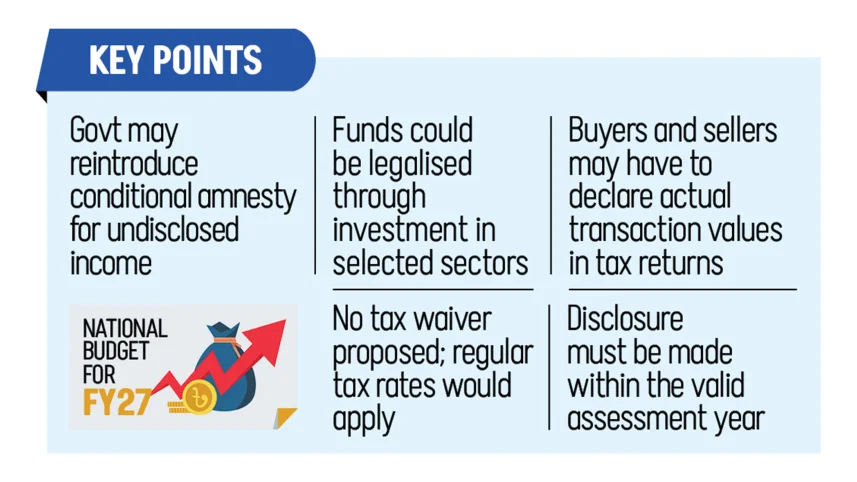
The government is likely to reintroduce a provision allowing the legalisation of undisclosed income through investment in selected sectors in the national budget for the next fiscal year.

The proposed amnesty scheme will include disclosure conditions, a finance ministry official said yesterday.

Speaking on condition of anonymity, the official said taxpayers may be allowed to regularise undisclosed funds by investing in designated sectors, provided they declare the actual transaction value in income tax returns filed by both buyers and sellers.

“Taxpayers can legalise their income by paying their regular rate in any assessment year in certain sectors, without any concessional treatment,” said the finance ministry official.

The Awami League government previously allowed taxpayers to legalise undisclosed assets by paying a flat 15 percent tax rate. Under that arrangement, individuals could declare previously undisclosed money in any assessment year by paying the specified rate, after which no government agency would question the source of the income.

But the proposed provision this time will introduce changes to that approach, said the official.

According to him, taxpayers will not be offered a single flat rate for regularising undisclosed income. Instead, in cases involving such undeclared gains, both buyers and sellers will be required to adjust their declared income and reflect the actual transaction values in their tax returns.

He added that structural inefficiencies in parts of the economy often lead to portions of income or capital gains remaining undeclared, and the government wants to provide an opportunity to adjust such income to encourage productive investment.

He also said the prime minister has, in principle, approved the proposal on May 14, with the expectation that it could help accelerate investment flows.

The official argued that the measure is intended to broaden the tax base and formalise informal capital, rather than offer a blanket waiver or reduced tax rate, as seen in previous amnesty schemes.

The move comes amid ongoing debate in policy circles over how to address large volumes of undisclosed income generated through property transactions, especially in land, flats and commercial real estate, where significant gaps often exist between market prices and declared deed values.

However, the proposal has already drawn criticism from economists and tax experts, who say repeated regularisation windows risk weakening compliance and discouraging honest taxpayers.

National Board of Revenue (NBR) Chairman Md Abdur Rahman Khan recently reiterated that the tax administration is moving away from concessional whitening schemes that allowed undeclared income to be legalised at reduced rates.

“We want to say that anyone can disclose undisclosed income in their tax records by paying taxes according to the existing rates. In fact, we would welcome that,” he said during a pre-budget discussion.

Criticising past practices, he added that successive amnesty schemes over the past five decades had “ultimately backfired”, as they discouraged compliant taxpayers and distorted tax culture.

“We want to move away from this culture,” he said, adding that individuals who evaded taxes in the past should not be incentivised with lower rates.

“At the very least, you must pay the regular tax,” he said.​
 

Controlling inflation will be the guiding principle of upcoming budget: Debapriya Bhattacharya

Staff Correspondent
Dhaka
Published: 21 May 2026, 20: 15

1779420365442.webp

Today, CPD's distinguished fellow Debapriya Bhattacharya is speaking at a roundtable discussion titled ''Budget in Crisis and Public Expectation'', organised by Prothom Alo. The meeting is held at the Sonargaon Hotel in Karwan Bazar, Dhaka. Prothom Alo

Debapriya Bhattacharya, a distinguished fellow of the private research organisation Center for Policy Dialogue (CPD), has stated that controlling inflation should be considered the primary goal of the budget for the fiscal year 2026-27 in order to maintain macroeconomic stability.

At this time, Debapriya Bhattacharya described the upcoming budget for the next fiscal year as a ''balancing act'' or a difficult test to maintain equilibrium against the backdrop of the current economic circumstances.

Debapriya Bhattacharya said that due to unresolved structural reforms, adverse global conditions, IMF conditions, and public expectations, the Finance Minister has to formulate the budget amidst these quadruple pressures. Under such circumstances, controlling inflation should be the primary target of the budget to maintain macroeconomic stability.

Today, on Thursday, Debapriya Bhattacharya made this statement at a roundtable discussion titled ''Budget in Crisis and Public Expectations'' organised by Prothom Alo. The meeting was held at Sonargaon Hotel in Karwan Bazar, Dhaka. The chief guest of the event was Finance and Planning Minister Amir Khasru Mahmud Chowdhury.

Debapriya Bhattacharya believes that an ''anchor'' in the framework of macroeconomics is necessary to return from a fragile economy to a path of prosperity.

He says maintaining inflation as the main goal for economic stability is still the most important. Secondly, in terms of government financial management, the budget deficit will be one of the anchors. In the present situation, the budget deficit should not exceed 4 per cent of the GDP.

Regarding the revenue collection target, Debapriya Bhattacharya said that covering the large annual revenue deficit is currently the big challenge.

There is no alternative to expanding the tax net into new areas and increasing efficiency in tax management to achieve the minister's target to raise the tax-GDP ratio to 8 per cent.

Debapriya Bhattacharya cautioned that in efforts to reduce the budget deficit, allocations for education and health should not be reduced, stating that there is a tendency within the Annual Development Programme (ADP) to keep projects alive with many ''sweetheart deals'' or limited allocations.

Tax exemption and subsidy reform

Debapriya Bhattacharya suggested that unnecessary tax exemptions should be reduced to keep the budget deficit under control.

He noted that currently, about 6 per cent of GDP is given away in tax exemptions. This includes sectors like agriculture as well as major corporate sectors.

Citing specific sectors, he mentioned that currently, tax exemptions exceeding Tk 250 billion are given in corporate income tax. In the garment and textile sectors, the amount of this exemption is nearly Tk 46.46 billion.

Again, in the power and energy sectors, exemptions amount to about Tk 76. 11 billion.

Debapriya Bhattacharya said that the National Board of Revenue (NBR) should thoroughly review these areas of tax exemption and that there is an opportunity to reconsider the vast tax exemptions granted in the power sector in particular.

To address economic disparities, Debapriya Bhattacharya called for the introduction of wealth tax and inheritance tax rather than relying solely on income tax.

He said that it has never been possible to eradicate disparity with income tax alone in the world. Wealth tax is necessary for this. Concerns over a middle-class backlash due to fear of losing popularity should not persist. Additionally, there should be an ''inheritance tax'' on property acquired through inheritance as it is an ''unearned income''. Creating a political narrative in support of this is essential.

Bangladesh faces a moderate debt crisis

Expressing concern over the pressure of repaying foreign debt, Debapriya Bhattacharya said Bangladesh has now entered a ''moderate debt distress'' situation. Managing foreign and domestic debt is a massive challenge now. Particularly for foreign debt payment, more than double the amount spent on education and health sectors is currently being allocated.

Effective coordination between Bangladesh Bank and the Ministry of Finance is needed to control this situation.

As an alternative source of revenue growth, Debapriya Bhattacharya advises the government to release shares of its multinational and profitable industrial establishments in the stock market.

He mentioned that this discussion has been ongoing since the tenure of former Finance Minister Saifur Rahman. Even the most recent interim government could not make a bold decision on this.

The current Finance Minister was the founding president of the Chattogram Stock Exchange. If he cannot do this, then who will? Mainly due to resistance from bureaucrats, this has not been possible because they receive various benefits by sitting in the board meetings of these organisations.​
 

NATIONAL BUDGET FOR FY27

Prioritise reforms to support growth

Economists urge govt

Star Business Report

1779421768478.webp


The government should focus on reforms and higher productivity to restore economic growth and financial stability instead of relying on demand side expansion and populist measures, economists said yesterday.

“This budget gives us an opportunity to restore financial stability while supporting growth,” said Ashikur Rahman, principal economist at the Policy Research Institute of Bangladesh (PRI).

He made the remarks at PRI’s monthly macroeconomic insights session titled “Restoring Growth through Productivity Reforms: Pre-Budget Priorities” held at the organisation’s office in Dhaka.

Rahman said Bangladesh must prioritise reforms in the financial and revenue sectors, improve the investment climate, and address ongoing problems in the electricity and energy sectors.

“Without effective reforms, an expansionary budget could increase inflation and debt burdens, undermining the ongoing stabilisation process,” he warned.

He also called for reforms in state-owned enterprises (SoEs), saying these organisations hold assets equivalent to 17 percent of GDP but generate negative returns.

“This is draining the economy. You are bleeding money without any reason,” he said, blaming poor corporate governance, weak financial management, lack of transparency and political influence for the poor performance of SoEs. He also criticised the governance structure of many SoEs.

Bangladesh’s macroeconomic situation remains fragile because of weaknesses in the fiscal, financial and energy sectors. Rahman stressed that macroeconomic stabilisation alone would not be enough to restore strong and sustainable growth.

Bangladesh now needs productivity-focused reforms, including tariff rationalisation, trade openness, tax reforms, better investment conditions, energy sector restructuring, more foreign direct investment and improved infrastructure.

He noted that both Fitch Ratings and the Asian Development Bank have recently expressed concerns about Bangladesh’s economic outlook.

Inflation remained above 9 percent in April, while tight liquidity and high lending rates pushed private sector credit growth to historic lows, he said.

Businesses have cut investment because of inflation, uncertainty and energy shortages. At the same time, banks are increasingly investing in government securities instead of private lending due to rising risks and weak loan demand.

Rahman also criticised Bangladesh Bank for easing single-borrower exposure limits, warning that it could increase loan concentration among large business groups and weaken the banking sector further.

He also expressed concern over proposed amendments to banking laws that may allow wilful defaulters to return to the banking sector.

Meanwhile, Zaidi Sattar, chairman of PRI, said Bangladesh can no longer rely only on traditional growth drivers.

Future competitiveness will depend on productivity, innovation, policy predictability and openness to investment and technology, he said.

After Bangladesh graduates from the least developed country (LDC) status, the transition period would require export diversification, deeper integration into global value chains and a modern industrial policy framework, Sattar said.

Fahmida Khatun, executive director of Centre for Policy Dialogue, said reforms should go beyond slogans and be properly implemented.

She noted that previous non-political governments had also launched reform initiatives, but many failed to produce meaningful results because of weak execution.

Khatun said one of the government’s biggest challenges is preventing key sectors such as banking, energy and infrastructure from falling under the control of vested interest groups.

She also expressed concern over the slow implementation of development projects and the sharp rise in operating expenses, warning that both are undermining fiscal discipline.

Controlling inflation should not depend only on contractionary monetary policy, she said. It also requires creating a more competitive market environment.​
 

Next budget should focus on relief, not ambition

Economists and business leaders say FY27 budget should ease pressure on people, tackle economic challenges and deliver reforms

Star Business Report

1779496012002.webp


The country is going through a difficult period due to both domestic and global shocks, and the upcoming national budget must respond to those mounting economic pressures while pushing through essential reforms, according to economists and business leaders.

Since confidence is weakening among both investors and the general public, they say expectations for the new budget are to bring relief rather than be overly ambitious.

At a pre-budget roundtable at Pan Pacific Sonargaon Dhaka yesterday, economist Hossain Zillur Rahman said the next budget will have to address four key challenges: fragile business confidence, financial sector weakness, volatility in energy supply and weak budget implementation capacity.

Speaking at the event organised by Prothom Alo, Rahman, the executive chairman of Power and Participation Research Centre (PPRC), said Bangladesh is facing a prolonged period of economic strain and therefore needs a practical, implementable budget for the next fiscal year.

Rahman, who was an adviser of the caretaker government, also called for a special action framework involving stakeholders from different sectors, rather than relying solely on the bureaucracy, to address the crisis and help stabilise the economy within the next two years.

He said the plan should be strictly time-bound. Earlier initiatives such as the Delta Plan had failed to deliver due to implementation delays.

The economist also pointed to inefficiencies in public spending, especially in the health and education sectors. While allocations remain high, he said, weak execution has limited results.

Rahman urged the government to prioritise an implementable budget over a popular one.

He said sluggish investment is another major concern. Although the finance minister is operating under difficult circumstances, the problem still can be solved.

He further said the misuse of public resources continues in different forms. “Sometimes direct looting is taking place. Secondly, corruption is taking place through policy tools such as over-invoicing and under-invoicing.”

He also talked about administrative harassment and described it as remnants of the “licence raj”, saying such practices continue to enable corruption.

Shawkat Hossain, head of online at Prothom Alo, moderated the roundtable, while Editor Matiur Rahman was also present.

At the programme, Debapriya Bhattacharya, distinguished fellow at the Centre for Policy Dialogue (CPD), said expectations from the newly elected government are high.

He said the upcoming budget would have to strike a careful balance between public expectations and economic realities.

But it would not be realistic to expect too much from the finance minister, given that current challenges are caused by both domestic pressures and global economic uncertainty, said Bhattacharya.

He said controlling inflation should be a key priority in the next budget, alongside addressing pressures in the foreign exchange market and high interest rates.

He also noted that a budget deficit of around 4 percent would be acceptable.

Bhattacharya added that fiscal space does exist, pointing out that tax exemptions and subsidies currently amount to around 6 percent of GDP.

He cited tax exemptions of about Tk 25,000 crore and subsidies of Tk 4,646 crore in various sectors.

The economist also suggested offloading shares of publicly listed companies in the stock market to improve efficiency and broaden participation.

Simeen Rahman, chief executive officer of Transcom Group, said one of the biggest challenges facing businesses is the ongoing stress in the financial sector.

She said reforms are essential, but more importantly, the right reforms are needed, as many of the current challenges businesses are facing today have been inherited from previous administrations.

“The business community is affected every single day,” she said, urging the government to pursue reforms more aggressively despite the difficulties.

On the budget, she said the key challenge is to expand the tax base rather than increasing the burden on existing taxpayers.

She called for full digitisation and automation of the tax system to ensure transparency and efficiency, noting that the current tax-to-GDP ratio is around 6 percent and should be raised significantly.

She also advocated a uniform value-added tax (VAT) rate across sectors, saying differentiated rates create scope for manipulation.

On advance income tax (AIT), she said the current 5 percent deduction at the import stage is rarely refunded by the National Board of Revenue (NBR), effectively making it a permanent cost. She proposed reducing it to at least 3 percent.

She added that tax deducted at source, especially on institutional and corporate sales, is treated by the NBR as a final tax liability, creating an excessive burden on businesses. She suggested reducing the rate from 5 percent to 3 percent to provide relief.

M Masrur Reaz, chairman of Policy Exchange Bangladesh, said investment, employment and private sector credit growth remain weak. The government should prioritise economic recovery in the budget and focus on job creation.

Mohammad Hatem, president of Bangladesh Knitwear Manufacturers and Exporters Association (BKMEA), said exporters are not receiving refunds on advance income tax despite paying it upfront. He called for widening the tax net and improving the investment climate.

Md Mahbubur Rahman, chief executive officer of HSBC Bangladesh, said Bangladesh needs a clear policy to increase foreign currency inflows.

He added that this is an opportune time to attract investment from the Middle East and stressed the importance of improving energy security.

Md Golam Mowla, general secretary of the Moulvi Bazar Baboshayee Samity in Dhaka, said prices of imported spices such as cloves and cardamom, as well as fruits, remain high due to heavy import duties.

Selim Jahan, former director of UNDP, pointed to several key challenges including economic stabilisation, macroeconomic management and restoring dynamism. He said job creation and investment growth remain central concerns.

Mohammad Mustafa Haider, group director of TK Group, said Bangladesh is losing competitiveness to countries such as China, India and Vietnam due to high bank interest rates. He noted that loan repayment periods in Bangladesh are shorter than in many of these countries.

Imran Hassan, secretary general of the Bangladesh Restaurant Owners Association, said small local bakery units are being squeezed out as large corporate groups enter the market.

He said large firms are selling packaged rice at Tk 140 per kilogram while farmers receive only Tk 70.

He also said many small rice husking mills have shut down due to corporate expansion in the sector.

Finance Minister Amir Khosru Mahmud Chowdhury said the government plans to bring low-income groups such as shoemakers, potters, theatre people, artisans and painters under budgetary coverage.

He said non-governmental organisations and private sector actors will be engaged to support these groups.

The finance minister also said the government will pursue deregulation to improve the ease of doing business and activate the creative and sports economy in the next budget.​
 

Latest Posts

Back