| Global Defense, OSINT & Geopolitics Wire

[🇧🇩] Coastal/Inland Riverine Shipping & Passenger Logistics

[🇧🇩] Coastal/Inland Riverine Shipping & Passenger Logistics
22
3K
More threads by Bilal9

G Bangladesh Defense

Make protecting our rivers a top priority​

The government must make the best use of the river route classification initiative

1708127063253.webp

VISUAL: STAR

We welcome the initiative taken by Bangladesh Inland Water Transport Authority (BIWTA) to bring 10,187 kilometres of non-classified river under classification to protect them from unplanned structures, such as bridges and culverts. It is also reviewing the already classified routes for reclassification. This initiative is supposed to ensure better navigability of our rivers and save many of them from extinction.

According to a report in this daily, the BIWTA is implementing a Tk 18.3-crore project, with assistance from the Institute of Water Modelling (IWM), to determine or review the standard high-water level (SHWL) and standard low-water level (SLWL) of 16,155 kilometres of river in total (Currently, 5,968 kilometres of river or 95 river routes are classified). Data from 442 water-level stations from four different agencies, including the BIWTA, accumulated over the last 25 years, has been analysed to figure out the SHWL and SLWL of these river routes. Based on the findings from this project, the BIWTA has prepared a list of 367 river routes that need to be classified or re-classified. The classification system will consider the least available depth, the importance of the waterway, the traffic intensity, and the level of dependency on the route.

On paper, this initiative seems rather promising. But given the rampant irregularities in river management that we have witnessed for years, we cannot help but feel sceptical about its success. Is the BIWTA properly equipped to withstand the exertion of power by the local political influentials—some of whom are closely connected with the government—from building structures over the rivers as they please? Then there are some government agencies who have also defied the BIWTA's authority in the past to build small bridges. And what about indiscriminate encroachment, which also disrupts natural water flow and kills navigability?

Only a couple of days ago, our state minister for shipping said almost one-third of our rivers had lost navigability. In order to bring them back to their former glory, this initiative could prove to be effective—if properly implemented and strictly adhered to. Saving our rivers must be a top priority for the government right now. This will need coordinated efforts from all agencies, and there can be no scope for anyone—even someone with political influence—to put their toe out of line. The government must also equip the BIWTA with the authority to hold anyone who defies its rules to account. We have no time to waste when it comes to our rivers.​
 

Rivers, one by one, are losing navigability​

Government must take steps to restore our rivers

1708127217585.webp

VISUAL: STAR

Is it really surprising—after decades of rampant encroachment and pollution—that about a third of our rivers are on their deathbed? This is the estimate given by our state minister for shipping, who on Tuesday said that 308 rivers in Bangladesh, out of around a thousand, have lost their navigability. Dhaka division emerged as one of the worst sufferers in this case, with an astounding 85 of its rivers meeting this fate, while Khulna topped the list with 87. The number of rivers deemed to have normal flow or lost it over time may be debatable, but for the government to go on record with this admission is appreciable.​

​

The question is, what is the government going to do about it? Restoring the navigability of these rivers will take a monumental undertaking involving careful handling of various challenges such as pollution, encroachment, and sand lifting, as well as navigating various barriers, both legal and political. It will require a sustained administrative pushback against problems created by government departments themselves. As another report from Wednesday shows, the construction of an unplanned bridge by one such department is choking the Ichhamati River in Pabna. It is because of such incursions and constructions that the river has shrunk to a width of barely about 120 feet.​

​

And not just rivers, a vast number of canals and ponds in the country have also been ravaged. In Dhaka, for example, 95 canals have been lost or reduced to less than half of their original length over the past 80 years, as a recent study has shown. The list of waterbodies to be restored or recovered is long, and the government cannot pick and choose from them—it has to save all. That we haven't been able to take even baby steps in that regard, despite impassioned urgings by the PM, is alarming indeed. Therefore, we urge all respective government agencies and ministries to rise to the challenge, take drastic steps to address the deeply entrenched systemic issues, and save our rivers.​
 

A river indistinguishable from a canal is no river​

Plight of the Karatoya highlights the pitiful state of our rivers

1708127431711.webp

VISUAL: STAR

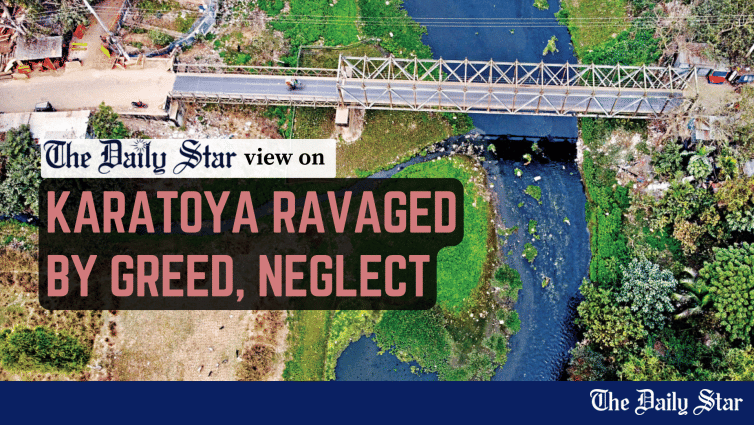
It appears no amount of coverage or warning is enough to stop the onslaughts on our rivers. Rivers are suffocating to death and, through our actions or inactions, we are all complicit in that. This was once again highlighted by a photo published by this daily on Tuesday revealing the ever-worsening state of the Karatoya River in Bogura. The river, from the picture, looks almost indistinguishable from a canal thanks to encroachment and pollution. Its water has been blackened by the waste and sewage regularly discharged into it, giving it an unnatural colour. The river thus is dying—shrinking, as per a 2018 survey, by a fifth of its total width at some points—but no one seems to care.


How is it that a country known for its rivers is so adamant on seeing their destruction? From unregulated waste disposal to grabbing of land to lifting sand, the mechanisms of destruction are many but preventive measures are scarce, if any. Only last Friday, we wrote in this column about how multiple rivers—Louhajang in Tangail, Mayur in Khulna, and Sonai in Sylhet—are struggling to breathe due to unabated encroachment and pollution. For this, the greed and neglect of both individuals and institutions—including those run by the government—are equally responsible.


The woes plaguing Karatoya in particular have been traced back to, among other factors, the construction of a three-vent regulator in Khalshi village in 1996. While the structure has reportedly served its initial purpose of saving the village from flooding, it has also caused it to remain dry for most of the year, resulting in obstruction of fish migration, pollution, and water stagnation which, in turn, helps with the breeding of mosquitoes and other disease-carrying organisms. This again shows lack of planning and care that is facing our rivers.
Read more​

​

This has to stop. The relevant authorities—including the National River Conservation Commission—must put an end to the rivercide being committed across the country. Rivers are national assets, and they must be protected for our own sake.​
 

Daudkandi to Tripura inland waterway route gets terminal, jetty​


1708645459487.webp


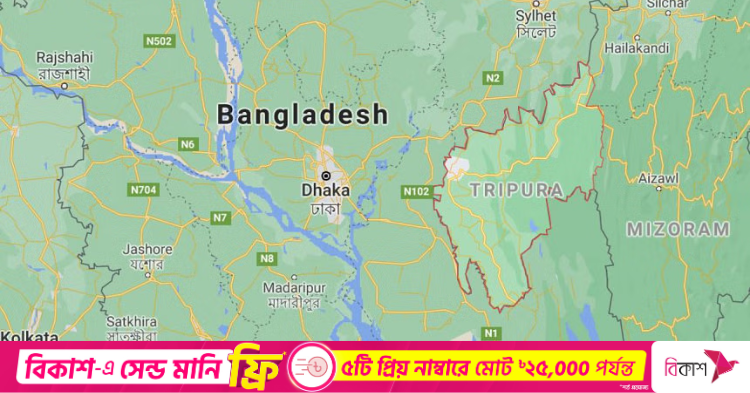
A new inland waterway terminal and a permanent jetty were inaugurated in Tripura's Srimantapuron Tuesday, which is expected to strengthen trade and economic relations between India and Bangladesh.

The development came nearly four years after the Indo-Bangla inland waterway protocol route between Sonamura of Tripura and Daudkandi of Bangladesh was first started, reported The Indian Express yesterday.

In July 2020, Tripura readied a floating jetty on the Gomati river in Sonamura, located 60km from Agartala, as part of the Indo-Bangla inland waterways connectivity project.

The jetty was included in the list of routes as part of an Indo-Bangladesh protocol signed between the India's high commissioner to Bangladesh, Riva Ganguly Das, and Bangladesh's shipping secretary, Md Mezbah Uddin Chowdhury, in Dhaka in May 2020.

Tripura Chief Minister Manik Saha, who virtually inaugurated the new infrastructure, said: "Import and export of commodities between both countries through waterways will be easier. Besides, the tourist footfall will also increase and also enhance scope of employment."

Small boats and ferries capable of carrying 50 tonnes of goods were scheduled to start moving through this route to Bangladesh soon.

The authorities are trying to further boost the navigability of the rain-fed river, including through plans to dredge the Gomati riverbed to make way for small ships and boats from Sonamura to Bangladesh's Ashuganj river port, which is only 60km away, during the winters.

India's Tourism Minister Sushanta Chowdhury said that Prime Minister Narendra Modi had emphasised connecting the northeast of India with different states and neighbouring countries through roadways, waterways, railways and airways.

"Currently, we have six highways and a few more will come up. We have been connected with different places of the country through railways. We had never thought that the Rajdhani Express would run here. We had never dreamt of waterways connectivity to Bangladesh," he said.

Sarbananda Sonowal, union minister for ports, shipping and waterways, who joined the inauguration virtually, unveiled different projects worth Rs 308 crore, including upgraded terminals at Karimganj and Badarpur, a passenger-cargo terminal at Bogibeel near Dibrugarh in Assam and the inland water transport terminal at Sonamura.​
 

Water transport workers to go on indefinite strike from Tuesday​

1709686175424.webp

Photo: Star/File

Water transport workers across the country is set to go on an indefinite work abstention from early Tuesday to press home their 11-point demand.

Bangladesh Water Transport Workers Federation announced the strike for an indefinite period at a press conference at Jatiya Press Club today, its General Secretary Chowdhury Ashiqul Alam told The Daily Star.

The 11-point demand includes forming a contributory provident fund through the Directorate of Seamen and Emigration Welfare and Trustee Board, implementation of decision to provide appointment letters, identity cards and service book, and providing Tk 10 lakh compensation if a worker dies at the workplace or accident.

Their demand also includes the withdrawal of the decision to cancel the licence of four masters and drivers of the Ovijan-10 launch.​