Home Watch Videos Wars Login

[🇧🇩] Corruption Watch

[🇧🇩] Corruption Watch
346
11K
More threads by Saif

G Bangladesh Defense

Is dual citizenship to blame for money laundering?
“Is Bangladesh a place of looters?” – this question was raised by the High Court last month.

1723854190485.webp

VISUAL: TEENI AND TUNI

"Is Bangladesh a place of looters?" – this question was raised by the High Court last month. The court asked this question referring to a recent Bangla report, whose headline roughly translates to "Festival of purchasing properties abroad." The court's question is indicative of what is going on in the financial sector of Bangladesh right now. But to blame "dual citizenship" for the ever-growing culture of looting as well as money laundering may be inappropriate.

The act of earning a second citizenship in another country has never been a main contributor to trafficking funds overseas. While investigating the main reasons or avenues of illicit outflows of funds, not a single report of the US-based think tank Global Financial Integrity has blamed dual citizenship as a vital reason. Rather, dual citizenship has proven to be a boon to remittance inflows in Bangladesh, and those inflows rescued the economy from sliding into a full-scale disaster emerging from the dollar crisis.

As reports in February unveiled, the US is the top source of remittances to Bangladesh, surpassing Saudi Arabia and the UAE. The US requires residency or citizenship to allow Bangladeshi people to earn and send dollars to their home country. Other European countries that award citizenship to Bangladeshi people are gradually turning out to be increasingly reliable sources of remittance income. In contrast, Middle-Eastern countries are gradually losing their oil-based revenue because of the rise in green substitutes. These nations are comparatively restrictive in offering their citizenship to Bangladeshi workers. As a result, the relative share of remittance from these countries is dwindling.

The court's direction in framing causality may be mistaken. Dual citizenship is not the root factor for looting wealth from the country. It is the very "Bangladeshi style of rewarding for looting banks" that is to blame for the financial haemorrhage that Bangladesh is facing now. In the name of loan rescheduling, the general amnesty conferred upon the big defaulters by the central bank is a major reason why the act of looting has triggered a renaissance of stashing funds overseas of late. Recently, a former central bank governor commented that the concessions given to defaulters in this country have no parallel in any country or in history.

Of course, the looters are sometimes seeking dual citizenship under the "investment residency" quota in different countries by showing their enormous wealth, which they gained through the loose banking rules approved by the government. Getting citizenship in developed countries is hard and problematic for them, because those countries will ask for evidence of valid sources. These looters prefer parking their funds in countries where there are less queries. In the end, they park their ill-gotten money in the Swiss Bank which does not ask anything. Thus, allowing these looters to steal and get away with it in the first place is the root cause of looting, not dual citizenship.

Hundreds of cases on defaulted loans are pending with legal institutions, and there has been no exemplary punishment for those who plundered public money. That impunity induces the delinquent borrowers to acquire dual citizenship in order to protect their future overseas. The trend of money laundering as well as defaulting on loans is simultaneously rising since the government allowed extended family-based directorship in private banks in 2017. It invariably helped banks turn into private shops for siblings and cronies, and largely ruined the corporate culture. These institutional changes and privileges to the tycoons are at the root of money laundering. The tardiest legal system has refuelled the culture of looting. A former caretaker government adviser recently blamed court stay orders on big default cases – a process that has made the wound even worse.

The justices commented that dual citizenship holders have less responsibility towards the country as their hearts are divided. Thousands of students migrate to developed nations every year for higher studies. When they earn citizenship after getting jobs, they send money back to their families. They also enrich their birthplace by delivering their ideas, technology, and expertise – which economists define as trickle-down benefits. Many Bangladeshis migrate overseas through lotteries or family visas. They struggle a lot, but still send money back to their home country. By any means, these are not any instances of either less responsibility or divided hearts.

Forty-nine percent of all countries now allow dual citizenship and most of them are developed or middle-income countries. After understanding how beneficial dual citizenship can be for Bangladesh in an increasingly globalised world, the government on February 27 added another 44 countries on top of the existing 57 countries where Bangladeshis can get dual citizenship. This step deserves appreciation as timely and farsighted for a super-densely populated country like Bangladesh.

While Bangladesh appears to be liberal in allowing dual citizenship, both Pakistan and India are highly restrictive. But the amount of money laundered out of India or Pakistan is no less than that from Bangladesh. The 2021 Global Financial Integrity Report shows that Bangladesh lost the third highest quantity of trade-related outflows ($8.3 billion) after Pakistan ($8.5 billion) and India ($67.5 billion) annually over 2009-2018. The revenue loss was 17 percent for Bangladesh, 19 percent for Pakistan, and 20 percent for India. The nature of citizenship seems to have played no role in their case.

Poor governance in the financial sector, politicised interventions into banking affairs, allowing massive clemency to habitual defaulters, rewarding money launderers in the national budget and, finally, not punishing any big defaulters or stock market scammers are the main reasons why money laundering and buying properties abroad by a handful of bandits have skyrocketed. On February 6, the agriculture minister acknowledged the evolution of Begum Paras in Canada, US and Dubai. It has nothing to do with dual citizenship, which has been in place among nations for decades.

If anyone is politically pampered and plots to be a wilful defaulter, they needn't be overseas to remain safe. They are much safer in what the court labels as a "place of looters." If they can somehow manage a nomination for the next election, this place will turn into a "paradise of plundering" for them. Why would anyone care about dual citizenship then?

Dr Birupaksha Paul is a professor of economics at the State University of New York at Cortland in the US.​
 
Analyze

Analyze Post

Add your ideas here:
Highlight Cite Respond
  • Sad (0)
Reactions: Bilal9
Global Defence Corp. (a supposedly US-based thinktank) is reporting that Hasina, Rehana, Rehana's daughter Tulip (British MP) and Hasina's son Joy conspired with Russians (RosAtom, Russia's Nuclear plant builder) to embezzle close to 5 Billion through various offshore accounts at Malaysian banks.


Of course, if this is indeed true - one cannot blame RosAtom, they were probably forced into the lucrative deal by Hasina's insistence. It is also no secret that Hasina gave Indians complete access as contractors to the project, their people (RAW operatives) know the ins and oouts of the plant and its blueprints. The more I think about it - the more angry I get, what a traitor to the country this woman was, both politically and financially! All because Modi gave her assurances to let her stay in power!!


@Saif bhai please keep me honest, I don't know if the source Global Defense Corp. is a legit entity.
 
Last edited:
Analyze

Analyze Post

Add your ideas here:
Highlight Cite Respond

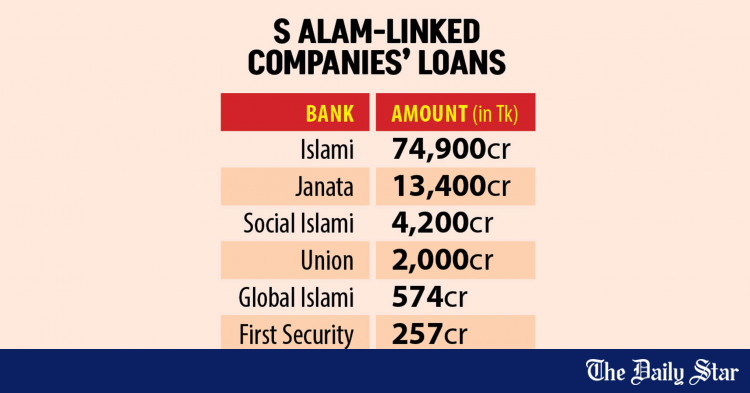
S Alam group, Associates: Tk 95,000cr loans taken from 6 banks

1724108561863.webp


S Alam Group and its associate companies took out Tk 95,331 crore between 2017 and June this year from six banks, with 79 percent of the sum coming from Islami Bank.

This amount is equivalent to 5.78 percent of the banking sector's total outstanding loans as of March.

However, the total amount taken from these six banks is likely higher, according to Bangladesh Bank and bank officials with knowledge of the matter.

Documents pieced together by The Daily Star show that most of the loans were taken by bypassing banking rules and regulations, which is a testament to how the Chattogram-based conglomerate exerted its influence on the country's banking sector.

Founded in 1985 by Mohammad Saiful Alam, a relative of former Awami League politician Akhtaruzzanan Chowdhury Babu and former Land Minister Saifuzzaman Chowdhury, S Alam Group has grown into one of the largest conglomerates in Bangladesh.

For example, within one month of opening an account with Islami Bank's Chaktai branch in Chattogram, a modest corrugated tin seller Murad Enterprise was given Tk 890 crore without even verifying the need for the funds and the company's financial capacity to pay back the sum.

A year later, another loan of Tk 110 crore was given to the company, which turned out to be a shadow company of S Alam Group, BB documents show.

What is worse is that the bank, where S Alam Group has controlling stakes, took very little collateral from Murad Enterprise.

The conglomerate and companies with ties to it took Tk 74,900 crore from Islami Bank, whose chairman since June last year is Alam's eldest son Ahsanul Alam.

Of the amount, Tk 26,000 crore was borrowed in the name of its subsidiaries, and the remaining amount was in the name of 29 associate companies, such as Nabil Group, Desh Bandhu Group, Unitex Group, and Anantex Group.

Islami Bank's Khatunganj branch in Chattogram is particularly noteworthy: a staggering Tk 35,924 crore was taken from the branch through 10 companies, documents show.

S Alam Group and its shadow companies, such as Nabil Foods, Nabil Auto Rice Mills, MS AJ Trade International, and Anowara Trade International, secured loans amounting to Tk 29,575 crore from the Rajshahi branch of Islami Bank.

Another Tk 23,900 crore was taken from Islami's offshore banking unit and other branches over the years in violation of rules.

Rules were also not followed by state-run Janata when extending loans to the business giant, whose interests range from commodity trading to fishery, from construction materials to real estate, from textiles to media, from intercity buses to shipping, and from power and energy to banks and insurance.

S Alam Group and its affiliate companies took Tk 13,400 crore from state-run Janata Bank.

About Tk 10,449.45 crore was taken in the name of S Alam subsidiaries, with as much as 90 percent of the loans taken from Janata's Sadharan Bima Corporate Branch in Chattogram.

The remaining Tk 2,950.55 crore was taken from Janata by its associate companies.

Janata's lending to S Alam Group breached the bank's single borrower exposure limit by an alarming margin.

According to banking law, a bank is prohibited from lending more than 25 percent of its paid-up capital to a single party. At the end of June this year, Janata's paid-up capital stood at Tk 2,314 crore.

Some Tk 4,200 crore was taken from Social Islami Bank (SIBL), whose chairman Belal Ahmed is Alam's son-in-law. Five more relatives of Alam are on the board of SIBL.

Some Tk 2,000 crore was taken from Union Bank, whose board consists of Alam's siblings Halima Begum, Osman Goni, and Md Rashedul Alam and his wife Marzina Sharmin. Their nephew, Mohammad Mostan Billah Adil, is also on the board.

S Alam Group and its associate companies took Tk 574 crore from Global Islami Bank (GIB), whose vice-chairman is Alam's daughter Maimuna Khanam. Seven other relatives of Alam, including his brother Shahidul Alam and sister Rokea Yasmin, are on the board of the 11-year-old bank.

Some Tk 257 crore was taken from First Security Islami Bank (FSIBL), whose chairman is Alam himself. Alam's wife, Farzana Parveen, and four other relatives are on the board of FSIBL.

If the loans taken by its associate companies are added, the total amounts taken from SIBL, FSIBL, Union, and GIB will go up, according to industry insiders.

In light of the gross irregularities, the BB yesterday restricted the lending activities of the banks save for Janata.

Alam; Subrata Kumar Bhowmik, executive director of S Alam Group; the managing directors of the six banks; and BB spokesman Md Mezbaul Haque could not be reached for comment.​
 
Analyze

Analyze Post

Add your ideas here:
Highlight Cite Respond

6 banks with ties to S Alam barred from lending

1724111004888.webp


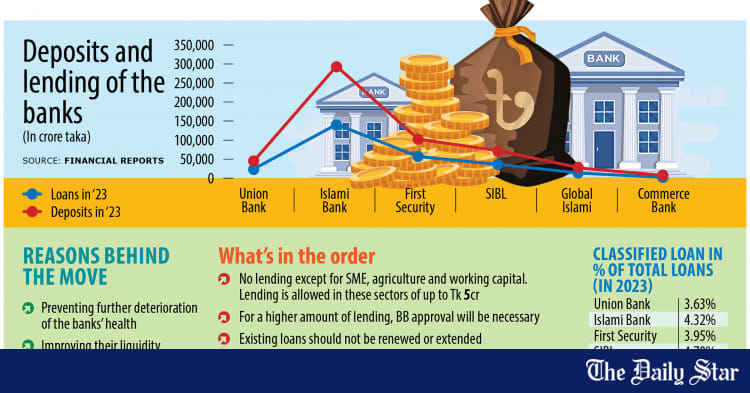
The Bangladesh Bank restricted six banks linked to S Alam Group from lending activities to prevent their situation from deteriorating further amid allegations of wrongdoing.

Experts say the restriction may help boost liquidity in the six cash-strapped banks, which were all running their activities by taking special liquidity support from the central bank.

The banking regulator made the decision yesterday through a letter sent to the banks, namely Islami Bank Bangladesh, First Security Islami Bank, Social Islami Bank, Union Bank, Global Islami Bank, and Bangladesh Commerce Bank.

However, the lenders will be able to disburse agriculture loans, SME loans against deposits, and loans under incentive packages up to Tk 5 crore, the BB letter added.

In order to provide loans above Tk 5 crore, the respective bank will have to get prior approval from the central bank.

It also prohibited the six banks from rescheduling any previous loans until further notice.

Alongside that, they cannot extend or increase exisThe central bank also ordered the six banks to submit monthly repayment data of its 20 largest borrowers.

"The decision was taken in order to protect further deterioration of the banks, and protect depositors' funds," the letter sent by the central bank read.

The central bank passed the order to bring discipline to the banks, said Syed Mahbubur Rahman, a former chairman of the Association of Bankers, Bangladesh (ABB), adding that such policies had previously been issued for state-run banks.

As the banks have some liquidity issues, it may help improve the situation, he said.

The liquidity coverage ratio (LCR) of Islamic banks in Bangladesh tumbled to 58.7 percent at the end of last year from 87.7 percent in 2022 and 188.5 percent in 2021, according to a report released by Fitch Ratings, an American credit rating agency.

Excess liquidity in the sector plummeted to Tk 1,518 crore at the end of March this year, a 91.3 percent drop compared to September of 2022.

These six banks have long been battling a liquidity crisis. As such, they were utilising the central bank's special liquidity support until last week, when the central bank cut that facility.

Aside from liquidity issues, the banks are also contending with high amounts of non-performing loans (NPLs). The total bad loans of the six banks rose around 8 percent year-on-year to Tk 9,674 crore in 2023.

"We also restrict lending by some branches when we see that the NPLs of the branches are high. This is a common practice to bring back discipline," added Rahman, who is also managing director and CEO of Mutual Trust Bank.

In recent weeks, several reports have come out indicating that Mohammad Saiful Alam, the owner of S Alam Group, borrowed large amounts from these six banks using companies that exist only on paper.

Most of these loans may sour, according to experts.

There are 10 Shariah-based banks in Bangladesh, with five owned by the S Alam Group.

A top official of a leading bank said such restrictions may improve the banks' situation.

However, he cautioned that it may impact Shariah-based financing in the country as half of the Islamic banks will remain out of financing activities.

"Let the banks survive first and set aside worries about its impact on Shariah-based banking for this moment," the official said.

"There are five other Shariah-based banks in the country and two of them are doing well. So, people can go to those banks for loans in the meantime. The restriction will not remain year after year, so they will come back soon."

If the banks cannot survive, Shariah-based banking will be squeezed. So, this is a good decision, he said.

The banker hoped the banks would bounce back strongly after structural reforms and contribute to Shariah-based banking again.

As of 2023, Islamic banking assets accounted for over 25 percent of the overall banking sector's assets in Bangladesh.

However, despite impressive growth and potential, the sector has been facing a significant crisis since the middle of 2022 due to loan irregularities, scams and a lack of good governance at some Shariah-based banks.

The deposit growth of Islamic banks plummeted to 2.9 percent year-on-year in 2022 from 20.1 percent the year prior, according to the central bank's Financial Stability Report 2022.​
 
Analyze

Analyze Post

Add your ideas here:
Highlight Cite Respond

ACC widens net to fight corruption
Solamain Salman 20 August, 2024, 23:51

1724198512718.webp


The Anti-Corruption Commission is widening its anti-graft net across the country to bring corruption suspects under its scrutiny over amassing illegal wealth and money laundering.

A huge number of corruption allegations gathered at the commission, but the scrutiny could not be carried out due to pressure from ruling groups during the successive tenures of now deposed prime minister Sheikh Hasina, ACC officials said.

With Hasina resigning as prime minister and fleeing to India amid the student-led mass uprising on August 5, ACC officials said they have now gathered courage and strength to scrutinise graft allegations against many powerful people.

After Hasina’s fall, the commission has intensified its activities to catch the corruption suspects, while complaints have already been submitted to the commission against several dozen former ministers, lawmakers, bureaucrats, and businesspeople, said officials concerned.

As a part of the fresh ACC move, the commission has prepared a primary list of around 200 graft suspects to bring them under ACC net for inquiry, a director general of the commission told New Age on Tuesday.

Apart from starting new inquiries, the commission also took initiatives to dispose of pending inquiries and cases, a task that it could not complete due to political pressures, commission officials said.

As part of the fresh move, the ACC launched inquiries against 63 individuals in the past four working days for graft allegations.

The 63 graft suspects include 20 former ministers, 30 former lawmakers, two former bureaucrats, two top police officials, and two former officials of the Prime Minister’s Office.

ACC on Tuesday took decisions to conduct inquiries against seven people, including former shipping minister Shajahan Khan and primary and mass education minister Mostafizur Rahman Fizar, over their alleged involvement in amassing illegal wealth.

The decision came at a meeting held at the agency’s headquarters with commission chairman Mohammad Moinuddin Abdullah in the chair.

The other five graft suspects are former lawmakers Jannat Ara Henry, Ashim Kumar Ukil and his wife Opu Ukil, the prime minister’s former deputy press secretary Ashraful Alam Khokon, and the PMO staff, Jahangir Alam.

The allegations against the two former ministers and three lawmakers include amassing a huge amount of movable and immovable wealth illegally through corruption and irregularities during the past three consecutive terms of the Awami League government.

The ACC decided to conduct an inquiry against the former prime minister’s former deputy press secretary, Ashraful Alam Khokon, over allegations of amassing illegal wealth.

Khokon, during his tenure as the former PM’s deputy press secretary from August 18, 2013 to February 2021, amassed several hundred crores of money through corruption and irregularities, according to allegations.

The allegations said Khokon was involved in gold syndicates, currency smuggling, and illegal VoIP businesses.

Khokon amassed several crores of money in the name of himself and his family members through taking bribes and financial benefits from various business entities, including Nagad and Max Group, according to the allegations.

ACC also initiated another inquiry against the former PMO household staff, Jahangir Alam, who allegedly amassed wealth worth Tk 400 crore.

Jahangir and his family members have plots of land and houses in the capital and in his village home in Noakhali.

About the intensified ACC move, ACC secretary Khorsheda Yasmeen told New Age that they got allegations against ministers, lawmakers, and others earlier, but there was a delay in taking decisions due to ‘procedural causes.’

About the move, Transparency International Bangladesh executive director Iftekharuzzaman told New Age that the move might be viewed as welcome news, quite belated though, in the backdrop of the self-inflicted credibility gap of the ACC.

‘While people will expect to see specific progress to ensure exemplary accountability of such erstwhile high-profile individuals for their abuse of power, this will remain yet another example that ACC tends to act against the so-called big fish only when they are out of power,’ he said.

It will not be unjustified to question that by failing to take action before their humiliating downfall, the ACC has in reality protected their corruption and violated their own mandate as well as the relevant law, he observed.

‘Be that as it may, nothing can justify any underestimation of the imperatives for a thorough overhaul of this institution as part of the state-restructuring to meet the aspirations of a new Bangladesh as articulated by the student-led people’s uprising,’ he said.

On Monday, the ACC took decisions to conduct inquiries against the ousted AL government’s 45 ministers, state ministers, lawmakers, secretaries, and beneficiaries on the charges of amassing illegal wealth through corruption.

Most of the former lawmakers and ministers, however, of the ousted government have either fled or gone into hiding since the fall of the regime through a mass uprising.

ACC also decided to start an inquiry against the former senior secretary for the disaster management and relief ministry Shah Kamal over allegations of corruption, abuse of power, misconduct, bribery, and amassing illegal wealth.

The commission launched an inquiry on Monday also against former Bangabandhu Sheikh Mujib Medical University vice-chancellor Professor Sharfuddin Ahmed and his private secretary Russell over allegations of receiving bribes of around Tk 100 crore through illegal appointments.

Apart from this, it also started an inquiry against the National Board of Revenue’s second secretary Arjina Khatun on the charges of amassing illegal wealth.

On Sunday, ACC started an inquiry against former finance minister AHM Mustafa Kamal’s wife Kashmeri Kamal, their daughter Nafisa Kamal, and three former lawmakers over allegations of embezzling Tk 20,000 crore by operating a syndicate to send workers to Malaysia.

The three former lawmakers are retired lieutenant general Masud Uddin Chowdhury, Nizam Uddin Hazari, and Benazir Ahmed.

The commission also decided to run an inquiry against former land minister Saifuzzaman Chowdhury Javed, former Dhaka Metropolitan Police commissioner Asaduzzaman Mia, and DMP’s former Detective Branch chief Harun Or Rashid.

Earlier on Thursday, the commission decided to initiate an inquiry against former home minister Asaduzzaman Khan and five others over amassing illegal wealth through taking bribes and money laundering.​
 
Analyze

Analyze Post

Add your ideas here:
Highlight Cite Respond

Stop extortion in transport sector
Bringing discipline in this vital sector is paramount

1724455384808.webp

VISUAL: STAR

It is disturbing to know that soon after the fall of the Sheikh Hasina government on August 5, BNP-affiliated transport leaders have emerged on the scene and taken control of major transport organisations across the country. According to a Prothom Alo report, the offices of Dhaka Road Transport Owners' Association and Bangladesh Road Transport Owners' Association, from where the transport sector used to be controlled by Awami League leaders, are now under the control of their BNP counterparts. Similarly, BNP men have taken control of almost all other transport organisations, bus terminals, and workers' unions.

Understandably, the main objective behind their push is to get their hands on extortion money. Reportedly, every year, around Tk 2,000 crore is collected by the transport owners' and workers' associations through extortion across the country. While about Tk 70 is collected openly from each bus or truck every day, there are various other fees, including "gate pass" fees or membership fees, that are collected from transport operators as daily, monthly, and sometimes one-time donations. According to a Transparency International Bangladesh (TIB) study published in March, politically connected individuals or groups, traffic and highway police, Bangladesh Road Transport Authority (BRTA) officials, transport organisations, and staffers of municipalities or city corporations all get a share of this money, which shows how pervasive this culture of extortion has been.

The manoeuvring and manipulation of the public transport system remains a perennial source of pain and suffering for commuters and non-commuters alike.

Unfortunately, the transport sector is just one example where BNP-linked men are taking control of important public sectors. After the fall of Awami League, we have seen how BNP-affiliated people have been trying to assert their control in every other sector, such as the health sector. Recently, we have also seen how groups claiming allegiance to the BNP have been trying to take control of slums and footpaths in the city. This tendency must stop urgently.

Extortion is one of the key reasons for the chaos and lawlessness in the transport sector, so the interim government must find a sustainable solution to this problem. The transport organisations, including powerful owners' and workers' associations, must be represented by honest individuals who can save this sector from the crippling influences of corruption and irregularities, which have led to our roads becoming one of the most dangerous in the world. Reform of state institutions was a major goal of the student-led mass movement; and to attain that goal, politicisation of vital public sectors including transport must stop.​
 
Analyze

Analyze Post

Add your ideas here:
Highlight Cite Respond

Eliminate scope to whiten black money
FBCCI urges NBR

1724630035223.webp


The Federation of Bangladesh Chambers of Commerce and Industries (FBCCI) yesterday demanded the abolishment of a provision that allows black money to be whitened without scrutiny by paying a 15 percent tax.

The apex trade body voiced the demand during a meeting with Md Abdur Rahman Khan, newly appointed chairman of the National Board of Revenue (NBR), at Sher-e-Bangla Nagar in Dhaka, according to a press release.

"There cannot be any discrimination between honest and corrupt taxpayers. This type of amnesty should never be given again to ensure justice and remove social discrimination," said FBCCI President Mahbubul Alam.

Such a provision can never be desired when building a corruption-free society or state, he added.

Other members of the delegation included FBCCI Vice-President Md Munir Hussain and Directors Mohammad Fayazur Rahman Bhuiyan, MA Razzak Khan, and Abul Kasem Khan.

On his first day in the NBR office, Khan told reporters that the scope to whiten black money should not exist at all

"The amnesty for black money is unexpected and indecent," he said.

Alam also called on the NBR chairman to simplify customs duty processes for imported goods to ensure a business-friendly environment by removing complexities related to duty values, HS codes and product descriptions.

They further urged him to curb the harassment of taxpayers during audits and dishonest practices by officials.

To this end, they proposed creating a hotline, app or complaint centre for businesspeople that face harassment.

They also suggested that taxation should be automated, including the management of value-added tax (VAT) and income tax, and ensuring speedy implementation of the National Single Window (NSW).

Alam also emphasised the need to bring eligible taxpayers under the income tax net to increase the nation's tax-GDP ratio.

He added that the NBR needed reforms. In particular, it is important to separate policy and policy implementation, he said.

Appreciating the NBR's plan to review the existing tax rules by forming three task forces, the businessmen requested that all stakeholders concerned be included as members.

The new NBR chairman told businessmen that the participation of private sector stakeholders in the task forces, including from the FBCCI, would be ensured.

"We'll try to ease the business environment in the country. The NBR will remain alert so that there is no injustice against businessmen," Khan added.

He also urged businesspeople to provide specific information about dishonest officials and conduct commercial activities sincerely.​
 
Analyze

Analyze Post

Add your ideas here:
Highlight Cite Respond

ACC accelerates anti-graft drives across Bangladesh
Solamain Salman 01 September, 2024, 00:37

1725148433901.webp


The Anti-Corruption Commission’s activities to bring corruption suspects under scrutiny are gathering pace following the August 5 fall of the Awami League government amid a student-led mass uprising.

The commission has also expedited its probes into new graft allegations, while it has widened its net in a bid to bring more individuals under scrutiny after the Muhammad Yunus-led interim government had taken charge on August 8.

The anti-corruption agency’s data shows that it took decision for 93 new enquiries, mostly regarding relatively smaller corruption charges, from April 1 to June 30, this year.

But it took decision for new enquiries against around 100 people, including heavyweights like former ministers, lawmakers and bureaucrats, within only 12 working days of the new government.

During the time of the Awami League rule, numerous allegations against powerful individuals regarding amassing illegal wealth through corruption, irregularities, money laundering, and abuse of power were gathered at the commission.

The commission could not carry out investigation into these allegations due to pressure from corners associated with the then ruling Awami League, said its officials.

Now that the Awami League is no more in power and the hindrances are removed, the commission now feels strong enough to probe the graft allegations against many formerly powerful individuals, including former ministers, lawmakers, and money launderers, officials said.

Transparency International Bangladesh executive director Iftekharuzzaman told New Age that the commission’s fresh move might be viewed as welcome news, quite belated though, in the backdrop of the self-inflicted credibility gap of the agency.

‘While people will expect to see specific progress to ensure exemplary accountability of such erstwhile high-profile individuals for their abuse of power, this will remain yet another example that ACC tends to act against the so-called big fish only when they are out of power,’ Iftekharuzzaman said.

It would not be unjustified to question that by failing to take action before their humiliating downfall, the anti-corruption agency had in reality protected their corruption and violated their own mandate as well as the relevant law, he observed.

‘Be that as it may, nothing can justify any underestimation of the imperatives for a thorough overhaul of this institution as part of the state-restructuring to meet the aspirations of a new Bangladesh as articulated by the student-led people’s uprising,’ he said.

The anti-corruption commission, meanwhile, is going to launch a combined drive against corruption and to recover illegal money from this week, said a top official of the commission on Thursday.

The drive will be conducted led by its enforcement unit with the help of its other based on the information of its intelligence wing, he added.

The commission in the past week also formed a panel to maintain the anti-corruption operations and support the law enforcement agencies.

The panel includes its deputy directors Debabrata Mondal, Md Humayun Kabir, Md Saiful Islam, and Md Tajul Islam Bhuiyan, and assistant directors Muhammad Zafar Sadeq Shibli and Shoyeb Ibne Alam.

The panel will assist in seizing evidence and handling legal matters during search operations.

Notably, after the interim government assumed power the commission is opening new enquiries one after another and resumed enquiries in pending probes.

Earlier, after submission of an allegation, scrutiny used to be kept long pending, but now it starts inquiry within 2–3 days of the submission of allegations.

Apart from starting new inquiries, the commission has also undertaken initiatives to dispose of pending inquiries and cases, a task that it could not complete due to political pressures, commission officials said.

After Hasina’s fall, the commission took decision to run inquiry against a number of former ministers, state ministers, lawmakers, secretaries, and beneficiaries on the charges of amassing illegal wealth through corruption.

As part of its fresh move, the commission has prepared a primary list of at least 200 graft suspects to bring them under its scrutiny, one of its directors general told New Age.

The commission’s inquiries have already been launched against a number of formerly powerful ministers, lawmakers, and businesspeople, including former ministers Asaduzzaman Khan, Dipu Moni, Anisul Huq, Hasan Mahmud, Golam Dastagir Gazi, Shajahan Khan, Saifuzzaman Chowdhury Javed, Mostafizur Rahman Fizar, Tipu Munshi, Sadan Chandra Majumder, Imran Ahmed, and Mohibul Hassan Chowdhuey, former state ministers Nasrul Hamid, Zunaid Ahmed Palak, Jakir Hossain, Kamal Ahmed Mojumder, and Sharif Ahmed, former lawmakers retired lieutenant general Masud Uddin Chowdhury, Nizam Uddin Hazari, Benazir Ahmed, Dhirendro Debnath Shambhu, Jannat Ara Henry, Ashim Kumar Ukil, Opu Ukil, and Shahe Alam, and the prime minister’s former deputy press secretary Ashraful Alam Khokon, former Bangabandhu Sheikh Mujib Medical University vice-chancellor Sharfuddin Ahmed, former cabinet secretary Kabir Bin Anwar, former senior secretary Shah Kamal, National Board of Revenue second secretary Arjina Khatun, former Dhaka Metropolitan Police commissioner Asaduzzaman Mia, and DMP’s former Detective Branch chief Harun Or Rashid, S Alam group chairman Mohammed Saiful Alam, and Padma bank former chairman Chowdhury Nafeez Sarafat.

About the commission’s intensified move, its secretary Khorsheda Yasmeen said that they received allegations against ministers, lawmakers, and others earlier but there was a delay in taking decisions due to ‘procedural causes.’

‘We are starting new inquiries following the ACC law, and there is no special anything,’ she added.​
 
Analyze

Analyze Post

Add your ideas here:
Highlight Cite Respond

Posts you haven't read yet..

Members Online

No members online now.

Latest Posts

Back
 
G
O
 
H
O
M
E