| Global Defense, OSINT & Geopolitics Wire

[🇧🇩] Corruption Watch

[🇧🇩] Corruption Watch
410
20K
More threads by Saif

G Bangladesh Defense

Govt tightens measures against loan defaulters, says finance minister

FE ONLINE REPORT

Published :
Jun 09, 2026 18:45
Updated :
Jun 09, 2026 18:45

1781158063831.webp


Finance Minister Amir Khosru Mahmud Chowdhury on Tuesday said the government has intensified banking-sector reforms, strengthened deposit protection and tightened measures against loan defaulters in an effort to restore public confidence and improve financial stability.

Responding to a question from Cox’s Bazar-3 lawmaker Lutfur Rahman in the Jatiya Sangsad, the minister said the reforms are being implemented under a comprehensive bank-resolution framework established through the Bank Resolution Act 2026.

He said the framework was first introduced through the Bank Resolution Ordinance 2025 and operationalised under the Bank Resolution Scheme 2025 before being enacted into law this year.

As part of the resolution process, five troubled Islamic banks have been merged to form Sommilito Islami Bank PLC, a key step aimed at strengthening the banking system and addressing long-standing weaknesses in the sector.

The minister said depositor protection has also been expanded under the Deposit Protection Act 2026, with the maximum protected deposit amount doubled to Tk 200,000 from Tk 100,000.

In a significant policy shift, depositors of non-bank financial institutions (NBFIs), who were previously outside the safety net, have also been brought under the protection framework.

“A clear legal framework, transparent resolution mechanisms and stronger depositor safeguards will play an effective role in rebuilding confidence among depositors and stakeholders,” Mr Chowdhury told the House.

The finance minister said the government and Bangladesh Bank have simultaneously stepped up efforts to recover defaulted loans and curb the accumulation of non-performing loans (NPLs).

The measures include policy support for recovering overdue loans, special resolution strategies for banks burdened with high levels of classified loans and stricter action against wilful defaulters.

Banks have been instructed to strengthen their legal divisions and recover at least one per cent of outstanding defaulted loans in cash through alternative dispute resolution mechanisms by June 30, he said.

Bangladesh Bank has also updated credit-risk management guidelines, while the recovery progress of the top 20 defaulters is being reviewed regularly at bankers’ meetings.

Banks with classified loans exceeding 10 per cent of their portfolios have been directed to form dedicated recovery-monitoring teams.

To strengthen credit discipline, the central bank is implementing Expected Credit Loss (ECL)-based loan classification and provisioning under IFRS 9, a move aimed at improving governance and reducing lending risks.

The minister said licensed collateral valuation firms have also been authorised to independently assess pledged assets alongside banks’ own valuations.

Mr Chowdhury said the government’s broader reform agenda includes updating agricultural loan-rescheduling policies, publishing lists of defaulters and wilful defaulters, revising incentives for regular borrowers and setting sector-wide borrowing limits for individual clients.

Legal reforms are also being pursued to impose tougher penalties on habitual defaulters, he added.

The government is considering including experienced bankers on the jury board of the Artha Rin Adalat and introducing measures to prevent defaulters from delaying recovery proceedings through writ petitions.

The minister said large companies seeking financing above Tk 10 billion would be encouraged to raise funds through bond issuances instead of relying heavily on bank borrowing, helping ease pressure on the banking system.

He also disclosed that legislation is being prepared to facilitate the establishment of private-sector asset management companies (AMCs) to help resolve distressed assets and strengthen long-term financial-sector stability.​
 

MOVE AGAINST DUTY-DODGING IN EXTERNAL TRADE
Global price benchmarks adopted to curb fictitious invoicing

Jasim Uddin

Published :
Jun 16, 2026 00:34
Updated :
Jun 16, 2026 00:34


1781589287185.webp


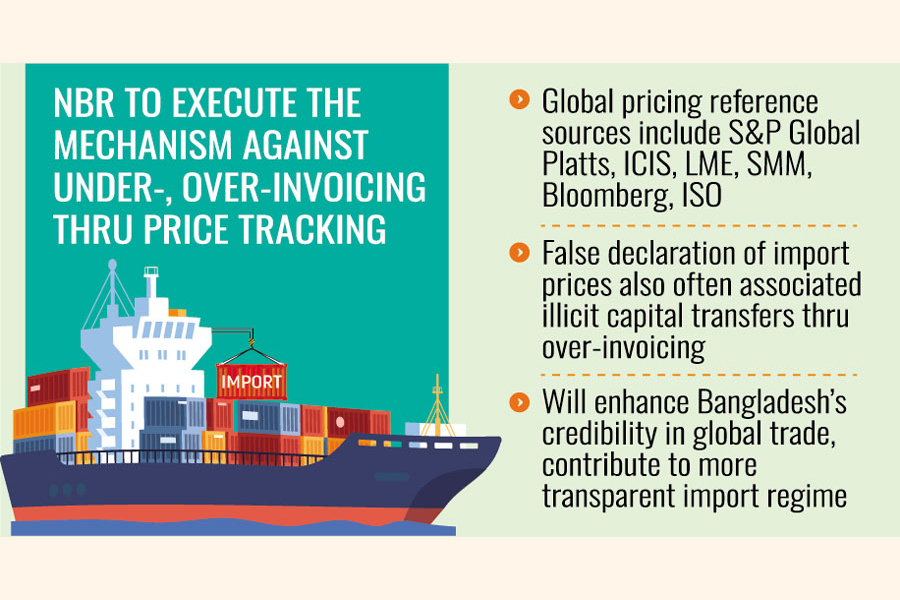
Government's revenue authority has moved to ensure accurate customs valuation by using internationally recognised price benchmarks to verify import prices and thus prevent duty-dodging through trade misdeclaration.

Officials say the mechanism will be executed to prevent under-invoicing and over-invoicing of commodities while facilitating hassle-free legitimate trade.

The National Board of Revenue (NBR) has issued an order to this effect. Through this general order, issued on June 11, the revenue authority has directed customs officials to compare prices declared by importers with information available from globally recognised and independent price-reporting agencies, commodity exchanges and market-intelligence platforms.

According to the order, reference sources include S&P Global Platts, Independent Commodity Intelligence Services (ICIS), London Metal Exchange (LME), Shanghai Metals Market (SMM), Bloomberg and the International Sugar Organization (ISO).

Under the new framework, customs officials may accept the value declared by an importer as the transaction value if it is consistent with prices available from these international sources and there is no specific evidence indicating that the declared value differs from the actual price paid or payable.

The order, signed by Md Tariq Hassan, First Secretary (Customs Policy and ICT) at the NBR, was issued under Section 266 of the Customs Act 2023 and came into effect immediately.

Seeking anonymity, revenue officials say businesses have long complained that customs authorities often assess imported goods at higher value, resulting in increased duty payments.

"The move is intended to bring greater transparency and consistency to customs valuation and address concerns over misdeclaration of import prices--a practice often associated with duty evasion through under-invoicing and illicit capital transfers through over-invoicing," says one official.

The NBR says customs officials frequently face difficulties in determining the assessable value of imported goods, often leading to disputes and delays in the clearance process.

To reduce such complexities and support trade facilitation, the new guidelines provide a structured framework for incorporating international market data into customs valuation.

Officials also say the measure would benefit compliant businesses while tightening scrutiny of non-compliant ones.

According to the order, benchmark prices must be based on pro forma invoices issued within 90 days prior to the submission of the import declaration.

The directive also introduces "greater accountability" in customs assessments. If a customs official rejects a declared transaction value despite its consistency with internationally recognised price references, the decision must be backed by specific evidence and approved by an officer not below the rank of Assistant Commissioner of Customs.

The order further reiterates that where a minimum customs value has been prescribed through a government notification, imported goods cannot be assessed below that threshold.

"However, if an importer declares a value higher than either the international reference price or the notified minimum value, customs duties will be assessed on the higher declared value," the order reads.

Speaking to The Financial Express, Snehasish Barua, a chartered accountant and partner at SMAC Advisory Services Ltd, has said the adoption of a modern, data-driven valuation model would reduce "bureaucratic red tape and discretionary decision-making" in customs assessments.

"This approach aligns domestic customs valuation with prevailing international market prices, protecting compliant importers from unfair competition. A system-guided process will ensure greater uniformity in assessments and help reduce cargo-clearance time, improving Bangladesh's business environment," he says.

He adds that the use of real-time market data could help plug revenue leakages caused by under-invoicing, strengthen revenue collection and support the transformation of Bangladesh Customs into a more digital and efficient revenue administration.

"Ultimately, it will enhance Bangladesh's credibility in global trade and contribute to a more transparent import regime," he added.​
 

Fraudsters gobble up Tk 926m in 2025
They are still active though BFIU, CID working to tackle financial crimes: BB official

SAJIBUR RAHMAN

Published :
Jun 16, 2026 10:26
Updated :
Jun 16, 2026 10:26

1781589437652.webp


Bangladesh's payment ecosystem suffered losses amounting to Tk 926.01 million due to fraudulent practices in 2025, with mobile financial services (MFS) accounting for the major part of it.

Such a significant volume of fraud-related losses highlights the persistent vulnerabilities in the country's fast-growing digital finance sector, according to insiders.

According to Bangladesh Bank (BB) data, a total of 81,423 fraud cases were reported across mobile financial services (MFS), cheque-based instruments and card transactions during the year.

Of the total fraud amount, Tk 827.21 million remained unrecovered, leaving an overall recovery rate of only 10.7 per cent.

The central bank data show stark variances in fraud patterns across payment channels.

While MFS fraud was widespread and difficult to recover, cheque fraud occurred infrequently but involved large amounts per incident. Card fraud, meanwhile, remained comparatively contained and showed signs of improvement during the year.

MFS emerged as the most vulnerable segment, accounting for about 88 per cent of the total fraud value recorded in the payment ecosystem.

The sector experienced fraud worth Tk 813.26 million in 2025, of which Tk 742.56 million remained unrecovered. The recovery rate stood at only 8.7 per cent, According to available data.

The number of fraud cases rose from 16,230 in the January-March quarter to a peak of 18,623 in April-June before gradually declining toward the end of the year. Fraud values followed a similar trend, reaching Tk 219.87 million in the second quarter.

Industry observers said the low recovery rate reflects the speed with fraudsters moving stolen funds through multiple accounts and intermediary wallets before victims or service providers can take action.

Although cheque-related fraud represented only a small share of total cases, it remained a significant source of financial risk because of the high value involved in each incident.

A total of 30 cheque fraud cases involving Tk 85.53 million were reported during 2025.

The average loss per incident amounted to nearly Tk 2.85 million, underscoring the high-value nature of cheque-related fraud.

Unlike MFS fraud, cheque frauds demonstrated strong recovery outcomes with financial institutions managing to recover about 81 per cent of the affected funds, making it the most recoverable fraud category among the three payment channels.

The first quarter recorded the highest cheque frauds valued at Tk 36.59 million, largely due to a handful of major corporate cheque misuse incidents.

Banking officials attribute most of the cheque fraud cases to forged instruments, documentation irregularities and weaknesses in internal control mechanisms.

Although cheque fraud does not currently pose a systemic threat, people familiar with the development warn that it would require continued monitoring because a small number of incidents can generate substantial financial losses.

They recommend strengthening branch-level verification processes, introducing image-based cheque analytics and reinforcing dual-control mechanisms to reduce operational and insider risks.

On the other hand, card fraud followed a markedly different trend during the year as the segment witnessed its highest level of fraud in the first quarter, when 3,740 cases involving Tk 26.5 million were reported.

Both the number and value of fraud incidents then fell sharply in subsequent quarters.

Fraud cases dropped to 1,717 in the following quarter, while losses fell to less than Tk 0.7 million. Although fraud activity increased modestly later in the year, it remained far below the levels recorded at the beginning of 2025.

Such a sharp decline suggests that stronger fraud-monitoring systems, stricter one-time-password (OTP) enforcement and improved merchant controls have helped curb fraudulent activities.

Card fraud achieved a recovery rate of about 47 per cent, significantly higher than that of MFS but lower than cheque fraud.

While card fraud remains operationally manageable, experts believe continued vigilance is necessary, particularly as e-commerce and cross-border digital transactions continue to expand.

Arif Hossain Khan, Executive Director of Bangladesh Bank, acknowledged the rise in payment-related fraud but said the central bank is intensifying its oversight efforts.

"Our Payment Systems Supervision Department remains actively engaged in monitoring the sector and conducts regular sample-based inspections," he said.

He warned that Mobile Financial Services (MFS) providers stand to suffer the most if they fail to curb such fraud.

"If MFS operators cannot reduce fraud incidents, they will be the biggest losers because their reputation and customer trust will be severely affected," he said.

Khan said relevant agencies, including the Bangladesh Financial Intelligence Unit (BFIU) and the Criminal Investigation Department (CID), are also working closely to tackle financial crimes.

"We are making every effort, but some criminals still remain active in society," Mr Khan said.

He also emphasised that fraud cases remain relatively low compared to the overall volume of digital transactions.

Fahim Mashroor, the founder of BDJobs, recently raised serious concerns over the security and growing vulnerabilities in the financial sector.

Mentioning that there has been a massive influx of fake Mobile Financial Services (MFS) accounts and fake SIM cards in the market, he warned that the recent withdrawal of taxes on SIM cards would compound the issue.

He criticised the central bank for its failure to penalise non-compliant MFS providers and banks.

Local financial institutions currently operate without any fear of accountability, he noted.

Mashroor emphasised that both MFS providers and banks need to adopt state-of-the-art technology to check financial fraud.​
 

BB plans tougher steps as bad loan recovery elusive
Mostafizur Rahman 17 June, 2026, 00:41

1781672309147.webp

A file photo shows people walking past the headquarters of the Bangladesh Bank at Motijheel in the capital. | New Age photo

The Bangladesh Bank has intensified efforts to contain the country’s mounting default loan crisis through a series of regulatory, legal and policy measures, but economic weakness, lengthy legal processes and poor recovery rates continue to pose major obstacles to meaningful improvement.

Data from the Bangladesh Bank showed that classified loans rose to Tk 5,88,704 crore at the end of March 2026 from Tk 5,57,216 crore three months earlier. Defaulted loans now account for 32.26 per cent of total outstanding loans, one of the highest ratios globally.

Although non-performing loans fell from a record Tk 6,44,518 crore in September 2025, the decline was largely driven by loan rescheduling and regulatory adjustments rather than a significant improvement in borrowers’ repayment capacity.

Compared with March 2025, defaulted loans increased by nearly Tk 1.68 lakh crore within a year, from Tk 4.20 lakh crore.

Bangladesh Bank spokesperson and Executive Director Areif Hossain Khan said reducing non-performing loans remained one of the governor’s highest priorities.

He said the central bank had taken several initiatives, including a Tk 60,000 crore stimulus package aimed at reviving closed factories and businesses, which could help restore production, improve cash flows and enhance borrowers’ repayment capacity.

BB officials said that Bangladesh Bank has prepared short-, medium- and long-term strategies to reduce default loans and strengthen recovery efforts.

The central bank plans to hold quarterly meetings with senior management of banks whose classified loans exceed 10 per cent of their total loan portfolios, they said.

It will also seek explanations regarding the recovery status of the top 20 defaulters of each bank.

Officials said Bangladesh Bank was preparing detailed recovery guidelines and monitoring frameworks, including setting benchmark ceilings for default loans.

Banks exceeding those limits may be required to follow additional corrective measures.

The central bank has also introduced the Expected Credit Loss framework, which will become effective from 2028. The system requires banks to estimate potential future losses and maintain provisions before loans actually become non-performing.

Bangladesh Bank and the government are also working on legal reforms, including amendments to the Bank Company Act and related regulations, with a focus on strengthening recovery mechanisms and discouraging wilful default.

Other planned measures include establishing an asset management company to handle distressed assets, creating a central database for collateral valuation, introducing incentives for bank employees involved in loan recovery and rewarding good borrowers with stronger repayment records.

Officials said the central bank was also considering seeking government approval to publish the names of defaulters and wilful defaulters.

Despite the wide range of initiatives under consideration, economists said the success of the strategy would ultimately depend on whether banks could recover large overdue loans, improve governance standards and restore lending discipline across the financial sector.

Syed Mahbubur Rahman, managing director and chief executive officer of Mutual Trust Bank, said the broader economic environment remained a major challenge.

He said some businesses were becoming defaulters because of prolonged economic difficulties, while banks were struggling to sell collateral or recover funds through legal channels.

Although banks were pursuing negotiations, litigation and asset auctions, recovery progress remained slow, he said, adding that reforms to the legal system were essential for improving recovery outcomes.

Mustafa K Mujeri, executive director of the Institute for Inclusive Finance and Development, said sustainable improvement would depend on actual recovery of defaulted loans rather than repeated rescheduling, waivers or temporary support measures.

He said the government should strengthen legal mechanisms, accelerate court procedures and take necessary action to recover assets from defaulters, including those who had left the country or were facing criminal proceedings.

Economists said that the long-running crisis was rooted in politically influenced lending, weak credit assessment, repeated rescheduling facilities, poor recovery efforts and prolonged regulatory forbearance over the past decade.

The problem became more visible after the political transition in August 2024, when many businesses linked to the previous power structure either scaled down operations or stopped servicing their debts.

The situation was further exposed as Bangladesh Bank gradually tightened loan classification rules, reducing the overdue period required for loan classification from 270 days to 180 days in September 2024 and then to 90 days in April 2025, bringing the system closer to international standards.

Bankers and analysts also noted that a significant portion of the increase reflected the recognition of previously unreported or under-classified bad loans after stricter supervision by the central bank.​
 

Bangladesh-linked money in Swiss banks swells
Latest deposits amount to Tk 126.79 billion

Asjadul Kibria

Published :
Jun 19, 2026 00:16
Updated :
Jun 19, 2026 00:16

1781825673228.webp


Bangladesh-linked money in Swiss banks ballooned further in 2025 by 41 per cent from the amount recorded in 2024 when there was a quantum leap of 232 per cent following previous two years' sharp decline.

The picture of much-talked-about 'Swiss bank balance' emerges from the Annual Banking Statistics 2025 released by the Swiss National Bank (SNB) in Zurich on Thursday.

According to the latest SNB data, total such deposits in Swiss banks -- including trade finances, investments, and funds held by Bangladeshi individuals and entities -- stood at CHF (Swiss Franc) 834.16 million last year.

Based on the current average exchange rate of Tk 152 per CHF, the amount is equivalent to approximately Tk 126.79 billion.

In 2024, the corresponding amount was CHF 589.54 million, or Tk 89.61 billion. The figures do not include deposits held through fiduciaries or wealth managers.

As the Bangladeshi taka (BDT) has depreciated against major foreign currencies over the past few years, figures converted to local currency using current exchange rates differ from those published previously by the FE.

Although Swiss bank deposits are often associated with stashed wealth, black money or illegally transferred assets from various countries, the SNB report does not provide any information on the nature or source of the funds.

Its statistics show Bangladesh-linked deposits had fallen to CHF 17.71 million (Tk 2.69 billion) in 2023 and CHF 55.27 million (Tk 8.40 billion) in 2022.

Deposits held by Bangladeshi and other non-Swiss individuals and entities are recorded under the "liabilities" section of Swiss banks' balance sheets.

These liabilities are mainly divided into two categories. The larger component, "amounts due to banks", accounted for CHF 822.71 million (Tk 125.06 billion) of Bangladesh-linked money in 2025.

The remaining CHF 11.45 million (Tk 1.74 billion) was classified as "amounts due in respect of customers' deposits".

The above-mentioned figures exclude deposits routed through fiduciaries or wealth managers. Bangladesh-linked deposits held through such channels amounted to CHF 8.31 million, or Tk 1.26 billion, last year.

A few years ago, Bangladesh Bank prepared an explanatory note on Bangladesh-linked deposits in Swiss banks.

The central bank argued that only around 10-15 per cent of such deposits belonged to individual clients, while the bulk of the money represented funds placed by banks for trade-related transactions.

According to Bangladesh Bank, therefore, only a small portion of the deposits may represent money transferred from Bangladesh and stashed abroad.

The SNB statistics also do not capture funds that Bangladesh-linked clients may have deposited through shadow entities or shell companies.

Meanwhile, total funds held by all foreign clients in Swiss banks declined further in 2025 to CHF 896.38 billion from CHF 977.12 billion in 2024 and CHF 983.45 billion in 2023.

The figure represents total liabilities of Swiss banks, excluding fiduciary liabilities.

The SNB data also show Indian deposits in Swiss banks declined by 7.78 per cent to CHF 3.23 billion in 2025 from CHF 3.50 billion in 2024.

Pakistani deposits also fell by around 13 per cent to CHF 236.35 million from CHF 271.67 million over the same period. These figures likewise exclude deposits held through fiduciaries.

Switzerland's banking system is known for maintaining strict depositor confidentiality -- a feature that has long contributed to the country's reputation as one of the world's leading tax havens.​