 Bangladesh Defense

Saif
Senior Member
- Joined
- Jan 24, 2024
- Messages
- 21,952
- Likes
- 9,837
- Nation

- Residence
- Axis Group

FTA talks with Malaysia Tuesday
Bangladesh and Malaysia will hold the first round of negotiations on a free-trade agreement (FTA) here tomorrow (Tuesday) amid hope that the deal will narrow lopsided trade balance and help exporters stay competitive after the country's LDC graduation. A team of senior officials from Malaysia's Mi
FTA talks with Malaysia Tuesday
Bangladesh and Malaysia will hold the first round of negotiations on a free-trade agreement (FTA) here tomorrow (Tuesday) amid hope that the deal will narrow lopsided trade balance and help exporters stay competitive after the country's LDC graduation.
A team of senior officials from Malaysia's Ministry of Investment, Trade and Industry (MITI) is due in Dhaka by October 26 (today), commerce ministry officials said.
The talks will take place at Pan Pacific Sonargaon Dhaka, and Commerce Secretary Md Ataur Rahman Khan is expected to attend the opening session.
The negotiations will be based on "A Zero Draft" already shared by Malaysia and will cover market access, business opportunities and other issues of mutual interest, the officials said.
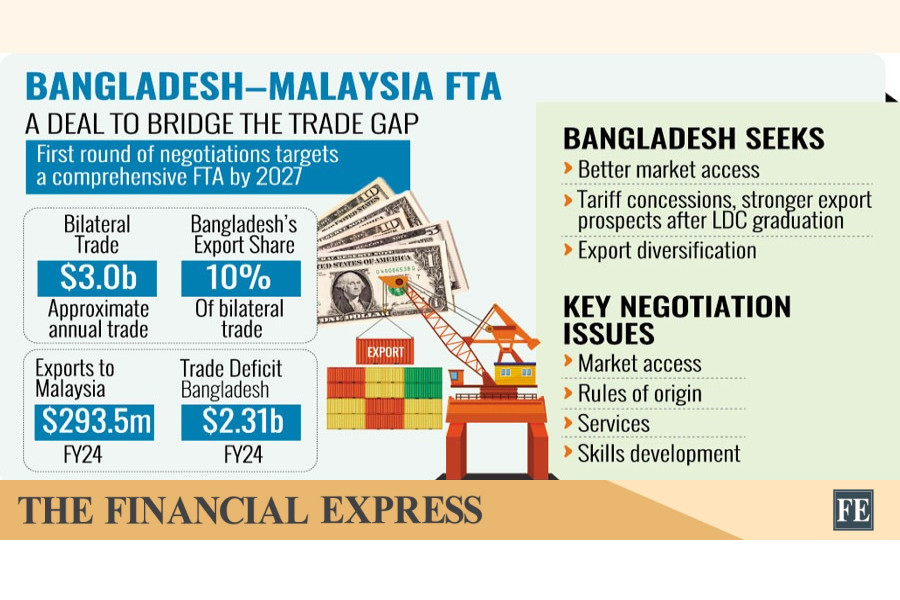
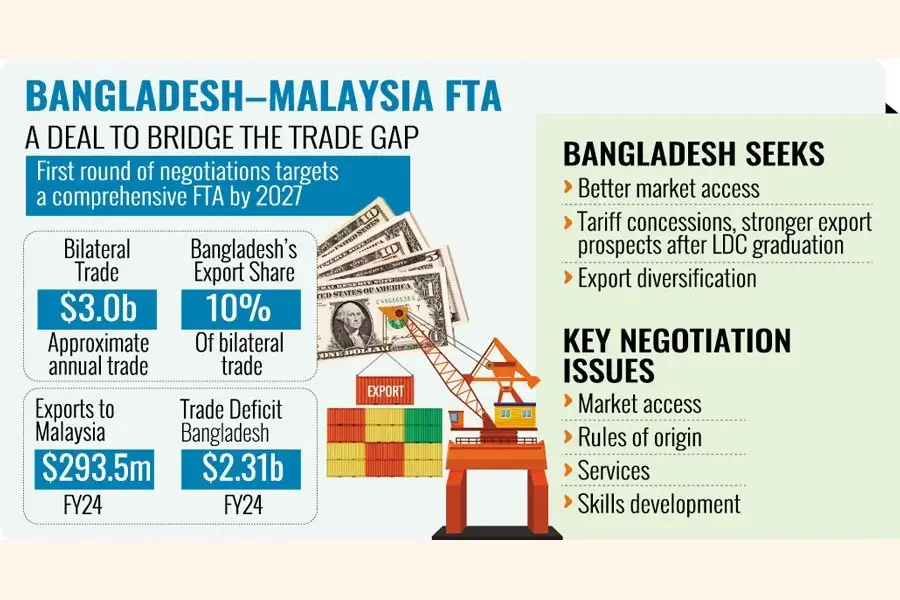
For Bangladesh, value addition and rules of origin are likely to top the agenda in view of its graduation from the least-developed-country status. Services are also expected to feature, given the large Bangladeshi workforce in Malaysia, along with skills development for the semiconductor industry.
The talks follow an understanding reached during Prime Minister Tarique Rahman's visit to Malaysia in June. A joint statement issued at the time set a target of concluding a comprehensive, future-oriented FTA by 2027.
Bangladesh-Malaysia Chamber of Commerce and Industry (BMCCI) President Md Anwar Shahid told The Financial Express that a large Malaysian delegation was expected in Dhaka ahead of the first round.
"Such negotiations usually take time," he said, noting that Malaysia had already shared the terms of reference (ToR) or zero draft and that both governments were keen to seal the deal by 2027.
Mr Shahid hopes the FTA would give fresh momentum to bilateral trade and investment.
He pointed to Malaysia's fast-growing semiconductor industry, which he said would need around 30,000 skilled workers in the coming years-an opening for Bangladesh if it can build the right workforce.
Adequate trainings may create jobs opportunity for Bangladesh young's, he added.
Bangladesh High Commissioner to Malaysia Manjurul Karim Khan Chowdhury earlier told the international media that the two countries had set December 2027 as the target for signing.
"The first round of talks will be an important step in advancing the agreement process," he said.
Malaysia's trade-promotion agency, Malaysia External Trade Development Corporation (MATRADE), says FTAs can improve market access and create opportunities in trade, investment, services and economic cooperation.
Its Deputy Chief Executive Officer S Jai Shankar told local media earlier that Malaysia was keen to deepen bilateral economic ties.
The two countries currently have no comprehensive FTA, so businesses on both sides miss out on the preferential market access, tariff concessions and trade facilitation such a deal could offer. That gap will matter more once LDC graduation strips away the trade preferences Bangladeshi exporters now enjoy.
A deal could lift Bangladesh's exports of readymade garments, leather and footwear, and food and agricultural products to Malaysia. It would also provide a structured framework for imports such as fuel, machinery, and iron and steel.
Malaysia is one of the largest overseas job markets for Bangladeshis. Around 800,000 Bangladeshis currently work over there, making a significant contribution to the country's remittance earnings, according to BMCCI.
Trade, however, remains heavily tilted in Malaysia's favour. The BMCCI puts annual bilateral trade at around US$3.0 billion, with Bangladesh's exports accounting for only about 10 per cent.
According to Bangladesh Bank data, Bangladesh exported goods worth $293.51 million to Malaysia in FY2023-24 and imported goods worth more than $2.6 billion, leaving a deficit of around $2.31 billion.
Bangladesh mainly exports knit and woven garments, leather and footwear, food and beverages, vegetables and spices to Malaysia. Its main imports from Malaysia include mineral fuels, edible oils, iron and steel, plastics, machinery and chemicals.
Halal products offer another route to expanding trade, the BMCCI president said.
According to industry insiders, several Bangladeshi products already carry certification from Malaysia's halal authority, the Department of Islamic Development Malaysia (JAKIM), and Malaysia has recognised Bangladesh's Islamic Foundation as a halal certification body.
Recognition alone, however, may not unlock the market. The foundation will need to strengthen its technical expertise and certification capacity.
