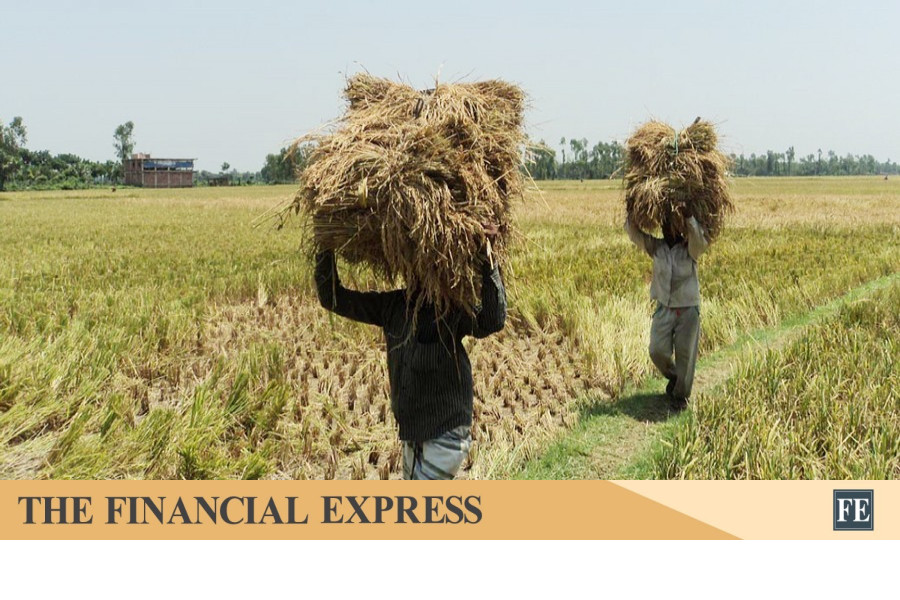
[🇧🇩] Farm Loans and our Farmers

[🇧🇩] Farm Loans and our Farmers
3
129
More threads by Saif

G Bangladesh Defense

Saif

Senior Member
Joined
Jan 24, 2024
Messages
18,624
Likes
8,667
Nation

Residence

Axis Group

Farm loan disbursement rises in April

1750034582949.webp


Disbursement of agricultural credit by scheduled banks surged significantly month-on-month in April, although it was slightly lower than that in the corresponding period of last year.

According to a report by the Bangladesh Bank, banks disbursed a total of Tk 3,239 crore in agricultural loans during the month.

This was an increase of 18.45 percent from the Tk 2,734 crore disbursed in March 2025.

However, this figure was 5.74 percent lower compared to the Tk 3,436 crore disbursed in April of the previous year.

There was also a notable improvement in loan recovery, with scheduled banks recovering Tk 3,362 crore in April 2025, which is 11.36 percent higher than the Tk 3,019 crore recovered in March.

Despite this monthly gain, the amount recovered was 4.97 percent lower than the Tk 3,538 crore recovered during the same month last year.

The outstanding balance of agri credit, including interest, stood at Tk 57,153 crore at the end of April this year.

This represents a 1.18 percent rise compared to the Tk 56,487 crore recorded at the end of April 2024.

Meanwhile, overdue agricultural loans reached Tk 9,992 crore at the end of April this year, showing a very marginal decline of 0.02 percent from Tk 9,994 crore in the same month of the previous year.

The Bangladesh Bank attributed this slight improvement in overdue loans mainly to lower defaults by state-owned commercial banks during the period under review.

In the microfinance sector, disbursement and recovery also showed robust growth.

Grameen Bank, along with 10 large non-governmental organisations, collectively disbursed Tk 14,716 crore as microcredit in April of the current fiscal year, which is a 20.22 percent increase compared to the same month a year earlier.

Their loan recovery amounted to Tk 14,910 crore, reflecting a 7.75 percent rise from April last year.

At the end of April 2025, the outstanding microcredit balance for these institutions stood at Tk 120,407 crore.

Overdue loans in this segment totalled Tk 8,229 crore, representing 6.84 percent of the total outstanding microcredit balance.​
 

Agri loan waiver and the questions it raises

FE
Published :
Mar 01, 2026 00:07
Updated :
Mar 01, 2026 00:07

1772325383325.webp


The government's decision to waive agricultural loans of up to Tk 10,000 along with accrued interest for 1.2 million farmers is a welcome move to ease the burden on a vulnerable segment of the population. Small and marginal farmers usually operate with very little margin for error. They face unpredictable challenges from weather, pests and price swings, all of which can easily trap them in debt. In this context, reducing part of their financial burden makes sense not just on humanitarian grounds but also economically. Freed from the pressure of repayment, farmers can reinvest in seeds, irrigation and other essentials that boost productivity. That, in turn, strengthens food security and keeps rural communities stable. It may also help restore their credit standing, making it easier to return to formal banking instead of turning to informal lenders who often charge exorbitant rates.

The effectiveness of such a policy, however, depends on how well it is designed and carried out. One recurring problem in Bangladesh has been the difficulty of identifying the right beneficiaries in social safety net programmes. With this waiver now public, there is a concern that people who are not genuine farmers will present themselves as borrowers in order to access benefits. A loan waiver can also create the wrong kind of incentive, encouraging some to take agricultural loans in the hope that these will eventually be written off. Without strong verification, there is a real danger that the programme will be captured by those it was not meant to serve, reducing its impact on genuine farmers. This is why the authorities need to rely on credible databases, careful scrutiny at the local level and digital tracking of agricultural activities to ensure that only those who till the land and depend on agriculture for their livelihood are the ones who gain from this scheme. Otherwise, it could end up being a windfall for fraudulent borrowers while doing little to change the reality of the marginal farmer.

A further question arises from the decision to extend the waiver across the board rather than focusing on those in the most acute distress. Not all farmers carry the same level of debt, and a uniform waiver risks subsidising those who are relatively better off while diverting resources away from those who need support the most. This kind of blanket approach overlooks the fact that many small farmers repay their debts and also fails to distinguish responsible borrowers from those who default due to hardship.This concern takes on added weight given the wider fiscal pressures the government is currently facing. Debt obligations are rising, with external repayments set to increase in the current and coming fiscal years. Domestic borrowing has also grown as well, adding to the strain on public finances. In effect, when the government waives loans, the liability does not disappear but is effectively transferred to the state which must compensate the banks.

There are also longer-term considerations that cannot be ignored. Frequent loan waivers can weaken credit discipline by creating an expectation that debts will eventually be forgiven, which in turn can discourage timely repayment and undermine the financial health of banks. Lenders may respond by becoming more cautious, potentially restricting access to credit for the very farmers the policy aims to support. There is no doubt that a loan waiver can provide temporary respite. But without a robust ecosystem of fair pricing, modern technology and reliable access to finance that empowers farmers to stand on their own feet, its benefits may prove short lived while its fiscal costs linger.​
 

‘We farm just to survive, there is no profit’

Staff Correspondent
Sunamganj
Published: 25 Apr 2026, 21: 24

1777161221466.webp


Farmer Ali Akbar is busy threshing paddy under the scorching summer sun at Baon Haor in Sunamganj Sadar upazila on 25 April 2026. Prothom Alo

Farmer Ali Akbar cultivated Boro paddy on 20 bighas of land in the haor this season. He has harvested paddy from three bighas so far. With no cash in hand on one side and a shortage of labourers on the other, he has taken his 13-year-old son, Redwan, to the fields to harvest the crop.

This correspondent met Ali Akbar on Friday afternoon working under the scorching summer sun at Baon Haor in Sunamganj Sadar upazila. Alongside two other farmers, he was stacking harvested paddy in the threshing yard.

When asked how he was doing, he said, “We are under pressure from all sides. We farm just to survive. There is no profit. The price of paddy and the cost are almost the same. Everything is expensive now. It’s hard just to run the household.”

A sharecropper from Hasonbahar village by the haor, Ali Akbar explained that cultivating one bigha of land now costs around Tk 5,000, including labour, fertiliser, seeds and pesticides. Harvesting requires four labourers per bigha, each earning Tk 700–800 a day this season.

There are also costs for machine threshing. Each bigha yields 12 to 14 maunds of paddy. After expenses, whatever remains is barely enough to get by.

He added that the high price of diesel has increased the cost of harvesting and threshing this year. A shortage of harvest labourers is another major concern.

Ali Akbar has a family of six—his wife and four sons. Due to financial hardship, he could not continue his eldest son Redwan’s education beyond seventh grade. The paddy he gets from sharecropping does not last the whole year. Rising prices have made the situation even more difficult.

1777161261166.webp

Paddy harvested from the haor is being threshed by machine in the threshing yard at Baon Haor in Sunamganj Sadar upazila on 25 April 2026. Prothom Alo

Referring to rising market prices, he said, “Soybean oil costs Tk 200, potatoes Tk 30. No vegetables are below Tk 70–80. They say oil cannot be imported because of the war. Transport costs have gone up, so everything is expensive. But we don’t get a fair price for our paddy.”

In the month of Chaitra, many households in the haor areas run out of rice. Although the old notion of ‘Chaitrer Nidan’ (hardship in the month of Chaitra) has lessened, shortages still persist during this time. Farmers often take loans to cultivate their land, which they must repay when harvesting begins in the month of Boishakh.

Ali Akbar said many are forced to sell paddy at low prices to repay debts while managing household expenses. Paddy is currently selling at Tk 800 per mound in the fields. Prices may rise towards the end of Boishakh, but farmers are compelled to sell early at lower rates.

As the conversation continued, local youth Shahin Mia, 35, arrived at the threshing yard with a machine. Ali Akbar and his son became busy with work. When asked about the diesel needed for operating the machine, Shahin said it requires two litres per hour.

On Thursday morning, Shahin had to wait about an hour at a fuel station in town and show his agricultural card to get 15 litres of diesel. He also had to tip a staff member Tk 50. He said it is difficult to run the machine continuously due to diesel shortages, and fuel is not easily available. As a result, operating the machine is not very profitable this season.

During the conversation, two other farmers Abdul Musabbir, 60, and Nur Ahmed, 38, were standing nearby. Musabbir said, “There is a war going on in some other countries, but we are the ones suffering. There is no electricity, no diesel. What can we do? Everything we buy is expensive. The days ahead seem likely to be even worse.”​
 

Bumper crop but farmers incur loss due to lower price

Neil Ray

Published :
Apr 27, 2026 00:10
Updated :
Apr 27, 2026 00:10

1777246925423.webp


The contrast between price of rice and that of the new harvest of paddy grown in the haor area could not be starker. While rice price registered a 5.50 per cent rise here and still showing no sign of coming down in defiance of the general trend of price fall up to 19 per cent in the international market, the new boro harvest has been experiencing a drastic fall in price. Accepted that newly harvested paddy has moisture and it enjoys a lower price in the market. If this is so, why should last year's stored paddy price drop from Tk1,400 to Tk1,100 a maund (roughly 37.32 kgs)---Tk300 less straightway at a go?

The millers and hoarders are taking an undue advantage of the widely anticipated bumper yield of boro. This is just the early stage of boro harvest. Now the newly arrived coarse varieties have market prices between Tk670-700 a maund and finer varieties between Tk850-950. But the production cost of a maund of paddy stands at Tk 800. So, farmers growing coarse paddy have to incur a loss of more than Tk100. In case of finer varieties, the yield is less than the coarse varieties. Farmers also have to sustain losses if they are compelled to dispose of their crop early in the season.

Such things can happen only because the market is controlled, monopolised and manipulated by middlemen, millers and hoarders. They dictate the term as many farmers are often compelled to sell their produce immediately after harvest. How the market will behave when boro harvest starts in full swing within a week or so is not known. The stockists are unlikely to loosen their manipulative grip.

The government will start its paddy procurement drive from May 3 and rice procurement from May 15 and continue up to August 31. But such a drive never really had the desired impact on the paddy or rice market. The kind of seriousness and sense of purpose in carrying out the drive successfully has been missing so far. If it becomes any different this time, farmers can consider themselves lucky. This year the government has fixed the procurement price of paddy and rice at Tk36 and Tk49 a kg respectively.

How the four-month procurement drive will be carried out will largely decide the fate of farmers now facing losses. The government has its own limitation for storing capacity of grain silos. So the millers and stockists always have a role to play. If the government could procure paddy or rice in competition with private players, price of paddy and rice did not drop so abruptly.

The country's annual need for rice is 42.4 million metric tonnes whereas it produces about 40 million tonnes. This year the government's target is to procure a total of 1.8 million tonnes of boro paddy and rice. This country usually maintains a 'security stock' of 1.3 million tonnes. So the amount procured is not big enough for stabilising the market. There is a clear need for importing some rice to meet the shortfall and also any emergency need. It cannot stop the private players from manipulating the market.

Not all farmers can avail of the opportunity of selling their paddy and rice to the government when the procurement drive goes on. Although four months drive is expansive enough, the drive will be useless when its procurement target is filled. There indeed lies the problem. Now here is a dilemma for the government. It cannot procure the early harvest's paddy or even rice for heavy doses of moisture. This is the time the stockists and millers come to the scene to purchase rice at lower prices. They get the cheaper paddy dried well for future stocks. Once the stocks reach full quotas, they start demanding higher prices and make unreasonable profits. The government watches helplessly.

This is how monopoly business with items of longer shelf life continues and both growers and consumers are exploited at both ends of the supply chain. The supply side economy is thus distorted and inflation refuses to come down. So, the government should enhance the storage capacity of grain silos or even set up new ones in order to play a decisive role in time of farmers' sad plight.​
 

Latest Posts

Back