| Global Defense, OSINT & Geopolitics Wire

[🇧🇩] ICT Industry in Bangladesh

[🇧🇩] ICT Industry in Bangladesh
185
12K
More threads by Saif

G Bangladesh Defense

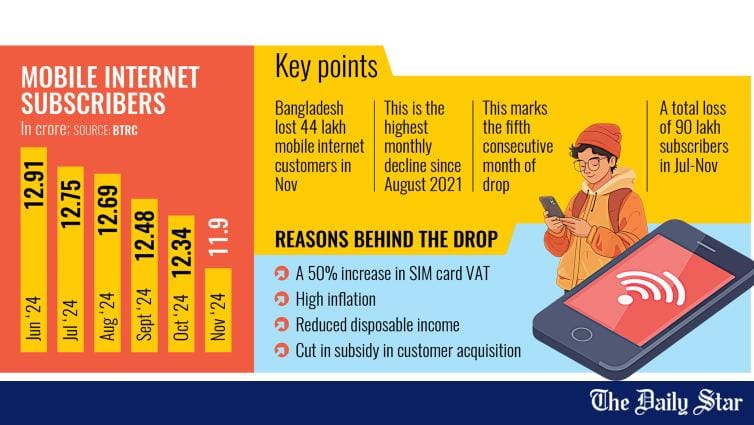
Mobile internet users dropped by 44 lakh in November

1736294627367.webp


The number of mobile internet subscribers in Bangladesh witnessed a significant drop of 44 lakh in November, contributing to an overall decline in internet subscribers to 13.28 crore from that in October.

This decline marks the highest drop in internet subscribers since August 2021, based on data available on the website of Bangladesh Telecommunication Regulatory Commission (BTRC).

It also represents the fifth consecutive month of decline since July. Over those five months, internet subscriber numbers have decreased by a staggering 90 lakh.

Industry experts identified a VAT hike on SIM cards as the primary reason for this decline.

In July, the VAT was raised by 50 percent, from Tk 200 to Tk 300.

This hike has made it difficult for mobile operators, particularly smaller ones like Banglalink and Robi, to continue subsidising SIM cards.

Larger operators like Grameenphone, with greater financial resources, have managed to absorb the tax hike.

This resulted in fewer new connections and increased competition imbalances.

The increased cost of SIM cards has also discouraged onboarding of new customers, especially amid ongoing economic challenges that have reduced disposable income.

"We have been observing the declining trend in a number of connections for the last couple of months. High rate of inflation is the primary reason for such scenario," said Shahed Alam, chief corporate and regulatory officer at Robi Axiata.

Besides, the increased rate of SIM tax decreasing mobile network operators' capability of providing subsidy in new customer acquisition resulted in an overall decline in the total number of subscribers, he said.

"The recent decline in mobile internet subscribers can be attributed to several factors," said Taimur Rahman, chief corporate and regulatory affairs officer of Banglalink.

"The current economic challenges have likely slowed the entry of new users and the reactivation of inactive ones," he said.

The increase in SIM tax in the last budget has made it harder for mobile operators to subsidise SIM cards -- an essential driver of subscriber growth in the past, he said.

Smaller operators are particularly affected as larger ones can afford greater subsidies, which exacerbates competition imbalances in the telecom market, Rahman said.

To reverse this trend, policymakers should consider reducing the SIM tax to make connectivity more affordable, he said.

At the same time, government-led digital literacy initiatives could significantly boost mobile penetration, delivering wider socioeconomic benefits, he added.

A significant reason for the drop in active users could be economic hardship or growing reliance on fixed broadband, but the definition of active mobile internet users also requires scrutiny, Abu Nazam M Tanveer Hossain, a telecom expert.

The current report considers only Mobile Station International Subscriber Directory Numbers (MSISDNs) active in the past three months, ignoring usage patterns or devices, he said.

"The regulator should prioritise unique user numbers, which is feasible as each MSISDN is linked to an NID. This would help determine whether changes in user numbers reflect genuine trends or a reporting strategy by operators," he added.

According to BTRC data, November's decline was solely due to the fall in mobile internet subscribers, reducing the total to 11.90 crore. The number of broadband users remained unchanged at 1.37 crore.​
 

Broadband internet to be costlier as 10pc duty imposed
Staff Correspondent
Dhaka
Published: 11 Jan 2025, 12: 27

1736642702546.webp


The government has imposed a 10 per cent supplementary duty on broadband internet, in addition to a 3 per cent hike in the supplementary duty on mobile talktime and internet packages.

According to internet service providers (ISPs), this is the first time the broadband service has been brought under supplementary duty. Now, a monthly bill of Tk 500 will increase by an additional Tk 50 due to the supplementary duty.

Midway through the current 2024-25 fiscal year, the government has raised the value-added tax (VAT) and supplementary duty on over a hundred goods and services. In this regard, two ordinances – the value-added tax and supplementary duty (amendment) ordinance - 2025 and the excise and salt (amendment) ordinance - 2025 – were issued on Thursday.

The mobile network operators have already started charging the consumers extra, in line with the 3 per cent additional tax.

According to the Bangladesh Telecommunication Regulatory Commission (BTRC) data, mobile internet users decreased by 10 million to 119 million throughout the past five months until November. In contrast, the number of broadband users has increased from 13.5 million to 13.7 million during the same period.

The ISPs said the total tax on the broadband service now stands at 15.5 per cent – a combination of the previous 5 per cent VAT and the newly introduced 10 per cent supplementary duty. A broadband internet bill of Tk 500 will now add Tk 77.50 in taxes, while a Tk 1,000 bill will add Tk 155 in taxes.

Imdadul Haque, president of the Internet Service Providers Association of Bangladesh (ISPAB), said the additional costs will be added to the bills from next month. Citing the ISPs direct communication with consumers, he noted that all will express dissatisfaction with the extra charge. He urged the government to revoke the additional duty.

Meanwhile, the chief corporate affairs officer (CCAO) of Grameenphone, Tanvir Mohamad, expressed dismay at the decision of duty hike. In a statement, he noted that the tax hike came at a time when there are efforts to overcome economic challenges, with inflation remaining above the 10 per cent threshold. It increased the burden of indirect taxes on consumers.

In the budget for 2024-25 fiscal year, the Awami League government raised the supplementary duty on mobile network services from 15 per cent to 20 per cent. With VAT, surcharges, and other fees, the total tax burden on mobile services now exceeds 42 per cent.

For a Tk 100 recharge, the government will receive around Tk 30 in tax, alongside other fees. Against an income of Tk 100, the mobile operators will remit over Tk 56 to the government in taxes and fees.

Animesh Kaiser, a businessman who uses both mobile and broadband internet for professional and personal use, described the price hikes as a blow to the dead. The simultaneous cost hike for both mobile and broadband services will add to the financial strain.​
 

Killing the golden goose of internet opportunity
Govt’s tax hike to stifle growth and revenue

1736724920492.webp

The internet is no longer just a source of entertainment, but also crucial for financial services, education, healthcare, transportation, and freelancing opportunities. Photo: Prabir Das

The previous Awami League regime, which touted its efforts to make Bangladesh digital, mirrored the poor farmer in Aesop's fable of the golden goose when dealing with the mobile voice and internet sectors. The interim government is now replicating this flawed approach following its predecessor's footsteps.

Just as the farmer in the fable killed the goose in a misguided pursuit of greater wealth, the government's escalating taxes on mobile internet threaten to stifle digital accessibility and growth—the modern equivalent of golden eggs.

At present, the government appears to be taking an even more detrimental path, burdening an essential sector with excessive taxes. The internet is no longer just a source of entertainment, but also crucial for financial services, education, healthcare, transportation, and freelancing opportunities.

When additional levies, such as revenue sharing and minimum taxes, are considered, the total tax burden exceeds 56.3 percent—one of the highest globally, according to industry analysts

The National Board of Revenue (NBR) increased the supplementary duty (SD) from 20 percent to 23 percent on January 9, just six months after it was raised from 15 percent. Experts warn that this move will further hinder the sector's growth.

Consumers were already paying Tk 139 for Tk 100 worth of mobile services, factoring in 15 percent VAT, 20 percent SD, and a 1 percent surcharge before the hike. Now, they must spend Tk 142 instead.

When additional levies, such as revenue sharing and minimum taxes, are considered, the total tax burden exceeds 56.3 percent—one of the highest globally, according to industry analysts.

The most alarming move by the interim government is the introduction of a 10 percent supplementary duty on broadband internet, severely undermining an ambitious plan to reduce broadband prices by up to 20 percent by Emdad ul Bari, chairman of Bangladesh Telecommunication Regulatory Commission (BTRC).

Despite rising to power after a youth-led movement, the current administration has failed to learn from the previous government's missteps like soaring internet service taxes.

The supplementary duty on mobile data and voice services was just 3 percent in FY16, which steadily climbed to the current 20 percent.

Also, the tax on SIM card sales increased to Tk 300 from Tk 200 in the last fiscal year, while doubling the VAT on SIM cards from Tk 100 to Tk 200 in 2020-21.

These arbitrary tax hikes, driven by the government's preference for mobile VAT due to its transparency and ease of collection, have had a profound impact.

Already grappling with inflation, the market suffered further, marking the fifth consecutive month of decline from July to November. During this period, internet subscribers dropped by 9.3 million.

Alongside price increases, the Awami League's over-issuance of licences in the internet ecosystem led to market oversaturation, weak regulation, and inefficiency.

Many licences were granted to unqualified entities with inadequate resources, often influenced by political preferences. This fragmented market stifled competition, limited innovation, and hindered infrastructure development, with the government's vision for a "Digital Bangladesh" remaining unfulfilled.

It initially aimed to increase ICT exports to $1 billion by 2018 and $5 billion by 2021, later extending the $5 billion target to 2025. Yet, Bangladesh's ICT exports remain stagnant at just over half a billion dollars.

In comparison, Pakistan's IT exports are more than five times higher, highlighting Bangladesh's failure to capitalise on its digital potential.

Poor internet quality, high costs, and slow digital transformation have further eroded the dream of a tech-driven economy.

Bangladesh scored 62 out of 100 in the June 2024 ICT Development Index by the United Nations International Telecommunication Union, lagging behind Myanmar, Sri Lanka, the Maldives, Vietnam, and Bhutan.

The country ranked 113th out of 174 in the IMF's Artificial Intelligence Readiness Index and dropped to 82nd out of 121 countries in the 2023 Digital Quality of Life Index by Surfshark as the internet speed was measured at 5 percent below the global average.

Freelancing, a key growth area for youth employment, is also struggling as the country ranked 29th out of 30 freelancing destinations in CEO World's April 2024 report, trailing behind South Asian peers India and Pakistan.

Bangladesh ranked 109th out of 147 countries for mobile internet speed and 108th for broadband speed in the May 2024 Ookla Speedtest Global Index, falling behind nations such as Kenya, India, and Rwanda.

While internet service providers (ISPs) and mobile operators often face criticism for subpar services, much of the blame lies with the government and the regulator.

The BTRC has issued directives that benefit a select few with close ties to the former regime. This was done under the heavy influence of the previous government's interference, creating an uneven playing field, burdening consumers with high costs, and hindering the growth of digital service providers.

Treating broadband licences like cable TV businesses was another damaging decision by the previous regime. This approach allowed local strongmen and political operatives to dominate area-based operations, making many regions inaccessible to compliant ISPs.

As a result, numerous customers remain stuck with outdated 1 Mbps broadband speeds when anything below 5 Mbps is now considered unacceptable for ISPs globally.

Developed countries regard 100 Mbps or higher as standard broadband, particularly with the expansion of fibre-optic networks. Despite the government's Tk 4,000 crore investment in fibre infrastructure, the outcomes have fallen significantly short of expectations.

This digital divide continues to widen. In the first quarter of the current fiscal year, internet usage in urban areas was nearly double that of rural regions.

Only 36.5 percent of rural individuals used the internet, compared to 71.4 percent in urban areas, according to the national statistical agency's latest survey. The recent tax hikes may exacerbate this disparity.

Digital service providers have long argued that slow and costly internet has stifled their potential with the past government bearing significant responsibility for this.

Many were hopeful of a different approach by the interim government to recognise the internet's potential to drive growth, boost the economy and solve pressing issues.

Instead, the previous government's squandering of the internet's opportunities has been compounded by the interim administration. What could have been a chance to revive this invaluable sector now risks being buried so deeply that any hope of resurrection may be lost forever?​
 

Boosting Bangladesh’s ‘creator economy’

1736897118745.webp

VISUAL: SALMAN SAKIB SHAHRYAR

The creator economy, a $250 billion global industry, is the ecosystem of individuals monetising content, skills, and creativity on platforms like YouTube, TikTok, Instagram, and Facebook (SignalFire, 2023). According to a study by Adobe, there are over 303 million creators worldwide, from vloggers and gamers to educators and podcasters. The number is rising exponentially as social media platforms become more accessible to the wider masses.

In Bangladesh, the growth of this sector is already evident. Platforms like YouTube and Facebook have started to recognise Bangladeshi creators. The earning depends on their niche and audience size (Dhaka Tribune, 2024). For instance, TikTok alone has seen a dramatic rise in rural content creators who showcase everything from traditional cooking to local craftsmanship. Guess their views—millions!

This is just revolutionary. You no longer need a fancy studio or deep-pocketed investors to start. A smartphone and an internet connection would suffice. But while the barrier to entry is low, the challenge lies in persistence and adaptability. For Bangladeshi youth, the creator economy offers something rare: freedom. Freedom from fixed career paths, freedom to work from anywhere, and freedom from those who control career decision.

Globally, the creator economy is set to grow to $480 billion by 2027, as reported by Goldman Sachs. For individual creators, the average earnings can vary widely. A typical YouTuber can earn up to $100,000 annually, while micro-influencers often collaborate with brands for significant side incomes.

To thrive in this ecosystem, creators need more than just talent—they need to master storytelling, algorithms, and audience engagement. Most importantly, they must navigate societal perceptions. In suburban Bangladesh, for instance, young women face additional hurdles: societal scepticism, familial pushback, and the absence of an enabling work environment. Yet, with every viral video or growing follower count, it is possible to break the barriers.

Globally, creators like MrBeast (Jimmy Donaldson) and Marques Brownlee (MKBHD) have demonstrated how this economy can scale beyond imagination. MrBeast started by posting random YouTube videos as a teenager and now runs a multimillion-dollar content empire with brands and philanthropy intertwined. The lesson we learn from him: focus on what others overlook—quality storytelling and relentless experimentation.

If you take a close look, you will find successful creators have embraced specific strategies to rise above the noise. The first is finding a niche. Whether it's tech reviews, makeup tutorials, or cooking recipes, specificity is the key. The second one is consistency. Audiences and algorithms reward those who show up regularly with value-driven content. Finally, engagement is critical. The best creators aren't just talking to their followers, they're building communities.

Take Emma Chamberlain, a YouTuber who started with raw, unpolished videos of her daily life. Her authentic style resonated with millions, earning her, not just followers, but collaborations with major brands. These stories may seem distant, but their principles are universal: be authentic, be consistent, and think like an entrepreneur.

Bangladesh sits on the edge of a creator economy revolution. With 40 million internet users under the age of 30 (Bangladesh Telecommunication Regulatory Commission, 2023), the potential for this sector is immense. Yet, the ecosystem remains underdeveloped. Creators often struggle with limited monetisation options, slow internet speeds, and a lack of formal guidance.

But the gaps are opportunities in disguise. Platforms like YouTube and Facebook are beginning to pay attention to Bangladeshi creators, opening avenues for ad revenue and sponsorships. TikTok has become a creative playground for rural youth, showcasing everything from dance trends to DIY tutorials. Yet, the full potential remains untapped.

What can change this? First, better infrastructure should be in place—faster internet, affordable devices, and digital literacy programmes. Second, cultural acceptance of content creation as a viable career, particularly for women must be recognised. Third, policy support from governments is crucial. Besides providing incentives for digital creators, the government can create an enabling environment for them.

As Peter Thiel writes in Zero to One: "Brilliant thinking is rare, but courage is in even shorter supply." The creator economy rewards those who dare to think differently and act boldly. For a generation of Bangladeshi youth grappling with unemployment and societal expectations, this economy offers a chance to rewrite their narratives. The question is: will Bangladeshi youth seize the opportunity to shape their future through each upload?

Sabbir Rahman Khan is a knowledge management, communications, and advocacy professional.​
 

High tax barrier to affordable internet in rural areas: TIPAP roundtable
United News of Bangladesh . Dhaka 16 January, 2025, 23:08

High government taxation has made it nearly impossible to offer affordable internet services to rural communities, said industry stakeholders on Thursday.

They raised the concern during a roundtable discussion organised by the Technology Industry Policy Advocacy Platform at The Daily Star auditorium, according to a press release.

When a mobile phone user buys a Tk 100 internet package, over Tk 60 directly goes to the government, they said.

The government collects significant revenue from 10 crore mobile internet users and shows no interest in reducing internet costs, they added.

TIPAP coordinator and Bdjobs founder Fahim Mashroor moderated the discussion, which brought together representatives of leading telecom companies, internet service providers, software firms and freelancing community.

Mashroor said, ‘Urban areas have twice as many internet users as rural ones. While an average urban broadband user consumes 100GB of data per month, a rural user consumes only 6GB. In contrast, Indian mobile data users consume three times more data than their Bangladeshi counterparts.’

He added, ‘This limited mobile data usage keeps Bangladesh far behind neighbouring countries in delivering education, healthcare and essential services through the internet.’

Speakers blamed excessive taxation for high mobile data prices. They said that users faced a 15 per cent VAT, a 23 per cent supplementary duty, a 2 per cent surcharge and a 6 per cent revenue-sharing cost. According to mobile operators, these taxes have more than doubled over the past decade.

Internet service providers also criticised the monopolistic practices of two government-backed companies controlling the Nationwide Telecommunication Transmission Network. These monopolies drive up data transmission costs to rural areas, they said.

Stakeholders urged the Bangladesh Telecommunication Regulatory Commission to allow telecom and internet service providers to manage transmission independently, which they believed would lower costs and make internet services more affordable.

Participants criticised the National Board of Revenue’s recent introduction of supplementary duties—3 per cent on mobile internet and 10 per cent on broadband. They demanded an immediate repeal, arguing that the increase contradicts the spirit of the ‘July Revolution,’ which highlighted the importance of internet access.

Telecommunications expert and BUILDCON CEO Mahtab Uddin Ahmed, AMTOB secretary general Lieutenant Colonel (retired) Mohammad Zulfikar, Robi chief regulatory officer Shahedul Alam, Banglalink chief regulatory officer Taimur Rahman, ISPAB president Imdadul Haque, IIG Association president Aminul Hakim, former BASIS president Almas Kabir and Mobile Subscribers Association president Mohiuddin Ahmed, among others, were present at the time.​