| Global Defense, OSINT & Geopolitics Wire

[🇧🇩] India's Water Terrorism Against Bangladesh

[🇧🇩] India's Water Terrorism Against Bangladesh
327
17K
More threads by Saif

G Bangladesh Defense

Dhaka, Delhi to discuss water issues Sunday

1795304376861.webp


Bangladesh and India are set to hold a meeting under the Joint Rivers Commission (JRC) here on Sunday amid the urgency underscored by the Ganges Water Sharing Treaty, signed on December 12, 1996, which is due to expire on the same date this year.

The Indian delegation is already in Dhaka, and this will be the last meeting under the current treaty, a senior official told UNB on Saturday.

Md. Anwar Kadir, Member, Joint Rivers Commission, Bangladesh, and Chairman, Joint Committee, Bangladesh side, will lead the six-member Bangladesh delegation at the meeting.

Sharad Chandra, Commissioner (FM) and Member, Joint Rivers Commission, India, will lead the Indian delegation.

Sanjay Kumar Gangwar, Chief Engineer, Central Water Commission; Ramesh Raj Sambharia, Senior Joint Commissioner; Kanneluru Gautam, Under Secretary (IFD); Renjina Mary Varghese, Under Secretary (BM Division), Ministry of External Affairs, New Delhi; and Pooja Kumari Jha, Second Secretary (P&I), High Commission of India, are part of the Indian delegation.

Dr. Md. Sazzad Hossain, Chief Engineer, Hydrology, Bangladesh Water Development Board; Mohammad Abu Sayed, Director, Joint Rivers Commission; Mohammad Samsozzaman, Ministry of Water Resources; Md. Baky Billah, Director (South Asia-1), South Asia Wing, Ministry of Foreign Affairs; and Kazi Shahidur Rahman, Executive Engineer, Joint Rivers Commission, will join the meeting as members of the Bangladesh delegation.

Dhaka says it is a routine meeting, and the committee's responsibility is to ensure that the existing treaty is being implemented properly while treaty renewal or extension is not within the jurisdiction of this committee.

Official Spokesperson at the Ministry of External Affairs Randhir Jaiswal said the Joint Rivers Commission is the established mechanism to discuss all water-related, cross-boundary river-related issues, including the Ganga.

"The government of India remains committed to a constructive and forward-looking relationship with Bangladesh while safeguarding India's interest," he told reporters in New Delhi on Friday.

Securing its fair share of the transboundary rivers' waters is likely to become a major issue for Bangladesh in the coming days, making effective water diplomacy, international cooperation and constructive engagement with India increasingly important, officials and experts have said.

The government in Dhaka has been increasingly vocal in recent weeks, communicating a vision that Bangladesh will be seeking a new or revised agreement that safeguards its interests, particularly its share of dry-season flows, with the inclusion of a guarantee clause.

“Water could emerge as one of the major challenges for the entire world, including Bangladesh, in the future,” said Local Government, Rural Development and Co-operatives Minister Dr Abdul Moyeen Khan recently, stressing the need to integrate proper water management into national development planning.

Bangladesh and India share 54 transboundary rivers, but the Ganges remains the only one covered by a bilateral water-sharing agreement between the two countries.

Water Resources Minister Shahiduddin Chowdhury Anee said Bangladesh wants a new or revised Ganges agreement rather than simply renewing the existing treaty, with provisions guaranteeing its required share of water during the dry season.

“Our main priority will be to bring back the guarantee clause that was included in the 1977 agreement,” he said.

The 1977 agreement, negotiated by the BNP's founder Ziaur Rahman, included a safeguard stipulating that if the Ganges flow at Farakka fell below the level projected in the treaty to be provided to Bangladesh as its scheduled share during any 10-day period, the release to Bangladesh would not fall below 80% of that share.

State Minister for Foreign Affairs Humaiun Kobir recently said Bangladesh would seek an outcome that safeguards its national interests and security, including through a possible guarantee clause.

Asked whether the existing treaty would be renewed or replaced with a new agreement, he said, “Whatever is best for Bangladesh’s interest will be done.”

Foreign Minister Dr Khalilur, while attending the ninth Indian Ocean Conference in Mauritius, said they would like to see that there is an arrangement and a new treaty, or a revised treaty, ensuring the essential needs of their people.

“These are common rivers, and we have common legacies here, common interests, and, as I said, there's no other alternative but to seek a solution that is durable and will win public trust. And this will also be very important to lay the basis for the relationship over the next 25 to 50 years,” he told the media on the sidelines of the conference.

The Foreign Minister said they have done 55 years (of bilateral relations) already. “So, I don't think we should look at five years or ten years. We have to look at the very long term. So, mutual climate resilience as a priority in our foreign policies, our people policy, I should say, will actually be a key driver of the future.”​
 

Will the proposed Ganges Barrage become another Farakka?

S Nazrul Islam

For a project of such immense public importance as the proposed Ganges Barrage, the more discussion that takes place before its implementation, the better. In this context, I welcome the article titled "Padma Barrage: Why Bangladesh needs it and the challenges ahead", written by a professor at the Bangladesh University of Engineering and Technology (BUET) and published in The Daily Star on November 5. However, the article raises certain points that need further discussion.

Bangladesh's Ganges Barrage idea was indeed a response to the Farakka Barrage

The author begins by noting that the idea of the Ganges Barrage was put forward in the 1960s and therefore "predates the impacts associated with Farakka". This is correct. However, what is the purpose of mentioning this? Does the author want to deny that the Ganges Barrage idea was a response to Farakka? The Farakka Barrage idea can be traced back to Arthur Cotton in 1853 and was followed up by others such as Stevenson Moore in 1919 and William Willcocks in 1930. Following independence, the Indian government took it up in the 1950s and formally approved the project in 1961. The Ganges Barrage idea that B. M. Abbas and others proposed in the 1960s was certainly a direct response to the anticipated effects of the Farakka Barrage, though not to its already manifested effects. In fact, the Ganges-Kobadak (GK) irrigation project, initiated in the 1950s, was also, to a great extent, a response to India's anticipated decision to build the Farakka Barrage. There is no scope for confusion here.

1795306929103.webp

A map showing the proposed Padma Barrage at Pangsha and associated river management works. Map: Institute of Water Modelling

The primary objective of past studies was to select a site for the barrage

Next, the author notes that the Ganges Barrage is "a project more than six decades in the making" and that during this period, foreign consulting firms have studied the proposal. Citing these facts, he creates the impression that these studies have already validated the project and all that remains now is to plunge into its implementation. In this regard, he mentions the 1963 study by Tippett-Abbett-McCarthy-Stratton (TAMS). Actually, there were also studies by Associated Consulting Engineers (ACE, 1969), the Expert Study Group (1984) and the French Engineering Consortium (1989). However, as the Feasibility Report (DCC/BWDB 2016), on which the government is now basing the Padma Barrage project, itself notes, all these studies focused mainly on site selection. They were not aimed at a dispassionate appraisal of the merits and demerits of the proposed barrage.

The reason why the foreign companies were asked to focus on site selection, and not on the broader question of whether such a barrage is desirable, is not far to seek. For the water engineering community, it is almost an article of faith that building dams, barrages, embankments, sluice gates and other such infrastructure is a good thing. This is what they learn, teach and live on. Therefore, it is not surprising that the Bangladesh Water Development Board (BWDB), an organisation populated almost entirely by engineers, is not particularly interested in an objective assessment of the pros and cons of the proposed barrage, nor does it want the foreign consulting firms it hires to focus on this question. Rather, it just wants these firms to select the site.

The proposed barrage will be able to store only a small fraction of the Ganges' monsoon flow

Another point that warrants further discussion is the article's suggestion that the proposed barrage will not have a significant negative effect on downstream flow. This misconception begins with the false notion that the barrage will store a huge amount of the summer flow, and that the water needed to augment the dry-season flows of the Ganges distributaries will come mainly from this storage.

In the Bangla version of his article (published in Prothom Alo on October 28), the author rightly notes that "a barrage cannot create water; it can only store and redistribute the water that flows into the river". However, this statement is only partly true, because a barrage is primarily capable of redistributing water, not storing it. If storage is the primary objective, one needs to construct a dam, not a barrage. A dam creates a vast reservoir in which large quantities of river water can be stored for use during the dry season. Kaptai Lake, formed by the Kaptai Dam, is an example. But this is generally feasible only in hilly regions, not on flat terrain.

It is therefore not surprising that a closer look reveals that the proposed barrage will be able to store very little of the Ganges' summer flow. According to the data presented in the Feasibility Report (FR), the storage capacity of the proposed barrage will be 2.89 BCM (billion cubic metres). However, the total summer flow of the Ganges in Bangladesh is 189.05 BCM. Hence, the water that can be stored will amount to only 1.53 per cent of the Ganges' summer flow. The remaining 98.47 per cent will flow onwards towards Goalundo. The proponents of the barrage are therefore creating a mirage by suggesting that it is an entirely win-win proposition, with no trade-off involved and no pain to be reckoned with.

The proposed barrage will divert more than half of the Ganges' water at Pangsha

This brings us to the third point in the article that needs further discussion. The author claims that the barrage will ensure an adequate flow downstream of Pangsha even during the critical months of March and April. He cites a figure of 9,000 cusecs (or 255 cumec) and suggests that this should be adequate for the downstream Ganges. Where he obtained this number, and why he deems it adequate, are not spelt out. However, we can use the FR's data to examine his claim.

According to the FR, during the dry season (January to May), the total volume of water to be supplied to five distributaries of the Ganges (Baral, Ichamati, Hisna, Gorai and Chandana) and two pump houses (Godagari and Bheramara) will be 9.05 billion cubic metres. Given that the storage capacity of the barrage is 2.89 billion cubic metres, only about 34 per cent of the water to be supplied to these seven destinations can be obtained from the barrage's stored reserves. The remaining 66 per cent must come from the Ganges' current flow. The FR further states that the planned average flow through these seven channels, facilitated by the barrage, will be 743 cumec in March and 799 cumec in April. As noted above, 66 per cent of this, amounting to 490 cumec in March and 527 cumec in April, will have to be obtained from the Ganges' current flow at the Pangsha barrage site.

The FR also states that, during the 1997–2010 period, the flow of the Ganges beneath the Hardinge Bridge in March and April averaged 945 and 934 cumec, respectively. Consequently, after the diversion, the flow downstream of Pangsha during these two months will be 455 and 402 cumec, equivalent to 48 and 43 per cent, respectively, of the pre-barrage flow. Given these outcomes, how can it be claimed that the construction of the barrage will not significantly reduce the flow downstream of Pangsha? Furthermore, how can the author be satisfied with a downstream flow of 255 cumec (9,000 cusecs) at Pangsha for the main Ganges when the barrage aims to send 225 and 230 cumec to the Gorai alone in March and April?


1795307038359.webp

The Gorai River has dried up beneath the Gorai Bridge in Kumarkhali, Kushtia. Reduced dry-season flows, partly attributed to water diversion at the Farakka Barrage, have contributed to the deterioration of this important Ganges distributary. Photo: Star

The proposed barrage will become a ‘second Farakka’ for the people living downstream of Pangsha

These results show that, for the people of the Ganges Dependent Area (GDA) downstream of Pangsha, the proposed barrage will effectively become another Farakka. Under the current Indo-Bangladesh Ganges Water Sharing Treaty, when the dry-season flow of the Ganges at Farakka falls below 70,000 cusecs (approximately 2,000 cumec), the flow is shared equally between the two countries. With the proposed barrage, people downstream of Pangsha will be worse off because they will receive less than half.

Proponents of the Padma Barrage seek to evade this stark reality. While the Executive Summary of the FR dwells extensively on the benefits of the barrage for the upstream GDA, it offers little, if any, discussion of the barrage's expected negative impact on the downstream GDA. When questioned about this, experts involved with the project either make inappropriate remarks or claim that the downstream effects are addressed in the report's appendices. These claims raise two questions. First, if the downstream effects are indeed discussed in the appendices, why is there little or no reflection of these discussions in the Executive Summary? Second, why have these appendices not been made public, despite repeated public demands?

The reduction in flow at Pangsha by more than half cannot but have deleterious effects on the downstream GDA. First, to the extent that silt accumulates at the head of the barrage, the river downstream will try to regain its sediment balance through increased riverbank erosion. Second, the barrage will greatly amplify the seasonal fluctuations in the downstream Ganges flow. The flow in winter will dwindle to less than half of what it is now, which is already half of what reaches Farakka. It will therefore fall to a quarter of what reaches Farakka, a flow that is itself declining because of further upstream interventions by India. The summer flow, on the other hand, will remain at roughly the same level as now. This amplification will destabilise the river, with siltation in winter and widening of the river in summer. In short, what happened to the Teesta under the double whammy of India's Gajaldoba Barrage and Bangladesh's Dalia Barrage will be repeated. A similar double whammy (from India's Farakka Barrage and Bangladesh's barrage at Pangsha) will now descend on the downstream Ganges.

The reduction in the Ganges' winter flow downstream of Pangsha will reduce the flows of the distributaries of both the Ganges and the Padma. Among these distributaries is the Arial Khan River, on which most of the rivers of Barisal Division depend. This will aggravate salinity intrusion in the lower parts of the division. The reduced flow will also affect the Meghna estuary, disturbing the delta formation process and aggravating salinity intrusion. This could be all the more consequential because the very low gradient will make it easier for salinity to reach all the way to the Haor area in the north. Bangladesh can ignore the downstream effects of diversion at Pangsha only at its own peril.

Switch from the current commercial and cordon approach to rivers to the Ecological and Open approach; sign the 1997 UN Convention on the Law of the Non-Navigational Uses of International Watercourses; abandon the Ganges Barrage idea; and negotiate vigorously with India to establish Bangladesh's rightful claim to all the shared rivers.

Doubtful claims about upstream siltation

Echoing the FR, the author of the article also claims that the proposed barrage will not cause significant upstream siltation. He presents two arguments in support of this claim. First, the barrage gates will remain open during the monsoon, when the bulk of the river-borne silt arrives, allowing the silt to pass downstream. Second, the barrage will include "under-sluices", allowing the bed-load part of the sediment to pass. However, these arguments are not reassuring.

To take the first, the gates of the Farakka Barrage are also opened during the monsoon. Yet this has not prevented upstream siltation. In fact, siltation has raised the Ganges riverbed as far north-west as Patna, the capital of Bihar, leading to severe flooding and bank erosion along the entire stretch. Consequently, a strong movement has arisen in India, under the leadership of Nitish Kumar, the former chief minister of Bihar, demanding the demolition of the Farakka Barrage. The barrage has caused serious riverbank erosion in the Malda and Murshidabad districts of West Bengal. It has made the Ganges unstable, forcing the river to seek alternative routes to bypass the barrage. All this is happening when the barrage has failed to achieve its primary official objective, namely desilting Calcutta Port. No wonder, then, that in India the word "Farakka" has become a synonym for "fraud".

As for the under-sluices, several points may be noted. First, there will be only 18 under-sluices, compared with 78 regular gates. The width of each under-sluice suggests that together they will cover only about 15 per cent of the 2.1-km-long barrage. Moreover, while the location of the under-sluices will be fixed, the configuration of the river channel will be in constant flux. Hence, more often than not, the under-sluices will not be aligned with the most active part of the channel. Finally, over the past seven decades, the BWDB has distinguished itself by its dismal failure to manage the regular sluice gates on much smaller rivers. Hoping that it will successfully manage the under-sluices on the Ganges is simply too much. The expectation that the under-sluices will prevent upstream siltation is therefore unrealistic.

Consider alternatives

Echoing the Feasibility Report, the author of the article also offers an exuberant account of the expected benefits of the proposed barrage. Those who are aware of Bangladesh's water development saga should not be surprised by these rosy pictures of increased production, high internal rates of return and so on. (Interested readers may see my book Water Development in Bangladesh: Past, Present, Future, Eastern Academic, 2022.) What is needed instead is attention to possible alternatives.


1795307105087.webp

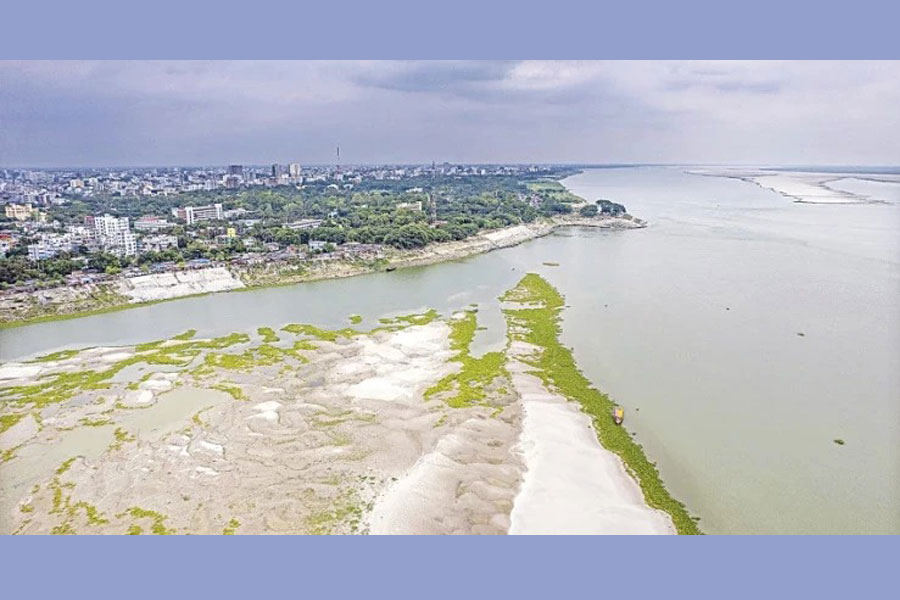
An aerial view shows a stretch of the Padma River where vast sandbars have emerged, signalling a serious water crisis largely blamed on the Farakka Barrage upstream. Photo: Rashed Shumon

The paper titled "Ten Questions and Six Proposals Regarding the Ganges Barrage", presented on August 22 at the CIRDAP auditorium in Dhaka, offers an alternative way of addressing the problems that Farakka and other upstream interventions have created for the GDA in Bangladesh. It emphasises the following tasks.

First, remove all obstructions erected on the distributaries of the Ganges so that its summer flow can reach the Bay of Bengal, even without a barrage. Second, revive and rejuvenate all the rivers, rivulets, khals, beels and other waterbodies of the GDA. This will create storage space many times larger than the 2.89 BCM of the proposed barrage. Third, expand Tidal River Management (TRM) coverage to provide immediate relief to the millions of people suffering from horrendous waterlogging. Fourth, embark on a comprehensive de-polderisation of the GDA, focused on converting the permanent embankments into ashtamashi badh (eight-month dams). Our ancestors invented these as the best way to cope with the extreme seasonality of rainfall and river flow in the Bengal Delta, an invention we foolishly abandoned because of wrongheaded foreign advice and financing and the collaboration of misguided Bangladeshi policymakers and experts. Fifth, take the problem of submergence in the coastal area seriously; restore the process of sedimentation of land within the polders as the key to the solution; and move away from the Coastal Embankment Improvement Project (CEIP) now being implemented, which is only digging the hole deeper for coastal people. Sixth, switch from the current commercial and cordon approach to rivers to the Ecological and Open approach; sign the 1997 UN Convention on the Law of the Non-Navigational Uses of International Watercourses; abandon the Ganges Barrage idea; and negotiate vigorously with India to establish Bangladesh's rightful claim to all the shared rivers.

Dr S. Nazrul Islam is a professor at the Asian Growth Research Institute and a former Head of Development Research at the United Nations.​
 

Dhaka urges Delhi to start Ganges water talks


1795393223651.webp


Bangladesh on Sunday urged India to take necessary steps to begin formal negotiations on the renewal of the 1996 Ganges Water Sharing Treaty before its current term expires on December 12.

“Bangladesh has already completed all necessary preparations related to the treaty. Bangladesh hopes that India will take the required steps before the expiry of the current term of the treaty to pave the way for the commencement of formal negotiations,” Prof. Rashed Al Mahmud Titumir, Prime Minister’s Finance and Planning Adviser and head of Bangladesh's 10-member technical committee on Ganges Water, told UNB while responding to a question.

Prof Titumir said Bangladesh's Water Resources Minister Shahiduddin Chowdhury Anee has recently sent a letter to his Indian counterpart through diplomatic channels to expedite discussions on the treaty, urging an early start to the negotiations.

To initiate discussions on the treaty, Bangladesh formed a high-level technical committee in June, 2026 and informed India of the decision, requesting New Delhi to notify Dhaka about the formation of its own technical committee, he said.

Prof Titumir said Bangladesh renewed its request in August, urging the Indian side to form a technical committee and begin discussions on the treaty.

Official Spokesperson at the Ministry of External Affairs Randhir Jaiswal said the Joint Rivers Commission is the established mechanism to discuss all water-related, cross-boundary river-related issues, including the Ganges.

"The government of India remains committed to a constructive and forward-looking relationship with Bangladesh while safeguarding India's interest," he told reporters in New Delhi on Friday.

Meanwhile, the 91st meeting of the Bangladesh-India Joint Committee on the implementation of the Ganges Water Sharing Treaty was held in Dhaka on Sunday.

At the meeting, the two sides finalised the annual report on the implementation of the treaty for 2026, Prof Titumir told UNB.

The treaty was signed between Bangladesh and India on December 12, 1996, for sharing the waters of the Ganges River at Farakka.

Under Article IV of the treaty, a Joint Committee was formed under the leadership of the two countries' Joint Rivers Commissions to monitor its implementation.

Since 1997, the Joint Committee has been overseeing the deployment of joint monitoring teams at Farakka and the Hardinge Bridge points, monitoring their activities and preparing annual reports on the implementation of the treaty.

The committee holds three meetings every year. One meeting is held in Kolkata following a field visit to Farakka, while another takes place in Dhaka following a field visit to the Ganges/Padma River in the Hardinge Bridge area. The third meeting is devoted to preparing the annual report.

Since 1997, a total of 91 meetings of the Joint Committee have been held alternately in Bangladesh and India.

In 2026, the committee's 89th meeting was held in Dhaka on April 8, while its 90th meeting took place in Kolkata on May 22.

Md. Anwar Kadir, Member, Joint Rivers Commission, Bangladesh, and Chairman, Joint Committee, Bangladesh side, led the six-member Bangladesh delegation at the meeting held on Sunday.

Sharad Chandra, Commissioner (FM) and Member, Joint Rivers Commission, India, led the Indian delegation.

Sanjay Kumar Gangwar, Chief Engineer, Central Water Commission; Ramesh Raj Sambharia, Senior Joint Commissioner; Kanneluru Gautam, Under Secretary (IFD); Renjina Mary Varghese, Under Secretary (BM Division), Ministry of External Affairs, New Delhi; and Pooja Kumari Jha, Second Secretary (P&I), High Commission of India, were part of the Indian delegation.

Dr. Md. Sazzad Hossain, Chief Engineer, Hydrology, Bangladesh Water Development Board; Mohammad Abu Sayed, Director, Joint Rivers Commission; Mohammad Samsozzaman, Ministry of Water Resources; Md. Baky Billah, Director (South Asia-1), South Asia Wing, Ministry of Foreign Affairs; and Kazi Shahidur Rahman, Executive Engineer, Joint Rivers Commission, joined the meeting as members of the Bangladesh delegation.

Securing its fair share of the transboundary rivers' waters is likely to become a major issue for Bangladesh in the coming days, making effective water diplomacy, international cooperation and constructive engagement with India increasingly important, officials and experts have said.

The government in Dhaka has been increasingly vocal in recent weeks, communicating a vision that Bangladesh will be seeking a new or revised agreement that safeguards its interests, particularly its share of dry-season flows, with the inclusion of a guarantee clause.

“Water could emerge as one of the major challenges for the entire world, including Bangladesh, in the future,” said Local Government, Rural Development and Co-operatives Minister Dr Abdul Moyeen Khan recently, stressing the need to integrate proper water management into national development planning.

Bangladesh and India share 54 transboundary rivers, but the Ganges remains the only one covered by a bilateral water-sharing agreement between the two countries.

Water Resources Minister Shahiduddin Chowdhury Anee said Bangladesh wants a new or revised Ganges agreement rather than simply renewing the existing treaty, with provisions guaranteeing its required share of water during the dry season.

“Our main priority will be to bring back the guarantee clause that was included in the 1977 agreement,” he said.

The 1977 agreement, negotiated by the BNP's founder Ziaur Rahman, included a safeguard stipulating that if the Ganges flow at Farakka fell below the level projected in the treaty to be provided to Bangladesh as its scheduled share during any 10-day period, the release to Bangladesh would not fall below 80% of that share.

State Minister for Foreign Affairs Humaiun Kobir recently said Bangladesh would seek an outcome that safeguards its national interests and security, including through a possible guarantee clause.

Asked whether the existing treaty would be renewed or replaced with a new agreement, he said, “Whatever is best for Bangladesh’s interest will be done.”

Foreign Minister Dr Khalilur, while attending the ninth Indian Ocean Conference in Mauritius, said they would like to see that there is an arrangement and a new treaty, or a revised treaty, ensuring the essential needs of their people.

“These are common rivers, and we have common legacies here, common interests, and, as I said, there's no other alternative but to seek a solution that is durable and will win public trust. And this will also be very important to lay the basis for the relationship over the next 25 to 50 years,” he told the media on the sidelines of the conference.

The Foreign Minister said they have done 55 years (of bilateral relations) already. “So, I don't think we should look at five years or ten years. We have to look at the very long term. So, mutual climate resilience as a priority in our foreign policies, our people policy, I should say, will actually be a key driver of the future.”​