Home Watch Videos Wars Movies Login

[🇧🇩] Indo-Bangla Relation: India's Regional Ambition, Geopolitical Reality, and Strategic Options For Bangladesh

[🇧🇩] Indo-Bangla Relation: India's Regional Ambition, Geopolitical Reality, and Strategic Options For Bangladesh
579
26K
More threads by Saif

G Bangladesh Defense
I see 'Donald Lu' in the midst there. Be very wary of him as he was one of the leading figures to oust Imran Khan.

He is the one involved in ouster of Hasina as well.
 
Analyze

Analyze Post

Add your ideas here:
Highlight Cite Respond

Bangladesh not exporting hilsa to India this year

1726793974981.webp


Bangladesh will not export hilsa fish to India on the occasion of Durga Puja in October, according to a top commerce ministry official, discontinuing a long-standing tradition of the country as a "goodwill gesture" to its neighbour.

The decision of the export ban is to ensure adequate hilsa supply in the local market so that the prized fish remains more accessible to people, according to authorities.

This stand by the interim government marks a clear departure from the deposed Sheikh Hasina-led Awami League government.

During the puja festival, Bangladesh, the largest producer of hilsa, usually relaxes the ban on exports of the fish, a sought-after delicacy especially in India's West Bengal.

Hilsa consignments from Dhaka are treated as a gift to Indian people from Bangladesh during the biggest religious fest for Hindu people.

"We have around 50 applications pending for exporting the fish to India," said a senior commerce ministry official. "But we have not received any export permission from the Ministry of Fisheries and Livestock this year."

As per policy, the commerce ministry permits the export of any goods based on the opinion of the ministry concerned.

In the case of hilsa, the fisheries and livestock ministry did not allow for exports this year, the official said, requesting not to be named.

Farida Akhtar, adviser to the fisheries and livestock ministry, in multiple media interviews said the interim government wants to increase hilsa supply in the domestic market.

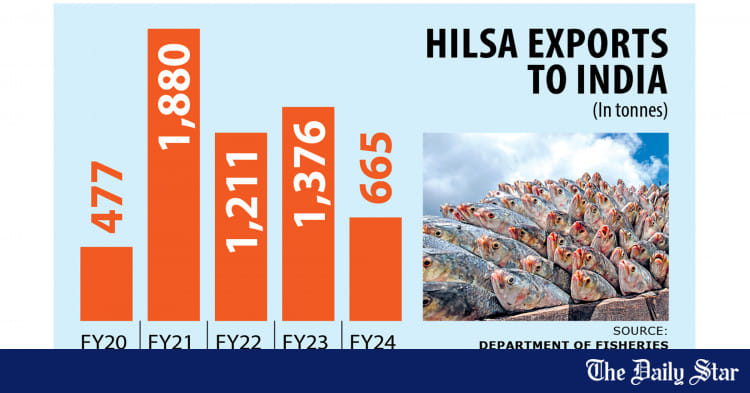
In fiscal 2023-24, Bangladesh exported 664.86 tonnes of hilsa to India at $7.71 million, according to data from the Department of Fisheries.

In fiscal 2022-23, Bangladesh exported 1,376.42 tonnes of hilsa worth $13.68 million, the data shows.

Demand for the fish is also high in Bangladesh. Despite an uptick in hilsa hauls in recent years, the fish still remains pricier in the local market.

In fiscal 2022-23, Bangladesh produced a total of 571,342 tonnes of hilsa. In fiscal 2021-22, the production of hilsa was 566,593 tonnes, shows fisheries data.

Hilsa is netted from rivers in August and September, when the fish comes into rivers from the Bay of Bengal to lay eggs. Fishers catch up to 600,000 tonnes of the fish annually, with a majority of the haul coming from the sea.

In 2017, hilsa was recognised as a geographical indicator for the country.

Despite being the national fish, buying hilsa still is a luxury for many in the marginal class.

In Dhaka, a piece of hilsa weighing one kilogramme (kg) is being sold between Tk 1,400 and Tk 1,600 at retail. Hilsa weighing below one kg is priced between Tk 1,100 and Tk 1,200 per kg at retail.​
 
Analyze

Analyze Post

Add your ideas here:
Highlight Cite Respond

Bangladesh for working relations with Delhi on mutual respect: adviser
Staff Correspondent 21 September, 2024, 16:39

1726964767338.webp

Foreign adviser to the interim government Md Touhid Hossain.

Foreign adviser to the interim government, Md Touhid Hossain, said on Saturday that Dhaka would like to maintain working relations with New Delhi on the basis of mutual respect by removing ongoing tension between the two neighbours.

Admitting the current strain in the India-Bangladesh relations, he said that it was necessary to admit problem if there was any to resolve that.

‘We must recognise that there is a kind of tension in our relations with India at the moment. We can resolve the problem and maintain working relations with them on the basis of mutual respect,’ Touhid, also a retired diplomat, told a press briefing on Bangladesh’s participation in the 79th United Nations General Assembly at the foreign ministry.

He expressed his belief that it was possible to advance bilateral relations between India and Bangladesh on the basis of mutual respect and fairness.

Responding to another question, he said that there was no possibility of any meeting between chief adviser to the interim government, Professor Muhammad Yunus, and Indian prime minister Narendra Modi on the sidelines of the UNGA, saying that ‘Modi is scheduled to leave New York before Professor Yunus is to reach there’.

The foreign adviser, however, said that he would have a bilateral meeting with his Indian counterpart S Jaishankar on the sidelines of the UNGA.

He said that the chief adviser was expected to join bilateral talks with the prime minister of Pakistan, the prime minister of the Netherlands and the prime minister of Nepal.

He would also join a meeting with the United States secretary of state Antony Blinken on the sidelines.

Touhid said that Professor Yunus would leave Dhaka for New York on September 23 by a commercial flight with a 57-member delegation unlike previous years with more than 100 delegates by chartered flights.

Concluding his three-day trip, the chief adviser would leave for Bangladesh on September 27, he added.

This would be the first foreign trip of Professor Yunus after he took over as the chief adviser to the interim government on August 8 following the fall of autocratic regime of Sheikh Hasina, who fled to India amid a student-led mass uprising on August 5.

Asked whether the government was taking any move to bring back Hasina, now facing dozens of cases on charges of murders and committing crimes against humanity, Touhid iterated that they would follow a judicial process in this regard.

Asked about Bangladesh’s focus in the UNGA, he said that the chief adviser was expected to present an account of the student-led mass uprising in Bangladesh behind the political changeover leading to the formation of the interim government and his reform agenda in various sectors to the international communities.​
 
Analyze

Analyze Post

Add your ideas here:
Highlight Cite Respond

Biden, Modi talk about Bangladesh

1727047194705.webp

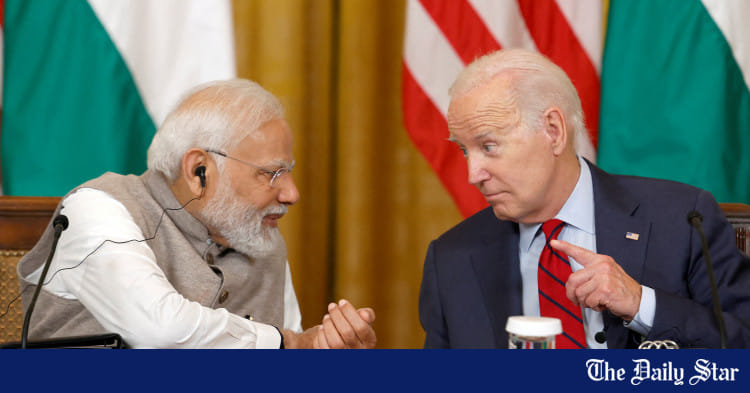
File photo: US President Joe Biden and India's Prime Minister Narendra Modi meet with senior officials and CEOs of American and Indian companies in the East Room of the White House in Washington, US, June 23, 2023. File photo: Reuters/Evelyn Hockstein

The developments in Bangladesh came up during discussions between US President Joe Biden and Indian Prime Minister Narendra Modi at the former's personal residence in Wilmington, Delaware, yesterday.

Indian Foreign Secretary Vikram Misri said there was also an exchange of views between Modi and Biden about the situation in Bangladesh.

Vikram's remarks came during a media briefing in Washington in reply to a question from India's state-owned TV channel Doordarshan journalist if Bangladesh was a part of the discussions between the two leaders and if he could share the contours of the discussion.

"Look, as I said, these discussions cover subjects that are in the region. They may be of bilateral interest to one party or the other, but they do have significance beyond the region as well. In this context, a number of situations came up for discussion. Bangladesh also figured in the discussions, and there was an exchange of views with regard to the situation there."

Vikram did not elaborate further.

This was the first time that Bangladesh came up in the discussions between Modi and Biden in their first in-person bilateral meeting since the change of guard in that country after the ouster of Sheikh Hasina as prime minister on August 5 in the face of a student-led mass movement that led to her escape to India.

The Modi-Biden sharing views on Bangladesh came in the backdrop of reports that the chief adviser of Bangladesh's interim government Prof Muhammad Yunus may meet Biden in the US later this week.

The possibility of a first in-person meeting between Modi and Yunus has been dashed as the chief adviser is going to the US only after Modi returns to India from his three-day visit to the US.​
 
Analyze

Analyze Post

Add your ideas here:
Highlight Cite Respond

India eager to strengthen ties with Bangladesh
Says Mirza Fakhrul after meeting Pranay Verma

1727047545077.webp

Photo: Collected

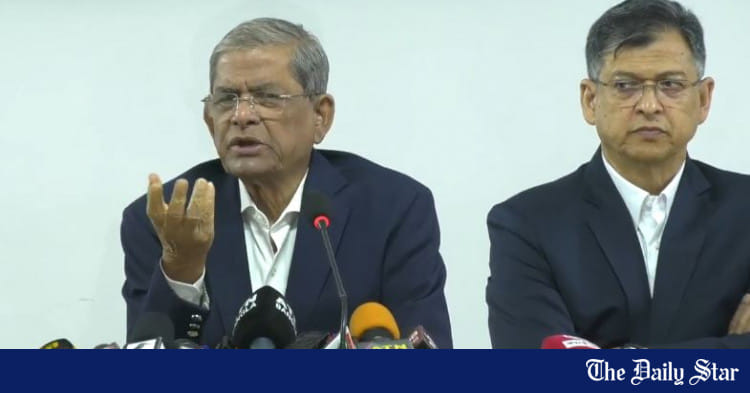
India is eager to further strengthen its relationship with Bangladesh, said BNP Secretary General Mirza Fakhrul Islam Alamgir yesterday after meeting Indian High Commissioner Pranay Verma.

"They also want to strengthen our relationships with the political parties of their country," Fakhrul told reporters after the meeting at the BNP Chairperson's office in Gulshan.

The meeting, which lasted nearly an hour, is the first formal talks between Indian officials and BNP leaders since Sheikh Hasina's regime was deposed on August 5.

Fakhrul said, "We raised the issues Bangladesh is facing with India, including the water-sharing issue, which requires a swift resolution."

On border killings, Fakhrul said, "We also conveyed the necessity of stopping the border killings.

"We also discussed security concerns between both the countries. They assured us they are vigilant and working towards resolving these problems as quickly as possible."

Fakhrul said India is keen on fostering greater goodwill and positivity in the relationship between the two neighbours.

Other BNP leaders present at the meeting included Standing Committee member Salauddin Ahmed, Vice Chairman Nitai Roy Chowdhury, and foreign affairs advisory committee member Shama Obaid.​
 
Analyze

Analyze Post

Add your ideas here:
Highlight Cite Respond

Ties with big neighbours: Balance will still be the mainstay

1727047939856.webp


Foreign Affairs Adviser Md Touhid Hossain has spoken at length with The Daily Star on a host of issues facing Bangladesh at this critical juncture of the country's transition to democracy. In an interview with our diplomatic correspondent Porimol Palma, the career diplomat shared his views on Dhaka-Delhi ties, Sheikh Hasina's stay in India, revival of Saarc and human rights, among other things.

TDS: What challenges is the government facing in maintaining and promoting relations with foreign countries?

Touhid:
For a small country like Bangladesh with big neighbours, it is important to maintain a balanced relationship. We've been doing so and the interim government will also try to do the same.

There will always be challenges. Our relationship with each country is unique. For example, three sides of Bangladesh are bordered by India. Many of our rivers flow through India. We have a lot of trade, and our ties are historical as well as cultural. On the other hand, China, our biggest trade partner, funds many projects here. We have interests in our relationships with both India and China. China and India have issues of conflict, but we have to maintain ties with both of them.

The US, which is the number one superpower, is our single biggest export market, and a major source of our remittance. Our relations with Europe is also very important. As a bloc, the European Union is our biggest export destination. So our ties with different country are different.

TDS: We've seen some hiccups in our relations with India, and anti-India sentiment here after the fall of the Awami League government. What would be our strategy to stabilise this relationship?

Touhid:
Our strategy will be to protect our interests. It does not mean we will ignore India's interest. For India, Bangladesh is a very important country when it comes to security. India's Northeast region suffered from insurgency, which was removed with our cooperation.

You need to remember that we are going through a phase of revolution and there may be some conflicts of interest. However, the relationship was very profitable for India during the previous regime. This led India, especially its media, to take a negative approach towards the current situation in Bangladesh. Most of their accusations were baseless. I believe these aspects will eventually be removed.

TDS: Will you take the initiative to bring back Sheikh Hasina from India?

Touhid:
If our court issues orders to bring her back, we will take the necessary initiative. It is up to India how it will cooperate. I don't want to speculate anything. We'll see when the time comes.

India has its interests in the relationship with Bangladesh, just like we do. So the relationship has to be based on mutual interest and respect. We're only talking about the relationship between the two governments when it has to be people-centric so that the people benefit from the relationship. It is not an ideal situation for governments to say that the relationship is good while people here have anti-India sentiments.

TDS: What are your expectations from India?

Touhid:
There are many expectations, but some small issues make the relationship bitter. For example, border killing. Just the other day, a 14-year-old girl was killed at the border. This is in no way justifiable. If India sincerely wants it, border killing can be fully stopped.

Then, there is the water-sharing issue. People have bitter feelings about the Teesta deal. It's not our concern what problem India's Centre and West Bengal government have. India has to solve it. The water is a liability for us in the rainy season, which is natural, and we aren't asking India to stop it. However, when this water is an asset in the dry season, we're not getting it. This is not acceptable. We know the water level is low in the dry season. But whatever water is there should be shared. Even if we can have an interim agreement with India on Teesta, it'll have a positive impact on the minds of the people of Bangladesh.

TDS: What will the interim government do about the agreements and Memoranda of Understanding with India that have been criticised?

Touhid:
The interim government will do whatever is needed for the sake of national interest, regardless of its tenure. We'll take care of all the issues.

MoUs and agreements are different. Conditions of agreements are to be implemented. If that is to change, it needs to be done as per the provisions of the agreements. For MoUs, we have to know peoples' expectations and seek expert views. We have to revisit the MoUs based on all these factors. If we have to sign any agreement, we will do it, protecting the interest of both parties.

TDS: Will revisiting MoUs or signing agreements take place anytime soon?

Touhid:
It's not that we'll start working tomorrow on this. It will come as part of the normal process. India too has to have its time. They won't sit with us tomorrow if we ask them for a meeting today. We'll try to take initiative on each issue based on priority in a mutually agreed time. It won't happen in a week or two, but we may take initiative in the next few months, or at least by this year.

TDS: Chief Adviser Professor Muhammad Yunus has said he wants to revitalise the South Asian Association for Regional Cooperation (Saarc). Is it possible, given the Pakistan-India enmity?

Touhid:
I don't think it is impossible. I want to be optimistic. When Saarc was working, it was not that it brought about a huge change. But, some work was really going on, for example on meteorology, agriculture, free trade, etc. Then Saarc was going ahead even when India and Pakistan were engaged in small fights sometimes. The process was suspended by India's initiative. India-Pakistan conflict won't end overnight. But other South Asian countries should not be victims of this Indo-Pak enmity. All the other countries are eager to cooperate through Saarc.

Chief Adviser Prof Yunus is very interested in resuming the Saarc activities on whatever small scale. We want to come out of the stalemate.

TDS: Bangladesh has a lot of baggage in terms of human rights abuses. Can the government come out of this?

Touhid
: A major objective of this government is to work in the area of human rights. Rights activists are in the council of advisers. The UN fact-finding mission will look into all of the rights violations and killings that took place in the last weeks of the previous government. Even post-August 5 attacks over political ideologies or on minorities – all can come under this investigation. Everyone has the right to get justice. We want transparency in the whole process of the investigation.

TDS: Will the foreign ministry undergo reforms to function more effectively, keeping in mind that the economy is a big part of our diplomacy?

Touhid:
The foreign ministry, like any other time, will play an auxiliary role. We will extend support to other ministries as per their need. In some cases, re-allocation of business may be required. From our side, we can raise the issues that arise in the areas of overseas employment, foreign investment or export.

TDS: Prof Yunus has a global standing. How can we best utilise it in diplomacy?

Touhid:
We have started benefitting from this already. You know that 67 Bangladeshi migrants were pardoned by the UAE president after Prof Yunus directly spoke to him. We will use his standing for our just demands.

TDS: How shall we navigate in the geopolitically changing world, especially amid the global power competition in the Indo-Pacific?

Touhid:
We'll try to have our interests protected despite such competitions. We'll follow the path where we have our best national interest.

TDS: Aren't our national integrity, track record of human rights and democracy important for this?

Touhid:
We're working to establish democracy on a strong footing. It'll be truly representative. There won't be any fake elections. The purpose of the sacrifice of the young people and their aspiration is democracy. We will work to that end. Reforms on human rights will be visible soon. So we are on the right track.​
 
Analyze

Analyze Post

Add your ideas here:
Highlight Cite Respond

Dhaka strongly protests at Amit Shah’s remark on Bangladesh nationals
Staff Correspondent 23 September, 2024, 19:39

1727138914873.webp

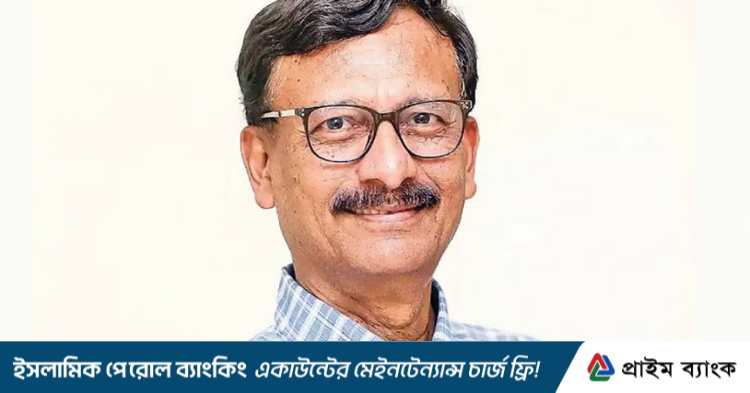
Amit Shah | UNB/ Collected photo

The interim government of Bangladesh on Monday lodged a strong protest against the Indian union home minister Amit Shah’s remarks about Bangladeshi nationals made during his recent visit to the Indian state of Jharkhand.

The Indian minister said that the BJP would free Jharkhand from ‘Rohingya and Bangladeshi infiltrators’ and hang them ‘upside down’, The Hindu reported on Sunday.

Terming Amit’s remarks as highly deplorable, the Ministry of Foreign Affairs in a protest note sent to New Delhi through the Indian mission in Dhaka called upon the government of India to advise the political leaders to refrain from making such objectionable and unacceptable remarks.

‘Through the protest note handed over today to the deputy high commissioner of India in Dhaka, the ministry conveyed its serious reservation, deep sense of hurt and extreme displeasure and called upon the government of India to advise the political leaders to refrain from making such objectionable and unacceptable remarks,’ said a foreign ministry press release.

The ministry also emphasised that such remarks, coming from responsible positions against the nationals of a neighbouring country, undermine the spirit of mutual respect and understanding between two friendly countries, it mentioned.​
 
Analyze

Analyze Post

Add your ideas here:
Highlight Cite Respond
The Indian media is calling Bandarban, Rangamati, and Khagrachori as Bangladesh's three sisters. It is their desire to make CHT unstable to punish Bangladesh for following an independent foreign policy. It is my opinion that Bangladesh should join hands with China to break up India's seven sisters and annex them afterwards.


Analyze

Analyze Post

Add your ideas here:
Highlight Cite Respond

Members Online

No members online now.

Latest Posts

Back
 
G
O
 
H
O
M
E