[🇧🇩] Indo-Bangla Relation: India's Regional Ambition, Geopolitical Reality, and Strategic Options For Bangladesh

[🇧🇩] Indo-Bangla Relation: India's Regional Ambition, Geopolitical Reality, and Strategic Options For Bangladesh
694
34K
More threads by Saif

G Bangladesh Defense

Will let the media know about progress on Tarique visit, says Delhi

1786750750312.webp


Despite reports of preparations for Prime Minister Tarique Rahman's possible visit to Delhi next week, the Indian Ministry of External Affairs has not confirmed it.

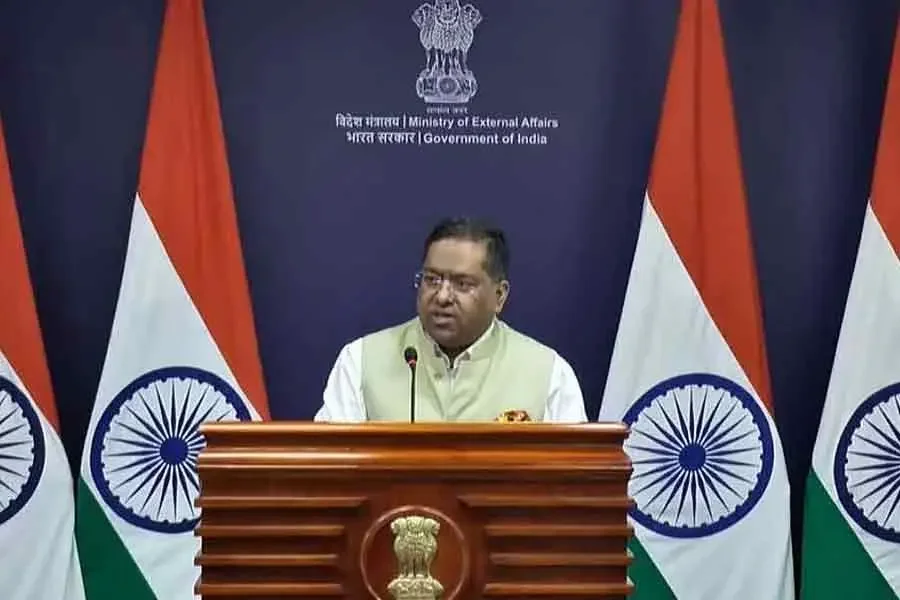
In a briefing on Friday, ministry spokesperson Randhir Jaiswal said, as he has done previously, that he would “let [the media] know if there is any progress” regarding the Bangladesh premier’s visit to Delhi.

Diplomatic and political sources in Dhaka and Delhi say that preparations are under way for Tarique’s first visit to India next week, ahead of the BIMSTEC summit in Delhi.

These sources say that the likely date of the prime minister's visit could be Aug 22-23, exactly a week after India's Independence Day.

The Prime Minister's Office and the Ministry of External Affairs have not yet made any official announcement on the matter. Officials have declined to speak on the meeting on the record.

However, Indian media outlets have also started publishing reports on Tarique's possible visit.

NDTV wrote that during this possible visit, the prime minister is expected to meet his Indian counterpart Narendra Modi. Different issues of bilateral relations may be discussed between the two countries. Trade, communication, energy, border management and regional security may be in focus.

This would be Tarique’s first visit to India as prime minister and could be a significant step to resetting relations between the South Asian neighbours amid recent tensions.

Quoting sources, Indian media reports have said that a two-day visit is being planned as a bilateral visit.

Modi's government had invited Tarique for a bilateral visit soon after the BNP came to power after winning an absolute majority in February’s general election.

Tarique, as the current chairman of BIMSTEC, has also been invited to the outreach session of the BRICS summit to be held in New Delhi in September.

The Bangladesh government has not made any clear statement about whether the prime minister will attend the BRICS event.

However, Foreign Minister Khalilur Rahman's statement last week indicated that he would prioritise bilateral visits over BRICS.

Government sources in Dhaka say that preparations are quietly but surely under way for the prime minister's first visit to the neighbouring country.

Last week’s meeting between the prime minister and Indian High Commissioner Dinesh Trivedi last week may have played a role in changing the calculus on the meeting.

A source in the foreign ministry told bdnews24.com that Foreign Minister Khalilur will leave for the United States on Aug 27 or 28 to attend the UN General Assembly. Before that, he will join the prime minister on a visit to India.

Jaiswal, spokesperson for the Indian external affairs ministry, was asked at a briefing on Friday about media reports about a possible visit next week.

In response, he said: “As I had conveyed earlier, we have extended an invitation to the prime minister of Bangladesh for a bilateral visit.

“We have also extended an invitation to the prime minister of Bangladesh for a visit to India for the outreach session of the BRICS summit. I shall keep you updated if there is any progress in this regard.”

To a question regarding Bangladesh’s request for power and energy supply from Delhi amid the ongoing fuel and energy crisis, Jaiswal spoke about existing agreements between the two countries.

“As you know, we have an ongoing arrangement with Bangladesh for the supply of diesel. This continues. So far, as far as the additional requests you have mentioned are concerned, this will be examined while keeping our own requirement, our refining capacity, and the availability of diesel here in our country in mind.”​
 

People won't accept PM Tarique's India visit without accountability for sheltering Hasina: Nahid

Asif Mahmud terms it 'a betrayal of the people'

Star Online Report

1786751987634.webp


National Citizen Party (NCP) Convener and Opposition Chief Whip Nahid Islam today called the BNP-led government “fraudulent”, accusing it of betraying the people by failing to implement the referendum verdict.

“We can call this a fraudulent government and one that has breached the people’s trust,” he said at a rally organised by the NCP’s Dhaka South unit at Shaheed Faruk Road in the capital’s Jatrabari in the afternoon.

Nahid also said people would not accept a visit to India by Tarique Rahman unless New Delhi was held accountable for sheltering Sheikh Hasina and allowing her to speak from there.

The NCP chief said, “If this government fails to implement the roadmap approved through the referendum, we will not allow it to remain in power.”

He also warned of a movement unless the government addressed the gas and electricity crisis and reduced energy prices.

He said the BNP had claimed before the election that an elected political government would improve law and order and the economy.

“But after the elected government came to power, we saw that the law and order got worse than before. Extortion and corruption also increased,” he said.

He also alleged that the government had broken all previous load-shedding records within five months.

Addressing the rally as the main speaker, NCP spokesperson Asif Mahmud Shojib Bhuyain said any visit by Tarique Rahman to India before New Delhi hands over Sheikh Hasina and others accused of the July Uprising killings would amount to “a betrayal of the people of this country”.

He said those responsible for the killings during the July uprising are still being sheltered in India. From there, they continue giving interviews and posting videos on Facebook.

“Until India hands over those responsible for the July uprising killings --and those accused of killing Osman Hadi, now in Indian custody -- it will be a betrayal to the people of this country, if the prime minister sets foot on Indian soil,” he said.

“Bring them back to Bangladesh first, carry out the death sentences handed down to them and ensure justice. Relations with India can be considered after that,” he added.

Asif said there could be no ties with India until it handed over those responsible for the killings.

Responding to statements by Hasina and other Awami League leaders about returning to Bangladesh, Asif said the NCP also wants them to return to face trial.

“We hear from across the border that Sheikh Hasina wants to return to Bangladesh. Awami League leaders are also giving interviews in different places, saying they want to return,” he said.

“We also want you [Hasina] to come. The families of the martyrs and our mothers pray every day that those responsible for killing their children are brought to justice. If Sheikh Hasina returns, we are ready to ensure justice,” he added.

Speaking about the presidential election, Asif accused the BNP of disregarding the July Charter by holding the election under the existing provisions of Article 70.

He said the NCP did not want Article 70 to be applied in the case of presidential election and in turn allowed MPs to vote freely.​
 

Bangladesh PM's visit to India should take place much sooner: Dinesh Trivedi


1786922067445.webp


Reiterating his optimism about addressing any issue through top-level meetings and interactions, Indian High Commissioner to Bangladesh Dinesh Trivedi on Sunday night said he remains very hopeful that a visit to India by Bangladesh Prime Minister Tarique Rahman "should take place much sooner."

"Issues can only be sorted out by meeting, and I am very hopeful," he said, noting that hearts are very close and that he wants to see a golden chapter in Bangladesh-India relations.

Speaking at a welcome dinner hosted by Masud Jamil Khan, Honorary Consul of Ireland in Bangladesh, and his wife Kate Jaro Khan in Baridhara, the High Commissioner said Bangladesh and India do not only share a border; they really share a dream.

The Indian envoy said Bangladesh and India are two sovereign countries. "We have our challenges. There is no doubt about it. And if you do not have challenges, that is not democracy. No matter how chaotic is democracy......"

He also said, "We need our space. We have our differences. We have our arguments. That's okay. But as long as our goals are the same, that we want people, not only of these two countries, but all over the world, you have dignity, respect, mutual respect for each other. 
And that's what we strive for. And I sincerely wish.....My very objective is to have a golden period between India and Bangladesh."

Highlighting his efforts towards that goal, the High Commissioner said they have to move on.

The envoy said Prime Minister Tarique Rahman is truly a people's person and Prime Minister Narendra Modi, too. "Both are people's persons, and the objective is the same. And this is where I have said many times in the media, wherever they have asked me that when two such leaders meet and interact, there is no problem, there is no issue, which cannot be discussed and which cannot be sorted out".

Masud Khan said that over time, the relationship has developed into a broad partnership encompassing trade and investment, connectivity, energy, education, culture, security, development cooperation, and people-to-people relations.

"But of course, there is always more that can be achieved, and we must always acknowledge our challenges," he said.

Masud Khan hoped that during the High Commissioner's tenure, Bangladesh and India will continue to address their shared challenges with openness, mutual respect, and a spirit of cooperation. "And we wish him all success during his time here."

Ambassadors and High Commissioners stationed in Dhaka, former diplomats, businesspeople, city elites, and former civil and defence officials were also present.

On Saturday, the High Commissioner highlighted the importance of working together to advance the partnership in key sectors and nurture the exceptional bond of friendship between Bangladesh and India.

“We recognise that it is the people-to-people connection, rooted in shared aspiration and mutual goodwill, that remains the true beating heart of this enduring friendship,” he said while celebrating India’s 80th Independence Day at the Indian High Commission in Dhaka.

Trivedi urged the two countries to work together towards shared prosperity, noting that Bangladesh and India are advancing their partnership across vital sectors, ranging from trade and connectivity to security and healthcare.

“Let us also continue to nurture the exceptional bonds of friendship between India and Bangladesh, working hand in hand toward shared prosperity,” he said.

The High Commissioner reflected on the foundations of the relationship and said the two countries are bound by a shared history of the freedom struggle and had built their ties on mutual respect and partnership.

“With the history of the freedom struggle, our bond is deeply entwined. On this solid bedrock of shared history, mutual respect, and partnership, our relationship continues to flourish,” Trivedi said.

Describing his first meeting with Prime Minister Tarique Rahman as fruitful, Indian High Commissioner to Bangladesh Dinesh Trivedi recently said Bangladesh and India not only share a border but also share dreams.

"We are looking forward. Our invitation is there in place. We are positive that if the two leaders meet together, there will be a discussion. There will be issues in democracies. It's not democracy if there is no issue. But there is only one people's issue, which is good relations. It's a win-win situation if there is a good relationship," he told reporters when his attention was drawn to the outcome of the meeting.​
 

Dhaka seeks propitious environment for PM’s Delhi visit: Foreign ministry spokesperson

Diplomatic Correspondent
Dhaka

1786923800906.webp

Foreign Ministry Spokesperson AKM Shahidul Karim Prothom Alo

An environment propitious to Prime Minister Tarique Rahman’s visit to India needs to be created. To this end, Bangladesh has urged the Indian authorities to swiftly return former prime minister Sheikh Hasina and other fugitive criminals under the bilateral extradition treaty, and to hand over to Bangladesh the alleged killers accused in the murder of Shaheed Sharif Osman Hadi.

Foreign Ministry Spokesperson AKM Shahidul Karim made the remarks at a press briefing on Sunday afternoon. The Foreign Ministry spokesperson said, “We are waiting for their (India’s) response. Bangladesh and India have been in touch with each other for several weeks on the possibility of a bilateral visit by Prime Minister Tarique Rahman to India.”

However, this process was vitiated by the open press interaction in New Delhi on 5 August by Sheikh Hasina, who has been convicted by the International Crimes Tribunal for committing crimes against humanity. “We have made our position clear on this matter. We are of the view that a propitious environment needs to be created for the visit,” said AKM Shahidul Karim.

The Foreign Ministry spokesperson further said, “To this end, we have requested the Indian authorities to expeditiously act on our request to extradite Sheikh Hasina and other fugitive criminals and to hand over to Bangladesh the accused killers of Shahid Sharif Osman Hadi in compliance with our bilateral extradition treaty, we are awaiting their response.”

“We reiterate that we'll continue to pursue our Bangladesh first policy to promote friendly bilateral relations with other countries, including our neighbours, on the basis of sovereign equality, national dignity, non-interference in each other's internal affairs and mutual benefit,” added the Foreign Ministry official.​
 

Bangladesh First: Rethinking the relationship with India

M Humayun Kabir

Bangladesh-India relations are currently at a point where there is a clear need to rethink the relationship from a new perspective. The Bangladesh-India relationship should be viewed through the post-July-August 2024 lens, based on mutual respect, mutual trust, dignity and sovereign equality. Bangladesh is ready to work with India, but India must also help create a conducive environment in which the two countries can talk and normalize their relationship.

The relationship, however, is currently stalled. After the election and the formation of the new government, there was an impression that relations would soon return to normal. Six months later, that has not happened. Developments such as border killings and push-ins have not been viewed positively by the people of Bangladesh. Rather, they have reinforced a perception that India does not sufficiently respect Bangladesh's sensitivities and aspirations.

The invitation from India to Prime Minister Tarique Rahman should therefore be viewed from two perspectives. India has invited him, in its capacity as chair of BIMSTEC, to participate in the BRICS summit in Delhi. At the same time, Indian Prime Minister Narendra Modi had sent a congratulatory message when the new government was formed and invited the Bangladeshi prime minister to visit India with his family.

My sense is that India is keen to talk to Prime Minister Tarique Rahman. The Indian High Commissioner recently met him and then travelled to Delhi. Before leaving, he indicated that if the two prime ministers met, the problems between the two countries could be addressed and some results possibly achieved.

India's renewed interest is understandable. Bangladesh and India are deeply interconnected because of geography, history and mutual interdependence. What happens in one country can quickly affect the other. We have a multi-layered and multidimensional relationship that transcends the border.

At the same time, Bangladesh has changed. The July uprising transformed the aspirations of the people. Bangladeshis are now more independent-minded, more ambitious and more aspirational. The subsequent election, which was widely seen as fair and broadly participatory, brought the BNP government to power with a huge mandate. These two domestic developments have cross-border implications and affect how Bangladesh looks at its important partners, including India, China, the United States and other countries.

India naturally wants to understand the new government's perspectives and priorities. What does it think about India and China? How does it want to organize itself and govern the country domestically? How does it view the broader regional and global environment? The best person for India to engage with on these questions is the prime minister because he is the person who ultimately decides.

Any such engagement, however, should be based on Bangladesh's stated principle of Bangladesh First. The policy means that Bangladesh will not be subservient to anyone. We can be equal partners and engage with all our partners, based on protecting and promoting its national interests, on an equal basis without giving special preference to any particular country.

We want bilateral relations with India, China, the United States, the European Union, South East Asian countries and those from the Middle East. Whoever can serve our interests, we will work with them. Just as Bangladesh does not interfere in India's choices, we expect India to do the same for us.

Bangladesh already works with multiple partners. Our core national interest is economic growth and prosperity, and this is built on several pillars.

Among many sectors, Bangladesh's external exposure in agriculture, is extensive, ranging from seeds to fertilisers and insecticides. The United States, India, China and Russia are among the partners with whom Bangladesh has worked to develop the sector. China and India are major sources of imports, while Bangladesh adds value to products and exports them to the United States and the European Union. Bangladesh receives remittances from countries such as Saudi Arabia, Qatar, the United Arab Emirates, the United States and Malaysia. These are also the source of employment for large number of Bangladeshi workers. In similar vein, Bangladesh’s dependence on energy on many of these countries is also huge. This shows that Bangladesh is already connected to multiple stakeholders across the world.

The departure now is that Bangladesh says it will no longer lean excessively on one particular partner for political or domestic reasons. Instead, it will work with everyone according to its own needs and interests. We have already been working quietly with multiple stakeholders. What is changing is that we are now taking a principled position.

This also explains Bangladesh's growing relations with China, Pakistan, Turkey and other countries. India may have concerns about Bangladesh's relationship with Pakistan, but we can reassure India that this is a normal relationship between two states. Bangladesh does not want its territory to be used to harm a third country. Our relations with China should also not be a source of unnecessary concern. China has been involved in Bangladesh's infrastructure development for decades because Bangladesh needs that assistance and China can deliver it.

Bangladesh will continue to work with China for advancing its national interests without affecting its relationship with any other country. The same applies to the United States, which is a major partner, our largest single export destination, a major investor and home to a large Bangladeshi community that is also an important source of remittances. China is our number one source of imports, and Chinese firms have invested significantly in Bangladesh.

Turkeye, too, is becoming relevant as Bangladesh seeks to create employment and diversify its economic partnership. With two growing economies, it is believed that Bangladesh and Turkeye can work together to expand cooperation in multiple areas for mutually benefits.

None of this means that Bangladesh has offensive intentions. Our principle is largely defensive. Bangladesh is a peaceful state without territorial ambitions. We want to improve the lives of our people and keep them safe. We want bilateral relations with India, China, the United States, the European Union, South East Asian countries and those from the Middle East. Whoever can serve our interests, we will work with them. Just as Bangladesh does not interfere in India's choices, we expect India to do the same for us.

Water management will remain one of the most important areas of engagement with India. There are 54 rivers flowing from India into Bangladesh, yet the two countries have only one water-sharing agreement, on the Ganges. The 30-year agreement signed in 1996 is coming to an end. If the agreement can be extended, or something better can be achieved, it would be beneficial both for Bangladesh and India, as it has proven during the last 30 years. A relationship of trust between the two prime ministers could help facilitate this process.

1786924727917.webp

Indian High Commissioner Dinesh Trivedi pays a courtesy call on Bangladesh Prime Minister Tarique Rahman at the Secretariat on August 10, 2026. Photo: PMO

There is, however, another issue equally important to Bangladesh’s foreign policy: the level of cohesion and coordination within the country. This is not discussed enough, but it is one of Bangladesh's Achilles' heels. We talk to the outside world, but we must be prepared domestically and well-coordinated if we are to negotiate effectively with India, China, the United States or anyone else.

The principle of Bangladesh First therefore also places an obligation on the country to coordinate its actions domestically. That coordination needs to exist at the political level, the bureaucratic level and among the people, as well as across the intellectual, academic and media communities. Everyone should be on the same team.

Bringing all stakeholders together and ensuring that everyone moves in sync is particularly important when the external environment is challenging. The more difficult the outside world becomes, the more necessary it is for Bangladesh to strengthen domestic coordination and policy cohesion so that it can weather the external storm.

Ultimately, Bangladesh's foreign policy should be guided by its own interests. A more independent foreign policy does not mean choosing one side against another. It means engaging with everyone from the standpoint of Bangladesh's own interests, while treating all partners as equals.

M Humayun Kabir is president of the Bangladesh Enterprise Institute (BEI) and a former ambassador of Bangladesh to the United States.​
 

Latest Posts

Back