Home Watch Videos Wars

[🇧🇩] Jute Industry in Bangladesh

[🇧🇩] Jute Industry in Bangladesh
63
3K
More threads by Saif

G Bangladesh Defense
Reviving Bangladesh's jute industry involves government mandates for jute packaging, modernizing state-owned mills through private management and investment, diversifying products into high-value items (composites, PPE), improving farmer support with funds and subsidies, and leveraging global demand for sustainable materials to boost exports, focusing on innovation and market expansion for eco-friendly jute goods.

Government Initiatives & Policy:
  • Mandatory Jute Packaging: Enforcing the Jute Packaging Act, 2010 nationwide for markets and stores to create domestic demand.​
  • Mill Revitalization: Reviving closed state-owned mills (BJMC) through leasing to private management, attracting foreign investment, and integrating workers.​
  • Financial Support: Creating development funds (JSDF) and providing low-interest loans and cash assistance to entrepreneurs and mills.​
  • Research & Development: Supporting innovation and diversification of jute products, though translating research into industrial use needs improvement.​
Industry & Market Strategies:
  • Product Diversification: Moving beyond traditional sacking into high-value applications like PPE (Personal Protective Equipment), composites, and luxury items.​
  • Market Expansion: Tapping into growing global demand for eco-friendly products in Europe, North America, and China.​
  • Digital Marketing & Branding: Enhancing branding, e-commerce, and digital presence to reach more buyers.​
Challenges & Solutions:
Signs of Revival:
  • Early signs of export recovery with increased shipments to key markets like Turkey.​
  • Increased government focus and commitment, aligning with global trends for sustainable fibers.​
 
Analyze

Analyze Post

Add your ideas here:
Highlight Cite Fact Check Respond
Jute sector losing edge due to high costs, old technology
Says chairman of jute spinners’ association

1767509400840.webp


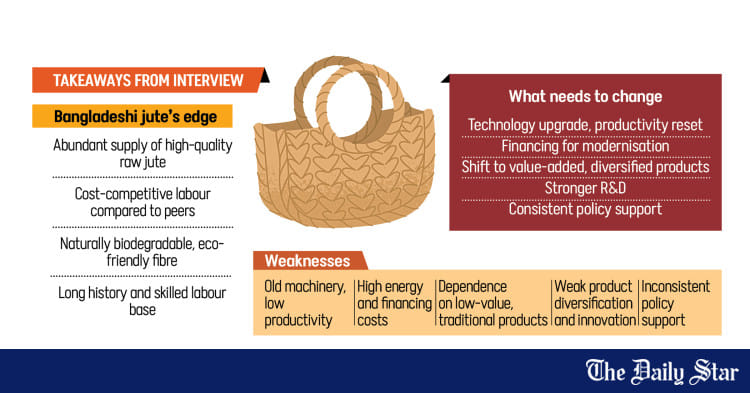
Bangladesh's jute industry is losing global competitiveness as outdated machinery, low productivity and high energy costs keep production expensive, while rival countries have modernised and achieved better cost efficiency, said Bangladesh Jute Spinners Association (BJSA) Chairman Tapash Pramanik.


Speaking to The Daily Star in a recent interview, he said the sector remains heavily dependent on traditional products such as yarn, hessian and sacks, even as global demand has shifted towards diversified, value-added and blended eco-friendly goods.

1767509430041.webp

Tapash Pramanik

"Bangladesh has lagged in research and development, design development and the commercialisation of new jute-based products," he noted.

Jute used to be one of the most prominent products of this region. Its high economic value and importance as a cash crop once earned it the moniker of the "golden fibre". But over the decades, it has lost its glory.


"The sector is largely treated as a legacy industry to be protected, not as a modern agro-industrial value chain to be rebuilt," Pramanik said.

Noting that the sector has environmental advantages, he said it has nevertheless failed to regain its former prominence due to structural, policy-driven and market-oriented challenges, while most government initiatives have been fragmented rather than transformative.

He pointed out the stark difference in policy support for the readymade garments (RMG) industry, the current crown jewel of Bangladesh's export economy, and the jute industry.


He pointed out that RMG benefited from predictable incentives, modern machinery, high productivity, export-focused strategies, access to low-cost finance and continuous R&D, enabling rapid global integration and higher margins.

In contrast, he said the jute sector remained dependent on bulk, low-value products, suffered from outdated technology, financial constraints, weak institutional support and limited innovation, leaving it stagnant in exports and unable to capture emerging global opportunities.

Policy failures played the most decisive role in holding back the sector, according to the BJSA chairman. "Weak and inconsistent policies discouraged long-term investment in modernisation and reinforced both technological stagnation and managerial inefficiency."

He also identified limited financial incentives and poor enforcement of laws, such as mandatory jute packaging, which undermined market confidence and demand.

State dominance without meaningful reform also allowed inefficient public sector mills to continue operating without accountability, he added.

At present, according to Pramanik, the most serious concern for the sector is high production costs, driven by obsolete machinery, low labour productivity, high energy prices and expensive financing. "These factors make jute products less competitive than synthetic alternatives and other natural fibres."

Limited access to affordable finance has further restricted modernisation, as mills struggle to secure low-interest, long-term loans.

Technological stagnation remains widespread, resulting in low efficiency, high wastage and inconsistent quality, he added.

Weak product diversification is another major challenge.

Despite growing global demand for diversified and lifestyle-oriented jute products, exports remain dominated by traditional, low-value items.

"Inconsistent policy support and weak enforcement create uncertainty for investors and exporters," Pramanik said.

Quality control issues, logistics bottlenecks, and the absence of strong global branding and effective trade diplomacy continue to erode Bangladesh's position in the international jute market, he added.

To overcome these challenges, Pramanik said the sector requires a coordinated approach in which the government acts as an enabler while private enterprises function as market drivers.

The government, he said, should provide stable, long-term policy support by recognising jute as a strategic export sector and strictly enforcing existing jute laws to stabilise domestic and export demand.

It should also offer affordable financing through low-interest working capital facilities and technology upgradation funds, while reforming sector institutions to improve accountability and ensure industry-oriented research and development (R&D).

Support for product diversification, quality certification and international branding, backed by active trade diplomacy, is equally essential, he also said.

Private enterprises, on the other hand, should prioritise modernising production, improving efficiency and shifting away from low-value commodity exports.

He added that effective public–private coordination through a joint sector platform is necessary to align policy, finance and market strategies for sustainable transformation.

For more than a decade, export earnings from jute and jute goods have stagnated between $900 million and $1 billion.

Breaking this deadlock, Pramanik said, will require deep structural reforms rather than short-term incentives.

The sector must move from volume-based, low-margin exports to value-based, diversified products with higher unit returns, he said.

A sector-wide technology and productivity reset is a must, including the creation of a dedicated jute technology upgradation fund and the phased replacement of obsolete machinery, said Pramanik, also the managing director of Teamex Jute Mills Ltd.

Financial reforms are also needed to treat jute as a priority export industry, offering single-digit interest loans and export-linked credit facilities.

Strengthening applied R&D, certification, and product innovation will help capture premium markets, he added.

"Proactive trade diplomacy and global branding of 'Bangladeshi Jute' as a sustainable product are necessary to expand markets and improve pricing power," Pramanik said.

Climate change poses an additional risk by affecting jute yields, fibre quality and cultivable areas.

Addressing this will require climate-resilient jute varieties, improved agronomic practices, diversified cultivation zones and crop insurance, Pramanik said.

Looking ahead, Pramanik said the industry should adopt an export-led strategy, engage directly with global buyers, ensure compliance, professionalise management and invest in innovation and R&D.

Key opportunities include eco-friendly packaging, partnerships with global brands for certified jute bags and wraps, lifestyle and home décor products such as rugs, mats and furniture, and technical textiles including geotextiles and automotive composites.

Agricultural and environmental applications, such as erosion control mats, also offer potential demand from NGOs and government projects, he said.

Bangladesh's strengths in the global jute market include abundant high-quality raw jute, an established production base, low-cost labour and a strong sustainability image.​
 
Analyze

Analyze Post

Add your ideas here:
Highlight Cite Fact Check Respond
Jute spinners demand suspension of raw jute exports amid supply crisis

FE ONLINE REPORT
Published :
Jan 04, 2026 20:20
Updated :
Jan 04, 2026 20:20

1767573775125.webp


Bangladesh Jute Spinners Association (BJSA) on Sunday urged the government to completely suspend raw jute exports, warning that continued exports amid declining production and soaring prices could severely damage the country’s jute industry.


The demand was formally placed through an application submitted on January 1 to the commerce and textiles and jute ministries.

On Sunday, a delegation of the association met with commerce and textiles adviser Sheikh Bashiruddin to reiterate their concerns.

According to the association, raw jute production declined in the last season due to natural disasters and other adverse factors.

Although the government allowed conditional exports of raw jute through a gazette notification in September, the move has once again led to supply shortages and sharp price hikes in the domestic market.

Industry insiders said the price of raw jute has recently surged to Tk 4,700–5,000 per maund, making it increasingly difficult for jute mills to procure adequate raw materials. As a result, many mills are struggling to maintain production, and some are at risk of closure, they warned.

BJSA Chairman Tapas Pramanik alleged that the export opportunity and rising prices have encouraged illegal hoarding of raw jute, creating market instability.

He said farmers are not benefiting from the price increase, while hoarders are making excessive profits.

“If raw jute exports and illegal stockpiling are not stopped immediately, genuine farmers and jute-based industries will suffer badly,” he said, adding that a large amount of undisclosed money has reportedly been invested in jute hoarding.

He also cautioned that escalating production costs are making Bangladeshi jute products uncompetitive in the international market, forcing foreign buyers to look for alternative products.

Regaining lost export markets in the future would be extremely difficult, he added.

In response, Adviser Sheikh Bashiruddin assured the delegation that the government has adopted a zero-tolerance policy against illegal jute hoarding.

He said legal action would soon be taken in four major jute-producing districts to curb stockpiling.

The adviser also said the government would review the demand for a complete suspension of raw jute exports.

Addressing concerns over jute seed shortages, he said that steps have already been taken to ensure the availability of quality seeds in the current season.​
 
Analyze

Analyze Post

Add your ideas here:
Highlight Cite Fact Check Respond

23 jute mills in Khulna to suspend production from Sunday due to shortage of raw jute
United News of Bangladesh . Khulna 31 January, 2026, 12:12


1769909888202.webp


Production at 23 private jute mills in Khulna region will be suspended from Sunday due to an acute shortage of raw jute.

The crisis was created after excessive rainfall disrupted jute cultivation in Shariatpur, Madaripur and Gopalganj, resulting in lower-than-expected output, jute mill owners said.


To protect domestic mills, the government imposed a ban on jute exports from September 8 but millers say the restriction has failed to stabilise supplies.

According to the Jute Mill Owners Association, mills are struggling to maintain normal operations as raw jute has become scarce and prices in local markets have surged abnormally.

The association has decided to shut down production at 23 mills in Khulna from Sunday.

Millers said excessive rainfall during May and June hampered jute production in the southern region.

Although the jute season began on July 1, the expected inflow of jute did not reach major trading hubs in Daulatpur, Khulna and Narayanganj.

The situation worsened after India imposed a ban on jute export to protect its farmers, leaving Khulna-based exporters in trouble, it said.

Taking advantage of the supply crunch, traders allegedly hoarded jute illegally in local markets. With no export opportunities, jute prices rose sharply in markets such as Chuknagar, Kapilmuni, Terokhada, Jhaudanga, Tala, Kalaroa and Parulia, further limiting mills’ ability to procure raw materials.

Mills set to halt production include Daulatpur Jute Mill, Khalishpur Jute Mill, Star Jute Mill, Sagar Jute, Jute Textile, Joy Jute, Habib Agro Jute, Ayan Jute, Jessore Jute, Nomani Jute, Ohab Jute, Faruk Jute, Web Jute, Super Jute, FR Jute, Quality Jute and Yasin Jute, among others.

In a letter to the government, the association said raw material shortages are pushing mills toward operational disruption while abnormal price hikes driven by middlemen have created an artificial crisis.

Bangladesh Jute Spinners Association chairman Tapas Pramanik said hoarders are controlling the market and warned that prices could rise further due to manipulation by exporters.

Sarjit Sarkar, acting assistant director of the Jute Department in Khulna, said raw jute is currently selling at Tk 4,800 to Tk 5,000 per maund in southern markets, though prices fell by about Tk 200 per maund on Wednesday.

He added that farmers typically have no stocks at home during this time of the year.

Meanwhile, Mongla Custom House assistant commissioner Lopa Saha said in a letter sent to relevant departments on January 20 that no jute exports were recorded from Mongla Port in the 2025–26 fiscal year.​
 
Analyze

Analyze Post

Add your ideas here:
Highlight Cite Fact Check Respond

Members Online

No members online now.

Latest Posts

Back
 
G
O
 
H
O
M
E