Bangladesh Defense

Saif
Senior Member
- Joined
- Jan 24, 2024
- Messages
- 22,417
- Likes
- 9,875
- Nation

- Axis Group

Monetary policy on right track
Despite a gradual moderation of the inflation in the last six months, the central bank has decided to maintain its tight monetary stance for another six months by keeping the policy rate unchanged at 10 per cent. The announcement of the latest monetary policy statement (MPS) last week also indicate
Monetary policy on right track
Asjadul Kibria
Published :
Aug 03, 2025 00:01
Updated :
Aug 03, 2025 00:01

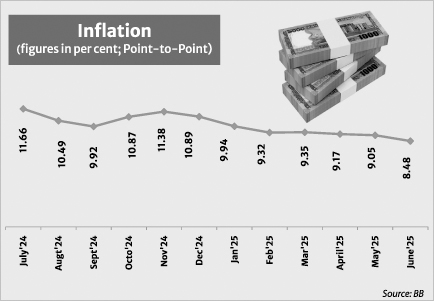
Despite a gradual moderation of the inflation in the last six months, the central bank has decided to maintain its tight monetary stance for another six months by keeping the policy rate unchanged at 10 per cent. The announcement of the latest monetary policy statement (MPS) last week also indicated that the central bank prefers to sacrifice growth for the time being by making credit flow for investment costly. The statement made it clear that the primary aim of the MPS for the first half of the current fiscal year (FY26) is 'to decelerate the rate of inflation further while maintaining exchange rate stability and strengthening financial stability.' Thus, Bangladesh Bank announced the third consecutive tight monetary stance, finding it successful to a large extent in reducing the inflationary pressure. The rate of inflation came down to 10.89 per cent in December last from 11.66 per cent in July last year. It decreased further to 8.48 per cent in June this year or at the end of FY25. Now, the latest MPS is designed to bring down the rate of inflation below 7 per cent in line with the budget target by the end of the current fiscal year. The interim government, in the national budget for FY26, has set a 5.5 per cent GDP growth target with an aim to contain the rate of inflation within a 6.5 per cent ceiling.
There is always a debate on the effectiveness of the tight monetary policy to curb inflation in developing countries like Bangladesh, mainly due to the presence of a big informal economy. Nevertheless, developing nations have started to manoeuvre the monetary policy to keep inflation in check. Though the result is mixed, monetary or credit policies in these countries have become a critical instrument to deal with inflation, as the ultimate success of the tight monetary stance is linked with the supportive fiscal and trade policies.
Bangladesh Bank started to announce half-yearly MPS around two decades ago, opening the window of policy transparency. Over the years, the MPS has been modified in line with the global standard practices. In recent years, the central bank has gradually shifted to an interest rate targeting framework from the traditional monetary targeting framework. This shift, which involves setting the key policy rate based on the desired level of interest rates in the economy, is a challenging transformation which is paying off slowly.
Under the interest rate targeting monetary policy framework, Bangladesh Bank is using the key policy rate, the repo rate to be precise, along with two supportive tools ?the Standing Lending Facility (SLF) and the Standing Deposit Facility (SDF) ? to operate the monetary policy. The MPS for the first half of the current fiscal year keep the policy rate unchanged at 10 per cent along with the SLF rate at 11.5 per cent, and the SDF rate at 8.0 per cent. It means that banks and financial institutions have to pay at least 10 per cent interest to borrow from the central bank, using treasury bonds, when there is a dearth of capital. To offset the high cost of borrowing, commercial banks have to charge higher interest rates for providing credit to their clients. The high policy rate will drive the banks to mobilise deposits from people to pay loans to traders and investors. If banks do not offer a higher rate of return, depositors will go for government securities bearing a higher rate of return. In this process, the money supply will be reduced from the market, and aggregate demand will also shrink. So, the price level will also decline.
Now, higher interest rates will make private investment more expensive as borrowing from the bank will be expensive for businesspeople. The net result will be a slowdown in private credit growth. The MPS has projected that private sector credit growth would be 7.20 per cent by the end of December this year, and it would increase modestly to 8.0 per cent at the end of the current fiscal year or June next year. With actual credit growth standing at 6.40 per cent at the end of FY25, the central bank found the projected growth of private sector credit reasonable. "Private sector credit growth is projected to be 8.0 per cent, assuming the contractionary nature of monetary policy aimed at containing persistently high inflation and lower credit demand from non-bank financial corporations," said the MPS.
Business bodies have already expressed their concern on tight monetary stance fearing further squeeze in credit flow. They said that businesses have been experiencing a tough time due to uncertain business environment, deterioration of law and order and disruption of energy supply. Now, the continuation of high interest regime will make matters worse, they argued. Though the concern expressed by the private sector is valid to some extent, it needs to be contextualised. The businesses have already adjusted with the high rate of interest and the latest MPS does not hike the policy rate further indicating that there is no need to rush for increasing the interest rates by the banks or financial institutions. Moreover, the MPS has stressed addressing the alarming level of non-performing loans through various measures. It will help the banks to improve their efficiency and may reduce the cost of lending. Private sector also needs effective intervention from the government to improve law and order so they might do their business smoothly.
Though the central bank has made it clear that it will ease the monetary stance when inflation comes down below 7 per cent, it may not be easy to do so due to various external and internal factors. Donald Trump, the president of the United States (US), has already launched a tariff war, putting global trade in turmoil. After a hectic negotiation, Trump imposed a 20 per cent additional tariff on Bangladesh, which was initially proposed at 37 per cent in April this year. Due to Trump tariffs, the cost of imports will increase, and so there will be a surge in imported inflation. The MPS also indicated this, saying that the US tariff-induced nominal depreciation of the local currency, or Taka, may further spur inflation.
The national election will be held early next year. The announcement of the date and election schedule will ease the uncertainties involving the election. At the same time, there will be a rise in the money supply during the electioneering. Candidates will spend a huge some of money to woo electorates. The increase in money supply is likely to add to inflation and make it difficult for the central bank to ease the monetary stance.
Asjadul Kibria
Published :
Aug 03, 2025 00:01
Updated :
Aug 03, 2025 00:01
Despite a gradual moderation of the inflation in the last six months, the central bank has decided to maintain its tight monetary stance for another six months by keeping the policy rate unchanged at 10 per cent. The announcement of the latest monetary policy statement (MPS) last week also indicated that the central bank prefers to sacrifice growth for the time being by making credit flow for investment costly. The statement made it clear that the primary aim of the MPS for the first half of the current fiscal year (FY26) is 'to decelerate the rate of inflation further while maintaining exchange rate stability and strengthening financial stability.' Thus, Bangladesh Bank announced the third consecutive tight monetary stance, finding it successful to a large extent in reducing the inflationary pressure. The rate of inflation came down to 10.89 per cent in December last from 11.66 per cent in July last year. It decreased further to 8.48 per cent in June this year or at the end of FY25. Now, the latest MPS is designed to bring down the rate of inflation below 7 per cent in line with the budget target by the end of the current fiscal year. The interim government, in the national budget for FY26, has set a 5.5 per cent GDP growth target with an aim to contain the rate of inflation within a 6.5 per cent ceiling.
There is always a debate on the effectiveness of the tight monetary policy to curb inflation in developing countries like Bangladesh, mainly due to the presence of a big informal economy. Nevertheless, developing nations have started to manoeuvre the monetary policy to keep inflation in check. Though the result is mixed, monetary or credit policies in these countries have become a critical instrument to deal with inflation, as the ultimate success of the tight monetary stance is linked with the supportive fiscal and trade policies.
Bangladesh Bank started to announce half-yearly MPS around two decades ago, opening the window of policy transparency. Over the years, the MPS has been modified in line with the global standard practices. In recent years, the central bank has gradually shifted to an interest rate targeting framework from the traditional monetary targeting framework. This shift, which involves setting the key policy rate based on the desired level of interest rates in the economy, is a challenging transformation which is paying off slowly.
Under the interest rate targeting monetary policy framework, Bangladesh Bank is using the key policy rate, the repo rate to be precise, along with two supportive tools ?the Standing Lending Facility (SLF) and the Standing Deposit Facility (SDF) ? to operate the monetary policy. The MPS for the first half of the current fiscal year keep the policy rate unchanged at 10 per cent along with the SLF rate at 11.5 per cent, and the SDF rate at 8.0 per cent. It means that banks and financial institutions have to pay at least 10 per cent interest to borrow from the central bank, using treasury bonds, when there is a dearth of capital. To offset the high cost of borrowing, commercial banks have to charge higher interest rates for providing credit to their clients. The high policy rate will drive the banks to mobilise deposits from people to pay loans to traders and investors. If banks do not offer a higher rate of return, depositors will go for government securities bearing a higher rate of return. In this process, the money supply will be reduced from the market, and aggregate demand will also shrink. So, the price level will also decline.
Now, higher interest rates will make private investment more expensive as borrowing from the bank will be expensive for businesspeople. The net result will be a slowdown in private credit growth. The MPS has projected that private sector credit growth would be 7.20 per cent by the end of December this year, and it would increase modestly to 8.0 per cent at the end of the current fiscal year or June next year. With actual credit growth standing at 6.40 per cent at the end of FY25, the central bank found the projected growth of private sector credit reasonable. "Private sector credit growth is projected to be 8.0 per cent, assuming the contractionary nature of monetary policy aimed at containing persistently high inflation and lower credit demand from non-bank financial corporations," said the MPS.
Business bodies have already expressed their concern on tight monetary stance fearing further squeeze in credit flow. They said that businesses have been experiencing a tough time due to uncertain business environment, deterioration of law and order and disruption of energy supply. Now, the continuation of high interest regime will make matters worse, they argued. Though the concern expressed by the private sector is valid to some extent, it needs to be contextualised. The businesses have already adjusted with the high rate of interest and the latest MPS does not hike the policy rate further indicating that there is no need to rush for increasing the interest rates by the banks or financial institutions. Moreover, the MPS has stressed addressing the alarming level of non-performing loans through various measures. It will help the banks to improve their efficiency and may reduce the cost of lending. Private sector also needs effective intervention from the government to improve law and order so they might do their business smoothly.
Though the central bank has made it clear that it will ease the monetary stance when inflation comes down below 7 per cent, it may not be easy to do so due to various external and internal factors. Donald Trump, the president of the United States (US), has already launched a tariff war, putting global trade in turmoil. After a hectic negotiation, Trump imposed a 20 per cent additional tariff on Bangladesh, which was initially proposed at 37 per cent in April this year. Due to Trump tariffs, the cost of imports will increase, and so there will be a surge in imported inflation. The MPS also indicated this, saying that the US tariff-induced nominal depreciation of the local currency, or Taka, may further spur inflation.
The national election will be held early next year. The announcement of the date and election schedule will ease the uncertainties involving the election. At the same time, there will be a rise in the money supply during the electioneering. Candidates will spend a huge some of money to woo electorates. The increase in money supply is likely to add to inflation and make it difficult for the central bank to ease the monetary stance.