| Global Defense, OSINT & Geopolitics Wire

[🇧🇩] Monitoring Bangladesh's Economy

[🇧🇩] Monitoring Bangladesh's Economy
1K
56K
More threads by Saif

G Bangladesh Defense

Bangladesh export sector faces global economic headwinds, domestic challenges: Experts

UNB
Published :
Feb 05, 2026 13:15
Updated :
Feb 05, 2026 13:15

1770276839774.webp


Bangladesh's export sector is navigating a difficult transition as weak global demand coincides with domestic political and economic pressures. However, a sharp rebound in recent months is raising hopes of stabilisation.

Export earnings in the first seven months of the current fiscal year (FY26) fell 1.93% year-on-year to $28.41 billion, according to data from the Export Promotion Bureau (EPB), down from $28.96 billion in the same period a year earlier.

The decline reflects sluggish demand in major Western markets and disruptions linked to political change at home.

Yet December and January figures point to a potential turning point.

Exports in January 2026 reached $4.41 billion, only 0.5% lower than a year earlier, but up 11.22% from December's $3.96 billion, signalling renewed momentum.

"Exports in the last two months show a shining future as global trade conditions are gradually improving," said Dr Zahid Hussain, former lead economist at the World Bank's Dhaka office.

He noted that exporters continue to face domestic challenges, including uninterrupted energy supply and labour unrest, which remain critical constraints for the manufacturing sector.

At the same time, global trade remains unsettled by geopolitical tensions and trade policy uncertainty, including the impact of US President Donald Trump's trade war.

Major global suppliers have adopted a wait-and-see approach as consumers in the United States and the European Union struggle with high living costs and job losses.

The ready-made garments (RMG) sector has once again emerged as the backbone of Bangladesh's export performance. RMG earnings rose 11.77% year-on-year to $22.98 billion during July-January, accounting for about 81% of total exports.

Sustained global demand and improved factory efficiency helped the sector offset weakness elsewhere.

Other export segments showed mixed results. Leather and leather goods, jute and home textiles recorded improvements in January, while agro-processed products and frozen fish lagged behind, failing to match the apparel sector's growth.

The United States remained Bangladesh's largest export destination, with earnings of $5.21 billion in the July-January period, up 1.64%. Germany ranked second with $2.85 billion, followed by the United Kingdom at $2.77 billion.

Economists attribute the overall export dip to several factors. Slowing consumption and high inflation in Europe during the latter half of 2025 dampened demand for non-essential goods.

Domestically, a massive student-led movement and a subsequent change in government in mid-2024 disrupted supply chains through factory closures, transport strikes and port congestion, with spillover effects into the current fiscal year.

Energy shortages also weighed heavily on production. Persistent gas and electricity constraints in late 2025 raised costs and hurt competitiveness, particularly for small and medium-sized exporters.

In addition, a strong post-pandemic rebound in FY25 created a high comparison base, making current performance appear weaker.

Analysts say the recent month-on-month rebound could mark a turning point. With the exchange rate stabilised at around Tk 122 per dollar and continued momentum in RMG and leather, export performance for the full fiscal year could end stronger than early data suggested.

Still, longer-term risks remain. "Depending on a single product, it is very difficult to increase exports," said Dr M Masrur Reaz, chairman and founder of Policy Exchange Bangladesh.

He warned that Bangladesh must accelerate product diversification, particularly as apparel exports face tariff challenges in the US market.

Rising living costs in Western economies are reshaping consumer behaviour and limiting purchasing power, he added, reinforcing the need for innovation and a broader export base to ensure sustainable growth.​
 

‘Strong institutions key amid economic uncertainties’

FE REPORT
Published :
Feb 05, 2026 10:00
Updated :
Feb 05, 2026 10:00

1770277157687.webp


Bangladesh urgently needs competent and resilient institutions to navigate mounting global and domestic pressures, including geopolitical tensions and the imminent challenges of graduating from least developed country (LDC) status, prominent businessman Mahbubur Rahman has said.

At a time of heightened uncertainty, strong institutions are essential to absorb shocks, manage economic transitions and sustain policy credibility beyond political cycles, he noted, stressing that institutional strength will be decisive in safeguarding long-term stability and growth.

Despite Bangladesh's economic progress over the past couple of decades, the global environment has changed in ways that now pose fresh challenges for the country, said Mr Rahman, who is also the president of the International Chamber of Commerce, Bangladesh (ICCB).

Mr Rahman made the remarks while speaking at a seminar titled 'Election, Politics & Economy of Bangladesh: The Way Forward', organised by the Institute for Democracy & Human Rights (IDHR) of Millennium University and held at a city hotel on Tuesday.

ICCB Vice-President and Ha-Meem Group Chairman A K Azad, Policy Research Institute Chairman Dr Zaidi Sattar, eminent lawyer Shahdeen Malik, and Executive Director of Khan Foundation and Chairperson of the Board of Trustees of Millennium University Rokhsana Khondoker were also present.

Junior Research Fellow at the University of Oxford Dr Mahreen Khan and World Bank Research Analyst and Programme Coordinator Nausheen Khan spoke as keynote speakers.

In his speech, the ICCB president also outlined key expectations from the upcoming government. Businesses can adapt to policy changes, but they struggle with uncertainty.

Emphasising institutional independence, Mr Rahman said key economic institutions, such as the central bank, regulatory authorities and the judiciary, must operate independently.

"Investor confidence depends not on personalities, but on systems," he added.

Economic reforms are effective when they are inclusive, which requires sustained engagement among policymakers, political leaders, businesses, labour representatives and civil society.

Elections should not interrupt this process; rather, they should reinforce and deepen dialogue. Transparent governance reduces corruption, while a free media improves accountability.

Bangladesh's future would not be determined by elections alone, nor by economic policies in isolation. The future government would work closely with all stakeholders, including the business community, to address upcoming challenges and ensure sustainable growth and development, he added.
​
 

Rethinking VAT reform in Bangladesh

The case for prioritising sales data

Md. Abdur Rouf
Published :
Feb 04, 2026 23:34
Updated :
Feb 04, 2026 23:34

1770339254387.webp


Having worked in the VAT management system for nearly three decades since 1995, I have had the opportunity to observe numerous policy initiatives and administrative reforms. Despite these efforts, Bangladesh continues to have one of the lowest tax-GDP ratios in the world, a reality that clearly fails to justify many of the measures undertaken over the years. The fundamental reason for this outcome is that reforms were not implemented with proper prioritisation. Consequently, VAT has not been collected in line with the true potential of the economy.

To understand why VAT collection remains below the potential, it is necessary to identify the core problem accurately. The most critical weakness in the VAT management system is not the number of registered entities but the absence of a reliable mechanism for recording sales data. Proper recording of sales data should, therefore, be treated as the highest priority. If sales data are accurately captured, the scope for VAT evasion is virtually eliminated. At the same time, reliable sales data facilitate income tax collection and the preparation of accurate financial accounts. If VAT, income tax, and accounting systems were aligned through proper sales data recording, the impact on the economy would be transformative.

At present, substantial time and manpower are devoted to VAT registration, maintenance of purchase and sales registers, submission of VAT returns, and related compliance activities. However, these processes have not been implemented flawlessly, and the expected outcomes have not been achieved. In contrast, even if one function-namely, proper maintenance of sales records-was carried out effectively, VAT collection would have increased dramatically. Compliance should never be treated as an end in itself; it is meaningful only insofar as it ensures correct VAT collection.

This point becomes clearer when we consider two hypothetical scenarios. In the first scenario, there is no VAT registration, no purchase and sales registers, and no VAT return submission, yet all sales data of all entities are preserved in a central server in real time. In such a system, the correct amount of VAT could be easily assessed and collected solely on the basis of sales data. In the second scenario, all entities are registered, registers are maintained, and VAT returns are submitted, but widespread VAT evasion continues and the correct amount of VAT is not collected. From the perspective of revenue mobilisation, the first scenario is far superior.

A closer examination of the VAT landscape confirms this idea. The real problem in Bangladesh's VAT system is not non-registration. Almost all manufacturers, importers, exporters, large traders, and large service providers are already registered. The entities that remain outside the VAT net are mainly medium and small traders and service providers with relatively low turnover, whose customers are largely members of the general public. Evidence of VAT evasion, however, is frequently visible among registered entities, for example at restaurant counters where sales are often underreported.

In terms of revenue contribution, only about 5 per cent of total VAT is collected at the trading stage, while approximately 50 per cent is collected at the manufacturing stage and about 40 per cent at the service stage. Discrepancies between turnover declared in VAT returns and figures reported in audited financial statements are commonly observed even among large entities. This clearly indicates that the preservation of accurate sales records, rather than the expansion of registration among small traders, should be the primary focus of VAT administration.

Current data further reinforce this argument. About 58 per cent of total VAT is paid by only 109 entities registered under the Large Taxpayers Unit (LTU), VAT Commissionerate. On this basis, it can reasonably be concluded that the top 1,000 entities contribute around 90 per cent of total VAT. As of November 2025, there are approximately 645,000 VAT registrations, meaning that the remaining 644,000 entities together contribute only 10 per cent of total VAT. Of these, 100,000 entities account for just 1.55 per cent of VAT revenue. Even if another 100,000 entities were brought under the VAT net, the increase would be negligible.

By contrast, the economy has the potential for nearly a 200 per cent increase in VAT collection. This potential cannot be realised simply by registering more small shopkeepers and service providers. Instead, if the sales data of the top 25,000 entities were accurately recorded, VAT collection could realistically be doubled.

Despite this reality, special registration campaigns continue to be emphasised. Under such campaigns, VAT registration is often forcibly granted based on minimal information such as name, address, and nature of business. These entities are later required to submit registration forms, trade licences, TINs, rental agreements, and bank certificates to regularise their status. Only after scrutiny and the issuance of an ID and password in the e-VAT system can VAT returns be submitted online. Experience shows that most forcibly registered entities never appear for regularisation. Even among those that do, many fail to submit VAT returns. Those who submit returns often file zero returns or pay negligible amounts of VAT, making little difference to overall VAT collection.

Over time, the number of VAT returns submitted becomes disproportionately low compared to the number of registered entities, necessitating deregistration drives. From registration to deregistration, the administrative workload of VAT offices increases significantly, yet the number of entities paying substantial VAT does not rise. This is because most newly registered entities are small or medium traders and service providers with limited VAT liabilities. Organic growth in VAT registration is therefore sufficient. What is urgently needed is a targeted effort to ensure proper recording of sales data, which would increase the number of entities contributing meaningful amounts of VAT.

Historical experience supports this conclusion. When VAT was introduced in Bangladesh in 1991, a large number of registrations were issued through special campaigns. Eventually, it was found that while there were around 700,000 registered entities, only about 35,000 VAT returns were submitted. Investigations revealed that most non-filers were non-existent entities. Consequently, extensive deregistration activities were undertaken during 1997-98. This experience clearly demonstrates that VAT collection cannot be significantly increased merely by expanding registration numbers; accurate sales data preservation is far more effective.

A similar pattern appears to exist in income tax administration. Currently, there are about 13 million TIN holders in Bangladesh. A large number do not file returns. Among those who do file, many submit zero returns, and among those who pay tax, many pay only the minimum amount. This raises an important question: has the number of taxpayers paying substantial income tax increased in proportion to the rise in TIN registrations?

Recognising the importance of sales data, efforts to record it began in 2004 with the introduction of Electronic Cash Registers (ECRs), followed by VAT software and Electronic Fiscal Devices (EFDs). However, none of these initiatives succeeded. More recently, an API-based, machine-less approach has been introduced, but it too has yet to demonstrate sufficient promise. Over the past 21 years, no visible progress has been achieved in the systematic recording of sales data. This underscores the need to place sales data recording at the very top of the priority list in VAT management.

There are differing opinions regarding the appropriate information technology model for recording sales data. In my view, it is sufficient to capture a limited set of invoice information-such as the names of buyer and seller, item details, price, and VAT amount-in a central server on a real-time basis. Such a model would require less financial investment, less manpower, and less technological complexity.

In an era of rapid technological advancement, recording all sales data in real time is not a difficult task. It is far less complex than the systems operated by global technology companies or even those used in Bangladesh's telecom and banking sectors. This can be achieved using domestic financing, local technology, and existing human resources; what is required is a clear policy decision and strong initiative. During the 1980s, the proposal to introduce a National Identity Card was widely considered impossible, yet it was later successfully implemented and now supports numerous administrative functions. Proper sales data recording can similarly support multiple objectives, including the accurate collection of VAT and income tax.

Recently, 131,000 VAT registrations were issued under a special campaign. An objective assessment of how many of these newly registered entities submit VAT returns and how much VAT they actually pay would provide valuable guidance for future policy decisions. VAT collection cannot be significantly increased by registering small shopkeepers and service providers alone. The number of entities paying substantial VAT does not rise through such measures, as most new registrations involve entities with minimal contribution to total VAT revenue.

In conclusion, the core problem in Bangladesh's VAT management system is not insufficient number of VAT registrations, but the widespread concealment of sales by registered entities. Capturing sales records on a real-time basis would enable the collection of the correct amount of VAT, strengthen income tax administration, and improve the quality of financial reporting. Therefore, ensuring proper sales data recording must be given the highest importance and the topmost priority in the VAT management system of Bangladesh.

Dr. Md. Abdur Rouf is a VAT Specialist who is Chairman of International VAT Training Institute.​
 

Will FDI surge after election?

Asjadul Kibria
Published :
Feb 07, 2026 22:34
Updated :
Feb 07, 2026 22:34

1770511010824.webp


Notwithstanding various efforts and policy supports, inflow of foreign direct investment (FDI) in Bangladesh is still nominal. The annual average net inflow of FDI stood at $1.60 billion in the last 10 years which is less than one per cent of the country's gross domestic product (GDP). Like many key economic indicators, the repressive regime of Hasina also inflated the FDI statistics to mislead people about the success in relation to economic advancement. That's why, at one stage, annual inflow of FDI was reported to cross $3 billion level. The net FDI in terms of balance of payments (BoP), however, never crossed $2 billion level except FY19.

After the fall of the authoritarian regime on August 5 in 2024 due to student-led mass uprising, Bangladesh Bank revised the FDI data in order to comply with the International Monetary Fund (IMF)'s updated version of BoP estimation guideline. As a result, the amount of net inflow of FDI declined sharply compared to the data reported on the basis of half-yearly survey. Though the process of revision started in FY15, it gained momentum two years ago. Due to revision, the real scenario of FDI turns out to be disappointing. For instance, net FDI was $3249.68 million in FY23, as per the survey-based reporting. The latest revision has made it $1605.40 million.

Now that the national elections is going to take place on Thursday, everything has become the poll-centric. There is also speculation that the inflow of FDI might go up after the election. Empirical data showed that inflow of FDI declined in the election years on three occasions and increased on two occasions in the last two and a half decades. [Due to lack of adequate data on FDI in the early 1990s, FDI situation during the national elections (5th) in 1991 and 1996 (6th and 7th within 100 days) has not been taken into consideration.]

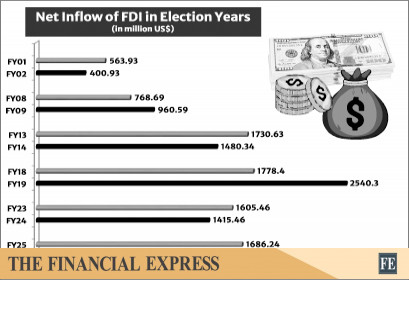
Statistics available with Bangladesh Bank showed that net inflow of FDI in FY02 declined to $400.98 million from $563.93 million in FY01. The eight national elections took place on October 1 in 2001 which was also the first day of the second quarter of FY02. The decline in FDI by around 29 per cent was disappointing for the newly elected Khaleda-led government at that time.

The FDI jumped by around 25 per cent in FY09, the year when ninth national elections took place. The date was December 29 in 2008. Net inflow of FDI reached at $960.59 million in FY09 from $768.69 million in FY08. The surge in FDI was a confidence booster for the newly elected Hasina-led government.

The 10th general elections took place on January 5 in 2014, at the middle of the FY14 and it was a highly controversial one. Hasina re-elected as the prime minister in 2014. For the foreign investor reacted negatively, as net FDI declined by 14.50 per cent to $1480.3 million in FY14 from $1730.6 million in FY13.

The 11th general elections was far more disputed as ballot boxes at a large number of polling booths across the country allegedly were stuffed with fake ballots in night before the day of election, December 30 in 2018. Through the heavily rigged and manipulated elections, tyrant Hasina was re-elected. Net FDI surged by 42.85 per cent in FY19 to $2540.30 million from $1778.40 million in FY18. The big surge in FDI at that time also raised questions aplenty as allegation of data manipulation by the government surfaced.

Finally, during the 12th national elections on January 7 in 2024, also at the middle of the FY24, net inflow of FDI declined. The FDI dropped by 11 per cent to $1415.46 million in FY24 from $1605.46 million in FY23. Though Hasina got re-elected through massive vote engineering, her repressive regime survived for six months after the election. Student-led mass uprising compelled her to step down and flee to New Delhi on August 5 in 2024.

After Yunus-led interim government assumed the power, it has stepped up a number of reform measures in various sectors. One of the measures is checking and revising the flaws of the economic indicators. Under the initiative, Bangladesh Bank has revised the of FDI data in line with the internationally updated calculation method with a calculation that covered the FY20 and latter years. As a result, a significantly lower amount of FDI has been recorded in contrast with the previously reported data up to FY23.

As the current fiscal year (FY26) is the election year, there is an indication that the net FDI will finally lower than $1686.24 million in FY25. During the first quarter (July-September) of FY26, net inflow of FDI recorded at $315.09 million. As per the balance of payments (BoP) table, net inflow of FDI in the first five months (July-November) of the current fiscal year estimated to $651 million.

Meanwhile, global FDI increased by 14 per cent last year to an estimated $1.6 trillion, according to UN Trade and Development (UNCTAD).

According to the latest Global Investment Trends Monitor, released by the UNCTAD in the last month, FDI flows to developed economies jumped 43 per cent to $728 billion. European Union alone recorded a 56 per cent jump. By contrast, FDI flows to developing economies dropped by two per cent to $877 billion, accounting for around 55 per cent of the global FDI.

"Lower-income countries were hit the hardest, with three quarters of least developed countries experiencing stagnant or declining inflows," said the investment monitor report.

For Bangladesh, the observation is not fully applicable as the country witnessed a big jump in FDI in the first nine months of 2025. During the January-September period of the last year, the net inflow of FDI stood at $ 1,406.59 million, compared with $ 1,270.39 million in January-December 2024. The main reason is the resumption of normal economic activities, which was seriously disrupted during the July mass uprising.

Nevertheless, comparisons between calendar and fiscal years can sometimes create confusion. This article focuses on the fiscal year to examine the impact of the election on FDI and finds that a decline in FDI in an election year is normal, while a rise is an exception. Foreign investors generally follow a wait-and-see policy to monitor election-centric political developments and the early moves of the newly elected government. The existing multinational entities (MNEs) continue their regular operations without injecting fresh capital or expanding their commercial activities. FDI may rebound in the next fiscal year provided that the newly elected government ensures socio-political stability in the post-election period.​