| Global Defense, OSINT & Geopolitics Wire

[🇧🇩] Monitoring Bangladesh's Economy

[🇧🇩] Monitoring Bangladesh's Economy
1K
56K
More threads by Saif

G Bangladesh Defense

NBR bifurcation: A critical decision

Published :
Mar 27, 2026 00:44
Updated :
Mar 27, 2026 00:44

1774570406942.webp


The long-debated proposal for bifurcation of the National Board of Revenue (NBR) appears, at least for now, to be at a crossroads. What once seemed like a decisive reform initiative has slowed as policymakers pause to reconsider whether the groundwork has truly been laid. The finance ministry's recent observation that the ordinance promulgated by the interim government is "half-baked" has effectively stalled the process. As Finance Minister Amir Khasru Mahmud Chowdhury aptly remarked that such a significant reform must be "baked properly" before it can be implemented, underscoring the complexity and sensitivity of the issue.

The ordinance aimed to divide the NBR into two separate entities: one responsible for tax policy and the other for tax administration. This reform, encouraged by the International Monetary Fund (IMF) as part of a broader fiscal restructuring agenda, was envisioned as a transformative step towards creating a more transparent, accountable, and efficient tax system. By separating the functions of policy formulation and enforcement, the government sought to eliminate a longstanding conflict of interests, where the same authority crafted tax laws and implemented them. However, the constitutional timeline adds urgency to the debate. The government is required to either approve the ordinance by April 12, 2026, without amendment, or allow it to lapse automatically if not ratified by parliament. The finance minister's statement suggests that the current government is reluctant to proceed under the existing format, indicating that the bifurcation, at least in its present form, is unlikely to move forward.

The idea of separating tax policy from administration is not new. The IMF first recommended such a restructuring as early as 1993, and the World Bank reiterated the suggestion in 2007. Over the decades, economists, business leaders and development partners have consistently advocated for modernising the revenue administration to improve efficiency and credibility. Bangladesh's persistently low tax-to-GDP ratio has often been cited as evidence of systemic weaknesses, reinforcing calls for institutional reform.

The current impasse reflects a deeper tension between the urgency of reform and the need for careful institutional design. While external partners such as the IMF continue to encourage structural changes, the absence of consensus within the domestic administrative apparatus makes implementation politically and practically challenging. In this context, the government's cautious approach may be interpreted not merely as reluctance, but as an attempt to avoid hasty reforms that could produce unintended consequences. Structural changes of this magnitude require not only legal adjustments but also cultural and procedural shifts within institutions. Without adequate preparation, the separation of policy and administration could result in fragmentation rather than efficiency. Ultimately, the debate over NBR bifurcation is less about whether reform is needed and more about how and when it should be carried out. Allowing the ordinance to lapse would not necessarily signify a rejection of reform, but rather a recognition that the proposed framework may not yet be ready for implementation. The challenge for policymakers lies in balancing the momentum for change with the responsibility to ensure that any restructuring is both comprehensive and sustainable.​
 

Over 24 days

Expatriates send more than $3b, raising possibility of a new record

Staff Correspondent
Dhaka
Published: 26 Mar 2026, 20: 13

1774572124329.webp

Over $3 billion (300 crore dollars) in remittances have been received in the first 24 days of March, raising the possibility of setting a new single-month record, according to the Bangladesh Bank.

Expatriate Bangladeshis residing in various countries sent 3.05 billion dollars to the country by 24 March.

This month included the holy Eid-ul-Fitr, and typically, the flow of remittances increases during the Eid months.

Expatriates send more money during this time to cover their families' Eid expenses.


According to the central bank, the highest remittance in the country's history came last March. At that time, expatriates sent a total of 3.29563 billion dollars to the country.

The second highest remittance came in December of the previous year, with 3.2266 billion dollars coming to the country. The third highest remittance came last January, amounting to 3.17 billion U.S. dollars.

Meanwhile, from July of the current 2025-26 fiscal year to 24 March, a total of 25.504 billion dollars has come in as remittances. This is 10.90 per cent more than the same period of the previous fiscal year, when remittances amounted to 21.238 billion dollars.

On the other hand, due to the Middle East crisis, the price of the dollar from remittances has increased. To manage the impending economic shocks from the Middle East crisis, eight leading economists have advised Bangladesh Bank to hold on to its reserves.

The economists stated that the extent of the crisis is not yet clear. If there's a global crisis, there will be pressure on reserves and the dollar. Therefore, reserves need to be maintained. Additionally, it is not the right time to alter policy interest rates to reduce interest rates. Once the impending pressure eases, initiatives can be taken to reduce interest rates to increase investment.

In a recent meeting with Bangladesh Bank, the economists gave these suggestions. They advised finding alternative sources for fuel instead of depending on the Middle East. Even if global market prices increase, they suggested not passing this on to consumers right away, as it would increase inflation.​
 

Revenue collection surges 12pc in 8 months

bdnews24.com
Published :
Mar 25, 2026 21:18
Updated :
Mar 25, 2026 21:18

Revenue collection has rebounded sharply from the slump seen during the interim government’s final months, registering a 12 per cent growth in the first eight months of the ongoing fiscal year.

The National Board of Revenue (NBR) released the latest data on Wednesday, showing total revenue collection of Tk 2.54 trillion in July–February, compared with Tk 2.26 trillion in the same period last year.

The collection target for February was Tk 3.25 trillion, leaving a shortfall of nearly Tk 0.71 trillion.

The revenue authorities recorded double-digit growth in all months except October, January, and February, pushing the average growth in July–February to 12.36 per cent.

Single-month growth peaked in July at 24.61 per cent, followed by 18.03 per cent in August and 20.15 per cent in September.

This contributed to a 20.80 per cent rise in revenue in the first quarter compared with the previous fiscal year.

Growth slowed sharply to 3.31 per cent in October.

Although November and December returned to double-digit gains -- 15.41 per cent and 11.45 per cent respectively -- January again showed weak expansion, with February indicating some recovery yet remaining in single digits.

The previous fiscal year had been disrupted by quota protests, mass uprisings, and a change in government, which had frozen economic activity and suppressed revenue collection.

The government now aims to collect Tk 5.03 trillion via NBR in the ongoing fiscal year, up from the budgeted Tk 4.99 trillion.

Including other sources, the total revenue target stands at Tk 5.64 trillion, equivalent to 9 per cent of GDP, with Tk 0.65 trillion expected from non-NBR sources.​
 

BUTTRESSING BOP AGAINST WAR SHOCKS
Govt seeking $2.0b in bailout from foreign financiers
IMF informed, ERD also working with other sources for funds, BB governor tells media men

FE REPORT
PuMar 30, 2026 00:05
Updated :
Mar 30, 2026 00:05

1774829904967.webp


Bangladesh opts for seeking an additional $2.0 billion in bailout from foreign development partners to buttress the balance of payments (BoP) through minimising shocks stemming from war crises in Mideast countries.

Bangladesh Bank (BB) Governor Md Mostaqur Rahman revealed the plan Sunday during a consultation with representatives of the country's leading print-media outlets regarding the central bank's current role in the context of ongoing tensions in the Middle East after USA-Israel duo launched attacks on Iran.

"Though it is in preliminary stage, we have already shared our plan to the IMF (International Monetary Fund) while ERD is also working with other sources for the BoP-supporting funds," he said.

The media persons expressed their concern over negative impact on foreign-currency reserves if the war in the Gulf countries prolongs further as nearly 70 per cent of the $30-billion remittance comes from this region and it might badly impact the country's BoP position.

But the central bankers attending the meeting dispelled the fear of immediate impact of the war that began on February 28 last, saying that the country has enough stock of foreign currencies to mitigate immediate shocks of the crisis if it arises.

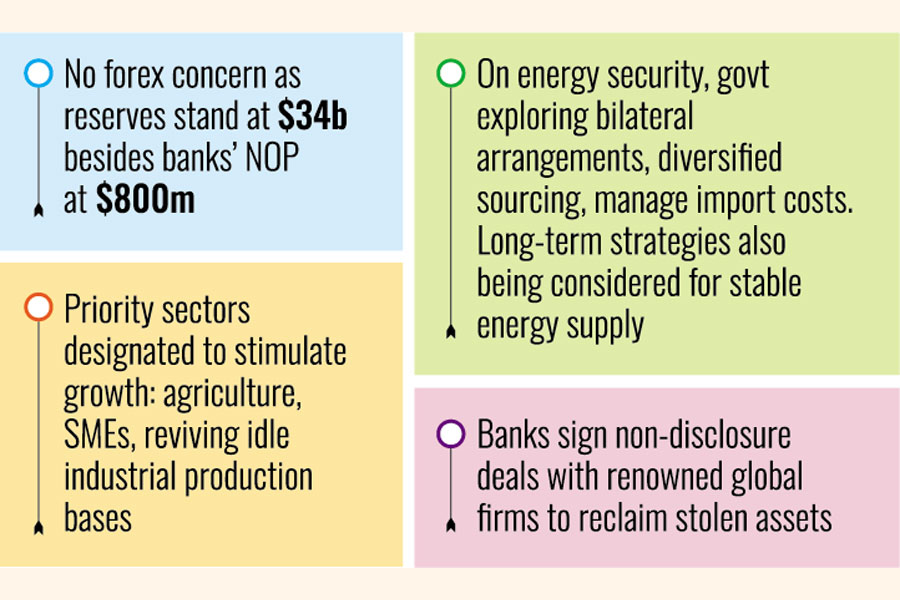
The BB governor said energy security remained another major concern. The government is exploring bilateral arrangements and diversified sourcing to reduce dependence on single suppliers and manage import costs. Long-term strategies are also being considered to ensure stability in energy supply.

There should be no political influence in the financial sector, he said. Instructions have been given to take decisions without any form of external influence, even as they push for stronger governance and accountability.

He mentions that although the global success rate in terms of recovering stolen assets remains nominal, efforts are also underway to recover siphoned-off assets as majority of the banks signed NDA (non-disclosure agreement) with renowned global firms.

On the economic front, Mr Rahman said three priority sectors have been identified to stimulate growth: agriculture, small and medium enterprises (SMEs), and the revival of idle industrial production bases.

The central bank governor stresses the importance of bringing underutilised factories back into production-even partially-to prevent further economic loss and maximize the use of national assets.

The central bank is also concerned over the country's low tax-to-GDP ratio, currently below 7.0 per cent, noting that both administrative reforms and increased economic activity are needed to improve revenue collection.

In a major policy push, the governor said, they are accelerating the transition to cashless transactions. The use of a unified Bangla QR payment system, "Bangla QR," will be made mandatory at all payment points by June 30, with enforcement measures, including penalties for noncompliance, expected from July.

Officials believe this will increase transaction transparency, reduce cash- handling costs, and boost revenue.

Deputy Governor Dr Md. Kabir Ahmed ruled out any serious pressure as far as foreign-currency reserves is concern. The forex reserves stood at $34 billion now and the NOP (net open position) in banks rose to $800 million.

On the other hand, they expect that the country would see at least $2.0- billion-higher remittance inflow in this financial year (FY'26) from the figure of previous fiscal (FY'25). "Simultaneously, the IMF is expected to disburse two remaining installments involving $1.20 billion of its $5.5 billion worth of lending package for stabilising Bangladesh's macroeconomic situations," he said.

Dr Kabir also notes that the demand for US dollar is relatively low in the post-winter season. "So, there is no worry as far as forex reserves is concerned."

Deputy governors of BB Nurun Nahar, Dr Md. Habibur Rahman and Md. Zakir Hossain Chowdhury and BB spokesperson Arief Hossain Khan also spoke at the meeting.​
 

Investment, savings slide as growth slows
BBS data signals deepening economic strain amid inflation, weak demand

FHM Humayan Kabir

Published :
Mar 29, 2026 09:17
Updated :
Mar 29, 2026 11:35

1774831272318.webp


Bangladesh's investment and savings ratios declined sharply in FY2024–25, reflecting a broader economic slowdown that has pushed GDP growth to its lowest level since the pandemic.

The latest official data point to weakening domestic demand and a more cautious investment climate. Economists warn that the twin decline in investment and savings could have far-reaching consequences for employment, income growth and poverty reduction, raising fresh concerns over the country's macroeconomic stability.

According to the recently released final estimates of the Bangladesh Bureau of Statistics (BBS), the investment-to-GDP ratio fell to 28.54 per cent in FY25, down from 30.70 per cent in the previous FY24.

Domestic savings dropped by nearly two percentage points to 21.98 per cent, while national savings followed a similar downward trajectory, settling at 27.67 per cent in FY2025.

Domestic savings declined to 21.98 per cent of GDP in FY2025 from 23.96 per cent in FY2024, the official data showed. Similarly, national savings fell to 27.67 per cent of GDP in FY2025 from 28.42 per cent in FY2024, according to the BBS final estimates.

Analysts say this contraction underscores a cautious environment for both public and private capital, with private investment dropping to 22.03 per cent of GDP in FY2025 from 23.96 per cent in FY2024. Public sector investment also declined slightly to 5.80 per cent of GDP in FY2025, from 5.91 per cent in the previous fiscal year, the data showed.

Economists attribute the decline to a combination of persistently high inflation and weak domestic demand, which has forced many households to prioritise immediate consumption over long-term savings.

Furthermore, high interest rates and exchange rate volatility, with the average dollar rate used for BBS calculations rising to Tk 120.82, have significantly eroded real purchasing power and surplus income.

The drop in these key indicators aligns with a revised GDP growth rate of 3.49 per cent for FY2025, down from the provisional estimate of 3.97 per cent. This marks the third consecutive year of deceleration for the Bangladesh economy.

While the industrial sector posted modest growth of 3.71 per cent, both the services and agriculture sectors slowed, expanding by 4.35 per cent and 2.42 per cent respectively.

In a rare positive development, per capita income rose to Tk 334,511 (US$2,769) in FY2025, up from Tk 304,102 (US$2,738) in FY2024, according to BBS data. However, analysts caution that the increase in dollar terms partly reflects exchange rate adjustments and nominal growth, rather than a broad-based improvement in living standards.

The current economic landscape suggests that, without a significant boost in investment and savings, growth recovery may remain uncertain.​