Bangladesh Defense

Saif
Senior Member
- Joined
- Jan 24, 2024
- Messages
- 22,417
- Likes
- 9,875
- Nation

- Axis Group

Bangladesh requests $2.0b ADB budget support
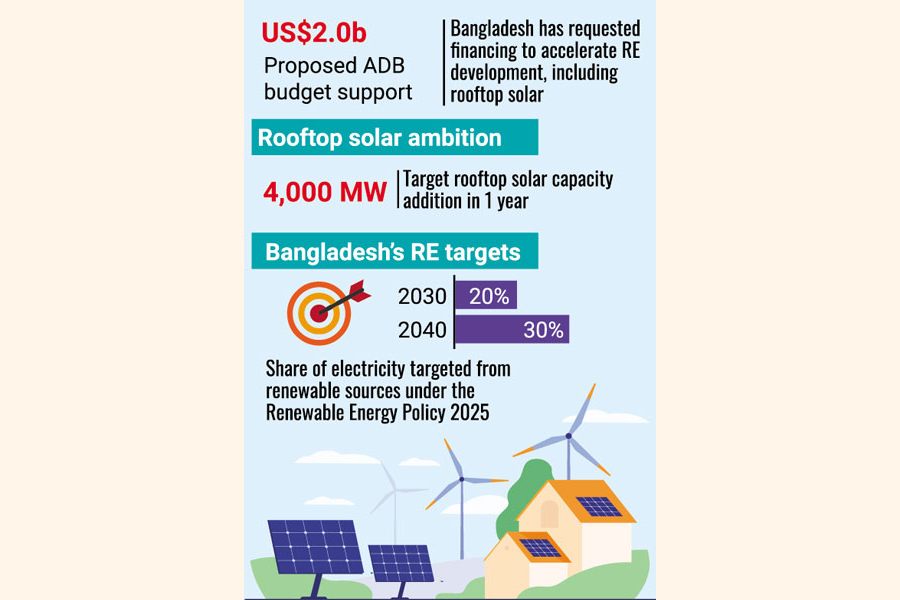
Bangladesh has recently placed a request for US$2.0 billion in budgetary support from the Asian Development Bank (ADB) for accelerating switch from expensive imported fossil fuels to renewables. The funds will be used particularly to accelerate renewable energy development, including rooftop
Bangladesh requests $2.0b ADB budget support
Bangladesh has recently placed a request for US$2.0 billion in budgetary support from the Asian Development Bank (ADB) for accelerating switch from expensive imported fossil fuels to renewables.
The funds will be used particularly to accelerate renewable energy development, including rooftop solar power, officials said Monday.
The government has stepped up efforts to reduce dependence on fossil fuels and imported energy and utilise its natural resources for renewable-energy improvements, they added.
The Economic Relations Division (ERD) under the Ministry of Finance (MoF) has recently sent a letter to the Manila-based lender following a request from the Finance Ministry, said a senior ERD official.
"After getting request from the finance division, we sent a letter early this month to the ADB. We are hopeful of getting the budget support from the Manila-based lender," he added.
They are expecting the entire funds in 2-3 annual tranches.
The proposed assistance is expected to support government's renewable-energy-expansion drive, with rooftop solar emerging as a major priority amid persistent pressure on the country's power sector and rising concerns over energy security.
The government seeks to mobilise external financing for a rapid expansion of solar-power capacity and introducing policy reforms to encourage investment in clean energy.
Another ERD official has said if the ADB fails to mobilise the entire $2.0 billion, then other development partners like the Asian Infrastructure Investment Bank (AIIB) could join as co-financers of the initiative.
"We are waiting for response from the ADB. If the lender alone cannot provide the funds, we have to communicate with some other donors to co-finance the budgetary support," he added.
Meanwhile, some government officials have said the ADB has already indicated its willingness to support Bangladesh's renewable-energy initiatives through policy-based lending.
The lender held discussions with officials from the Finance Division, Power Division, Sustainable and Renewable Energy Development Authority (SREDA), Bangladesh Energy Regulatory Commission and Bangladesh Power Development Board in early October on reforms and renewable-energy integration into the national grid.
The government is looking to expand rooftop-solar installations across public buildings, commercial establishments and industrial facilities to increase domestic electricity generation without relying entirely on conventional power plants.
The Power Division has been pursuing an ambitious plan to add up to 4,000 megawatts (MW) of rooftop solar capacity within a year.
The initiative is expected to create opportunities for private investors while helping meet the country's growing electricity demand, the officials said.
Bangladesh's Renewable Energy Policy 2025 sets a target of generating 20 per cent of the country's electricity from renewable sources by 2030 and 30 per cent by 2040.
The National Rooftop Solar Programme is also designed to accelerate solar-power generation through the use of rooftop spaces.
Expanding solar power could help reduce the use of natural gas and imported fuels in electricity generation, ease pressure on foreign-exchange reserves and lower the government's exposure to power-sector subsidies.
The proposed ADB support would come at a time when Bangladesh is seeking to strengthen its energy security while managing fiscal constraints and completing demands for development financing.
Officials will now need to finalise the proposed financing framework and clarify how the funds would be deployed, including the balance between budget support, policy reforms and investment in renewable-energy infrastructure.
The outcome of negotiations will be important in determining how quickly the government can translate its rooftop-solar-power ambitions into additional electricity generation.