[🇧🇩] Monitoring Bangladesh's Economy

Quick Reply ✓ Posted!
[🇧🇩] Monitoring Bangladesh's Economy
1K
55K
More threads by Saif

G Bangladesh Defense

Behind persistent inflation

1794266346122.webp


In the words of Nobel Laureate economist Milton Friedman, inflation is “always and everywhere a monetary phenomenon”. The International Monetary Fund (IMF), along with many economists of the monetarist school, has often treated this proposition as a truism. While the positive relationship between money supply and aggregate demand is well established, the effectiveness of contractionary monetary policy in controlling inflation has frequently proven contingent on a range of economic conditions and structural factors.

The issue has once again come under scrutiny as Bangladesh’s efforts to curb persistent inflation through monetary tightening have produced little success. Proponents of the monetarist view in Bangladesh argue that the delayed adoption of contractionary monetary policy reduced its effectiveness and that inflation would have been even higher had policy tightening been postponed further.

It is undeniable that several demand-side factors triggered inflation in Bangladesh in the post-COVID period. The sudden release of pent-up demand following the pandemic, the lagged effects of easy credit dispensed during the COVID years, and accelerated public expenditure aimed at compensating for delays in project implementation, all contributed to a sudden spike in the level of aggregate demand putting significant upward pressure on the level of prices.

However, the rising supply-side constraints and disruptions in supply-chain were no less important in pushing up costs and consequently the general level of prices in the post-COVID period. Requirements for disinfecting shipping containers through fumigation after the outbreak of COVID-19 added directly to international transportation costs of merchandise. Soon afterwards, the start of the Russia–Ukraine war in February 2022 caused a significant increase in global commodity prices including energy prices. The Bangladesh government was subsequently compelled to raise domestic energy prices several times to contain the burden of subsidies on the budget, further reinforcing inflationary pressure.

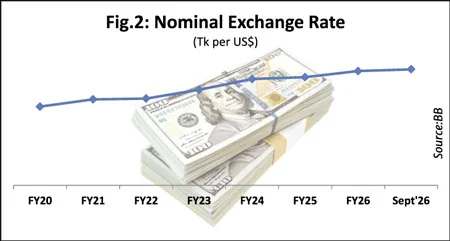
Inflation in the United States (US) rose to nearly 10 per cent, prompting US Federal Reserve to raise policy interest rates substantially. This resulted in increased demand for US-dollar-denominated financial assets and contributed to an appreciation of US dollar against most currencies, adding to global inflationary pressures. Bangladesh was no exception; indeed, the pressure on the taka was exacerbated by widespread money laundering during the previous political regime. The taka depreciated by approximately 44.8 per cent between FY21 and FY26. In addition, Bangladesh Bank’s earlier policy of allowing taka to depreciate gradually encouraged speculative demand for foreign exchange, putting further pressure on the exchange rate and contributing to inflation.

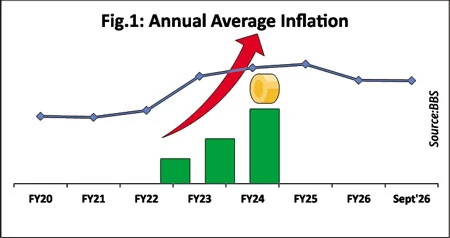
The charts below compare the trend in inflation with the nominal exchange rate. Their close correspondence is consistent with the view that higher import costs resulting from taka depreciation were a major contributor to recent inflation in Bangladesh.

As opportunities for money laundering narrowed under the interim government and the exchange rate became better aligned with market conditions, the foreign-exchange market stabilised to some extent. A more stable exchange rate and a reduction in the scope for hundi transactions helped remittance inflows recover. Meanwhile, the contractionary monetary policy adopted under the then Bangladesh Bank governor, Ahsan H Mansur, with the policy rate set at 10 per cent, significantly reduced import demand and helped improve the foreign-exchange reserve position. Yet, as the charts above indicate, inflation remained high, easing only marginally despite exchange-rate stability.

Bangladesh Bank’s unchanged monetary policy stance and continued reliance on high policy rates came under scrutiny as inflation remained elevated. Economists questioned whether maintaining the same approach could deliver better results after such a prolong period. Their criticisms rested on three main arguments:

a) First, because cost-push factors appeared to be central to persistent inflation, a strategy focused primarily on managing demand was unlikely to be sufficient.
b) Second, demand-management measures needed to be complemented by policies that eased supply-side bottlenecks, improved supply-chain management and enhanced market efficiency.
c) Third, in the face of expansionary fiscal measures involving expanded social safety-net programs, new pay-scales for public sector employees etc the efficacy of contractionary monetary policy in controlling inflation became suspect.
1794266435505.webp


1794266446542.webp


1794266459306.webp


1794266477533.webp


These observations, however, raised further questions.

First, weaknesses in supply-chain management and market inefficiencies undoubtedly contribute to higher prices for consumers in Bangladesh. Measures to address them would therefore help ease price pressures. However, such weaknesses have long been structural features of the Bangladeshi economy, which historically experienced moderate inflation for extended periods. It is therefore difficult to regard these structural problems alone as the principal explanation for the recent persistence of high inflation. If Bangladesh maintained moderate inflation for years despite these supply-side bottlenecks, why have they become such critical policy concerns now?

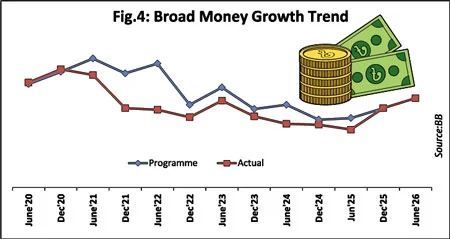
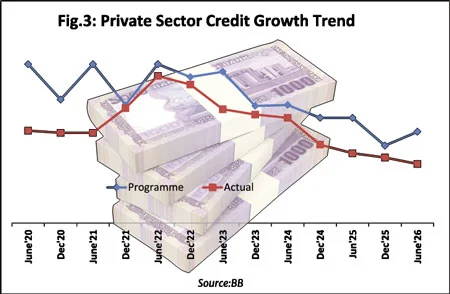
Second, the evidence in the following two charts indicates that, for much of the period under review, actual growth in private-sector credit and broad money remained below Bangladesh Bank’s programmed targets. Global economic turbulence, rising energy costs and political transitions contributed to a sluggish investment climate from the beginning of the Russia–Ukraine war. This resulted in low demand for credit which along with slow growth in remittance inflow during the initial years also impacted on Broad Money growth. Thus, it appears that the true criticism of Bangladesh Bank’s continued contractionary monetary stance is not so much its inadequacy in controlling inflation through demand management under current circumstances, rather it is the redundancy of the policy in the face of an already subdued investment demand situation that is all very evident.

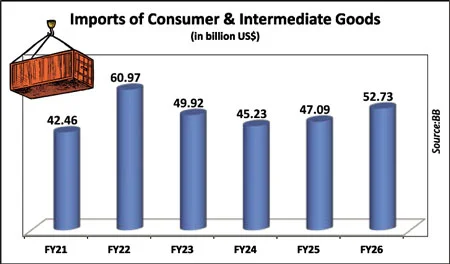
Between FY22 and FY26, total import of consumer and intermediate goods steadily declined from a peak of $14,845 million to $11,841 million (Fig 5).
1794266506916.webp


As narrated earlier, rising global commodity prices and depreciating local currency were the main reasons behind falling importsduring the initial years. High policy rates and strict LC margin requirements imposed by Bangladesh Bank also contributed to the declining trend in imports. In view of the increased cost of imports and reduced supply of imported consumer and intermediate goods the outcome of high domestic inflation was no surprise.

Nevertheless, high inflation persisted in Bangladesh even after global commodity prices and the domestic foreign-exchange market had stabilised. This was because of the continued adherence to contractionary monetary policy stance and restrictive import policy of Bangladesh Bank that sustained inflationary expectations. While strict cash margin requirements were put in place to restrict import of non-essentials and luxury goods, the high policy rates affected economic activities across the board and adversely affected aggregate supply. Bangladesh Bank’s continued contractionary stance may therefore have become not only a redundant instrument of demand management, but also a factor prolonging inflation by weakening aggregate supply and sustaining inflationary expectations.

The writer is an economist.​
 

The remittance dividend: balancing the taka and external accounts

Al Maruf Khan

1794270922038.webp


A PRONOUNCED and sustained acceleration in inward workers’ remittances is reshaping Bangladesh’s external macroeconomic landscape as the country enters the second quarter of the 2026–27 fiscal year. Fresh operational data from Bangladesh Bank reveals that in the first four days of November alone, expatriate wage earners channelled $647 million into the domestic banking network. This represents a steep 40.3 per cent surge compared to the $461 million received during the corresponding period in 2025.

Driven by an extraordinary single-day realisation of $126 million on November 4, this early-month performance builds upon a robust foundation established in October, when receipts during the first fortnight reached $1.516 billion (+12.2 per cent year on year). Cumulatively, from July 1 through November 4, 2026, official remittance receipts crossed the twelve-billion-dollar milestone to stand at $12.112 billion, marking a 14.2 per cent expansion over the previous fiscal period. This is as per Bangladesh Bank settlement records.

While the opening days of any calendar month routinely capture monthly Gulf wage disbursements, the sheer velocity of the current run-rate, averaging $161.75 million per day over early November, points to deeper structural realignments. This surge builds directly upon the first quarter (July–September 2026), where official remittances reached $8.592 billion, reflecting a 13.3 per cent year on year growth. As external sovereign debt obligations peak and trade liabilities expand, this formal currency pipeline has emerged as the indispensable stabilising anchor of Bangladesh’s external accounts.

To understand the longevity of this influx, one must look directly at the primary source: the economies of the Gulf Cooperation Council, led predominantly by the Kingdom of Saudi Arabia. Together, these jurisdictions generate between 55 and 60 per cent of Bangladesh’s aggregate inward transfers.

In Saudi Arabia, execution of Vision 2030 megaprojects, spanning NEOM, the Red Sea developments, Qiddiya, and heavy civil infrastructure ahead of Expo 2030 and the 2034 FIFA World Cup, continues to sustain immense demand for overseas manpower. While Saudi fiscal planners have rationalised schedules on select uncommitted ventures to prevent economic overheating, on-the-ground operational sites retain large labour contingents. Of course, very recently declared rescheduling of Asian Cup to be held in Saudi Arabia may raise concerns about the other ongoing mega event planning. The rescheduling of the Asian Cup is a tactical setback and a scheduling headache, but it is hoped that this is not an abandonment of Saudi Arabia’s major event strategy. Instead of cancelling larger fixtures like Expo 2030 or the 2034 World Cup, the kingdom is likely to use this buffer to rationalise infrastructure spending, address security and travel insurance concerns, and align future event staging with its phased fiscal framework. Bangladesh has economic stake on this. Critically, aggressive nationalisation quotas under the Saudi Nitaqat framework have primarily targeted white-collar, executive and commercial retail functions. The blue-collar and semi-skilled construction tiers, where Bangladeshi manpower remains concentrated, face minimal direct displacement from native job seekers. This is a bit assuring for all of us.

Concurrently, a decisive structural shift has curbed parallel black-market leakage. For years, the informal hundi syndicate siphon diverted billions in foreign currency away from state reserves. Over recent quarters, however, Bangladesh Bank’s pragmatic management of the crawling peg exchange corridor, alongside realistic pricing within the interbank market, has compressed the spread between official bank counter rates and kerb market rates to a negligible 1.5 to 2.0 per cent. When combined with the government’s 2.5 per cent fiscal cash incentive and commercial banks’ competitive top-up premiums, transferring money via formal, regulated pipelines now offers equal or superior value to illicit alternatives. Rapid digital linkages between Gulf-based financial apps such as Al Rajhi Tahweel and STC Pay and Bangladeshi mobile financial services have effectively eliminated transit delays, making banking channels the default route for rural remittances.

Although the extraordinary daily average of $161.75 million logged across the first four days of November will naturally taper towards mid-month as household transfers normalise, we hope that forward predictive modelling may indicate sustained volume for the remainder of the quarter. Even under conservative projections, where the daily receipt rate moderates to between $68 million and $75 million across the remaining 26 days of November, total receipts for the month may be projected to reach between $2.4 billion and $2.60 billion.

Looking ahead to December 2026, customary year-end dynamics will come into play. Expatriates frequently increase remittance transfers in the calendar year’s final month to settle annual property obligations, finance seasonal family commitments, weddings or optimise savings yields. December inflows are anticipated to record another strong performance in the $2.0 billion to $2.4 billion band.

Consequently, on a near term anticipation by any layman, aggregate remittance inflows for the entire second quarter (October-December 2026) may be projected to conclude between $7.75 billion and $8.10 billion. This performance positions cumulative remittances for the first half of FY2026-27 (H1) comfortably around $15.0 billion to $15.4 billion, a substantial buffer against ongoing trade liabilities.

A critical question confronting corporate treasurers, currency traders and import houses is whether this influx will trigger a sharp appreciation of the taka against the greenback. The macroeconomic evidence suggests that outright appreciation remains unlikely, and indeed counterproductive. Instead, the influx acts as a relief valve, absorbing severe structural pressures.

Interbank demand for foreign exchange remains heavy and structurally persistent. Fresh first-quarter BOP data reveals that despite selective import controls, merchandise imports (f.o.b.) surged 15.1 per cent year-on-year to $19.331 billion in July–September 2026, widening the quarterly trade deficit to $7.475 billion. Mandatory settlements for crude petroleum, LNG, food grains and industrial raw materials have accelerated outlays. Consequently, the Current Account Balance posted a deficit of $1.332 billion for Q1, abruptly reversing the transitory surplus observed through August. In this context, the early November remittance inflow of $647 million is not generating surplus reserves; rather, it is acting as a vital counterweight preventing the interbank rate from breaking past Tk 126.00 per dollar.

Since the introduction of the crawling peg arrangement (initially introduced around Tk 117.00–118.00), Bangladesh Bank has systematically nudged the mid-rate upward to reflect market fundamentals. In late October to early November 2026, the weighted-average interbank reference rate crossed Tk 124.00, settling in the Tk 124.30 to Tk 124.55 corridor. The upward crawl of the official dollar rate in late 2026 has been accelerated by state obligations to settle overdue and maturing energy import bills (fuel oil, LNG, and fertiliser). Commercial banks facing liquidity shortfalls have had to purchase dollars from Bangladesh Bank at rates exceeding Tk 124.30, raising the formal floor. While a premium remains in the curb market, the spread between the formal banking rate ( about Tk 124.50) and the kerb rate ( about Tk 127.50) has narrowed to roughly 2 per cent to 3 per cent, down from gaps of 10 per cent to 15 per cent seen in prior years.

Strong remittance inflows (averaging over $2.5 billion per month and supported by the government’s 2.5 per cent cash incentive) alongside resilient readymade garment exports have stabilised BPM6 usable reserves around $31.54 billion. This growing buffer prevents sharp intraday devaluations and allows the central bank to manage the taka’s descent systematically. Without the early November liquidity injection of $647 million, the interbank exchange rate would have faced upward pressures pushing past Tk 126.00 per dollar. Instead, incoming foreign exchange allows commercial lenders to settle private sector LCs from organic liquidity rather than calling exclusively on central bank reserves.

Market indicators suggest nominal stability will prevail, with the exchange rate holding in a narrow, controlled corridor between Tk 124.00 and Tk 124.80 per US dollar through year-end. Bangladesh Bank is expected to resist any sharp currency appreciation, as strengthening the taka would immediately erode the local-currency returns enjoyed by expatriate families, risking an unwelcome shift back towards unrecorded curb market. Domestic market will also face already mounting double digit inflation, although official inflation still claimed to be at 8.34 per cent.

For policymakers at Motijheel, these remittance trends provide much-needed breathing space, but they also necessitate disciplined monetary and external sector coordination across three critical dimensions. Firstly, exchange rate policy and crawling peg defence. The consistent inflow enables Bangladesh Bank to defend the midpoint of its managed crawling peg band (around Tk 124.00–124.50/$) without deploying large-scale administrative freezes. Rather than executing frequent emergency dollar auctions, such as the targeted currency support extended to state-owned banks for sovereign energy settlements, the central bank can allow commercial interbank trading to clear private transactions. Secondly, safeguarding foreign exchange reserves under BPM6 against non-trade drains. Bangladesh Bank’s latest accounts show that official interest payments alone consumed $648 million in the first quarter, while total services and primary income debits drained an aggregate $5.222 billion. With scheduled bilateral and multilateral debt amortisation averaging between $650 million and $850 million monthly through Q2 FY27, robust remittance inflows are the only firewall keeping gross reserves under the IMF’s BPM6 standard stabilised around $31.3 billion to $31.6 billion. Without this $8.59B+ quarterly transfer pace, import coverage would rapidly erode toward vulnerable levels. Thirdly, managing domestic monetary liquidity and inflation. As foreign currency conversions generate liquidity in local bank branches across rural and peri-urban hubs, domestic taka balances naturally expand. While this supports household consumption amid food price pressures, unsterilised liquidity risks working against disinflation targets. Consequently, Bangladesh Bank will maintain its restrictive monetary posture — keeping its policy repo rate elevated at 10.00 per cent or higher — while utilising open-market operations and Bangladesh Bank bills to absorb excess bank liquidity.

Ultimately, the November remittance surge underscores the profound resilience of Bangladesh’s overseas workforce and validates the efficacy of exchange-rate reform and anti-hundi formalisation. Yet, macroeconomic managers cannot afford complacency. With the trade deficit exceeding $7.4 billion and the current account in negative territory, stability cannot rest indefinitely on migrant transfers alone. Sustainable equilibrium demands aggressive export diversification, containment of trade-based illicit outflows and disciplined management of external debt amortizations.

Al Maruf Khan, a practising chartered accountant, is a trade and economic analyst.​
 

Healing multipronged economic strains


1794354420770.webp


Bangladesh's financial sector has been on the cusp of significant transformation over the last few years, evolving from a largely cash-based economy to digital financial services. With a population of around 180 million, nearly 60 per cent being unbanked or underbanked, the potential for financial inclusion through digi

tal innovation is immense. Decentralised finances like Mobile Financial Services (MFS) platforms such as bKash, Nagad and Rocket have already demonstrated their abilities for digital financial solutions, collectively processing billions of taka in transactions annually.

In this context, Bangladesh Bank (BB), the country's central bank, has embarked on an ambitious initiative to revolutionise the banking sector by introducing Digital Banking licenses. On September 24, 2026, the banking regulator issued letter of intent (LoI) to five technology-driven companies with a six-month timeframe to complete all the regulatory conditions before approaching for licences.

With such decision, the BB opened a new window for establishing digital banks-financial institutions that operate entirely online without physical branches by leveraging technology to provide banking services through digital channels such as mobile apps, websites, and other electronic platforms.

The companies that got preliminary licences are bKash Digital Bank, Boost Digital Bank with Axiata, Digital Banking of Bhutan-DK, Kori Digital Bank and Nova Digital Bank with Veon and Square.

This initiative aligns with Bangladesh's broader vision of becoming a cashless society through facilitating digital transactions along with taking the virtual- banking services to the people of the remote areas where traditional and conventional banking services have not reached yet despite various financial inclusion-promoting efforts.

Digital banks promise to address several critical challenges facing Bangladesh's financial sector: limited access to banking services in rural areas, high operational costs of traditional banks, inefficient manual processes, and the growing demand for convenient, 24/7 banking services among tech-savvy youth. With over 120 million internet users and more than 180 million mobile-phone subscribers, Bangladesh presents a massive opportunity for digital-banking expansion.

Bangladesh Bank is placing importance on expanding digital-banking services to make banking more accessible, technology-driven and inclusive. In particular, digital banks can play an important role in bringing marginalised communities and entrepreneurs in the cottage, micro and small (CMS) sectors under formal financial services quickly and easily.

At present, due to high operating costs, capital- maintenance requirements and expensive physical infrastructure, it has not been possible to provide conventional banking services to many marginalised people in the country to the desired extent. Digital banks will help overcome these limitations through branchless, technology-driven services and extend banking services to people in remote areas.

In particular, many entrepreneurs in the cottage, micro and small sectors still depend on informal sources of financing. If they can be brought under formal credit and other financial services quickly through digital banks, it will have a positive impact on business expansion, job creation and overall socioeconomic development.

The proposed digital banks will provide end-to-end branchless virtual banking services. This will create opportunities to expand financial inclusion while making a positive contribution to economic activities and financial stability. Digital banks will not be an alternative to the conventional-banking system rather they will work as a complement to it.

Digital banks will be able to use artificial intelligence-based alternative credit- scoring methods to select customers for lending. The proposed framework places emphasis primarily on providing collateral-free loans.

Digital banks will not have any branches, sub-branches, booths, their own agents or their own ATMs, CDMs or CRMs, and they will not provide customer services directly over the counter (OTC). For necessary transactions, they will use conventional banks, mobile financial services and existing ATM/CDM/CRM networks in accordance with Bangladesh Bank's instructions.

Subject to compliance with the applicable regulatory framework and the maintenance of digital records, digital banks will be able to receive general authorised inward remittances. However, they will not be allowed to provide foreign trade financing or loans to medium and large industries.

It is believed that if digital banking is developed with appropriate regulation, technology-based risk management and protection of customer interests, financial inclusion in the country will expand further, and a modern, efficient and inclusive financial ecosystem will be established.

According to the digital bank guidelines, a proposed bank shall have a minimum paid-up capital of Tk 3.0 billion, which shall be constituted through ordinary shares.

The sponsor shall deposit the amount of his/her share capital in an account maintained with any scheduled bank in Bangladesh. The sponsor shall submit an undertaking stating that the deposited amount shall not be withdrawn without prior approval from Bangladesh Bank, along with a certificate issued by the bank accepting the deposit.

No sponsor can finance his/her share capital with any money obtained as a loan, debt, advance or otherwise from any bank, financial institution, person or organisation, or from any member of their families.

Without prior approval from the central bank, a sponsor must not transfer any of his/her shares in the proposed bank within five years from the commencement of the bank's banking business, the guidelines read.

Within five years from the commencement of operations, the proposed bank shall, subject to obtaining approval from the Bangladesh Securities and Exchange Commission (BSEC), issue ordinary shares to the general public equivalent to the amount of initial capital contributed by the sponsors.

Because digital banking is technology-driven and branchless, it will be available 24 hours a day, seven days a week, and extremely handy. So, with the proper technology, inventive and skilled human resources, and the right guidelines, it will serve many people from all over the country.

But the upcoming digital banks are likely to trigger immense challenge to the existing conventional and unconventional banks in the forms of losing deposits if they are not equipped with cutting-edge technology, big-data analysis and Artificial Intelligence-driven services to serve the growing tech-savvy populations who are reluctant in getting the services physically. However, the path of proposed digital banks may not be smooth as there are a few potential roadblocks that may prevent digital banking from expanding in Bangladesh. These are -- the unbanked population's lack of digital literacy and consumer know-how, cybersecurity to ensure safety of funds and guard against fraud, reliable technology for core banking systems, big-data analysis, machine learning, artificial intelligence, and credit underwriting, which will require software imports. Smart phone penetration will be another obstacle against the growth of digital banks as customers would require smartphones to avail services digitally. The uninterrupted supply of high-speed internet communication is also equally crucial to successful run of the full-fledged digital banks here.

Despite being fully virtual, digital banks may still require the use of a physical channel, such as a cash-in/cash-out network and a channel for onboarding and document validation. Since digital banks do not own their own networks or employ agents, they may need to rely instead on traditional banking channels or a mobile financial services (MFS) agent network.

The impact of digital banks can be significant on commercial banks. Since a digital bank is completely virtual, its operational costs are comparatively lower. Therefore, they will be able to offer better rates. On the other hand, customers will not need to come to the counter to receive services. As a result, customers' interest will be higher, especially of the young generation, who are being considered future clients. Therefore, deposit mobilisation may come under pressure for commercial banks unless they focus extensively on digital transformation.

Initially, digital banks may face some pressure. The concept of digital banking is completely new in Bangladesh. To overcome these initial challenges, extensive publicity across the country is necessary. At the same time, different types of incentives will have to be provided so that customers become interested and can make themselves important partners in smart banking.

Through this, the Bangladesh government will be able to bring people who are outside the banking system into various financial services through banking channels at affordable costs and in an easier manner.

Bangladesh Bank has taken various regulatory measures over the past few years to build a cashless society or less-cash society, but it has not yet achieved much outcome. This is because cash transactions still dominate our economy. According to Bangladesh Bank data, around one-third of the country's overall financial transactions take place digitally.

In this regard, if we can properly implement digital banking and develop the type of ecosystem required for it, we will be able to make significant progress in building a cashless society. This can solve many problems in a country like Bangladesh. One of the major problems of our economy is citizens' reluctance to pay taxes, as a result of which the government has to depend on borrowing either from domestic or foreign sources. If we can build a cashless society, information on every transaction will be traceable, and opportunities for tax evasion will decrease significantly. Revenue collection will increase, while the government's tendency to borrow will decline.

At the same time, banks' capabilities in liquidity management will also have to be increased. For banks to survive, they have to lend to productive sectors and create entrepreneurs. At present, banks are not lending to the private sector; instead, they are lending only to the government and making secure gains. This is not the characteristic of banking.

Therefore, digital banks will not only make an important contribution to financial inclusion but will also create an opportunity for a kind of revolutionary change in the overall economy of the country. So, the government must develop a complete digital ecosystem very carefully and in coordination with all stakeholders, so that we can enjoy its long-term benefits.​
 

Making BBS an independent and credible institution


1794354736934.webp


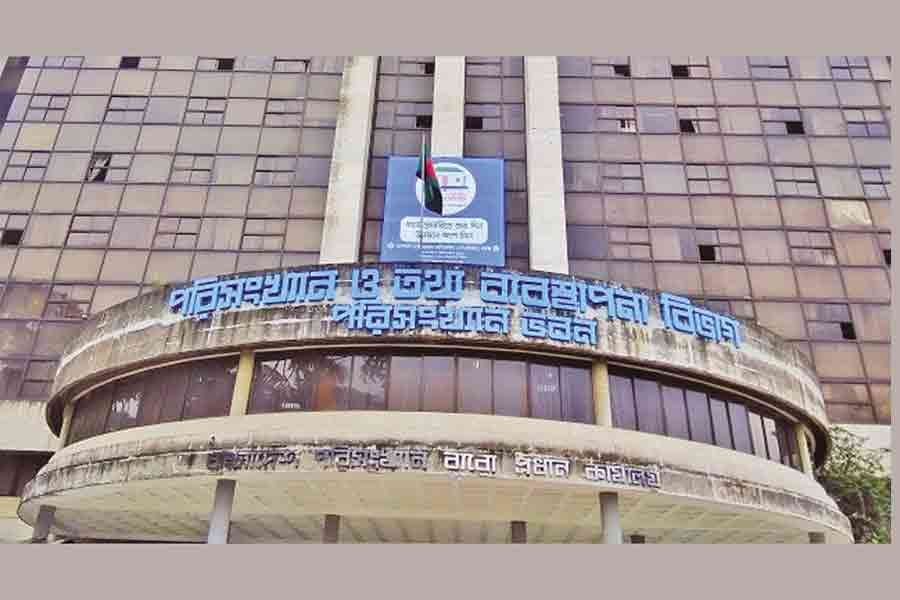
The Bangladesh Bureau of Statistics (BBS) has for long been under a cloud of statistical credibility gap. This is hardly an enviable position for an institution on the figures of which policymakers, businesses and researchers depend. So, it is a welcome development that Finance and Planning Minister Amir Khosru Mahmud Chowdhury has assured the public that the incumbent government would make the BBS fully independent, transparent and its data accessible to all. True, a government that manipulates its own data deceives itself. Needless to say, no policy on inflation, employment, poverty reduction or investment can be properly framed if the basic statistics on which it rests are unreliable. The issue, therefore, is not simply about restoring the image of a government agency. It concerns the quality of the nation's economic governance itself.

It would be worthwhile to recall how, during the previous autocratic regime, official statistics served the political interests of the powers that be. The White Paper on Bangladesh's economy prepared after the July 2024 uprising pointed to political interference and alleged collusion with the BBS to maintain an exaggerated picture of economic progress. Figures relating to GDP growth, inflation and other indicators remained questionable. The reported rise in per capita income was used to sustain a narrative of uninterrupted development and readiness for graduation from the least developed country (LDC) status. There were also large discrepancies between export earnings reported by the Export Promotion Bureau (EPB) and those reflected in banking records. As for inflation, the BBS rates often failed to reflect the price pressures faced by low and fixed income families. Worse still, the detailed data and methods needed by independent researchers to verify many such figures were often beyond public reach. Thus, the damage was not confined to statistical tables; it distorted policy priorities and undermined public trust.

Commendably, the incumbent government is conducting forensic examinations of historical economic data. A review has detected inconsistencies in earlier GDP estimation, while research with the Bangladesh Institute of Development Studies (BIDS) is envisaged. But just identifying past distortions will not suffice. Economists have pointed to the BBS's long-standing weaknesses including inadequate manpower, reliance on old surveys, outdated base years for some statistical series and poor coordination among agencies producing economic information. Reassuringly, the authorities are adopting Computer Assisted Personal Interviewing (CAPI) for the Consumer Price Index (CPI), direct publication and facilities for microdata analysis. The suggested open data policy and data laboratory for researchers are equally welcome. However, computerisation alone cannot guarantee the integrity of figures if the underlying survey methods, sampling, field supervision and professional standards remain wanting. After all, inaccurate information entered into a sophisticated digital system does not become reliable merely because it is processed faster.

What is necessary, therefore, is to give the BBS genuine legal, administrative and financial independence, free from political interference. Its leadership, staffing, surveys and publication schedules should be protected from ministerial dictates. Also, the BBS should be able to obtain authentic records from other public agencies and reconcile conflicting figures, particularly on exports, public expenditure and national income. The methodologies, revisions and anonymised survey data should be made available to researchers and citizens, with safeguards for privacy. There should also be independent scrutiny of the data and regular updating of the statistical base years to reflect a changing economy. The elected government has promised to break with the past practice of treating official statistics as an instrument of political publicity. However, the true test of the government's resolve will be whether it allows the statistical agency to publish inconvenient facts as freely as favourable ones. Hopefully, the incumbent government would demonstrate the required political will to make the BBS an independent and trustworthy institution.​
 

Revamping ADP performance


1794354852026.webp


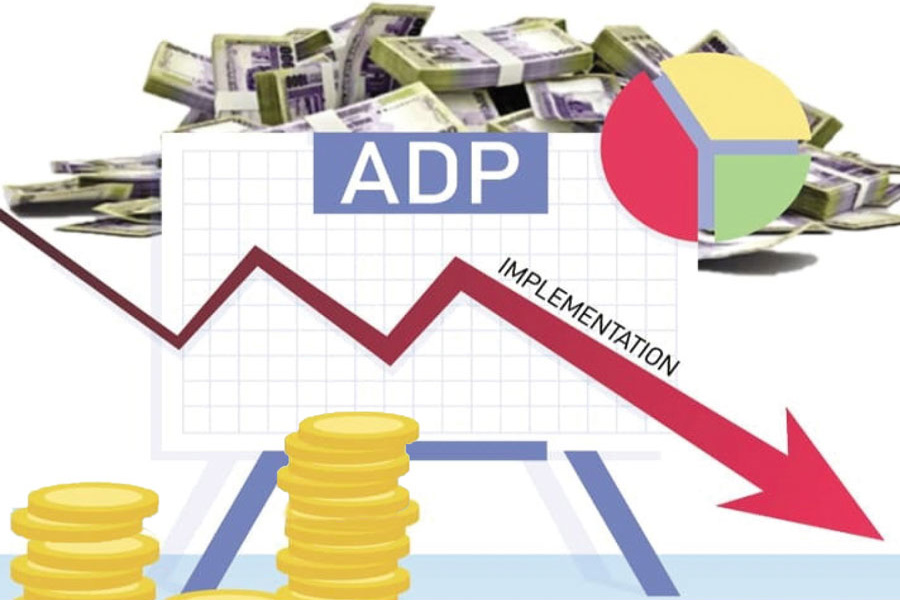
Bangladesh's Annual Development Programme (ADP) implementation has hit a record low, with government ministries and divisions spending only 3.89 per cent of the annual allocation during the first quarter of the 2026-27 fiscal year. According to the latest report of the Implementation Monitoring and Evaluation Division (IMED), expenditure during July-September stood at Tk 120.1754 billion against an annual allocation of approximately Tk 3,089.25 billion. Both the implementation rate and the amount spent were the lowest recorded for a first quarter in recent years, underscoring persistent weaknesses in the country's development administration.

The latest figures represent a further deterioration from the corresponding period of FY2025-26, when the implementation rate was 5.09 per cent and expenditure amounted to Tk 121.5827 billion. The contrast with earlier years is even more striking. The implementation rate stood at 4.75 per cent in the first quarter of FY2024-25, 7.50 per cent in FY2023-24 and 8.55 per cent in FY2022-23. The declining trend suggests that the problem is not merely a temporary setback but part of a broader difficulty in executing development projects efficiently. Although the ADP allocation has increased substantially, the capacity to utilise the funds has failed to keep pace.

The government allocated Tk 3,089.2486 billion for 1,172 development projects in FY2026-27, comprising Tk 1,900.00 billion from domestic resources, Tk 1,100.00 billion from foreign financing and Tk 89.25 billion from implementing agencies' own funds. Yet, the ability of the relevant ministries and divisions to translate these substantial allocations into actual expenditure remains limited. During the first quarter, implementation reached only 4.24 per cent of the government-funded allocation and 3.13 per cent of the foreign-funded component. The relatively weak utilisation of foreign assistance is also a matter of concern, as delays in implementing externally financed projects can undermine the timely use of committed resources and, in some cases, complicate the disbursement of funds.

Performance across major spending agencies was uneven. The 15 ministries and divisions receiving the largest ADP allocations recorded an average implementation rate of 6.62 per cent, although they account for 52.90 per cent of the total programme. The Ministry of Primary and Mass Education performed relatively well, spending 17.38 per cent of its allocation, followed by the Secondary and Higher Education Division at 13.07 per cent and the Local Government Division at 12.42 per cent. The Power Division spent 6.96 per cent, while the Ministry of Housing and Public Works and the Ministry of Water Resources recorded rates of 6.12 per cent and 6.04 per cent, respectively.

The picture was dismal in several other sectors. The Health Services Division spent only 1.78 per cent of its allocation, while the Railways Division and the Ministry of Shipping recorded implementation rates of 2.06 per cent and 2.05 per cent, respectively. The Foreign Ministry reported no expenditure against its allocation. Such disparities point to differences in the administrative and operational capacities of implementing agencies. They also suggest that a uniform approach to monitoring development projects may not be sufficient; agencies with persistently poor performance require closer scrutiny and specific measures to overcome their implementation bottlenecks.

The planning authorities have cited delays in procurement and the sluggish release of funds at the beginning of the fiscal year as reasons for the slow pace. While preparatory work often holds back spending during the initial months, these explanations have become familiar features of the country's development administration. Procurement delays, lengthy tendering procedures, difficulties in land acquisition, weak project management and inadequate institutional capacity to supervise multiple projects simultaneously have repeatedly obstructed implementation. Delays by contractors and shortcomings in fund management further complicate the process. The persistence of these problems indicates that the authorities have yet to address their underlying causes effectively.

A slow start also has consequences beyond the immediate shortfall in expenditure. When ministries rush to spend the remaining allocations towards the end of the fiscal year, the pressure to meet financial targets can take precedence over the quality and sustainability of project outcomes. Hasty procurement, inadequate supervision and incomplete preparatory work may result in cost overruns, substandard construction and repeated extensions of project deadlines. Consequently, even when funds are eventually spent, the public may not receive the full value of the investment. The challenge, therefore, is not simply to increase expenditure but also to ensure that public money is used efficiently and produces the intended benefits.

The problem is particularly concerning at a time when economic growth, private investment and employment creation are under pressure. Development spending is not merely an accounting exercise; it is expected to generate economic activity, improve public services and provide infrastructure essential for future growth. Delays in implementing projects postpone these benefits, while inefficient execution can erode the value of scarce public resources. Addressing the problem requires more than routine assurances or last-minute efforts to accelerate expenditure. The government needs to strengthen project preparation, improve procurement procedures, ensure timely fund disbursement and build the project management capacity of implementing agencies. Regular monitoring should identify delays early, with clear accountability for officials and contractors responsible for avoidable setbacks. Equally important is selectivity in approving new projects. Adding projects without adequately assessing their feasibility, financing requirements and implementation capacity can stretch already limited administrative resources.

Ultimately, the effectiveness of development spending should be judged not by the size of the ADP allocation but by the quality and timeliness of the benefits it delivers. Unless the government aligns its development ambitions with institutional capacity and addresses long-standing implementation weaknesses, larger allocations will continue to produce disappointing results.​
 

PKDefense Forums: Country-by-Country Military Discussions

Log In Register Forums
Latest
Back