| Global Defense, OSINT & Geopolitics Wire

[🇧🇩] Monitoring Bangladesh's Economy

[🇧🇩] Monitoring Bangladesh's Economy
1K
56K
More threads by Saif

G Bangladesh Defense

Remittance crosses $25b this fiscal year

1747097047678.webp

File photo: Reuters

Remittance inflow in the first ten months and eleven days of this fiscal year surpassed $25 billion, breaking all previous records.

Between July last year and May 11 this year, Bangladesh received $25.45 billion in remittances, up 28 percent year-on-year, according to data from the Bangladesh Bank.

The previous record was $24.77 billion, which came in fiscal 2020-21.

The surge in money sent home by Bangladeshi expatriates is being credited to a cocktail of factors, such as a narrowing gap between official and informal exchange rates, a clampdown on money laundering and a renewed sense of patriotism among people living abroad.

Since August 5 last year, remittance inflows have risen every month. In March, the country hit a single-month record of inflows: $3.29 billion.

The spike in remittance inflow is helping the government stop the depletion of foreign currency reserves.

As of May 7, foreign currency reserves stood at $20.3 billion.

The narrowing of the gap between official and unofficial exchange rates has driven this uptick, said a senior BB official.

Currently, the official exchange rate for the dollar ranges from Tk 121 to Tk 122.50, while rates in the informal market hover between Tk 123 and Tk 124.50, according to industry insiders.

The central bank official also said that they have informed banks that the BB will no longer provide direct dollar support, pushing them to source foreign currency on their own.

This has also contributed to the remittance collection through formal channels, the official said.

Last fiscal year, Bangladesh received $23.91 billion in remittance.​
 

17 political parties attend BIDA meeting on investment, BNP did not attend
FE ONLINE DESK
Published :
May 13, 2025 23:18
Updated :
May 13, 2025 23:18

1747179338269.webp


The Bangladesh Investment Development Authority (BIDA) recently held a consultation meeting with political parties to discuss improvements to the country's investment climate.

The meeting took place on Tuesday at BIDA's office in Agargaon, Dhaka, and was chaired by BIDA's Executive Chairman, Chowdhury Ashiq Mahmud bin Harun (Ashiq Chowdhury).

Out of 19 political parties invited, 17 attended the meeting. Notably absent were the Bangladesh Nationalist Party (BNP) and the Bangladesh Jatiya Party (BJP).

According to BIDA sources, BNP's Standing Committee member Amir Khasru Mahmud Chowdhury was invited but did not attend.

In response, he stated that the current investment climate is not the responsibility of the interim government and emphasised the need for a clear election date to allow investors to prepare accordingly, as per local media.

Representatives from various political parties shared their perspectives during the meeting.

MM Akash, a central committee member of the Communist Party of Bangladesh (CPB), highlighted the importance of political continuity for investment growth, noting that investors seek stability.

AHM Hamidur Rahman Azad, Assistant Secretary General of Jamaat-e-Islami, welcomed recent reforms by the interim government but acknowledged ongoing challenges. Nasiruddin Patwari of the National Citizens' Party (NCP) stressed the need to prioritise youth employment and environmental considerations in investment initiatives.

Zonayed Saki, Chief Coordinator of the Ganosamhati Andolon, pointed out persistent issues such as bureaucratic harassment and difficulties in obtaining bank loans, which hinder investment. Syed Ishaq Muhammad Abul Khair of the Islami Andolon Bangladesh criticised the complex registration process for starting a business, which often involves multiple agencies and unofficial payments.

Several parties, including the CPB, advised that foreign investments should not compromise national interests. Nasrin Sultana, Joint General Secretary of the Amar Bangladesh Party (AB Party), proposed the creation of an economic charter based on consensus among all political parties.

In his opening remarks, BIDA's Executive Chairman Ashiq Chowdhury emphasised that investment and employment are matters of national interest, transcending party politics. He acknowledged existing challenges in the investment sector and outlined ongoing and planned reforms aimed at creating a more conducive environment for investors. Chowdhury also mentioned that discussions with foreign companies are being conducted with national security considerations in mind.

The meeting underscored the importance of political stability and clear governance for fostering a favourable investment climate in Bangladesh.​
 

Sukuk: a game-changer in socio-economic development
Istequemal Hussain
Published :
May 13, 2025 23:59
Updated :
May 13, 2025 23:59

1747180096341.webp


To tap the liquidity of Sharia-compliant banking area for financing the government’s deficit budget and for supporting the country’s overall development, a decision was made to introduce Islamic bond, or ‘Sukuk’, in the fiscal year 2019-20.

On the one hand, a significant number of investors were disinclined to invest in interest-bearing Treasury bills and bonds, and other government securities, and on the other hand, the liquidity of Sharia-based banks and financial institutions remained largely unutilised due to the lack of opportunities to invest in conventional securities. In this context, the government issued the ‘Bangladesh Government Investment Sukuk Guideline, 2020’ on October 8, 2020, and appointed the Bangladesh Bank to act as the Special Purpose Vehicle (SPV) and Trustee. Additionally, the Finance Division of the Ministry of Finance serves as the originator for issuing Sukuk, and there is also a robust Sharia Advisory Committee in place to look after the Sharia compliance.
1747180134661.webp


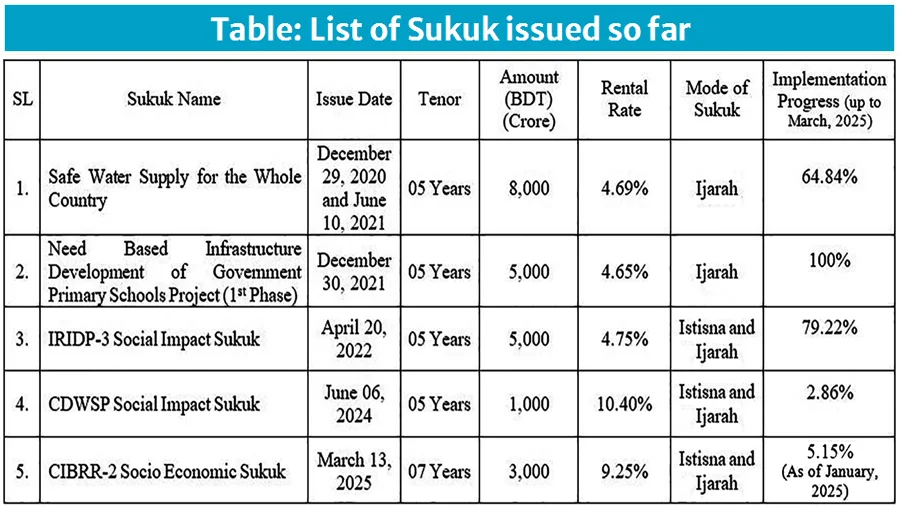
In the past few years, the Bangladesh government has raised Tk 220 billion by issuing five separate investments Sukuk. In furtherance, a decision has been made to issue the 6th Bangladesh Government Investment Sukuk, worth Tk 20 billion with seven-year tenure, using the Ijara methods for the project titled ‘Rajshahi Division Important Upazila & Union Road Widening & Strengthening Project (RDIRWSP)’.

SIXTH SUKUK: The prospectus for issuing the Bangladesh Government Investment Sukuk (RDIRWSP Socio-Economic Development Sukuk) has been finalised with the approval of the Sharia Advisory Committee of the Bangladesh Bank. The auction for the mentioned Sukuk will be held on May 19, 2025 at the head office of the Bangladesh Bank and will be issued on the next working day, which is on May 20, 2025. According to the prospectus, the Sukuk will be issued under the Ijara methods, with seven year tenure, that means maturity date would be May 20, 2032. Investors will be paid Tk 2.10 billion annually (at a rate of 10.50 per cent) as rent on a semi-annual basis. Banks and financial institutions with a current account/Al-Wadiah current account with the Bangladesh Bank can participate directly in the auction. Additionally, domestic and foreign individual investors, insurance companies, provident funds, and the Deposit Insurance Fund can participate through banks/financial institutions having a current account/Al-Wadiah current account with the Bangladesh Bank.

Various infrastructural projects require investment to carry out the country’s economic development activities, which are planned in the budget of each fiscal year. In general, to support the budget deficit, the government raises fund by issuing treasury bills and bonds through conventional banks. About one-fourth of the total assets held by Sharia-based banks in the banking sector had led the government to introduce Islamic bonds or Sukuk to utilise the liquidity of Sharia-based banks for government developmental activities. Currently, due to the high demand for Sukuk among the clients of conventional banks, the fourth Sukuk has been made more universal.

The term ‘Sukuk’ is actually the plural of ‘Sakka’—a type of legal document or contract. The first issuance of Sukuk took place in the seventh century in Damascus, present-day Syria. Sukuk represents Islamic certificates that signify undivided ownership rights in services, projects, investments, or real estate or their usufruct. In other words, Sukuk is a document indicating partial ownership of a tangible or intangible asset or a service.

The crucial difference between conventional bond and Sukuk is that Sukuk are issued based on ownership or rights over an asset. This means that Sukuk is not a debt rather a form of partial ownership or rights. The prime feature of Sukuk is that it is entirely managed according to Sharia principles, which means it is free from riba or interest.

Various structures or methods can be followed in issuing Sukuk, such as Mudarabah, Musharakah, Murabaha, Istisna, Salam, Ijara, and Qard Hasan. The implementation work of the project titled ‘Rajshahi Division Important Upazila & Union Road Widening & Strengthening Project (RDIRWSP)’ is in its initial stages. The sixth Sukuk based on the above project will be issued using the Ijara methods and main underlying contracts are Istisna and Ijara, where the asset will be prepared under the Istisna contract and then leased out under the Ijara contract, with the rental payments serving as the profit for the Sukuk holders amounting Tk 14.70 billion. In general, Ijara Sukuk is issued by the property owner to lease or rent the property in exchange of rental payments. Sukuk holders become owners of the underlying asset in exchange of their subscription.

According to the type of investors, the allocation percentages for the sixth Sukuk are as follows: (1) Shariah-based banks, financial institutions, and insurance companies—70 per cent of the issued Sukuk, (2) Islamic branches and windows of conventional mainstream banks—10 per cent of the issued Sukuk, and (3) individual investors, provident funds, deposit insurance etc—20 per cent of the issued Sukuk.

Additionally, besides the aforementioned three categories, all conventional banks/finance companies/insurance companies can participate in the Sukuk auction. The allocation of Sukuk to investors will follow three steps:

If the bids submitted by any of the three categories exceed the designated proportion, the Sukuk will be allocated to the bidders within that category on a pro-rata basis.

If fewer bids than the designated proportion are submitted in any category, and more bids than the designated proportion are submitted in another category, the remaining Sukuk will be allocated to the bidders who submitted higher bids on a pro-rata basis.

If the required subscription is not met across the three categories, the remaining Sukuk will be allocated proportionately among the participating conventional banks, financial institutions, and insurance companies.

Sukuk-1: The first Bangladesh Government Investment Sukuk was issued in two phases on December 29, 2020, and June 10, 2021, aiming to raise Tk 80 billion for the ‘Safe Water Supply Project Nationwide’ with bids reaching 3.79 times and 8.18 times of the issued amount respectively. Bids amounting Tk 478.79 billion were submitted. This five-year Ijara Sukuk has a rental rate of 4.69 per cent and will mature on December 29, 2025. The Department of Public Health Engineering is the implementing agency for the project, which is nearly 65 per cent complete.

Sukuk-2: The second five-year Sukuk of Tk 50 billion, was successfully issued on December 30, 2021, to finance the ‘Demand-Based Government Primary School Development Project (Phase 1)’. Structured under the Ijara method, the Sukuk offered a competitive rental rate of 4.65 per cent to investors. The issuance received a robust response, with bids reaching 4.66 times of the offered amount, reflecting strong investor confidence. The project was implemented by the Directorate of Primary Education under the Ministry of Primary and Mass Education and has now been fully completed, marking a significant milestone in the enhancement of primary education infrastructure.

Sukuk-3: The third five-year Sukuk, named IRDP-3 Social Impact Sukuk, worth TK 50 billion was issued on April 20, 2022, for the ‘Priority Rural Infrastructure Development Project-3’. This Sukuk was issued under the Istisna and Ijara methods, with a rental rate of 4.75 per cent for Sukuk holders. The Local Government Engineering Department is the implementing agency, and the project is currently 80 per cent complete.

Sukuk-4: The CDWSP Social Impact Sukuk, amounting to Tk 10 billion, was issued on June 6, 2024, under the ‘Chattogram Division Upazila & Union Road Widening & Strengthening Project (CDWSP)’. Aimed at improving connectivity and transportation across both rural and urban areas, the project focuses on widening and strengthening local roads in Upazilas and unions to support economic growth in the Chattogram Division. Structured under Istisna and Ijara contracts, the Sukuk offers a 10.40 per cent rental rate and attracted strong investor interest, with bids reaching 4.41 times of the issued amount.

Sukuk-5: The first Seven-year Social Impact Sukuk named ‘Construction of Important Bridges on Rural Roads (Phase-II) project (CIBRR-2)’ worth Tk 30 billion, aimed at improving rural connectivity in Bangladesh that focuses on building vital bridges on rural roads to facilitate better transportation, promote economic activity, and improve the quality of life for people living in rural areas. This Sukuk was issued under the Istisna and Ijara methods, with a rental rate of 9.25 per cent for Sukuk holders, and it was issued on March 13, 2024, with bids reaching 3.64 times of the issued amount.

End note: Sukuk play a pivotal role in driving socio-economic development and enhancing the stability of the Islamic financial sector in Bangladesh. By funding key infrastructure projects such as roads, schools, bridges, and water systems, Sukuk contribute to employment generation, to increase productivity, and broader economic growth. These instruments also support poverty alleviation and empowerment of rural people by improving connectivity and public welfare in underdeveloped regions. Moreover, Sukuk promote financial inclusion by offering Sharia-compliant investment opportunities to individuals and institutions that are hesitant to invest in interest bearing instruments due to religious restrictions.

Sukuk have emerged as a transformative financial tool in Bangladesh, advancing socio-economic development while fostering a stable and inclusive Islamic financial ecosystem. By aligning public financing with ethical and faith-based investment principles, Sukuk not only meet developmental needs but also solidify the foundation of Islamic finance in the country.

Istequemal Hussain is Director, Debt Management Department, Bangladesh Bank, and Member Secretary, Shariah Advisory Committee, Bangladesh Bank.​
 

CA’s office explains
10 reasons why NBR split


FE REPORT
Published :
May 14, 2025 00:47
Updated :
May 14, 2025 00:47

1747180297921.webp


Government decision dissolving the National Board of Revenue into tax- policymaking and tax-administration divisions is to improve efficiency, reduce conflicts of interest, and widen tax base, the CA Office says.

The explanation came Tuesday from the office of the head of interim government as a section of NBR staff took it amiss and went on a pen-down protest against the much-discussed measure.

The post-uprising government has announced the major structural reform that effected dissolution of the National Board of Revenue (NBR) to be replaced by two distinct entities under the Ministry of Finance-Revenue Policy Division and Revenue Management Division.

A group of NBR officials swung into protest against the move as soon as the announcement came to light.

"Established over fifty years ago, the NBR has consistently failed to meet its revenue targets. Bangladesh's tax-to-GDP ratio is approximately 7.4 per cent, one of the lowest in Asia. For context, the global average is 16.6 per cent, while Malaysia's stands at 11.6 per cent. To achieve the development aspirations of its people, Bangladesh must raise its tax-to-GDP ratio to at least 10," says the CA office in the statement to substantiate the recast.

Restructuring the NBR is critical to this goal, said a spokesman, adding that there is growing consensus that a single institution should not be responsible for both creating tax policy and enforcing it-such an arrangement breeds "conflicts of interest and promotes inefficiencies".

For years, businesses in Bangladesh have complained that policies have often prioritized revenue collection over fairness, growth, and long-term planning.

Saying that several longstanding issues have plagued the revenue board, the CA Office cites 10 reasons why it is done.

Conflicts of interest: Housing both policy-making and enforcement under one roof has led to compromised tax policies and widespread irregularities. Under the current system, officials responsible for tax collection are not subject to any accountability framework and are often able to negotiate payments from tax defaulters compromising public interest. In many cases, tax collectors are reluctant to take action against tax-evaders and assist them in doing so for personal interest.

There is no system and process in place for objectively measure the performance of tax collectors and their career progression has not been linked with measurable performance indicators.

Inefficient revenue collection: The dual mandate diluted focus on both policy formulation and institutional capacity-building. As a result, the tax net remains narrow, and revenue collection has lagged far behind potential.

Weak governance: The NBR has suffered from inconsistent enforcement, poor investment facilitation, and systemic governance issues, all of which have eroded investor confidence and weakened the rule of law.

Bureaucratic Overlap: The existing structure-where the head of Internal Resources Division also leads the NBR-has created confusion and inefficiency, hampering effective tax-policy design and delivery.

Demoralisation and internal tensions: The reform process has triggered anxiety among seasoned tax and customs officers, some of whom feel they may be sidelined or overlooked.

How the restructuring to help: The new structure is designed to address these chronic problems through a clearer, more accountable framework.

Clear division of responsibilities: The Revenue Policy Division will be responsible for drafting tax laws, setting rates, and managing international tax treaties. The Revenue Management Division will oversee enforcement, audits, and compliance. This separation ensures that the officials setting tax obligations are not the same as those collecting them, eliminating opportunities for any sort of connivance.

Improved efficiency and governance: By allowing each division to focus on its core mandate, the reform will enhance specialisation, reduce conflicts of interest, and improve institutional integrity.

Expanded tax base and stronger direct taxation: The reform is expected to broaden the tax net, reduce dependence on indirect taxation, and strengthen direct tax collection by placing skilled professionals in appropriate roles.

Better, more development-oriented policies: A dedicated policy unit can craft evidence-based, forward-looking tax strategies instead of reactive policies driven solely by short-term revenue goals.

Greater investor confidence: Transparent, predictable policies and a professional tax administration are expected to attract investment and reduce complaints from the private sector.

Ultimately, the government clarification concludes, this restructuring is not just a bureaucratic reshuffle-it's a necessary step toward building a fairer, more capable tax system. Strengthened policymaking and cleaner tax administration will be vital for Bangladesh to meet the needs-and realise the hopes-of all its citizens.​
 

Protectionism, apparel export overreliance key barriers
Says ADB chief economist about entry of Bangladesh to multilateral trade blocs

Doulot Akter Mala
Published :
May 14, 2025 00:53
Updated :
May 14, 2025 00:53

1747180680106.webp


inset-p1-1Protectionist policies and overdependence on apparel exports are among the major internal challenges preventing Bangladesh from joining multilateral trade blocs, said Albert Park, chief economist of the Asian Development Bank (ADB).

Speaking at an event on the sidelines of the 58th ADB Annual Meeting held recently in the Italian city of Milan, he said it is not that other countries are unwilling to sign trade agreements with Bangladesh.

Rather, the country's internal challenges are the main barriers to forming bilateral and multilateral trade agreements, he also said.

Responding to The Financial Express correspondent's queries, Park said regional and bilateral trade agreements must be emphasised for sustainable business growth in Bangladesh.

The four-day annual meeting, which brought together policymakers and development partners from across Asia and beyond, concluded on May 7.

Asia and the Pacific has significantly benefitted from participating in global value chains by adopting open trade and investment practices, said Park.

However, the region now faces mounting challenges, including Trump's tariff policy, geopolitical tensions, rising protectionism, and growing threats from climate change, pandemics, and other global shocks, he added.

"In this context, strengthening cross-border economic cooperation within Asia and between Asia and the Pacific is essential to building resilience and mitigating external risks," he said during a media group discussion.

Bangladesh's average import tariff exceeds 27 per cent - almost triple the global average. Even among the least developed countries (LDCs), its rates are exceptionally high.

A recent analysis based on the World Bank data showed average tariffs are 11 per cent in low-income, 7.0 per cent in lower-middle-income, 5.0 per cent in upper-middle-income, and 3.0 per cent in high-income economies.

The government has moved to rationalise the high tariff to weather the negative impacts on the economy after it graduates from the LDC status in 2026. The country may lose preferential trade access to many markets then.

Meanwhile, the government has moved to join the Association of Southeast Asian Nations (ASEAN), BRICS, and Regional Comprehensive Economic Partnership (RCEP), among other blocs, to mitigate the adverse impacts.​