| Global Defense, OSINT & Geopolitics Wire

[🇧🇩] New Government (BNP) in Bangladesh

[🇧🇩] New Government (BNP) in Bangladesh
95
4K
More threads by Saif

G Bangladesh Defense

Government to promote healthy politics from Parliament: Home Minister

UNB
Published :
Mar 11, 2026 22:51
Updated :
Mar 11, 2026 22:51

1773274640451.webp


Home Minister Salahuddin Ahmed on Wednesday said the government intends to cultivate a culture of responsible politics, starting with the Jatiya Sangsad.

“We are trying to improve our existing political culture gradually. It is not possible to implement it overnight, but we want to start practising good political culture from the National Parliament,” he said.

The minister made the remarks at a dialogue titled "Human Rights Commission Ordinance 2025: Expectations for the New Parliament", organised by Citizen Platform-Reform Watch at the Bangladesh China-Friendship Conference Center.

“We want to promote good democratic practices and eliminate the bad culture of the past by nurturing a positive political culture,” he added.

The dialogue was chaired by Dr Debapriya Bhattacharya, convener of Citizen Platform and fellow of the Center for Policy Dialogue (CPD), and attended by MPs Barrister A. M. Mahbub Uddin Khokon, Advocate Md Fazlur Rahman, Barrister Rumeen Farhana, Advocate Ahmed Azam Khan, Professor Rehman Sobhan, Barrister Sara Hossain, women's leader Khushi Kabir, and others.

Salahuddin Ahmed said serious human rights violations occurred under the previous regime, especially through misuse of state machinery. “As a political party and a nation, we are committed to protecting human rights, particularly those guaranteed in the Constitution. This is included in our election manifesto and our 31-point plan,” he said.

He added that human rights development must be gradual, and it is not possible to protect all rights fully overnight. “We aim to improve Bangladesh’s human rights standards and indicators at the international level, but this will take time. We are aware of the obstacles that may arise and are prepared to address them,” he said.

The Home Minister said the government has agreed on almost all aspects of the Human Rights Commission Ordinance. Some amendments may be needed, which will be introduced as bills in Parliament.

Regarding the 133 ordinances issued during the interim government, he said most can be accepted as they are, but several require discussion. “Under the Constitution, ordinances must be passed, amended, or repealed within 30 days of the first session of the National Parliament. If not, they will lapse, but can be reintroduced as bills in the next session,” he added.

He said the government will give an opening speech in Parliament and take all possible steps within the first 30 days, including the Human Rights Commission Ordinance and seven ordinances under the Home Ministry.​
 

The challenges before the prime minister

They are far more complex than we think
Mahfuz Anam

1773363298307.webp

VISUAL: ANWAR SOHEL

The new dispensation—new election, new parliament, new leadership at the helm of the country, and new possibility of accountable governance—can truly be called a product of public will. Tarique Rahman’s emergence as the new leader is also part of that change, which was impossible to imagine before the fall of Sheikh Hasina but appeared inevitable after. In fact, when we participated in the February 12 election, the prospect of his becoming the next prime minister seemed like a foregone conclusion. Such was the transformative nature of the change of fortune.

During his campaign as well as following his massive electoral victory, Tarique has given the impression of being a sober, reflective, and clear-thinking leader. He can be credited to have made a good start. Those have led to questions on which the prime minister must seriously introspect.

Normally, for anyone, first-time premiership can be quite challenging. It becomes far more so in case of a country like ours. Of course, we love Bangladesh with all our heart, but our mind never fails to warn us about the tremendous complexity of administering our beloved country. To start with, taking care of such a huge population—close to 18 crore—that lives within such a limited terrain—over 147,000 sq-km—and faces relentless natural calamities makes successful governance extremely difficult. Our industrial growth, though impressive compared to many other countries, suffers from a shortage of capital, lack of skilled workers, supply shortages, inadequate infrastructure, and vital management flaws, not to mention a short supply of energy. Added to that is the political instability that seems to be our fate. In fact, this new government has inherited over 15 years of corruption followed by 18 months of not so effective governance.

Whatever normal challenges the new prime minister would have encountered have now multiplied severalfold with the international order being sent on a wild spin by the whimsical and indecipherable decisions of the US president who appears to be serving the interest of Israel more than that of the US.

High unemployment, weak investment, the need for job creation, curbing inflation, export diversification, and stabilising the banking sector are among the most urgent economic challenges the BNP government faces. On the political side, rebuilding democratic institutions and allowing diversity of views and dissent will take time, but the early signs of that must appear from the very start. One of the most challenging tasks that Tarique Rahman is likely to face is handling parliament with an opposition which, if I am not mistaken, will be robust under Jamaat-e-Islami’s leadership. The question is: does the ruling party have enough experienced parliamentarians who know how to manoeuvre through the challenges that are likely to come?

We are looking forward to the workings of the new parliament, which had its inaugural session yesterday. We hope to finally have a parliament that truly represents the electorate, and not just the party that our MPs are nominated from. After the restoration of the parliamentary system in 1991, we had continuous elections—the last three being highly manipulated—and parliaments had to go through a lot of troubles and tribulations. But what we really did not have was a proper opposition. Despite the shrinking of space by ruling parties, they were responsible for wasting too much time boycotting the sessions, and hardly utilised parliament for debating issues of public concern and or revealing corruption or misuse of public money by the government.

We hope that we will not have a repeat of the culture of “opposition for opposition’s sake,” meaning never examining the government’s plan or proposal in terms of its true worth, as if the role of the opposition is nothing but to oppose anything that the government proposes. This leads to a wastage of time and resources and gives birth to a quarrelling culture, as opposed to a debating culture, which often leads to bitterness and abusive verbiage.

However, in delivering good governance, the biggest problem—one that will be most difficult to solve—will come from the prime minister’s own party. There will be two groups of BNP who will embarrass the government. The grassroots activists, unless firmly stopped from the very beginning, will try to take official procedures in their own hands, misinterpret them, distort them, and turn village- or upazila-level projects and regular government programmes into money-making machines.

The other group, consisting of the senior and mid-level ones, the party members who have suffered physically, financially and politically during the Awami League’s oppressive rule, will plead for favours in the guise of “compensations.” They will present the case of genuine oppression and “demand” favours from the party leader, putting him in severe moral dilemma. They will collectively and individually make the case, “We have suffered so much for nearly two decades, our freedom had vanished, our finances depleted and peace of mind evaporated. Now we need and deserve some special favours.” They will probably not say it but imply that “you are where you are because we endured what we endured.” Tragically, our past experiences prove that this is how the rot begins. First it will be minor favours, then it will be small business deals, and then a larger picture will emerge jeopardising the prospect of good governance.

Along with the party “claimants” will come the professionals who may have not joined the party but helped it silently and covertly. They will want their jobs, positions, privileges, and accumulated financial benefits back—in some cases with retroactive promotions. Such demands could create disarray within the administration and mark the first signs of the politicisation of the bureaucracy.

All the above “demands” will present a big moral dilemma for the prime minister. He will feel guilty if he does not respond, but he will damage his reputation and effectiveness if he does.

Our past teaches us that this is how corruption begins in a new administration. Slowly but surely, the party loyalists and their business backers become the conduit for most, if not all, government contracts. They not only monopolise them but also delay their implementation, resulting in cost escalation that damages financial discipline and control.

If there is one vital lesson to learn from Sheikh Hasina’s regime, it is to control the party apparatus from the very start. Think of the Awami League, the Chhatra League, the Jubo League, and all the other “Leagues”—Sramik, Krishak, Olama, Swechchhasebak, etc—and think of how they corrupted and destroyed its credibility and made controversial the very regime that they were supporters of. If the prime minister just examines the cronyism that has long persisted in three sectors—banking, power, and telecom—he will have a most clear and compelling picture of how one’s own party members drag their government down.

I know many of my long-term friends in the BNP will take umbrage at what I am saying and discard them all. Just one pointer: Awami League leaders did the same. Need I elaborate more?

Controlling corruption will be the prime minister’s toughest fight, and it will have to be mostly against his own supporters, coupled with the corrupt and self-serving businessmen who will use the party apparatus to promote their own interest, harming that of the country. In the process, they will corrode the premier’s credibility and make his government unpopular.

As we stated in the beginning, the latest election, the new parliament, and the new government are all a product of public will, which is applicable not only for the new leader but for us all. We now have dreams of a future that will be corruption-free, nepotism-free, partisanship-free, and free of fear and oppression. Tarique Rahman has options that no previous party leader had. He is new, fresh, untried, and comes from a long period of forced exile that has given him a chance to study and introspect about his country, from a place that has a long tradition of democracy, tolerance, and free speech. This is rare in our political history; it gives him an opportunity to give the nation a fresh start.

For that to happen, he will need to do many things, but the very first one will have to be to restrain his party, his supporters, people who extended favour to him, and even those who stood by him at his most perilous moments. This is most tough, but if it is not done, then we will slide down the very same lane of corruption and cronyism that caused the fall of Sheikh Hasina and her party. Tarique Rahman will have to put his party under discipline and accountability. And he has to do it now. As the saying goes, “Strike the iron while it is hot.” He is at the height of his popularity, acceptability, and power. He must make all tough decisions now.

Here again, history must be his guide, which proves that toughest decisions must come at the earliest moments of any government that is at its peak of popularity. With time, the popularity will inevitably erode. Then tough actions will become less and less possible.

Mahfuz Anam is the editor and publisher of The Daily Star.​
 

Democracy gets its House back

FE
Published :
Mar 14, 2026 23:37
Updated :
Mar 14, 2026 23:37

1773533475699.webp


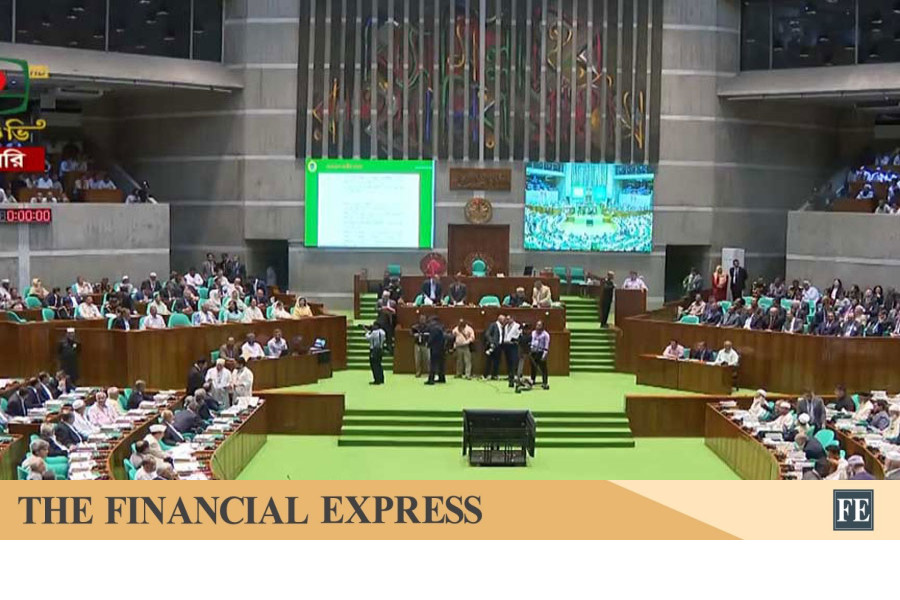
The maiden sitting of the 13th parliament was convened on Thursday after a long and difficult political journey. After fifteen years of authoritarian misrule that reduced successive parliaments to little more than rubber stamps, the country has now returned to a genuinely representative legislature. A transitional period of nearly two years under an interim government followed, serving as necessary, though often trying, passage between a discredited past and the promise of a democratic future. The election that produced the present House was widely expected to return representative politics to its rightful place at the centre of national life. Its first day proceeded through the customary steps that accompany the birth of a new legislature. A new Speaker and Deputy Speaker were elected and sworn in, and the formalities of an inaugural sitting were duly carried out. The chamber now includes an unusually large number of new lawmakers, many entering parliament for the first time. That reality will demand an adjustment period, but it also opens a window to restore the culture of debate and scrutiny that had long withered.

Yet this historic occasion was not without its contradictions and tensions. The opposition Jamaat-e-Islami and its allied parties staged a dramatic walkout during the presidential address chanting slogans, creating a moment of confrontation on what was otherwise a ceremonial day. Their objection was directed at President Mohammed Shahabuddin, whom they branded a collaborator of the deposed regime and labelled a traitor to the July uprising. The difficulty with this position is that the Speaker and Deputy Speaker of the very parliament in which these lawmakers sit both took their oaths of office administered by the same president, as did the Prime Minister himself and the entire cabinet. Home Minister Salahuddin Ahmed put the question plainly when he noted that opposition leaders had themselves engaged with the president on 5th and 6th August during the most critical hours of the political transition and that it was under his authority that the interim arrangement was constituted after all. To participate in a parliament whose entire constitutional architecture rests on oaths administered by the president while simultaneously declaring that president is unfit to address that parliament is not principled protest but rather a selective recognition of legitimacy, which is to say, no coherent principle at all.

Encouragement can nevertheless be drawn from the tone set by the prime minister in his opening remarks. He expressed a clear desire to see parliament function as the centrepiece of national discourse where all arguments and national problems would find resolution. That aspiration resonates deeply with the Bangladeshi public, which has borne the cost of its absence in full. What the country needs from this parliament, and what the Prime Minister's speech implicitly promised, is a legislature that debates with vigour, legislates with care and holds the executive to account with genuine independence.

This chamber inherits 133 ordinances from the interim period requiring parliamentary scrutiny and also carries the burden of institutional reform that demand serious law-making rather than political theatre. The ruling party's two-thirds majority is a democratic mandate of considerable weight but also a temptation toward unilateralism that must be consciously and consistently resisted. The opposition, for its part, must recognise that its role is not to delegitimise the chamber from within but to make it uncomfortable for power to be abused through argument and engagement. After all, Bangladesh has paid too high a price to see its hard-won parliamentary democracy reduced to contradiction and spectacle when so much serious law-making, deliberation and democratic work still lies ahead.​
 

Implementing BNP's Poll Manifesto: PMO asks ministries, divisions to make detailed plans

FE REPORT
Published :
Mar 14, 2026 13:11
Updated :
Mar 14, 2026 13:11

1773708082571.webp


The Prime Minister's Office (PMO) has asked all ministries and divisions to prepare detailed implementation plans in line with the election manifesto of the Bangladesh Nationalist Party (BNP)-led government following its victory in the 13th parliamentary election, sources say.

The directive specifically asked ministries to prepare implementation strategies for three different timelines, including the first 180 days of the government, the ongoing 2026-27 fiscal year, and a broader five-year action plan.

To ensure swift execution, ministries have been directed to identify the manifesto pledges relevant to their respective jurisdictions and prepare a comprehensive list along with an annual implementation roadmap.

In an official directive issued from the PMO, ministries have been instructed to formulate short-, medium-, and long-term action plans to implement the pledges made in the party's electoral manifesto.

According to the document, the 13th Jatiya Sangsad election held on February 12, 2026, resulted in a decisive victory for the BNP-led alliance, which subsequently formed the government. The manifesto commitments made before the election are now considered national commitments and must be implemented as part of the government's policy agenda.

Officials have also been asked to determine which commitments can be implemented within the government's first 180 days and which initiatives will require longer-term policy and budgetary support.

For the 2026-27 fiscal year, ministries must separately outline programmes that can be implemented within the first 60 days and the remaining 120 days of the fiscal period.

In addition, ministries have been instructed to ensure that necessary allocations are incorporated into the national budget to support the implementation of manifesto pledges over the next five years. Where necessary, new development projects may be proposed, while ongoing projects and programmes may also be restructured to align with the government's policy priorities. The PMO has asked ministries and divisions to review the manifesto in detail and submit their proposed action plans and implementation frameworks to the authorities concerned within three days.​
 

Govt must move forward with two-pronged strategy

Fahmida Khatun
Published: 18 Mar 2026, 17: 31

1773881394497.webp


Fahmida Khatun Prothom Alo

In its election manifesto, the BNP presented a range of proposals and plans on the economy and economic reforms. These included specific targets for GDP (gross domestic product) growth, the tax-to-GDP ratio, increased investment, social safety net programmes, a family card scheme, loan waivers for farmers, and investment in small and medium enterprises.

Soon after assuming power, the BNP government took initiatives to implement these plans and began work swiftly. Notably, one of its key promised programmes—the “family card”—has already begun to be distributed. This suggests that the government had prior preparation in this regard.

It must be remembered that in programmes like the family card, there should be no corruption or nepotism in selecting beneficiaries. These initiatives will require substantial funding, and it remains unclear where that will come from. If the government finances such programmes through bank borrowing, it could fuel inflation and crowd out private sector credit.

Strong reform measures in the economic sector are not yet visible. There can be no delay in this regard. In particular, an immediate decision is needed on reforming the National Board of Revenue (NBR).

The global situation has newly emerged as a major challenge for the government. In particular, instability in the international oil market due to conflict in the Middle East has forced Bangladesh to import fuel at higher prices, creating additional pressure on the economy.

On the one hand, the government is trying to control inflation; on the other, higher fuel import costs are increasing public expenditure and putting pressure on foreign exchange reserves. Bangladesh’s reserves are not at a level where such additional costs can be absorbed smoothly. Therefore, energy conservation, limited use, and expenditure control have become crucial. Reducing energy consumption would lower import costs and ease fiscal pressure.

The government has also taken another important step: delaying Bangladesh’s graduation from the Least Developed Country (LDC) category. It has formally applied to the United Nations in this regard. Experts have long argued that the country was not sufficiently prepared for LDC graduation. The current government has taken a relatively swift decision to move this process forward, which is a notable step.

Overall, the government has taken office at a time when the economy was already under pressure. On top of that, global geopolitical instability has made the situation more complex. In this context, the government must both implement its electoral commitments and manage newly emerging economic challenges.

In my view, the government needs to proceed with a two-pronged strategy—maintaining “fire-fighting” measures to address immediate crises, while also implementing medium- and long-term economic reforms, policy planning, and sustainable development strategies.

*Fahmida Khatun is Executive Director at the Centre for Policy Dialogue (CPD)​