Why do Bangladeshi immigrants take this position on Alberta’s independence issue?
On 30 October 1995, French-speaking Quebec came close to becoming independent as well. Voter turnout in the referendum was 94 per cent, the highest in Canadian history. The “No” side, opposing separation, won by just 50.58 percent of the vote
Helal Mohiuddin
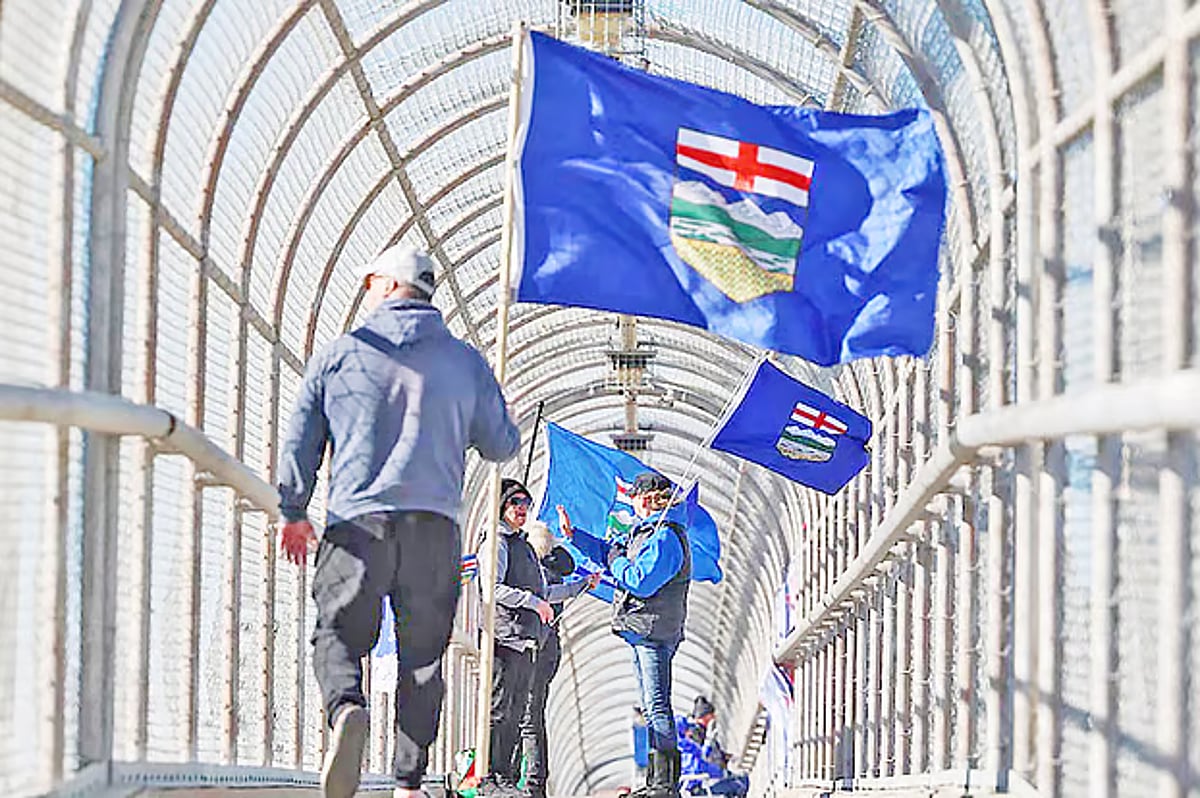
A supporter of Alberta independence holding a flag Reuters
On the night of 19 October, as ballot boxes were opened at more than 1,400 polling stations across Alberta, Bangladeshi immigrants across Canada watched their television screens with bated breath. The unofficial results were in: Alberta was not leaving Canada.
With unofficial results from approximately 86 per cent of polling stations counted, 75.3 per cent of votes were cast in favor of “unity,” while 24.7 percent supported separation. The margin exceeded 960,000 votes. In urban areas such as Calgary-Elbow, “unity” received 85 per cent of the vote. The margin was comparatively narrower in rural Alberta. Immigrants do not live in rural areas. The results made one thing clear: it was immigrants who ensured that Canada would never be allowed to break apart.
The votes of nearly all immigrants, including Bangladeshi immigrants, went against Alberta’s independence. About a week before the referendum, an Albertan colleague of mine asked: “If Bangladesh’s independence in 1971 was justified in the eyes of Bangladeshis, why are the aspirations of Alberta or Quebec unjustified?” Everyone interested in seeing Alberta separate from Canada knows that, on average, 90-95 percent of diaspora communities oppose the breakup of Canada.
The tenth question on the ballot was the real issue: Would Alberta remain a province of Canada, or would the provincial government initiate the legal process, in accordance with the Constitution, to hold a “binding” referendum on secession?
On 30 October 1995, French-speaking Quebec came close to becoming independent as well. Voter turnout in the referendum was 94 per cent, the highest in Canadian history. The “No” side, opposing separation, won by just 50.58 percent of the vote. The “Yes” side lost with 49.42 per cent. The margin was a mere 54,000 votes. A group of voters roughly equivalent in size to the crowd at a large stadium had prevented the province from breaking away. That very night, Premier Jacques Parizeau blamed immigrant voters for the defeat.
That statement still rankles in the memories of immigrants in Canada. Diaspora communities did not take kindly to an immigrant citizen’s vote being singled out as a “problem.” Yet the incident did not fuel anti-immigrant politics.
A motorcade rally in support of Alberta’s independence Reuters
Alberta is proof of how rewarding democracy can be when it is truly democratic. Premier Danielle Smith had worked tirelessly to make Alberta independent and had called the referendum. After the votes were counted, she herself reaffirmed Alberta’s place in a united Canada. She respected the people’s verdict.
Let us return to my colleague’s question and seek an answer: Why do the people of a nation that won its own independence in 1971 at the cost of blood oppose Alberta’s independence?
The answer lies in the referendum results. All five questions on the ballot concerned immigration. All five passed, with support ranging from 54 to 64 per cent. Discriminatory demands prevailed, including giving the province control over immigration; restricting provincially funded healthcare, education, and social services to citizens, permanent residents, and people with status approved by Alberta; and charging fees for services provided to people with temporary status. In fact, nearly 100 per cent of the votes cast by non-immigrants were in favour of tighter immigration controls.
A person who has lost their home and land to river erosion knows how devastating it is to hear the ground crumble beneath their feet. Someone who has left behind family, friends, and loved ones to find shelter on new soil does not want cracks to appear in that new home, too. In 1971, the Biharis stood against the breakup of Pakistan for the same reason. Breaking the bonds of their homeland, the scent of its soil and the deep attachment to the place that had nurtured them like a mother, they had arrived in a foreign country with nothing. They had not come there only to become uprooted all over again.
Two. I found an answer to my colleague’s question in Allen Buchanan’s book Secession: The Morality of Political Divorce. Buchanan explains the issue through the concept of “remedial secession.” A moral right to secede arises only as a remedy for serious injustices, such as genocide, systematic discrimination, or the complete denial of political voice. In its 1998 interpretation of international law, the Supreme Court of Canada expressed a position broadly similar to this. The right to self-determination belongs to colonized or oppressed peoples who are denied a fair opportunity to exercise self-determination within the state.
Bangladesh meets Buchanan’s criteria. The denial of the mother tongue in 1952, the trampling of an overwhelming popular mandate in the 1970 election, the dark night of 25 March, and nine months of genocide made independence the only option.
Alberta has its own legislature, constitutional ownership of its resources, and full representation in Ottawa. The current prime minister himself grew up in Edmonton. Quebec enjoys constitutional protection for the French language, its own immigration agreements, and its own civil law system. There is resentment, and there are allegations of injustice. But there is no inhumanity, exploitation, or deprivation on that scale.
Three. Like immigrants from other countries, Bangladeshi immigrants make the same argument: the oath we took was to Canada. Our passports are Canadian. Immigration, permanent resident status, and permits for students and temporary workers all fall under federal jurisdiction. Section 6 of the Charter grants us the right to live and work anywhere in the country. In an independent Alberta or Quebec, all of these rights and arrangements would suddenly have been thrown into uncertainty and a legal vacuum.
Four. One Alberta independence supporter proposed creating an “Albertan citizenship.” He said citizenship would be determined “on the basis of the decision of those who win the referendum.” Avnish Nanda, an immigration lawyer in Edmonton, had therefore warned that if Alberta became independent, there would be no guarantee of freedom and status for its new citizens. Immigrants who have already left their countries, abandoned their languages, lost recognition of their professional qualifications, and started from scratch are unlikely to risk being reduced to “zero” a second time. That is only natural.
Five. Another reason immigrants voted “No” was their fear that immigration would be restricted. The five referendum questions on immigration restrictions themselves demonstrate this concern. Why would diaspora communities vote “Yes” in a political climate that seeks to label them as “outsiders”?
Six. On 8 October 1971, Pierre Trudeau declared multiculturalism a state policy in Canada. Later, Section 27 of the Charter and the Multiculturalism Act of 1988 gave it a constitutional foundation. This model upholds minority rights and liberal democracy together.
The views of the 500,000 citizens who favour separation are equally legitimate. Alberta makes one of the largest contributions to Canada’s economy. However, the benefits of those contributions are used to develop less prosperous provinces.
Pierre Trudeau was among the first Western leaders to speak out in support of Bangladesh’s independence. Bangladeshi immigrants feel a deep, emotional and psychological sense of gratitude toward Canada and love the country for it. In their eyes, the provinces are like brothers. Why should they separate?
Seven. Bangladeshi immigrants viewed the situation as akin to taking a saw to a boat in the middle of a storm and cutting it into pieces. The US tariff war, threats to turn Canada into the “51st state,” and contacts between people close to the US administration and Alberta separatists all suggest that secession would narrow the space Canada provides as a refuge for immigrants. In the eyes of immigrants, creating a new fracture within the country at a dangerous time is like handing the keys to one’s home to a thief.
The province’s resentment began in 1980, prompted by Pierre Trudeau’s National Energy Program. In reaction to Ottawa’s control over Alberta’s oil resources, Gordon Kesler of the separatist Western Canada Concept party won the Olds-Didsbury by-election in 1982. Since then, the movement has experienced various ups and downs, giving rise to different factions and opposing positions.
The views of the 500,000 citizens who favour separation are equally legitimate. Alberta makes one of the largest contributions to Canada’s economy. However, the benefits of those contributions are used to develop less prosperous provinces. Since 1965, wealthy Alberta has received no benefits from the federal equalisation program. Yet for decades, it has been among the biggest contributors to Canada’s economy.
Pipelines, carbon policy, the energy sector—in every area, the province is subject to Ottawa’s intervention.
Will anti-immigrant sentiment increase following the defeat of Alberta’s separatists? Only time will tell. However, an analysis of historical patterns gives reason to believe that anti-immigrant sentiment will never become a cause for serious concern in Canada. Canada is not merely constitutionally committed to humanitarian values; it is also one of the world’s most humane countries in practice. The triumph of humanity comes before everything else in this country.
* Helal Mohiuddin Professor of Liberal Arts, Mayville State University, North Dakota, USA
 Bangladesh Defense