| Global Defense, OSINT & Geopolitics Wire

[🇧🇩] Save the Rivers/Forests/Hills-----Save the Environment

[🇧🇩] Save the Rivers/Forests/Hills-----Save the Environment
659
27K
More threads by Saif

G Bangladesh Defense

'Climate change to affect aquaculture'

Climate change will affect aquaculture production in Asia, which accounts for almost 90 percent of global aquaculture production.

Consequently, aquaculture in Bangladesh, one of the most vulnerable countries to climate change, is also expected to suffer, said Cherdsak Virapat, director general of the Centre on Integrated Rural Development for Asia and the Pacific (Cirdap).

"Bangladesh, Cambodia, China, India, Nepal, the Philippines and Vietnam have been identified as the most vulnerable countries worldwide," he said.

The Cirdap and the Bangladesh Shrimp and Fish Foundation (BSFF) organised the seminar, styled 'Promoting Climate Resilient Aquaculture and Fisheries for Integrated Rural Development in Bangladesh', at the Cirdap Auditorium in the capital yesterday.

During his presentation, Virapat said: "The impacts of climate change are serious and must be addressed now because the longer we fail to take action, the bigger the cost to remediate the impacts."

Preemptive mitigation of climate change should be a key consideration for the sustainable development of the aquaculture sector, he added.

Speaking about overcoming these challenges, Virapat said four strategic actions need to be established.

The first is increasing climate resilience of farmers, farming systems, and breeds available for farming.

The second is to increase the capacity to manage short- and long-term climate risks and reduce losses from weather-related disasters.

The third action should be improving sustainability of genetic diversity in brood stocks as a resource for long-term and continuous adaptation to climate change.

And finally, the third initiative should be finding potential and developing the capacity of aquaculture in mitigating the impact of and/or sequestrating the release of greenhouse gas emissions.

He also pointed out a way forward, seeking to define adaptation strategies for the main environmental, disease and genetic threats caused by climate change in order to inform and guide aquaculture community.

Virapat also underlined the need for improved water storage capacity and effective water utilisation for agriculture, industry and households and reduced fishing pressure along coastal areas.​
 

No environmental surcharge for firms for owning more than one car

The National Board of Revenue (NBR) has exempted companies and firms from paying the environmental surcharge for owning more than one car.

Only individual taxpayers will be required to pay the surcharge for having second, third, or more cars, particularly sedans, jeeps and microbuses, the NBR said in a circular issued this week.

The tax administration imposed the environmental surcharge on additional vehicles for the first time in fiscal year 2023-24 to discourage their ownership and enable Bangladesh to contain air pollution and meet its commitment to reducing carbon emissions.

In the first year, the NBR imposed a surcharge on all taxpayers, including companies and firms, on ownership of more than one car. The tax authority said the surcharge would be applicable for ownership of each car in excess of one.

If the engine capacity of the second vehicle was up to 1,500cc or 75 kilowatts, the NBR collected Tk 25,000 as a surcharge.

The surcharge goes up as the engine capacity of the vehicles increases.

For example, it slapped Tk 50,000 as a surcharge on the ownership of a second car with higher engine capacity -- between 1,500cc and 2,000cc or 75 kilowatts and 100 kilowatts.

The surcharge is Tk 3.50 lakh if the engine capacity of the vehicle is 3,500cc or 175 kilowatts, according to the NBR notification.

The tax administration has kept the rate of surcharge against the engine capacity of cars unchanged for FY25 but said it would only be applicable for individual taxpayers.

A senior official of the NBR said it exempted companies and firms from payment of the surcharge since the Bangladesh Road Transport Authority (BRTA) is yet to prepare a proper database of ownership of vehicles by companies.

Officials cannot properly track the ownership of cars by firms and companies during the renewal of registration or issuance of fitness certificates, the official said.

"They can do this for individual taxpayers. So, we have kept the surcharge payments for individual taxpayers," he said.

As per the NBR's circular, taxpayers must pay the surcharge during the renewal of fitness certificates.

The NBR also imposed conditions for the renewal of fitness certificates in the circular.

It imposes higher taxes if owners of vehicles, including those operated commercially, fail to show proof of submission of income tax returns for the current fiscal year, according to the circular.

As of June this year, Bangladesh had 61 lakh registered vehicles. Of those, the number of private passenger cars, microbuses, and jeeps stood at 6.3 lakh, according to BRTA data.

The NBR collected Tk 1,575 crore in taxes from the issuance of fitness certificates and renewal of registration in FY21, which was 48 percent higher compared to the previous year.​
 

Managing Sundarbans' resources sustainably
FE
Published :
Jul 12, 2024 21:30
Updated :
Jul 12, 2024 21:30
1720830942026.webp

File photo
Though often touted as a protected landscape, the world's largest closed canopy mangrove forest, the Sundarbans, cannot be said to be entirely protected. In fact, the Sundarbans, is under severe ecological distress, thanks to its depredation by humans as well as the vagaries of Nature. The victims are not only the Bengal Tigers, but also the birds and other animal species including the river dolphins and waterfowls surviving in its aquatic environment. To save this forestland declared a UNESCO world heritage site as well as a wetland of international importance under the Ramsar convention, Bangladesh and Germany are learnt to have reached two deals recently. The agreements so inked would reportedly ensure sustainable management of the Sundarbans and the Marine Protected Area (MPA) Swatch of No Ground (SONG). Notably, established in October 2014, the so-called 'Swatch of No Ground Marine Protected Area' is a reserve covering an area of 1,636 square kilometres and located 30 km away from the Dublar Char islands of the Sundarbans in the Bay of Bengal. It is a habitat of some endangered species of dolphin and whale.

A collaborative effort between the ministry of environment, forest and climate change (MoEFCC) and the ministry of fisheries and livestock (MoEFL), the endeavour, also termed SONG project, as spelt out in the agreements, aims to strengthen marine conservation in Bangladesh by way of improving collaboration and capacity building among responsible authorities and stakeholders. Understandably, the users of the Sundarbans' resources including fishermen, women and youth of the coastal communities living close to the MPA are among the stakeholders. As they are dependent on the Sundarbans for their sustenance, their participation is vital for what the project terms sustainable management of the Sundarbans and the MPA. But how can they possibly contribute effectively to the humongous task of protecting and managing the resources of the mangrove forest and the marine protected area while at the same time conserving their delicate ecosystems without the knowledge and skills required for the purpose? Here comes the question of developing their planning and surveillance capacities, skill of scientific monitoring and the ability of knowledge-based decision-making using digital tools. Once equipped with the required capacities and skills, it is expected that the coastal communities would be able to understand how they are inextricably linked to the Sundarbans and its MPA ecosystem and how they can thrive by way of proper management and conservation of the system.

As the neighbouring India does also share a portion of the Sundarbans, the strengthening of regional cooperation including financing is an imperative for sustainable management of the Sundarbans and restoration of the coastal ecosystem both in Bangladesh and India. To this end, a project styled, Sundar-BAY, is also learnt to be under implementation jointly by Bangladesh and India between March 2024 and February 2027 stressing public-private partnership between the two neighbours. As expected, this project will also focus on the conservation of the mangrove forest by providing ecosystem services to the local communities. Alongside building institutional capacity, promoting joint training programmes and providing environmental education, the SUNDAR-BAY project will also help initiate sustainable income generation activities among the local communities.

Both the projects will contribute towards meeting the UN's Sustainable Development Goals (SDGs), especially those concerning conservation of biodiversity and natural resources. There is no denying that managing the resources of the Sundarbans including the marine protected area surrounding it sustainably is about meeting a major existential challenge for Bangladesh. A host of other projects are also working with similar objectives in the Sundarbans. What is important is that they should be in a synergy to come up with a positive outcome.​
 

When protector turns polluter
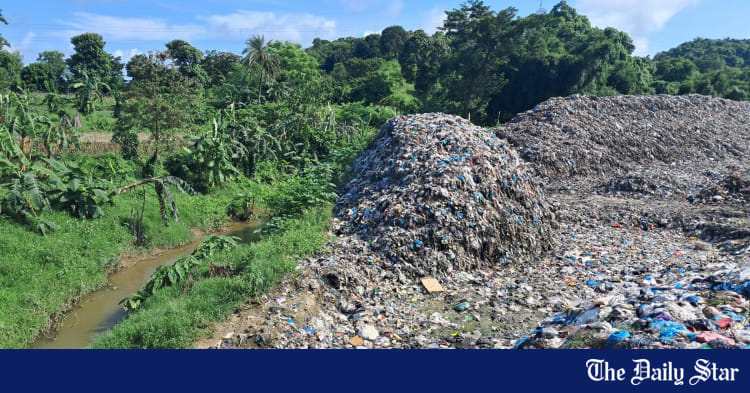
Hathazari municipality dumping waste in canal; landfill set up next to waterbody without permission

1721001825349.webp

It's tough to notice Sundari canal amid the piles of waste dumped next to one of its banks. Hathazari municipality has set up a landfill next to it without permission and continues to dump household waste there. A portion of the canal has already been turned into a narrow drain, obstructing its waterflow. Photo: Star

The Sundari canal in Chattogram's Hathazari upazila is facing a severe environmental crisis due to indiscriminate dumping of garbage by the municipality.

As the state agency, who is the custodian of the canal, has been dumping household wastes for years, a portion of the canal has already turned into a narrow drain, obstructing the waterflow of this waterbody.

The landfill, adjacent to the canal, was established in 2013 without obtaining environmental clearance from the Department of Environment (DoE).

The canal, around 5km in length, started from Jangalchari and ended at Subedar Pukur area under the upazila.

This correspondent visited the spot on Saturday and observed that a huge amount of plastic packets of chips, biscuits and several types of single use plastic (SUP) were lying along the banks on both sides of the canal.

Sultan Ahmed, a resident of the Madhyakhil area near the landfill, said, "It is unbearable for me and my family to stay home when the bad smell spreads after the municipality dumps the garbage."

Mansur Alam, a resident of the Rangipara area, regularly cultivates crops using water from the hilly canal.

"Sometimes the canal water turns black during discharge of untreated wastewater from the landfill into the waterbody," he added.

A protected forest, around 50 acres, is located near the landfill. Due to dumping garbage next to the forestland, some trees have already died.

Anwarul Islam, forester of the Hathazari Forest Office, said he verbally urged officials of the municipality to take measures to shift the landfill.

According to the Environmental Conservation Act, filling a canal (waterbody) is a punishable offence.

Nur Hasan Sajib, an assistant director of DoE, Chattogram, who has been transferred to Noakhali recently, confirmed that the municipality is using the land as a landfill without obtaining permission from DoE.

"We asked the authorities several times to set up a waste management plant. But they don't heed to our instructions," he claimed.

Lokman Hossain, a activist and resident of the upazila, said the environmental destruction is going on in broad daylight.

Asked why the municipality is violating the law and dumping waste in open spaces and the waterbody, Biplab Muhuree, secretary of the Hathazari municipality, said they are trying to set up a waste management plant.

"We are working to buy land to establish a plant. But we are facing a shortage of funds," he claimed.

He also admitted they established the existing landfill without getting permission from the authorities concerned as they had no space to dump the collected waste.​
 

Canals are no one's property to destroy at will
Strict enforcement of environmental laws vital to protect them

1721172587058.webp

VISUAL: STAR

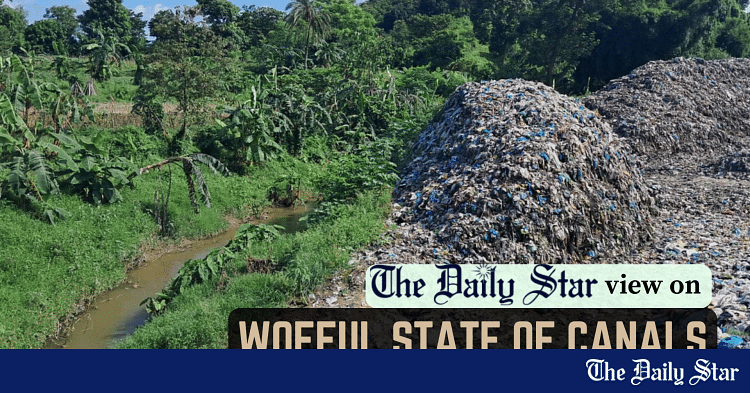
Two recent reports of The Daily Star have once again highlighted the worrying trend of canals and such waterbodies being subjected to misuse and exploitation, leading to them being filled up and obstructing their flow. We have seen the destructive effects of such practices in urban areas, including in Dhaka, which as recently as Friday got severely waterlogged as drainage canals filled with waste couldn't channel rainwater to the rivers. Abuse of canals in rural areas, where they play a crucial role by holding excess water and helping in irrigation, can have myriad other implications.

Our first report sheds light on the woeful state of a canal in Chattogram's Hathazari upazila. The local municipality has been dumping waste there for years, turning a part of it into a narrow drain. Adjacent to the canal is a landfill established without the necessary clearance from environmental authorities. This has only exacerbated the situation, with plastic waste seen littering the banks. Locals have described unbearable stench and adverse effects on their crops, but they are not the only victims. There is a 50-acre protected forest nearby that is being degraded, too.

A similar situation prevails in Kurigram's Rajarhat upazila, where a local influential has seized a portion of a canal for fish farming. Reportedly, the canal flows through 8-9 bighas of land owned by Bangladesh Railway and the Water Development Board before emptying into Teesta River. But its illegal occupation is disrupting the water flow, causing inundation of farmlands and affecting farmers.

Clearly, the degradation of canals is jeopardising not only local ecosystems but also the lives and livelihoods of people. And often, this is being done either by government bodies themselves, which is deeply alarming, or because of their negligence and inaction. The question is, why are they allowing this to happen despite knowing its devastating effects? While practical issues may sometimes create the scope for degradation of canals, like in the case of Hathazari municipality, the authorities must find a way to resolve them and ensure that no one—however powerful—can compromise these important waterbodies. The government should also ensure strict enforcement of all environmental laws and regulations.​