Bangladesh Defense

Saif
Senior Member
- Joined
- Jan 24, 2024
- Messages
- 22,317
- Likes
- 9,875
- Nation

- Axis Group

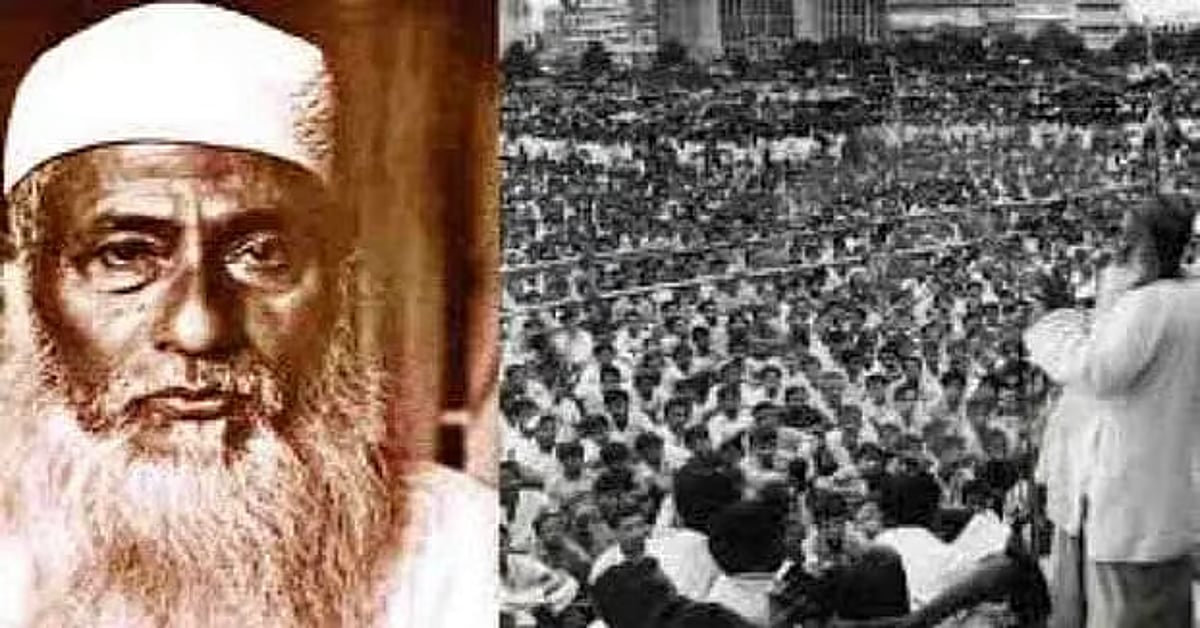
Bhashani wanted to ensure River Padma's due rights
Before anyone draws a litre of water from the Padma, they must think of the downstream districts, the Sundarbans, Padma’s right to meet the sea
 en.prothomalo.com
Bhashani wanted to ensure River Padma's due rights
Gawher Nayeem Wahra
Updated: 21 Jun 2025, 16: 32

On 16 May 1976 a long March was held from Rajshahi towards the Farakka Barrage in India under the leadership of Maulana Bhasani UNB
Given the prevailing favourable political circumstances in the country, this year Farakka Day (16 May) was observed much more visibly than in previous years. The enthusiasts, the overenthusiastic, the mildly enthusiastic and the impulsive enthusiasts, everyone took part in commemorating Farakka Day. There were even photo sessions on the occasion.
Outside Dhaka, meetings, rallies, and seminars were held in Rajshahi. Many attended these events on a one-day trip from Dhaka. All this reflects a high level of enthusiasm. This is only natural in a country where everyone loves festivities and celebrations.
But have we truly internalized, as Maulana Abdul Hamid Khan Bhashani did, that the Farakka problem cannot be solved with tears—whether from the eyes or from any other part of the body?
Ahmad Sofa used to say, “No one understood as clearly as Bhashani the devastation Farakka Barrage was causing to Bangladesh.”
It may have been deemed ‘discourteous’ for Bangladesh not to attend the inauguration of Farakka back then on 21 April 1975, despite an invitation, by the prime minister at the time, Sheikh Mujibur Rahman, chose to heed the words of his dear Maulana Bhashani. Reportedly, it was at Bhashani’s request that the water resources minister Abdur Rab Serniabat was told to cancel his trip.
India’s ambassador back then, the seasoned diplomat Samar Sen, was surprised by this last-minute decision. Though he said nothing, it is beyond doubt that India’s minister of agriculture and irrigation, Jagjivan Ram, who was the central figure at the event, was displeased. In 1971, he had served as India’s defence minister. Perhaps that is why he took it for granted that they would readily respond to the invitation.
There is no record of the interaction between Maulana Bhashani and Prime Minister Sheikh Mujib. However, it can be assumed that he reminded the prime minister of the meeting held on 16 May 1974 between the prime ministers of Bangladesh and India. In that meeting, both leaders had agreed that the Farakka Barrage would not be operated during the dry season until the two countries reached an agreement on water sharing. (Source: Rameez Mohd Bhat, International Journal of Applied Research 2020; 6 (2): 264-268 Hydro-politics between India and Bangladesh: A study of Farakka barrage dispute).
India cannot unilaterally open the barrage without respecting that consensus. Being witness to such an inaugural ceremony would mean retreating from our rightful claim to water.
Maulana Bhashani perhaps reminded them of the first meeting held in 1973 between Bangladesh and India regarding the Ganges. In that meeting, it was decided that the Farakka Barrage would only be operational after the two countries reached a final agreement on water sharing. (Source: previously cited)
Several meetings between the two countries took place until 1975, but due to disagreements on various issues, no resolution on water sharing could be reached.

During the dry season, due to the lack of water flow in the Padma, vast areas turn into sandbars. Padma River in the Talaimari area of Rajshahi city File Photo
By 1976, Maulana Bhashani was over ninety years old. He spent most of his time in the hospital. Even on the first day of the Bengali New Year (15 April) that year, he was in hospital.
After attending the Chhayanaut event in Ramna, Fakir Alamgir, a young and rising singer at the time, said upon arriving at Shahbagh, “Let’s go pay our respects to Huzoor.”
Whether it was his involvement with Biplobi Chhatra Union or out of deep reverence, he always referred to Maulana Bhashani as “Huzoor.”
Maulana Bhashani was asleep. It seemed his weary body simply wanted to rest.
There was little resemblance between the Maulana Bhashani I had first seen in 1970 on the “relief launch” during the relief efforts in cyclone-ravaged Monpura and the man lying in the hospital bed. It was as if a vibrant, plump grape had shriveled into a raisin.

But just days later, on 18 April 1976, upon being discharged from the hospital, it was as though the lion within him awoke. Maulana Bhashani declared that if India deprived Bangladesh of its rightful share of water, he would launch a long march.
This announcement surprised many at the time. Some dismissed it as a political stunt. But in truth, it was his final struggle at the risk of his life.
Monajat Uddin, a correspondent of Dainik Sangbad, participated in that long march on 16 May 1976. In his report the next day, he wrote that the 64 km journey was extremely arduous. The greatest concern was for Maulana Bhashani himself. After all, he was over 90 years old.
Monajat Uddin later recalled this in his memoir "Poth Theke Pothe", published on 1 January 1991.

On 28 April 1976, Maulana Bhashani issued a statement urging everyone to join and ensure the success of the long march.
Prior to the march, he also wrote a letter to Indian prime minister Indira Gandhi, explaining the reasons and background of the protest. From all this, it is clear that the long march was not just a dramatic gesture.
That letter, now part of history, ought to be essential reading for today’s youth. (Sources: 1. BBC Bangla report, Dhaka, 16 May 2022; 2. Majlum Jananeta Maulana Bhashani Smarak Sonkolon, edited by Mohsin Shastrapani and Bulbul Khan Mahbub; 3. Report titled Bhashani’s Farakka Long March of 1976 by M. Golam Mostafa, Convener, National Jatiya Krishak-Sramik Mukti Andolan, 14 May 2024).
Maulana Bhashani’s long march effectively laid the groundwork for bringing the issue to the international stage. Later, at the 31st UN General Assembly, Ziaur Rahman raised the Farakka issue. The UN recommended resolving the matter through bilateral discussions.
When the first non-Congress government, led by Morarji Desai, came to power in India in 1977, relations between the two countries somewhat improved. That same year, a five-year agreement on the sharing of Ganges water was signed. Subsequent agreements followed. The current agreement is set to expire in 2026.
The country’s higher judiciary declared in a verdict that a river is a “living entity.” This means rivers, like humans, have the right to a healthy and sustainable existence. There are legal provisions for taking action against those responsible for encroachment, pollution, or sedimentation
An analysis of the five Ganges water-sharing agreements reveals that Bangladesh’s share of water has gradually decreased over time.
Moreover, in other water-sharing agreements across the subcontinent, countries generally consider the total flow of the river and provide downstream countries with information about all barrages, dams, or embankments constructed upstream. This principle is even followed in the Indus Waters Treaty between India and Pakistan. However, such considerations have been neglected in the case of the Ganges Treaty.
India provides Bangladesh with information only about the Farakka Barrage. However, multiple other barrages and dams have been constructed upstream on the Ganges, which have disrupted and continue to disrupt the river's natural flow before it even reaches Farakka.
In addition, the upstream Indian states of West Bengal are themselves increasingly unable to contain their concerns over Farakka. Their interest in Ganges water is growing by the day. This suggests that in the coming years, our share is likely to shrink further.
Yet our need for water is rising. Just to keep the Sundarbans alive, floodwaters are required in Padma’s tributaries such as the Gorai, Kumar, and Madhumati rivers.
One possible solution is to increase our capacity to retain water and to use it more efficiently. However, discussions around Farakka Day did not reflect on what we ourselves can do, through our own strength and initiative, if India fails to supply the water we need.
In the concluding speech of his long march (17 May 1976), Maulana Bhashani declared, “If India ignores the demands of the people of Bangladesh regarding the Farakka issue, a movement to boycott Indian goods will begin.”
This writer was present that day and heard Maulana speak. He had also said, “A river has its own rights. If it is not allowed to meet the sea, the world will be rendered desolate. All of creation will be destroyed. It will dissolve into nothingness.” These powerful words from his speech were not prominently reported in any newspaper the following day.
Monajat Uddin’s book and the article "Maulana Bhashanir Jibon Srote" by Abu Noman Khan, former office secretary of the Jatiya Krishak Samity and witness of that day’s march, published in the book Majlum Janoneta Maulana Bhashani Smarak-Sonkolon, edited by Mohsin Shastrapani and Bulbul Khan Mahbub, contain many details about the long march. However, there is no narrative of the “rights of the river.”
Hasan Mir, a former official at Rajshahi Radio (who passed away last year), told this writer, “We actually didn’t understand the meaning or implication of that statement. That’s why it didn’t make it into the radio news.” The call for a “boycott of Indian goods" gained more prominence. But he has several times mentioned the due rights of the river.
What are a river’s rights?
Before this project, a water treatment plant worth Tk 103 crore was built in Shyampur, Rajshahi, in 2011. Due to lack of water in the Padma, it remains non-operational most of the year.
In the Sarangpur area of Godagari upazila, where a new water treatment plant is being built on the Padma, the Ganges enters Bangladesh from India and takes on the name Padma. From here, a distributary of the Padma, the Mahananda River, branches off. This WASA treatment plant is being constructed at the confluence of these two rivers.
And it's not just Rajshahi. Water from the Padma is being extracted for the residents of Dhaka city as well. For that, the Padma-Jashaldia Water Treatment Plant was set up in 2019 in Louhajang, Munshiganj.
Today, we talk about rivers as “living entities,” but Maulana had already expressed that idea way back then. Readers may recall that on 3 February 2019, the country’s higher judiciary declared in a verdict that a river is a “living entity.” This means rivers, like humans, have the right to a healthy and sustainable existence. There are legal provisions for taking action against those responsible for encroachment, pollution, or sedimentation.
Maulana Bhashani had essentially voiced this same principle 43 years before that court ruling, through his statement about the river’s rights.
Yet in discussions on Farakka Day, not a word was said about river pollution or about the implications of extracting water from the Padma while violating the river’s rights.
A mega project has been launched in Godagari to extract 200 million litres of water daily just for the residents of Rajshahi city. Professor Sarwar Jahan of Rajshahi University confirmed this. The previous government signed a deal with a Chinese company on 21 March 2021 to establish this project.
If such a vast quantity of water is extracted daily, the Padma will hardly be able to flow as far as Pabna. And what about the water needed for the Rooppur Nuclear Power Plant? How many millions of litres per day will that require? Where are those figures?
Why should Khulna city sit back and watch? It, too, is claiming a share of the Padma’s distributary rivers. Water from the Madhumati River is being diverted to Khulna. At present, nearly 53 per cent of Khulna city’s demand for safe drinking water is being met by the Madhumati alone.
Under this project, water from the Madhumati, located 71 km away, is diverted by pipe to the Samantasen area of Khulna, where it is treated. Alongside a water treatment plant with a daily capacity of 110 million litres, a reservoir with a storage capacity of 775,000 cubic metres has been built to store untreated water. This allows for a three-month supply of water for the city’s residents. Since June 2019, the project has been operating at full capacity, while the Madhumati is dying.
Back in 2000–01, efforts began in the Manikhar area to extract, treat, and supply water from the Madhumati River to meet the needs of Gopalganj town. This was the first water treatment plant in the area. A second was established there in 2019–2020.
We must not forget that aside from the Padma’s tributaries, the Gorai, Kumar, and Madhumati, there is no other route for fresh water to reach the Sundarbans. Without an adequate supply of fresh water, how will the Sundarbans survive?
Can Padma not be saved?
The growing tendency to extract water from the Padma to meet urban demands must be controlled. The Padma’s right to meet the sea cannot be obstructed.
Another long-story narrated as a hope for reviving the Padma goes back to the Pakistan era: the “Ganges/Padma Barrage.” Since 1961, efforts have been underway to implement this project. In 1970, the president at the time, Yahya Khan, allocated 5 crore rupees for preliminary work on the Ganges Barrage. Construction began about two and a half miles downstream from the Hardinge Bridge.
However, after the war, the Ganges Barrage Circle was dismantled in 1974. In 1980, to overcome the devastating effects of Farakka, General Zia laid the foundation stone for this project in Talbaria, Kushtia.
Following several feasibility studies, the site for the Ganges Barrage was later recommended to be in Pabna’s Pakshey. The recommendations stated that, once implemented, the Ganges Barrage project would restore navigability to 16 rivers including the Gorai, push back salinity intrusion in the region, and help reestablish the ecological balance that had been disrupted by Farakka.
The estimated length of the barrage is 2.1 km. It is to stretch from Satbaria in Sujanagar upazila of Pabna to Habaspur in Pangsa upazila of Rajbari district on the river’s right bank, that is, the opposite bank.
According to the feasibility report, the barrage will establish a direct road link between the southwestern region of the country and other parts. A four-lane road bridge built on the deck of the barrage, along with a 7 km approach road on the right bank, will connect the western and southwestern regions to the Rajbari-Kushtia highway through an 8.5 km link road.
The barrage will be modeled after the Teesta Barrage built in Dalia, Nilphamari. Upstream from the barrage, a vast reservoir will stretch 165 km to Panka in Chapainawabganj. This reservoir will have a water-holding capacity of 2,900 million cubic meters. From this volume, 2,000 million cubic meters of water will be supplied during the dry season through the barrage.

Site of the centre to extract water from Padma at Godagari, RajshahiCourtersy: Author
But this will require Herculean efforts and resources. Without making the effort to procure those resources, can the Padma really be saved simply through nostalgic recollections of the Farakka marches?
Before any citizen draws even one litre of water from the Padma, they must think of the downstream districts. They must think of the Sundarbans. And they must think of the Padma’s right to meet the sea.
If we don’t understand that killing a river means killing civilization, then how can we call ourselves civilized?
* Gawher Nayeem Wahra is a researcher
Gawher Nayeem Wahra
Updated: 21 Jun 2025, 16: 32
On 16 May 1976 a long March was held from Rajshahi towards the Farakka Barrage in India under the leadership of Maulana Bhasani UNB
Given the prevailing favourable political circumstances in the country, this year Farakka Day (16 May) was observed much more visibly than in previous years. The enthusiasts, the overenthusiastic, the mildly enthusiastic and the impulsive enthusiasts, everyone took part in commemorating Farakka Day. There were even photo sessions on the occasion.
Outside Dhaka, meetings, rallies, and seminars were held in Rajshahi. Many attended these events on a one-day trip from Dhaka. All this reflects a high level of enthusiasm. This is only natural in a country where everyone loves festivities and celebrations.
But have we truly internalized, as Maulana Abdul Hamid Khan Bhashani did, that the Farakka problem cannot be solved with tears—whether from the eyes or from any other part of the body?
Ahmad Sofa used to say, “No one understood as clearly as Bhashani the devastation Farakka Barrage was causing to Bangladesh.”
It may have been deemed ‘discourteous’ for Bangladesh not to attend the inauguration of Farakka back then on 21 April 1975, despite an invitation, by the prime minister at the time, Sheikh Mujibur Rahman, chose to heed the words of his dear Maulana Bhashani. Reportedly, it was at Bhashani’s request that the water resources minister Abdur Rab Serniabat was told to cancel his trip.
India’s ambassador back then, the seasoned diplomat Samar Sen, was surprised by this last-minute decision. Though he said nothing, it is beyond doubt that India’s minister of agriculture and irrigation, Jagjivan Ram, who was the central figure at the event, was displeased. In 1971, he had served as India’s defence minister. Perhaps that is why he took it for granted that they would readily respond to the invitation.
There is no record of the interaction between Maulana Bhashani and Prime Minister Sheikh Mujib. However, it can be assumed that he reminded the prime minister of the meeting held on 16 May 1974 between the prime ministers of Bangladesh and India. In that meeting, both leaders had agreed that the Farakka Barrage would not be operated during the dry season until the two countries reached an agreement on water sharing. (Source: Rameez Mohd Bhat, International Journal of Applied Research 2020; 6 (2): 264-268 Hydro-politics between India and Bangladesh: A study of Farakka barrage dispute).
India cannot unilaterally open the barrage without respecting that consensus. Being witness to such an inaugural ceremony would mean retreating from our rightful claim to water.
Maulana Bhashani perhaps reminded them of the first meeting held in 1973 between Bangladesh and India regarding the Ganges. In that meeting, it was decided that the Farakka Barrage would only be operational after the two countries reached a final agreement on water sharing. (Source: previously cited)
Several meetings between the two countries took place until 1975, but due to disagreements on various issues, no resolution on water sharing could be reached.
During the dry season, due to the lack of water flow in the Padma, vast areas turn into sandbars. Padma River in the Talaimari area of Rajshahi city File Photo
By 1976, Maulana Bhashani was over ninety years old. He spent most of his time in the hospital. Even on the first day of the Bengali New Year (15 April) that year, he was in hospital.
After attending the Chhayanaut event in Ramna, Fakir Alamgir, a young and rising singer at the time, said upon arriving at Shahbagh, “Let’s go pay our respects to Huzoor.”
Whether it was his involvement with Biplobi Chhatra Union or out of deep reverence, he always referred to Maulana Bhashani as “Huzoor.”
Maulana Bhashani was asleep. It seemed his weary body simply wanted to rest.
There was little resemblance between the Maulana Bhashani I had first seen in 1970 on the “relief launch” during the relief efforts in cyclone-ravaged Monpura and the man lying in the hospital bed. It was as if a vibrant, plump grape had shriveled into a raisin.
But just days later, on 18 April 1976, upon being discharged from the hospital, it was as though the lion within him awoke. Maulana Bhashani declared that if India deprived Bangladesh of its rightful share of water, he would launch a long march.
This announcement surprised many at the time. Some dismissed it as a political stunt. But in truth, it was his final struggle at the risk of his life.
Monajat Uddin, a correspondent of Dainik Sangbad, participated in that long march on 16 May 1976. In his report the next day, he wrote that the 64 km journey was extremely arduous. The greatest concern was for Maulana Bhashani himself. After all, he was over 90 years old.
Monajat Uddin later recalled this in his memoir "Poth Theke Pothe", published on 1 January 1991.
On 28 April 1976, Maulana Bhashani issued a statement urging everyone to join and ensure the success of the long march.
Prior to the march, he also wrote a letter to Indian prime minister Indira Gandhi, explaining the reasons and background of the protest. From all this, it is clear that the long march was not just a dramatic gesture.
That letter, now part of history, ought to be essential reading for today’s youth. (Sources: 1. BBC Bangla report, Dhaka, 16 May 2022; 2. Majlum Jananeta Maulana Bhashani Smarak Sonkolon, edited by Mohsin Shastrapani and Bulbul Khan Mahbub; 3. Report titled Bhashani’s Farakka Long March of 1976 by M. Golam Mostafa, Convener, National Jatiya Krishak-Sramik Mukti Andolan, 14 May 2024).
Maulana Bhashani’s long march effectively laid the groundwork for bringing the issue to the international stage. Later, at the 31st UN General Assembly, Ziaur Rahman raised the Farakka issue. The UN recommended resolving the matter through bilateral discussions.
When the first non-Congress government, led by Morarji Desai, came to power in India in 1977, relations between the two countries somewhat improved. That same year, a five-year agreement on the sharing of Ganges water was signed. Subsequent agreements followed. The current agreement is set to expire in 2026.
The country’s higher judiciary declared in a verdict that a river is a “living entity.” This means rivers, like humans, have the right to a healthy and sustainable existence. There are legal provisions for taking action against those responsible for encroachment, pollution, or sedimentation
An analysis of the five Ganges water-sharing agreements reveals that Bangladesh’s share of water has gradually decreased over time.
Moreover, in other water-sharing agreements across the subcontinent, countries generally consider the total flow of the river and provide downstream countries with information about all barrages, dams, or embankments constructed upstream. This principle is even followed in the Indus Waters Treaty between India and Pakistan. However, such considerations have been neglected in the case of the Ganges Treaty.
India provides Bangladesh with information only about the Farakka Barrage. However, multiple other barrages and dams have been constructed upstream on the Ganges, which have disrupted and continue to disrupt the river's natural flow before it even reaches Farakka.
In addition, the upstream Indian states of West Bengal are themselves increasingly unable to contain their concerns over Farakka. Their interest in Ganges water is growing by the day. This suggests that in the coming years, our share is likely to shrink further.
Yet our need for water is rising. Just to keep the Sundarbans alive, floodwaters are required in Padma’s tributaries such as the Gorai, Kumar, and Madhumati rivers.
One possible solution is to increase our capacity to retain water and to use it more efficiently. However, discussions around Farakka Day did not reflect on what we ourselves can do, through our own strength and initiative, if India fails to supply the water we need.
In the concluding speech of his long march (17 May 1976), Maulana Bhashani declared, “If India ignores the demands of the people of Bangladesh regarding the Farakka issue, a movement to boycott Indian goods will begin.”
This writer was present that day and heard Maulana speak. He had also said, “A river has its own rights. If it is not allowed to meet the sea, the world will be rendered desolate. All of creation will be destroyed. It will dissolve into nothingness.” These powerful words from his speech were not prominently reported in any newspaper the following day.
Monajat Uddin’s book and the article "Maulana Bhashanir Jibon Srote" by Abu Noman Khan, former office secretary of the Jatiya Krishak Samity and witness of that day’s march, published in the book Majlum Janoneta Maulana Bhashani Smarak-Sonkolon, edited by Mohsin Shastrapani and Bulbul Khan Mahbub, contain many details about the long march. However, there is no narrative of the “rights of the river.”
Hasan Mir, a former official at Rajshahi Radio (who passed away last year), told this writer, “We actually didn’t understand the meaning or implication of that statement. That’s why it didn’t make it into the radio news.” The call for a “boycott of Indian goods" gained more prominence. But he has several times mentioned the due rights of the river.
What are a river’s rights?
Before this project, a water treatment plant worth Tk 103 crore was built in Shyampur, Rajshahi, in 2011. Due to lack of water in the Padma, it remains non-operational most of the year.
In the Sarangpur area of Godagari upazila, where a new water treatment plant is being built on the Padma, the Ganges enters Bangladesh from India and takes on the name Padma. From here, a distributary of the Padma, the Mahananda River, branches off. This WASA treatment plant is being constructed at the confluence of these two rivers.
And it's not just Rajshahi. Water from the Padma is being extracted for the residents of Dhaka city as well. For that, the Padma-Jashaldia Water Treatment Plant was set up in 2019 in Louhajang, Munshiganj.
Today, we talk about rivers as “living entities,” but Maulana had already expressed that idea way back then. Readers may recall that on 3 February 2019, the country’s higher judiciary declared in a verdict that a river is a “living entity.” This means rivers, like humans, have the right to a healthy and sustainable existence. There are legal provisions for taking action against those responsible for encroachment, pollution, or sedimentation.
Maulana Bhashani had essentially voiced this same principle 43 years before that court ruling, through his statement about the river’s rights.
Yet in discussions on Farakka Day, not a word was said about river pollution or about the implications of extracting water from the Padma while violating the river’s rights.
A mega project has been launched in Godagari to extract 200 million litres of water daily just for the residents of Rajshahi city. Professor Sarwar Jahan of Rajshahi University confirmed this. The previous government signed a deal with a Chinese company on 21 March 2021 to establish this project.
If such a vast quantity of water is extracted daily, the Padma will hardly be able to flow as far as Pabna. And what about the water needed for the Rooppur Nuclear Power Plant? How many millions of litres per day will that require? Where are those figures?
Why should Khulna city sit back and watch? It, too, is claiming a share of the Padma’s distributary rivers. Water from the Madhumati River is being diverted to Khulna. At present, nearly 53 per cent of Khulna city’s demand for safe drinking water is being met by the Madhumati alone.
Under this project, water from the Madhumati, located 71 km away, is diverted by pipe to the Samantasen area of Khulna, where it is treated. Alongside a water treatment plant with a daily capacity of 110 million litres, a reservoir with a storage capacity of 775,000 cubic metres has been built to store untreated water. This allows for a three-month supply of water for the city’s residents. Since June 2019, the project has been operating at full capacity, while the Madhumati is dying.
Back in 2000–01, efforts began in the Manikhar area to extract, treat, and supply water from the Madhumati River to meet the needs of Gopalganj town. This was the first water treatment plant in the area. A second was established there in 2019–2020.
We must not forget that aside from the Padma’s tributaries, the Gorai, Kumar, and Madhumati, there is no other route for fresh water to reach the Sundarbans. Without an adequate supply of fresh water, how will the Sundarbans survive?
Can Padma not be saved?
The growing tendency to extract water from the Padma to meet urban demands must be controlled. The Padma’s right to meet the sea cannot be obstructed.
Another long-story narrated as a hope for reviving the Padma goes back to the Pakistan era: the “Ganges/Padma Barrage.” Since 1961, efforts have been underway to implement this project. In 1970, the president at the time, Yahya Khan, allocated 5 crore rupees for preliminary work on the Ganges Barrage. Construction began about two and a half miles downstream from the Hardinge Bridge.
However, after the war, the Ganges Barrage Circle was dismantled in 1974. In 1980, to overcome the devastating effects of Farakka, General Zia laid the foundation stone for this project in Talbaria, Kushtia.
Following several feasibility studies, the site for the Ganges Barrage was later recommended to be in Pabna’s Pakshey. The recommendations stated that, once implemented, the Ganges Barrage project would restore navigability to 16 rivers including the Gorai, push back salinity intrusion in the region, and help reestablish the ecological balance that had been disrupted by Farakka.
The estimated length of the barrage is 2.1 km. It is to stretch from Satbaria in Sujanagar upazila of Pabna to Habaspur in Pangsa upazila of Rajbari district on the river’s right bank, that is, the opposite bank.
According to the feasibility report, the barrage will establish a direct road link between the southwestern region of the country and other parts. A four-lane road bridge built on the deck of the barrage, along with a 7 km approach road on the right bank, will connect the western and southwestern regions to the Rajbari-Kushtia highway through an 8.5 km link road.
The barrage will be modeled after the Teesta Barrage built in Dalia, Nilphamari. Upstream from the barrage, a vast reservoir will stretch 165 km to Panka in Chapainawabganj. This reservoir will have a water-holding capacity of 2,900 million cubic meters. From this volume, 2,000 million cubic meters of water will be supplied during the dry season through the barrage.
Site of the centre to extract water from Padma at Godagari, RajshahiCourtersy: Author
But this will require Herculean efforts and resources. Without making the effort to procure those resources, can the Padma really be saved simply through nostalgic recollections of the Farakka marches?
Before any citizen draws even one litre of water from the Padma, they must think of the downstream districts. They must think of the Sundarbans. And they must think of the Padma’s right to meet the sea.
If we don’t understand that killing a river means killing civilization, then how can we call ourselves civilized?
* Gawher Nayeem Wahra is a researcher