Bangladesh Defense
Saif
Senior Member
- Jan 24, 2024
- 21,680
- 9,794
- Nation

- Residence
- Axis Group

Why saving nature in CHT matters
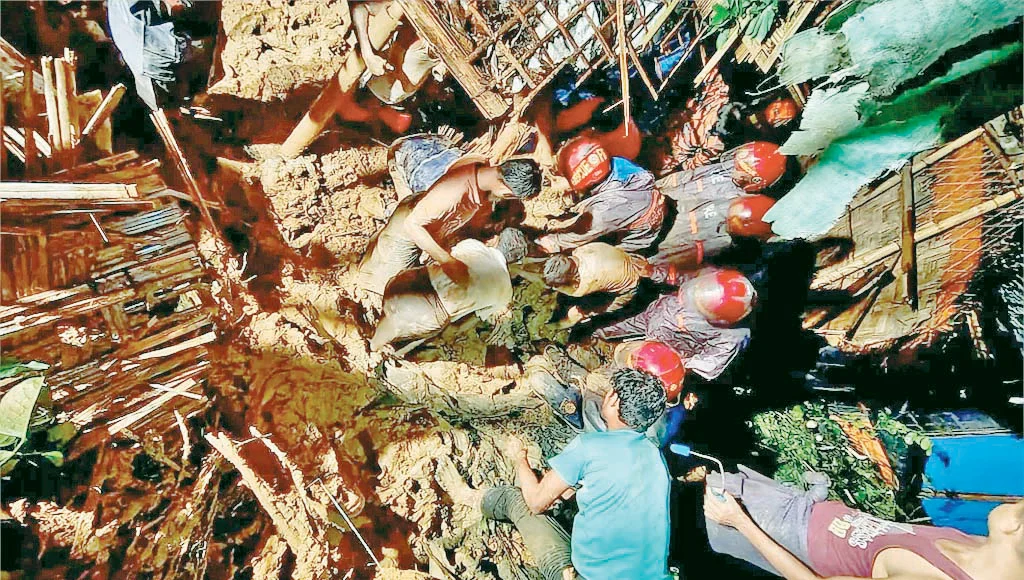
Civil defence personnel and local people conduct rescue work after a landslide strike a Jamtali Rohingya aat Ukhiya in Cox’s Bazar on July 6. | New Age
The government should protect forests, rivers and biodiversity while adopting more sustainable approaches to development and environmental governance to attend to the criss of climate change that has intensified floods, landslides and droughts, write Raja Devasish Roy and Hari Purna Tripura
THE devastating floods and landslides in the Chittagong Hill Tracts, along with those in parts of Chittagong and Cox’s Bazar, are not simply natural disasters. They are a stark warning of the consequences of decades of environmental degradation and unsustainable development. As of July 16, 2026, more than 57 people had lost their lives. Thousands of families were displaced, while homes, crops, roads, bridges, schools and other public infrastructure were severely damaged.
Yet this tragedy is neither isolated nor unprecedented. Every monsoon, the hill districts experience floods and landslides. During the dry season, the same region faces acute water shortages. These recurring crises point to a deeper environmental problem. They cannot be solved by emergency relief or rebuilding damaged infrastructure alone.
Bangladesh must rethink how development has been pursued in the Chittagong Hill Tracts. It must protect the region’s forests, rivers and biodiversity while recognising that Indigenous knowledge and practices offer valuable lessons for living with nature rather than exploiting it.
Human-made dimensions of ‘natural’ disasters
CLIMATE change has undoubtedly made floods, landslides, droughts and erratic rainfall more frequent and intense. But climate change alone does not explain why the Chittagong Hill Tracts has become increasingly vulnerable. Research shows that decades of deforestation, indiscriminate hill cutting, poorly planned infrastructure, rapid urbanisation, in-migration from the plains and the gradual erosion of Indigenous environmental stewardship have steadily weakened the region’s ecosystems. These disasters are, therefore, not only the result of climate change but also the consequence of decades of environmental degradation caused by misdirected development interventions.
The roots of this crisis stretch back to the colonial period. The British government delineated vast swathes of the region’s natural forests as ‘reserved forests’ without the participation or consent of Indigenous communities. It created monoculture teak (Tectona grandis Linn) plantations, whose seedlings or saplings were imported from Myanmar, restricted customary rights and displaced many forest-dependent Indigenous families, thereby contributing to resource crises in non-reserved forest areas too. Except for the Sangu Reserved Forest, most reserved forests were later converted into teak and other monoculture plantations, prioritising commercial timber production over conservation.
This approach continued during both the Pakistan and Bangladesh periods. During the Pakistan period (1947צ1971), the construction of the Kaptai Dam displaced nearly 100,000 people, most of them Indigenous Chakmas, as well as some valley-dwelling Bengali wet-rice farmers and shopkeepers. Many lost their ancestral lands and were forced to seek refuge in India and Burma (now Myanmar). After Bangladesh’s independence, more than 400,000 Bengalis from the plains were settled in the Chittagong Hill Tracts as part of state efforts to address the region’s political conflict during the 1980s. Most settlers had little knowledge of the hills’ fragile landscapes, forests and ecosystems. The same was largely true of many political leaders, military and civilian bureaucrats and other state actors responsible for planning and implementing development and ‘security’ measures in the region. Together, these policies reshaped both the environment and the political landscape of the Chittagong Hill Tracts, placing unprecedented pressure on its land, forests and ecosystems, while deepening Indigenous dispossession, enabling impunity for human rights violations and leaving longstanding land conflicts unresolved.
In recent decades, the Chittagong Hill Tracts has witnessed a rapid expansion of tourism resorts, dams, roads and highways (including the ongoing 1,036-kilometre-long ‘border road’ project), culverts and other infrastructure projects. While improved connectivity and economic development are undoubtedly important and desirable, many of these initiatives have proceeded without adequate assessment of their environmental, ecological and socio-cultural impacts. In many cases, they have also failed to respect the principle and right of Free, Prior and Informed Consent of Indigenous peoples and have been implemented with no compensation at all, or at best, with inadequate compensation or rehabilitation for the affected communities, most of whom are of Indigenous origin. Moreover, many projects have been designed according to standards suited to the plains, with little regard for the hills’ distinct geographical, ecological and socio-cultural characteristics, as well as customary land and resource regimes. Consequently, they have accelerated displacement, deforestation and biodiversity loss; disrupted natural drainage systems; and heightened the risks of landslides, flash floods, water scarcity and other environmental hazards.
Why protecting nature in CHT matters
PROTECTING nature in the Chittagong Hill Tracts is not only about conserving the hill forests or reducing disaster risks. It is about protecting Bangladesh’s water, food, economy and long-term development. The hill districts contain about 43 per cent of the country’s forests and nearly 80 per cent of its biodiversity. As these forests and ecosystems disappear, Bangladesh loses one of its most valuable natural resources.
The Chittagong Hill Tracts is also the source of many rivers and streams, some of which flow through the region from neighbouring countries. Unlike in the plains, however, the total volume of water in rivers originating in Bangladesh is much greater than that of foreign-origin rivers. Together, these rivers and their tributaries sustain agriculture, fisheries, industries and drinking water supplies. Rivers such as the Karnaphuli, Halda, Sangu and Matamuhuri have long connected Indigenous communities in the hills with Bengali communities in the plains through shared ecosystems, navigable waterways, livelihoods, markets and economic interdependence.
Bangladesh’s economy is inseparable from the ecological health of the Chittagong Hill Tracts. The Karnaphuli River, for example, is vital to the navigability and continued operationality of Chittagong Port, the country’s principal seaport. Likewise, the Halda River — the only natural spawning ground for major carp species in South Asia — is a cornerstone of Bangladesh’s fisheries. According to Dr Md Manzoorul Kibria, a noted Halda River researcher, the river provides an estimated annual economic value of around Tk 20,000 crore through fisheries, drinking water supply for Chittagong city and other ecosystem services. It is also one of the world’s most important remaining habitats for the endangered Ganges River dolphin (Platanista gangetica). What, however, is little known and acknowledged even less is that the conservation of the Halda River’s banks and watersheds depends to a significant extent on the upper riparian Indigenous bamboo-farming communities of the Fatikchari and Dabbua unions in Rangamati and Khagrachari districts and those further upstream in the hill districts.
The message is clear. If the forests and rivers of the Chittagong Hill Tracts continues to decline, Bangladesh’s water security, fisheries, Chittagong Port and economic resilience will all suffer. Protecting nature in the Chittagong Hill Tracts is, therefore, not simply an environmental responsibility — it is essential to Bangladesh’s prosperity, resilience and its sustainable future.
Redefining relationship with nature
ONCE, our survival depended on the forest. Today, the survival of the forest depends on us. — Jidison Pradhan Suchiang, Indigenous leader from Greater Sylhet.
This statement captures the Indigenous understanding of the reciprocal relationship between people and nature. It also reflects the ecological crisis created by dominant development models, which have made Indigenous stewardship of forests and biodiversity more important than ever.
For Indigenous peoples, caring for nature extends far beyond forest management. Rivers, mountains, forests, ancient trees, caves and rocks are not merely parts of the landscape; many are regarded as sacred and are deeply woven into cultural identity, spirituality and everyday life. Guided by spiritual tenets and traditional cosmologies, Indigenous children from different ethnic communities are taught from an early age never to defecate or urinate in water bodies, avoid building houses or cultivating in designated ecologically fragile landscapes, refrain from harming animals and other wildlife during mating and birthing seasons and avoid taking animal or plant resources beyond their needs of consumption. Water and earth are often revered as life-giving mothers, while certain trees, caves and rocks are believed to be the dwelling places of spiritual beings. This worldview is founded on reciprocity, respect and coexistence rather than domination.
These values are reflected in the way Indigenous communities manage their forests. The village common forest system is one of the most remarkable examples of community-led conservation of the Chittagong Hill Tracts. The system, known as mauza reserves under the premier Chittagong Hill Tracts law, the Chittagong Hill Tracts Regulation 1900, have recently been acknowledged in the 2025 National Forest Policy. Governed through customary institutions and collective decision-making, many common village forests have been recognised by the Forest Department and researchers as examples of effective forest conservation, biodiversity protection and water-source management, often achieving better outcomes than conventional state-managed forests. The streams and springs protected by Indigenous communities continue to provide drinking water, sustain agriculture and support local livelihoods.
The same philosophy also shapes Indigenous livelihoods. Before clearing land for swidden or jum cultivation, farmers traditionally seek permission from nature. Before burning a field, they pray for birds and animals to move safely away. The first harvest is offered to nature before it is consumed by people. Although formal education, changing livelihoods, state policies and dominant development models have gradually weakened many of these traditions, Indigenous knowledge and customary institutions continue to offer valuable lessons for conserving forests, biodiversity and water resources — not only in the Chittagong Hill Tracts but across Bangladesh. To ensure that such knowledge is maintained and used for the benefit of all, it is equally important to support these peoples’ efforts to protect their languages and scripts, spiritualities, political and social integrity and socio-economic well-being, with their Free, Prior and Informed Consent.
Conclusion
THE recent disasters in the Chittagong Hill Tracts remind us that building resilience requires far more than emergency relief and post-disaster rehabilitation. While climate change has intensified floods, landslides and droughts, decades of environmentally destructive development and the erosion of Indigenous stewardship have made the region increasingly vulnerable. Addressing this crisis requires protecting forests, rivers and biodiversity while adopting more sustainable approaches to development and environmental governance. Equally important, Indigenous knowledge, customary institutions and cultural values need to be recognised as practical resources for environmental stewardship. Given the vital importance of the Chittagong Hill Tracts to Bangladesh’s environment and economy, protecting nature in the region is not simply a regional or environmental concern; it is a national imperative for safeguarding the country’s ecological security, economic prosperity and climate-resilient future.
Barrister Raja Devasish Roy, the traditional chief of the Chakma Circle in the Chittagong Hill Tracts, is an advocate of the Supreme Court, former member of the cretaker administration (2008–2009) and former member of the UN Permanent Forum on Indigenous Issues. Dr Hari Purna Tripura is a researcher and development practitioner.
Civil defence personnel and local people conduct rescue work after a landslide strike a Jamtali Rohingya aat Ukhiya in Cox’s Bazar on July 6. | New Age
The government should protect forests, rivers and biodiversity while adopting more sustainable approaches to development and environmental governance to attend to the criss of climate change that has intensified floods, landslides and droughts, write Raja Devasish Roy and Hari Purna Tripura
THE devastating floods and landslides in the Chittagong Hill Tracts, along with those in parts of Chittagong and Cox’s Bazar, are not simply natural disasters. They are a stark warning of the consequences of decades of environmental degradation and unsustainable development. As of July 16, 2026, more than 57 people had lost their lives. Thousands of families were displaced, while homes, crops, roads, bridges, schools and other public infrastructure were severely damaged.
Yet this tragedy is neither isolated nor unprecedented. Every monsoon, the hill districts experience floods and landslides. During the dry season, the same region faces acute water shortages. These recurring crises point to a deeper environmental problem. They cannot be solved by emergency relief or rebuilding damaged infrastructure alone.
Bangladesh must rethink how development has been pursued in the Chittagong Hill Tracts. It must protect the region’s forests, rivers and biodiversity while recognising that Indigenous knowledge and practices offer valuable lessons for living with nature rather than exploiting it.
Human-made dimensions of ‘natural’ disasters
CLIMATE change has undoubtedly made floods, landslides, droughts and erratic rainfall more frequent and intense. But climate change alone does not explain why the Chittagong Hill Tracts has become increasingly vulnerable. Research shows that decades of deforestation, indiscriminate hill cutting, poorly planned infrastructure, rapid urbanisation, in-migration from the plains and the gradual erosion of Indigenous environmental stewardship have steadily weakened the region’s ecosystems. These disasters are, therefore, not only the result of climate change but also the consequence of decades of environmental degradation caused by misdirected development interventions.
The roots of this crisis stretch back to the colonial period. The British government delineated vast swathes of the region’s natural forests as ‘reserved forests’ without the participation or consent of Indigenous communities. It created monoculture teak (Tectona grandis Linn) plantations, whose seedlings or saplings were imported from Myanmar, restricted customary rights and displaced many forest-dependent Indigenous families, thereby contributing to resource crises in non-reserved forest areas too. Except for the Sangu Reserved Forest, most reserved forests were later converted into teak and other monoculture plantations, prioritising commercial timber production over conservation.
This approach continued during both the Pakistan and Bangladesh periods. During the Pakistan period (1947צ1971), the construction of the Kaptai Dam displaced nearly 100,000 people, most of them Indigenous Chakmas, as well as some valley-dwelling Bengali wet-rice farmers and shopkeepers. Many lost their ancestral lands and were forced to seek refuge in India and Burma (now Myanmar). After Bangladesh’s independence, more than 400,000 Bengalis from the plains were settled in the Chittagong Hill Tracts as part of state efforts to address the region’s political conflict during the 1980s. Most settlers had little knowledge of the hills’ fragile landscapes, forests and ecosystems. The same was largely true of many political leaders, military and civilian bureaucrats and other state actors responsible for planning and implementing development and ‘security’ measures in the region. Together, these policies reshaped both the environment and the political landscape of the Chittagong Hill Tracts, placing unprecedented pressure on its land, forests and ecosystems, while deepening Indigenous dispossession, enabling impunity for human rights violations and leaving longstanding land conflicts unresolved.
In recent decades, the Chittagong Hill Tracts has witnessed a rapid expansion of tourism resorts, dams, roads and highways (including the ongoing 1,036-kilometre-long ‘border road’ project), culverts and other infrastructure projects. While improved connectivity and economic development are undoubtedly important and desirable, many of these initiatives have proceeded without adequate assessment of their environmental, ecological and socio-cultural impacts. In many cases, they have also failed to respect the principle and right of Free, Prior and Informed Consent of Indigenous peoples and have been implemented with no compensation at all, or at best, with inadequate compensation or rehabilitation for the affected communities, most of whom are of Indigenous origin. Moreover, many projects have been designed according to standards suited to the plains, with little regard for the hills’ distinct geographical, ecological and socio-cultural characteristics, as well as customary land and resource regimes. Consequently, they have accelerated displacement, deforestation and biodiversity loss; disrupted natural drainage systems; and heightened the risks of landslides, flash floods, water scarcity and other environmental hazards.
Why protecting nature in CHT matters
PROTECTING nature in the Chittagong Hill Tracts is not only about conserving the hill forests or reducing disaster risks. It is about protecting Bangladesh’s water, food, economy and long-term development. The hill districts contain about 43 per cent of the country’s forests and nearly 80 per cent of its biodiversity. As these forests and ecosystems disappear, Bangladesh loses one of its most valuable natural resources.
The Chittagong Hill Tracts is also the source of many rivers and streams, some of which flow through the region from neighbouring countries. Unlike in the plains, however, the total volume of water in rivers originating in Bangladesh is much greater than that of foreign-origin rivers. Together, these rivers and their tributaries sustain agriculture, fisheries, industries and drinking water supplies. Rivers such as the Karnaphuli, Halda, Sangu and Matamuhuri have long connected Indigenous communities in the hills with Bengali communities in the plains through shared ecosystems, navigable waterways, livelihoods, markets and economic interdependence.
Bangladesh’s economy is inseparable from the ecological health of the Chittagong Hill Tracts. The Karnaphuli River, for example, is vital to the navigability and continued operationality of Chittagong Port, the country’s principal seaport. Likewise, the Halda River — the only natural spawning ground for major carp species in South Asia — is a cornerstone of Bangladesh’s fisheries. According to Dr Md Manzoorul Kibria, a noted Halda River researcher, the river provides an estimated annual economic value of around Tk 20,000 crore through fisheries, drinking water supply for Chittagong city and other ecosystem services. It is also one of the world’s most important remaining habitats for the endangered Ganges River dolphin (Platanista gangetica). What, however, is little known and acknowledged even less is that the conservation of the Halda River’s banks and watersheds depends to a significant extent on the upper riparian Indigenous bamboo-farming communities of the Fatikchari and Dabbua unions in Rangamati and Khagrachari districts and those further upstream in the hill districts.
The message is clear. If the forests and rivers of the Chittagong Hill Tracts continues to decline, Bangladesh’s water security, fisheries, Chittagong Port and economic resilience will all suffer. Protecting nature in the Chittagong Hill Tracts is, therefore, not simply an environmental responsibility — it is essential to Bangladesh’s prosperity, resilience and its sustainable future.
Redefining relationship with nature
ONCE, our survival depended on the forest. Today, the survival of the forest depends on us. — Jidison Pradhan Suchiang, Indigenous leader from Greater Sylhet.
This statement captures the Indigenous understanding of the reciprocal relationship between people and nature. It also reflects the ecological crisis created by dominant development models, which have made Indigenous stewardship of forests and biodiversity more important than ever.
For Indigenous peoples, caring for nature extends far beyond forest management. Rivers, mountains, forests, ancient trees, caves and rocks are not merely parts of the landscape; many are regarded as sacred and are deeply woven into cultural identity, spirituality and everyday life. Guided by spiritual tenets and traditional cosmologies, Indigenous children from different ethnic communities are taught from an early age never to defecate or urinate in water bodies, avoid building houses or cultivating in designated ecologically fragile landscapes, refrain from harming animals and other wildlife during mating and birthing seasons and avoid taking animal or plant resources beyond their needs of consumption. Water and earth are often revered as life-giving mothers, while certain trees, caves and rocks are believed to be the dwelling places of spiritual beings. This worldview is founded on reciprocity, respect and coexistence rather than domination.
These values are reflected in the way Indigenous communities manage their forests. The village common forest system is one of the most remarkable examples of community-led conservation of the Chittagong Hill Tracts. The system, known as mauza reserves under the premier Chittagong Hill Tracts law, the Chittagong Hill Tracts Regulation 1900, have recently been acknowledged in the 2025 National Forest Policy. Governed through customary institutions and collective decision-making, many common village forests have been recognised by the Forest Department and researchers as examples of effective forest conservation, biodiversity protection and water-source management, often achieving better outcomes than conventional state-managed forests. The streams and springs protected by Indigenous communities continue to provide drinking water, sustain agriculture and support local livelihoods.
The same philosophy also shapes Indigenous livelihoods. Before clearing land for swidden or jum cultivation, farmers traditionally seek permission from nature. Before burning a field, they pray for birds and animals to move safely away. The first harvest is offered to nature before it is consumed by people. Although formal education, changing livelihoods, state policies and dominant development models have gradually weakened many of these traditions, Indigenous knowledge and customary institutions continue to offer valuable lessons for conserving forests, biodiversity and water resources — not only in the Chittagong Hill Tracts but across Bangladesh. To ensure that such knowledge is maintained and used for the benefit of all, it is equally important to support these peoples’ efforts to protect their languages and scripts, spiritualities, political and social integrity and socio-economic well-being, with their Free, Prior and Informed Consent.
Conclusion
THE recent disasters in the Chittagong Hill Tracts remind us that building resilience requires far more than emergency relief and post-disaster rehabilitation. While climate change has intensified floods, landslides and droughts, decades of environmentally destructive development and the erosion of Indigenous stewardship have made the region increasingly vulnerable. Addressing this crisis requires protecting forests, rivers and biodiversity while adopting more sustainable approaches to development and environmental governance. Equally important, Indigenous knowledge, customary institutions and cultural values need to be recognised as practical resources for environmental stewardship. Given the vital importance of the Chittagong Hill Tracts to Bangladesh’s environment and economy, protecting nature in the region is not simply a regional or environmental concern; it is a national imperative for safeguarding the country’s ecological security, economic prosperity and climate-resilient future.
Barrister Raja Devasish Roy, the traditional chief of the Chakma Circle in the Chittagong Hill Tracts, is an advocate of the Supreme Court, former member of the cretaker administration (2008–2009) and former member of the UN Permanent Forum on Indigenous Issues. Dr Hari Purna Tripura is a researcher and development practitioner.