Home Watch Videos Wars

[🇧🇩] Steel Industry in Bangladesh

[🇧🇩] Steel Industry in Bangladesh
16
2K
More threads by Saif

G Bangladesh Defense

Saif

Senior Member
Joined
Jan 24, 2024
Messages
16,880
Likes
8,153
Nation

Residence

Axis Group

Steel industry in Bangladesh

The steel industry is an established and growing industry in Bangladesh. Predominantly based in the port city of Chittagong, the industry has emerged as a major contributor to the national economy. According to the experts, the growth of steel industry in Bangladesh is mainly induced by the rapid expansion of the country's shipbuilding and real estate sector, as well as the major investments in various infrastructure projects throughout the country.

History

The first ever steel mill was established in 1952 by the H Akberali Group of Industries as the "Bangladesh Steel Re-rolling Mills (BSRM)". Located at Nasirabad, Chittagong, the plant formed re-enforcing bars and structural sections. The mill gradually prolonged, adopting new technological know-how by setting up a cross-nation European mill in 1987 which incorporated a wire-rod mill. The BSRM group added a captive billet manufacturing plants in 1996 so as to make sure a stable distribution of billets of its plants. In 2006, the company installed pilot cold rolling mill to make ribbed high strength wires.

By this time, KSRM Steel Plant Ltd emerged. Very recently, they have established Billet Plant at Chittagong. Their factory situated at Ghoramara, Sitakunda at Chittagong. KSRM is a steel manufacturing organization belonging to Kabir Group of Industries. One of the largest rolling mills in Bangladesh. Moreover, several other steel companies emerged in the country, most notably GPH Ispat, RRM (The Rani Re-rolling Mills LTD, Kabir Steel Re-rolling Mills, AKS, Anwar ISpat, HKG Steel Mills Ltd., Rahim Steel Mills LTD, Seema Steel Re-rolling Mills LTD, Bashundhara Steels etc.

Market

German plant maker SMS Group has announced that it has signed a contract with Bangladesh based Bashundhara Multi Steel Industries Limited to build an plant in Bangladesh.
 
Analyze

Analyze Post

Add your ideas here:
Highlight Cite Fact Check Respond
  • Love (+3)
Reactions: Bilal9

Clear policy needed to boost investment
1706927158782.png

BSRM Chairman Alihussain Akberali speaks about his existing business and future plans


More support from various government departments and publication of a major policy document by the government is urgently required to attract investors, said Alihussain Akberali, chairman of BSRM, one of the biggest industrial groups of the country.

The government needs to lay the future pricing policy on market-based prices of all inputs to power projects, he said in an interview.

“We gave the Board of Investment (BoI), some nine months back, four to five proposals about the problems we were facing in setting up the largest steel plant and a power project. No one from the BoI has so far called us to hear our problems nor were our applications sent to relevant departments."

"How can there be industrialisation under such circumstances?†he questioned.

The major chunk of foreign investment is in the export processing zones (EPZs) where labour intensive industries are being set up and which offer a platter of gas, power and tax incentives.

But no importance is being given to import substitution industries, he said.

“We need active support from different ministries of land, water, power, roads and highways, home and energy to help us smoothly set up the two major Tk 3,000 crore projects which will generate employment for about 1,500."

"Today pillar to post, we are just groping in the dark. Of course we are used to it but at what cost to the country?"

It will be impossible for foreign companies to come to the country to set up heavy industries outside the EPZs, Akberali said.

Talking about his own group, the BSRM chairman said there were only 300 employees to start with and today the group boasts to have a workforce exceeding 1,700 which would grow by another 750 by the next year and a half.

BSRM made a modest beginning in the early 1950s under the aegis of his father Akberali Africawala, when the first steel re-rolling mill was set up in the then East Pakistan.

Akberali also said the last accounting year showed a group turnover of more than Tk 6,000 crore with a net profit of around Tk 150 crore.

He said the BSRM's growth and success in being able to supply quality steel to the market have been the result of constant upgradation of their business and using innovative technology.

He also said BSRM's main aim in doing business have been its integrity and honesty. They are a highly ethical group and are the largest taxpayers and the largest power and gas consumers in the country in the steel sector.

This alone is the reason for success of BSRM, he added.

“Our customers trust us for quality, correct dimensions of materials, correct weight delivered and timely delivery with adequate and rewarding credit facility to those who meet our business criteria.â€

Akberali said BSRM makes its products strictly in accordance with international and Bangladeshi standards and its mechanical properties including elongation not only meet the standards but are also way above the normal standard values.

This is possible because BSRM has invested in the most sophisticated quenching and tempering heat treatment and control equipment from a renowned European manufacturer, he said.

This technology ensures ductility along with high strengthened ductile bars which are safer.

This is the main reason why developers, consumers and various large projects trust BSRM and place orders with them, Akberali said.
On their expansion plan, the chairman said they are in the midst of setting up the largest billet making plant in the country at Mirsarai, with the production in the plant expected to commence in mid-2013.

The project cost is around Tk 1,300 crore and is being financed by a consortium of bankers from home and abroad.

The plant will have a production capacity of one million tonnes a year.

“We are expanding the capacity of our Nasirabad rolling mills to 450,000 tonnes per annum and are planning to set up a 150MW coal-based merchant power project at Mirsarai.â€

Akberali said this would be the largest ever project in the private sector which would sell 10 percent power to the Power Development Board, while the rest to various private customers.

Commenting on the housing sector in general, the BSRM chairman said high cost of flat registration is one of the biggest deterrents to the development of the sector.

He thinks this makes flat ownership an illiquid investment, where the exit route is not easy. A lack of utility connections such as water, gas and electricity is another big deterrent as many developers cannot hand over finished flats.

The high cost of urban land is the biggest reason for the depressed real estate market as it is impossible for working middle-class to own a flat in the city.

Land is the single largest cost element in the price of a flat.

"If the government could build more highways and roads connecting the existing cities, real estate developers would move their operations to the city outskirts to build new houses outside the cities.â€

He suggests the government give its khas land whereby real estate developers could be invited to build flats which could be sold in turn by the government to the lower and middle-class families on a long-term instalment basis.

About his experience on carrying out business activities in Bangladesh in general and in Chittagong in particular, Akberali said: "Doing business in Bangladesh is most easy and the policy is friendly for any investor."

The BSRM chairman also said the country is small having a homogeneous population, common culture and common language. There is no tension in running a business in the country. Chittagong is the port city, and so there is a big advantage of doing business here, he said.
 
Last edited:
Analyze

Analyze Post

Add your ideas here:
Highlight Cite Fact Check Respond
  • Love (+3)
Reactions: Bilal9

Steelmaker plans big

1706927248633.png

Zahirul Islam

PHP Group moves to expand and diversify, as it plans to make a strong foothold in the country's steel industry. The company has recently acquired a steel mill at Ghorashal, AMK Steels Mill, to produce deformed bar.

“We wanted to expand our steel industry. At present we produce corrugated iron sheet in our PHP Cold Rolling Mills and PHP Continuous Galvanising Mills. Now we are going to make deformed bar in the new mill,” says Zahirul Islam, managing director of PHP Ispat Ltd, a sister concern of the group.

Islam shares his views with The Daily Star on the company's latest move.

AMK Steels Mill that produces thermo mechanical treatment deformed bar was established in 2005. “The company was facing some problems, and those were hard for the company to avoid. So we acquired it for a renovation,” says Islam.

The net asset value of AMK Steels is around Tk 75 crore and the total asset value of the two mills is Tk 1,000 crore.

AMK Steels has been renamed PHP Ispat after acquisition.

PHP Cold Rolling Mills is the first of such mill in the country that started operations in 1999 and PHP Continuous Galvanising Mills started operations in 2001.

These two mills produce nearly 15,000 tonnes of corrugated iron sheet a month, meeting around 40 percent demand of the country. “Our annual turnover from the mills is Tk 2,000 crore.”

PHP Arabian Horse and PHP Arabian Horse Super are the two brands of the company's tins.

The official says they expect an increase in annual turnover by Tk 500 crore with the latest acquisition.

The country needs nearly 17 lakh tonnes of thermo mechanical treatment deformed-bar and 60-grade bar a year, according to Bangladesh Re-rolling Mill Owners' Association.

“We expect to produce one lakh tonnes a year and reach the three-lakh-tonne mark in the second or third year,” Islam says. “We hope to meet about 7 percent of Bangladesh's total demand initially.”

The company exports its PHP Arabian Horse and PHP Arabian Horse Super tins to Europe and Africa. In case of deformed bar, he says the company targets to fulfil the domestic demands at first, as the country still depends on imports.

Islam says steel is one of the important sectors in Bangladesh. “The demand for rod will increase on a regular basis. We are heading to become a developed nation. So we want to produce the best quality rods and fulfil the country's entire demand.”

“If we take initiatives to make best quality products then our competitors will also do so,” Islam says. “This healthy competition will let our people buy quality rods at competitive price.”
 
Last edited:
Analyze

Analyze Post

Add your ideas here:
Highlight Cite Fact Check Respond
  • Love (+3)
Reactions: Bilal9
A documentary on Steel Industry in Bangladesh.
 
Analyze

Analyze Post

Add your ideas here:
Highlight Cite Fact Check Respond
  • Love (+3)
Reactions: Bilal9

Steel sector’s operational cost rises 65% in a year​


1710888255726.webp


Dollar crisis, rise in utility bills taking toll, says Bangladesh Steel Manufacturers Association

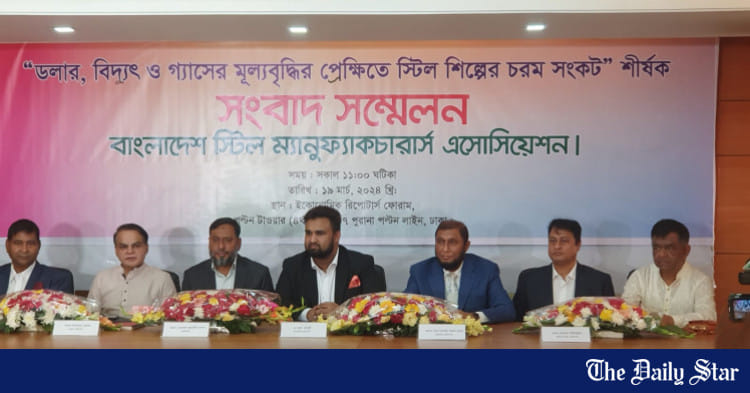
The country's steel sector experienced a 65 percent jump in operational cost in the last one year due to the appreciation of the US dollar and a rise in utility bills, said Mohammad Jahangir Alam, president of Bangladesh Steel Manufacturers Association (BSMA).

The US dollar's appreciation caused the 40 percent rise in the operational cost and utility bill hikes attributed to the rest 25 percent spending jump, he said today.​

Alam shared the information at a press conference on "Serious crisis of steel sector due to price increase of dollar, power and energy".

The BSMA, which represents some 41 large steel producers, organised the event at the Economic Reporters' Forum in Dhaka.

The loans given to the steel sector may turn sour as the rising operational cost is weakening the financial capacity of the sector's investors, Alam said.

Banks are also failing to open letters of credit (LCs) as per the requirement for importing steel raw materials because of the shortage of the American greenback, he said.

The amount of raw materials currently being imported is insufficient to meet the sectoral demand, which is disrupting the whole supply chain of the steel sector, he said.
 
Analyze

Analyze Post

Add your ideas here:
Highlight Cite Fact Check Respond
  • Sad (0)
Reactions: Bilal9

Members Online

Latest Posts

Back
 
G
O
 
H
O
M
E