Bengali Muslims and the ghosts of India's citizenship politics
Suraj Gogoi
The phantoms of migration and Partition have long haunted South Asia. They now haunt the region with a never-before-seen intensity. The figure of the irregular migrant stands at the centre of divisive and communal politics in India, occupying centre stage, particularly with the forceful introduction of citizenship regimes in the form of the National Register of Citizens (NRC), the Citizenship (Amendment) Act (CAA) 2019 and the Special Intensive Revision (SIR), which are tangible expressions of majoritarian, popular anxieties about nationhood and belonging in the subcontinent.
To see through the darkness of these regimes, one has to spotlight the ethos and character of nationalism(s) and identity assertions that made such regimes possible in the first place. Most critically, these regimes have rendered life unbearable for minorities and the social underclass, particularly Bengali Muslims affected by the NRC. They have become pathologically unfree and socially dead. The attacks against Bengali-speaking migrant workers across India in recent years are testimony to the perennial unfreedom they face.
The punishments of deportation and detention continue to haunt the Bengali Muslims of Assam. Shanbano Khatun, 55, sits at a village gathering after border police asked her to give her fingerprints. Photo: Rohini Mohan.
In the state of Assam, they are uprooted from a multitude of things: government policies, their mother tongue, poetry, home, ancestry, heritage, dress, food, memories, and so much more. The everyday vitality necessary to be a human being is taken away, thereby making them socially dead. Alongside this portrait of suffering, we also have a mass audience that has become inured to their plight. To attain, maintain and defend citizenship is to suffer, and this suffering has now become a public affair as a relentless exercise in disenfranchisement runs amok, haunting minorities.
Dualisms and the nation
A certain kind of revisionist history, housed within postcolonial writings, created a fixation on dualisms. Scholars such as Engseng Ho have warned of the dualisms that postcolonial theories have retained. The dualisms of foreigner/native and illegal/legal, as well as the distinction between the legible and the illegible, became objects and subjects of nationalist projects in postcolonial South Asia. Regional expressions of nationalism, which encompassed various claims ranging from, but not limited to, ethnicity and language to particular claims of nativity and indigeneity, also internalised such dualisms to create and maintain the figure of the “outsider”. In asserting these identities, such dualisms as insider/outsider and foreigner/native played a crucial role in shaping the ideologies of social and political movements at both regional and national levels. They also provided the necessary intellectual support and legitimacy for such movements, albeit through narrow claims of citizenship, nationality and belonging. In all this, the figure of the foreigner or outsider is thoroughly stigmatised and turned into an enemy. The dualism that Engseng Ho highlighted remains central to the nationalist point of view even today, through which the categories of native/foreigner, voter/D-voter and mapped/unmapped are still framed. It must also be noted that the figure of the foreigner has undergone its own transformation, from communal to linguistic and back to a certain ethnic, narrow jus sanguinis form in which a substantial element of communalism is also present. Blood over soil is the framework of citizenship in India today. There is only the law of blood, not of soil; of origin and race, not of birth.
The blind supporters and adherents of such dualisms are fixated on a parochial view of geography and a perplexing understanding of time. Arriving late on the scene can make someone illegal. The politics of cut-off dates for determining citizenship under the NRC is a case in point, where time becomes critical to the measurement of citizenship and belonging. These goalposts for inclusion in regional and national communities shift constantly. For some, it is 1826; for others, it is 1951 or 1966, or even 1971. These cut-off dates are never anchored in a single place or a consistent logic. A new time and place are invented to exclude more and more people. Dangerous forms of gatekeeping and litmus tests are employed in the name of the nation, when such gates and tests should not exist in the first place. The lack of a fixed temporal basis for determining citizenship is a fundamental marker of the new citizenship regimes in contemporary India. Such arbitrariness in the criteria for determining citizenship is deeply worrying, to say the least.
Nationalism became a matter of ethnic politics, and its hold has only strengthened over the years. The demand for the NRC emerged directly from the Assam Movement (1979–1985), which was organised around the dualism of natives versus foreigners (bidexi, bohiragoto). The figure of the foreigner as an enemy has been carefully manufactured over the years. The colonial bureaucracy, particularly through census records, portrayed the East Bengali peasant as land-hungry. In the postcolonial period, this figure of the foreigner was increasingly portrayed as an imminent security threat.
Razia Bibi (right) and her daughter-in-law Sajida Begum (left), both excluded from the NRC draft, sit with their husbands at home in Dhubri, Assam, on August 3, 2018. The absence of their names and the abandonment it represents haunts those who are excluded as voters and citizens. Photo: Reuters
S K Sinha's infamous report on “illegal” migration in Assam is a case in point. The figure of the “Bangladeshi” in contemporary India, around whom the need for these citizenship regimes is often legitimised, bears the wounds of such histories, including everyday xenophobia and regular acts of domicide directed against them. The dualism of legal and illegal haunts even internal migrant workers in our country today. Some of the unfortunate few are lynched, while many others are detained and deported or left as good as dead, with nowhere to go.
The haunted nation
Advances in technology and the increasing sophistication of bureaucracy do not guarantee that the hauntings experienced by citizens in a modern nation-state will wither away. A nation is haunted not only by its memories but also by change and efficiency, in a system in which we do not scrutinise our invasive technologies as closely as we scrutinise people.
The dead are never left eternally estranged. The documents of the dead have served as proof of legacy for their descendants in the NRC, where the dead return not merely passively but actively. Now, even the dead are summoned by the SIR process. It was recently reported that economist Bibek Debroy, who died in November 2024, was among those flagged in the Delhi SIR draft electoral roll. Is this a mere discrepancy or something more? Are the SIR and NRC creating séances with the dead? Do the dead also need to prove their citizenship? What are the rituals of inclusion and exclusion that determine who can be a citizen of India? Do ghosts live in India, while citizens live in Bharat?
Ex parte judgements in citizenship determination processes, with over sixty thousand such cases associated with the NRC alone, also testify to the absence of individuals able to defend their belonging and rights. Here, the bureaucracy haunts people's bodies and minds, affecting not only those who are enumerated but also those who enumerate them. The vortex created by the SIR also engulfed many Booth Level Officers (BLOs). Unable to bear the pressure of work, several reportedly died by suicide. The process haunted these workers during their lives, and it continues to haunt their families now. Likewise, those who are deported and those who return are also haunted by the humiliation and fear of being uprooted and discarded like rubbish. The punishments of deportation and detention continue to haunt the Bengali Muslims of Assam, for whom these possibilities remain ever-present. They remain so for several reasons, including reverification, the prospect of a new NRC, the SIR and other administrative measures. So many different processes through which their lives can be scrutinised, classified and controlled remain in place. These processes continue to haunt them.
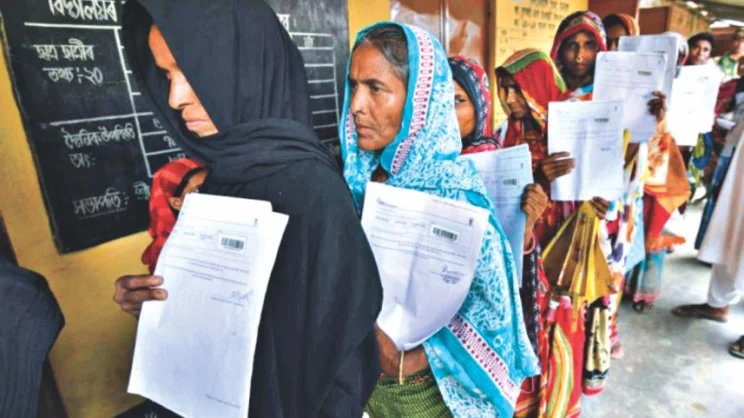
Women queue with documents at an administrative centre. Citizenship regimes in India have manufactured the need for chronic waiting. Photo: Rohini Mohan.
In modern South Asia, the story of citizenship is, in fact, also a story of abandonment. One is instantly reminded of the abandoned houses left behind by successive Partitions. With the SIR, NRC and CAA, we have a multitude of such stories of abandonment unfolding before our eyes. Maleka Begum, who was forcibly deported to Bangladesh at gunpoint in what is euphemistically called a “pushback”, but who miraculously managed to return, could not overcome the trauma of the experience. The humiliation of being pushed back continued to haunt her. Her last wish was to die in her own home, in her homeland, her watan.
Perhaps David Foster Wallace was right that every love story is a ghost story. Except that this is a love story involving the nation, where millions of citizens are ghosted by the nation and its society.
Left out of the NRC. Left at the border, in no man's land. Left in a detention camp. Left off the electoral rolls. The absence of their names and the abandonment it represents haunts those who are excluded as voters and citizens. Multiple reports also show that SIR-related exclusions are disproportionately higher among Muslims, while demands for exclusions are also rising sharply. This is not only a nation abandoning an important minority group but also a nation abandoning its constitutional commitments.
Perhaps David Foster Wallace was right that every love story is a ghost story. Except that this is a love story involving the nation, where millions of citizens are ghosted by the nation and its society. This ghosting is the ultimate form of abandonment, marked by loss and the denial of even the most basic sense of belonging. It condemns those abandoned to loneliness and a slow, painful decline.
Patients of the state
My friend Arijit once told me that the NRC is like a strange Uber ride of citizenship. Apply in your area, and only citizens get a ride. These new citizenship regimes are journeys that are exclusive, traumatic and filled with surveillance. So many people are abandoned during these journeys, and they become patients of the state. As patients, they have lost everything, or nearly everything, while remaining dependent on the very institutions that have subjected them to such uncertainty.
Citizenship regimes in India have manufactured the need for chronic waiting: for appeals, for trials, for reverification and even for applications. This is another way of manufacturing patients of the state.
Javier Auyero's influential ethnographic work, which bears almost the same name as this condition of suffering, Patients of the State: The Politics of Waiting in Argentina, fits remarkably well with the documentation processes involved in citizenship determination, as well as voter verification and appeal processes in contemporary India. Auyero shows convincingly how waiting, which may seem uneventful to the indifferent, causes profound misery and yet has become an everyday feature of interactions with the state. It is costly and traumatic for the poor. The act of waiting reveals the relationship between time and power. It produces subordination: someone is made to wait because those exercising power can afford to keep them waiting. The moment the power relationship changes, waiting as a tool of domination loses its edge or is removed from the equation. Citizenship regimes in India have manufactured the need for chronic waiting: for appeals, for trials, for reverification and even for applications. This is another way of manufacturing patients of the state.
The documentary burden imposed by the SIR, a revision of the electoral rolls, represents a form of bureaucratic continuity with the NRC. Citizenship determination processes involving appeals, verification and other procedures can drag on for decades. In the case of Maleka Begum discussed above, the process lasted for two decades, during which she became a patient of the state and its bureaucracy. Waiting for citizenship in such a case perhaps comes close to the expression that Peter Berger once used to describe the Palestinians and the growing rubble: an undefeated despair.
Two men display official papers outside a public building. To attain, maintain and defend citizenship is to suffer. Photo: Rohini Mohan
Citizenship determination and voter verification processes are also deeply unhomely, leaving people alienated and dehumanised at the altar of the nation. The citizens left behind, the “doubted” citizen-suspects of the NRC, the “unmapped” individuals of the SIR and the Muslims excluded from the CAA's preferential provisions, have become patients of the state, to borrow from Auyero, waiting for citizenship or recognition while confronting the attendant hostility of the bureaucracy. Symptoms of anxiety, trauma and uncertainty are noticeable among such patients. This subordinate and destitute group, produced by the state and numbering in the millions, has become “playballs to a thousand chances”, denied security or shelter. As they are left alone by the state, they learn to cope, manage and even live amid these conditions. This is no ordinary feat. Perhaps, as survivors, they are not only patients but also physicians nursing their own wounds.
One man's subaltern is another man's murderer of citizenship. The spectre of citizenship looms over unresolved questions of identity and the recurring desire to punish minorities in postcolonial South Asia. It is also reflected in the constant desire to clean the house without actually addressing the concerns of its residents. This is a form of inhumanity that the world has rarely witnessed and, sadly, rarely talked about, even as its victims descend into a state of undefeated despair.
Suraj Gogoi teaches at the Indian Institute of Management, Kozhikode.
 Bangladesh Defense
