 Bangladesh Defense

Saif
Senior Member
- Joined
- Jan 24, 2024
- Messages
- 22,417
- Likes
- 9,875
- Nation

- Axis Group

RMG owners offer Tk 15,800 minimum wage, workers find the amount unfair
Both sides agree to revise proposals
Saddam Hossain . Dhaka
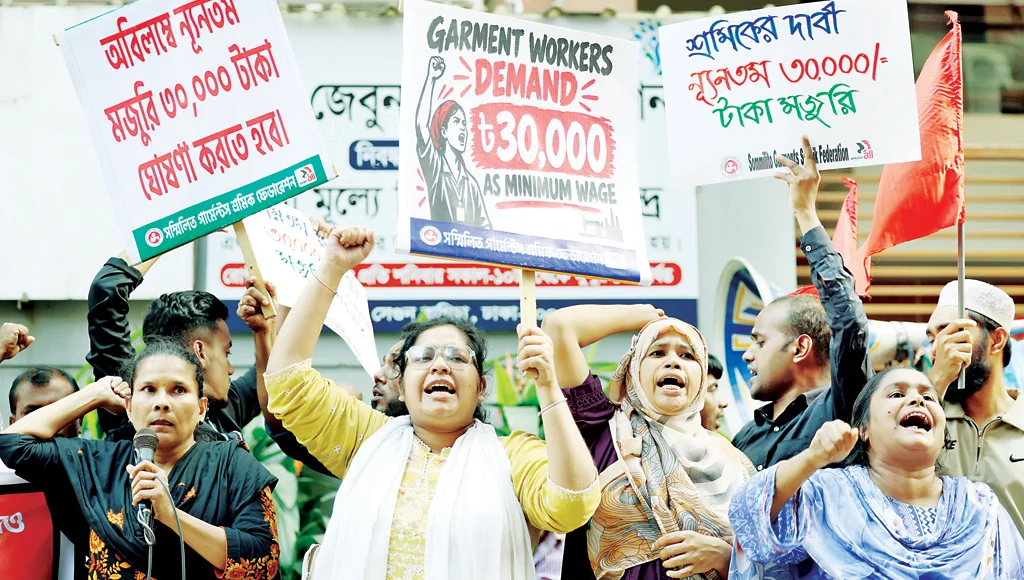
The owners’ representatives on the minimum wage board for the readymade garment sector on Monday proposed Tk 15,800 as the minimum monthly wage for garment workers, while workers’ representatives lowered their demand to Tk 22,000 from Tk 32,000 after nearly nine and a half hours of negotiations.
The workers’ representatives, however, termed the owners’ proposal unreasonable and both sides agreed to revise their respective proposals further and continue negotiations.
The third meeting of the six-member minimum wage board began around 11:45am at the board’s office at Segunbagicha, Dhaka, and adjourned around 9:00pm with the next meeting scheduled for 2:00pm today.
According to a board member, the owners initially proposed Tk 15,000 as the minimum monthly wage, around 20 per cent higher than the existing minimum wage of Tk 12,500.
Following intense negotiations, the owners raised their proposal to Tk 15,500, while the workers’ representatives revised their demand downward to Tk 25,000 from Tk 32,000.
At a later stage, the owners increased their proposal for a second time to Tk 15,800, prompting the workers’ representatives to lower their demand further to Tk 22,000.
The two sides agreed to continue discussions, with the next meeting scheduled for 2:00pm today.
At the board’s second meeting on November 9, workers’ representatives proposed Tk 32,000 as the minimum monthly wage for grade four workers, around 156 per cent higher than the existing wage.
Speaking to reporters around 4:45pm, while the meeting was under way, board chairman Syed Azad Subhani said the board had unanimously decided not to disclose the owners’ proposal at that stage.
He said the board would make recommendations and the government take the final decision, while factory owners would have to implement the new wages.
The board wanted to avoid confusion and tension among stakeholders, he added.
Denying that the proposal was being withheld out of fear that its disclosure might fuel unrest, he said the decision was based on legal and practical considerations.
The chairman said the board was considering inflation, market prices, workers’ family dependency, the financial capacity of factory owners, particularly small and medium-sized factories, Bangladesh’s competitiveness, wages in competing countries, and the country’s position among international buyers.
Findings from inspections of factories in competing countries were also presented to Monday’s meeting, he said.
Subhani said the board was considering workers’ demands but would not make any unrealistic decision. Workers were raising their demands through legitimate means, he said, adding that vandalising vehicles on roads could not be the work of workers.
Workers’ representative Babul Akhter said the owners had initially proposed a low figure, as they usually did.
He said the proposal was not final but was unreasonable to workers and nowhere near their demand. Both sides could revise their proposals to facilitate further discussions, he added.
‘The owners’ figure would rise a bit, and ours would come down a bit,’ he said.
Owners’ representative ABM Shamsuddin said the overall condition of the garment industry had to be taken into consideration when determining the minimum wage.
The chairman and representatives of both sides pledged to finalise the new wage structure within December.
The meeting was attended by neutral member Mosleh Uddin Ahmed, owners’ representative ABM Shamsuddin, workers’ representatives Babul Akhter and Anwar Hossain, and owners’ permanent representative Asif Ayub.
BGMEA President Mahmud Hasan Khan and Additional Senior Secretary Nur Mohammad Amin attended as experts for the owners’ representatives, while Bangladesh Mukto Garment Sramik Union Federation General Secretary Rashedul Alam attended as an expert for the workers’ representatives.
Meanwhile, protests continued in Ashulia and Gazipur on Monday, demanding an immediate declaration of a Tk 32,000 minimum monthly wage.
In Ashulia, production remained suspended at 55 factories, according to Industrial Police-1. Of these, 33 declared general holidays, while 22, including Ha-Meem, Envoy, Knit Asia and Next Collection, were shut indefinitely under Section 13(1) of the Labour Act, which allows employers to enforce a ‘no work, no pay’ policy.
Tension erupted after workers of Newage Group stopped production and staged a sit-in demanding a minimum monthly wage of Tk 32,000.
Protesters later vandalised an Alif Paribahan bus carrying students of Savar Government College and damaged two factories, Zon Ron Sweaters Ltd and Al-Muslim Accessories Ltd. They also attacked at least three workers who continued working.
Police fired tear gas shells and sound grenades after protesters threw brickbats at them.
Three female workers of a Newage Group garment unit were injured and taken to Ashulia Women and Children General Hospital. They were out of danger, while normal traffic resumed by 10:20am.
In Sreepur, workers attempted to block the Dhaka-Mymensingh Highway at Gargaria Masterbari around 10:30am after eight to 10 factories declared holidays.
Police fired sound grenades and tear gas shells after protesters threw bricks. Traffic resumed after law enforcers cleared the highway.
Law enforcement agencies, including 13 platoons of the Border Guard Bangladesh, were deployed in the industrial areas.
In a statement on Monday, women’s rights organisation Naripokkho expressed concern over the harassment and arrests of labour leaders, including women, during the ongoing protests. It demanded their immediate release and called for constructive dialogue.
The government formed the six-member minimum wage board on November 1 following labour unrest over demands for a substantial increase in wages.
The board held its first meeting on November 4 and its second on November 9.
The current minimum monthly wage of Tk 12,500 came into effect in December 2023, rising from Tk 8,000. The minimum wage was Tk 1,662.50 in 2006, Tk 3,000 in 2010, Tk 5,300 in 2013 and Tk 8,000 in 2018.
Both sides agree to revise proposals
Saddam Hossain . Dhaka
The owners’ representatives on the minimum wage board for the readymade garment sector on Monday proposed Tk 15,800 as the minimum monthly wage for garment workers, while workers’ representatives lowered their demand to Tk 22,000 from Tk 32,000 after nearly nine and a half hours of negotiations.
The workers’ representatives, however, termed the owners’ proposal unreasonable and both sides agreed to revise their respective proposals further and continue negotiations.
The third meeting of the six-member minimum wage board began around 11:45am at the board’s office at Segunbagicha, Dhaka, and adjourned around 9:00pm with the next meeting scheduled for 2:00pm today.
According to a board member, the owners initially proposed Tk 15,000 as the minimum monthly wage, around 20 per cent higher than the existing minimum wage of Tk 12,500.
Following intense negotiations, the owners raised their proposal to Tk 15,500, while the workers’ representatives revised their demand downward to Tk 25,000 from Tk 32,000.
At a later stage, the owners increased their proposal for a second time to Tk 15,800, prompting the workers’ representatives to lower their demand further to Tk 22,000.
The two sides agreed to continue discussions, with the next meeting scheduled for 2:00pm today.
At the board’s second meeting on November 9, workers’ representatives proposed Tk 32,000 as the minimum monthly wage for grade four workers, around 156 per cent higher than the existing wage.
Speaking to reporters around 4:45pm, while the meeting was under way, board chairman Syed Azad Subhani said the board had unanimously decided not to disclose the owners’ proposal at that stage.
He said the board would make recommendations and the government take the final decision, while factory owners would have to implement the new wages.
The board wanted to avoid confusion and tension among stakeholders, he added.
Denying that the proposal was being withheld out of fear that its disclosure might fuel unrest, he said the decision was based on legal and practical considerations.
The chairman said the board was considering inflation, market prices, workers’ family dependency, the financial capacity of factory owners, particularly small and medium-sized factories, Bangladesh’s competitiveness, wages in competing countries, and the country’s position among international buyers.
Findings from inspections of factories in competing countries were also presented to Monday’s meeting, he said.
Subhani said the board was considering workers’ demands but would not make any unrealistic decision. Workers were raising their demands through legitimate means, he said, adding that vandalising vehicles on roads could not be the work of workers.
Workers’ representative Babul Akhter said the owners had initially proposed a low figure, as they usually did.
He said the proposal was not final but was unreasonable to workers and nowhere near their demand. Both sides could revise their proposals to facilitate further discussions, he added.
‘The owners’ figure would rise a bit, and ours would come down a bit,’ he said.
Owners’ representative ABM Shamsuddin said the overall condition of the garment industry had to be taken into consideration when determining the minimum wage.
The chairman and representatives of both sides pledged to finalise the new wage structure within December.
The meeting was attended by neutral member Mosleh Uddin Ahmed, owners’ representative ABM Shamsuddin, workers’ representatives Babul Akhter and Anwar Hossain, and owners’ permanent representative Asif Ayub.
BGMEA President Mahmud Hasan Khan and Additional Senior Secretary Nur Mohammad Amin attended as experts for the owners’ representatives, while Bangladesh Mukto Garment Sramik Union Federation General Secretary Rashedul Alam attended as an expert for the workers’ representatives.
Meanwhile, protests continued in Ashulia and Gazipur on Monday, demanding an immediate declaration of a Tk 32,000 minimum monthly wage.
In Ashulia, production remained suspended at 55 factories, according to Industrial Police-1. Of these, 33 declared general holidays, while 22, including Ha-Meem, Envoy, Knit Asia and Next Collection, were shut indefinitely under Section 13(1) of the Labour Act, which allows employers to enforce a ‘no work, no pay’ policy.
Tension erupted after workers of Newage Group stopped production and staged a sit-in demanding a minimum monthly wage of Tk 32,000.
Protesters later vandalised an Alif Paribahan bus carrying students of Savar Government College and damaged two factories, Zon Ron Sweaters Ltd and Al-Muslim Accessories Ltd. They also attacked at least three workers who continued working.
Police fired tear gas shells and sound grenades after protesters threw brickbats at them.
Three female workers of a Newage Group garment unit were injured and taken to Ashulia Women and Children General Hospital. They were out of danger, while normal traffic resumed by 10:20am.
In Sreepur, workers attempted to block the Dhaka-Mymensingh Highway at Gargaria Masterbari around 10:30am after eight to 10 factories declared holidays.
Police fired sound grenades and tear gas shells after protesters threw bricks. Traffic resumed after law enforcers cleared the highway.
Law enforcement agencies, including 13 platoons of the Border Guard Bangladesh, were deployed in the industrial areas.
In a statement on Monday, women’s rights organisation Naripokkho expressed concern over the harassment and arrests of labour leaders, including women, during the ongoing protests. It demanded their immediate release and called for constructive dialogue.
The government formed the six-member minimum wage board on November 1 following labour unrest over demands for a substantial increase in wages.
The board held its first meeting on November 4 and its second on November 9.
The current minimum monthly wage of Tk 12,500 came into effect in December 2023, rising from Tk 8,000. The minimum wage was Tk 1,662.50 in 2006, Tk 3,000 in 2010, Tk 5,300 in 2013 and Tk 8,000 in 2018.
