[🇧🇩] Textile & RMG Industry of Bangladesh

[🇧🇩] Textile & RMG Industry of Bangladesh
460
20K
More threads by Saif

G Bangladesh Defense

EU apparel imports faced sharp decline in January; Bangladesh exports hit hard

UNB
Published :
Mar 23, 2026 20:48
Updated :
Mar 23, 2026 20:48

1774310703949.webp


The European Union’s apparel import sector has started the year 2026 on a dull note, recording a double-digit decline in value as major global suppliers, including Bangladesh, face significant negative growth.

According to the latest data from Eurostat, the EU's total apparel imports fell by 15.48 percent in January 2026 compared to the same month last year, with total import values dropping to €7.03 billion. This downturn was driven by an 8.36 percent decline in import volume (million kg) and a 7.76 percent decrease in average unit prices.

Bangladesh, one of the EU's primary garment sources, experienced a particularly challenging month. The country’s apparel exports to the EU fell to €1.43 billion in January 2026, marking a sharp 25.25 percent negative growth in value.

Analysis of the data reveals that this decline was a "double blow" in terms of both volume and price. Bangladesh saw a 17.49 percent decrease in the quantity of goods shipped, coupled with a 9.41 percent drop in the unit price per kilogram. This significant contraction highlights a cooling demand or shifting dynamics within the EU market for Bangladeshi Ready-Made Garment (RMG) products.

Other major manufacturing hubs also mirrored this downward trend, though to varying degrees.

China remained the top exporter with €2.22 billion, but still saw a 6.90 percent decline in value. Interestingly, while their unit prices dropped by 8.01 percent, their export volume actually grew slightly by 1.21 percent.

Turkey faced a severe hit with a 29.12 percent decrease in export value, totaling €619.98 million.

Other countries like India, Pakistan, Vietnam, and Cambodia all remained in negative territory, reflecting a broad-based slowdown in the European fashion retail market.

Mohiuddin Rubel, a former director of BGMEA, noted that the overall decline in unit prices (averaging €18.63/kg for the "World" category) indicates a highly competitive, price-sensitive environment in the EU. For Bangladesh, the decrease in unit price to €13.66/kg—which is significantly lower than the global average—indicates ongoing pressure on profit margins for local manufacturers.

As the year progresses, Bangladeshi exporters will be closely watching if this January slump is a temporary seasonal adjustment or a sign of more persistent economic headwinds in the Eurozone.​
 

RMG exports to EU surge 36pc in 5 years
29 March, 2026, 00:37

1774746095144.webp

Representational image. | New Age file photo

The country’s readymade garment exports to the European Union witnessed a growth of 35.82 per cent between 2021 and 2025, reaching 19.41 billion euros, bolstering its position as Europe’s second-largest supplier.

According to Eurostat data, in 2021, Bangladesh exported RMG items worth 14.3 billion to the 27-nation bloc, the country›s largest export destination.

During the five-year period, Bangladesh›s market share in the EU market reached 21.57 per cent in 2025, up from 19.78 per cent in 2021.New Age Specials

However, the recent downturn in exports, the geopolitical crisis in the Middle East, weaker demand, and intense competition have worried exporters.

In recent months, Bangladesh, along with major garment-exporting countries such as China, India, Turkey, and Vietnam, has experienced negative growth due to weak demand.

Moreover, the ongoing Middle East crisis triggered energy concern and shipping disruptions at major waterways like Hormuz Strait and Red Sea region, which might lead a global economic shock.

In the 2021-2025 period, Europe’s total apparel imports from global suppliers surged by 24.56 per cent from 72.25 billion euros in 2021 to 89.99 billion euros in 2025.

However, due to global uncertainties, an economic slowdown, and weak demand, import growth slowed in the last year, rising by only 2.10 per cent to 89.99 billion euros in 2025 from 88.14 billion euros in 2024, according to Eurostat data.

Among the major suppliers, China remained the EU’s top apparel source, followed by Bangladesh, Turkey, India, and Vietnam.

In January, RMG exports to the EU declined sharply by 25.25 per cent to 1.43 billion euros, down from 1.91 billion euros in January of 2026, according to Eurostat data.

Mohammad Hatem, president of the Bangladesh Knitwear Manufacturers and Exporters Association, told New Age that over the past five years, Bangladesh’s exports to EU countries have grown steadily.

‘This growth has been largely driven by rising demand among European consumers for Bangladeshi apparel and the country’s ability to maintain competitive prices,’ he added.Bangladesh travel guide

However, sustaining this momentum would not be easy, as Bangladesh’s exports have been facing decline over the past months with almost no sign of further increase.

‘The utilisation declaration forecasts in the recent months also suggested a slowdown in upcoming export orders from the EU,’ he added, saying that the EU buyers are shifting their buying pattern rapidly, particularly nearshoring and sustainable products.

He also said that due to trade tensions with the United States, China has aggressively expanded into EU markets, creating intense competition for Bangladesh.

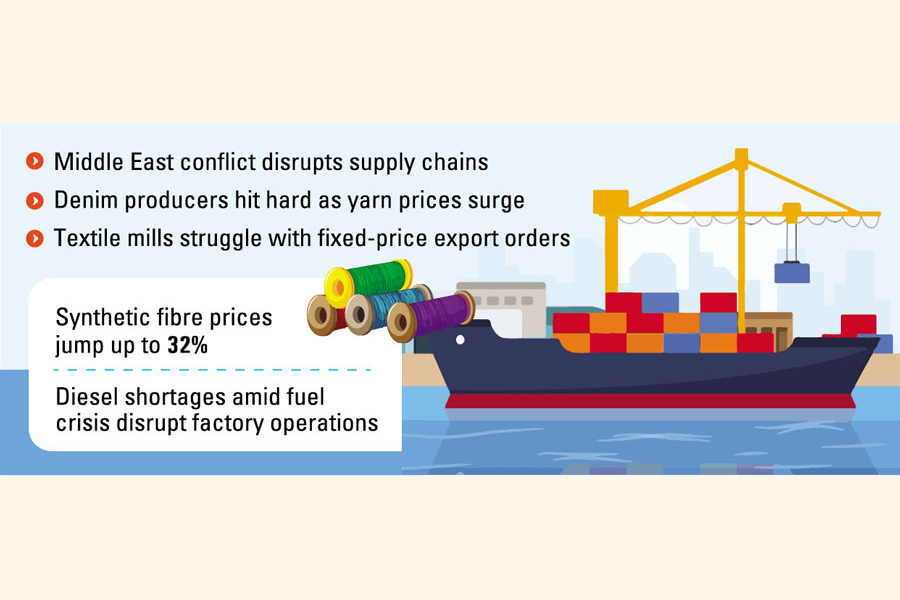
Regarding the ongoing Middle East crisis, he said the sector is facing a fuel crisis that might force factories to shut down operations during loadshedding because they cannot run their generators.

Moreover, many shipping lines hiked surcharges and suspended trade routes, which might affect the country’s trade, he added, saying that the sector is worried about global energy supply disruptions and hiked prices.

According to Eurostat data, in 2022, Bangladesh exported RMG worth 21.91 billion euros to the EU.

However, due to economic sluggishness across Europe caused by the Ukraine-Russia war, exports declined to 17.44 billion euros in 2023, then surged to 18.28 billion euros in 2024.

‘About 50 per cent of our total RMG export is bound to the EU, which is a good thing, but there might be challenges also,’ said Mohiuddin Rubel, former director of the Bangladesh Garment Manufacturers and Exporters Association.

He said that to maintain growth in the EU market, Bangladesh must focus on both volume and value addition, as well as product diversification, sustainable production, and entry into higher-value segments.

‘The market is now under value pressure alongside volume growth. Although orders exist, prices remain low. As a result, the model of supplying more products at lower prices alone might not be sustainable in the long term,’ he added.

He also said that the prolonged Middle East crisis could create a situation like Covid-19 and the Russia-Ukraine war, which could impact the RMG sector, which is already grappling with multifaceted challenges.

Recently, the Organization for Economic Cooperation and Development lowered its growth forecast for the EU by 0.4 percentage points to 0.8 per cent due to the Middle East crisis.

The organisation also raised its inflation forecast for the eurozone by 0.7 points to 2.6 per cent for this year.

Exporters urged the government to support the sector by offering policy incentives and tax breaks, and by encouraging green investment.​
 

RMG may face headwinds in next quarters: BB
Staff Correspondent 30 March, 2026, 00:07

1774836172355.webp

Women employees work at a readymade garment factory in Dhaka recently. | Md Saurav

The export performance of the country’s readymade garment sector might face growing headwinds in the coming quarters, said a report published by the Bangladesh Bank on Sunday.

Moreover, RMG exports would largely depend on the pace of economic recovery in major destinations, the stabilisation of global supply chains, and the sector›s ability to diversify products and markets.

The report, titled Quarterly Review of Readymade Garments, also stated that the near-term outlook for the RMG sector would remain ‘cautiously moderate’, reflecting a combination of external demand uncertainty and emerging opportunities in key export markets.

‘Strengthening logistics, enhancing productivity and expanding into higher value apparel segments might be critical for maintaining the competitiveness of Bangladesh in the global garment market,’ the report suggested.Political commentary Bangladesh

In the meantime, a prolonged Middle East crisis could create severe disruptions to energy supply and trade routes, and trigger global economic turmoil, said industry insiders.

According to the central bank’s report, Bangladesh’s RMG sector earned $9.75 billion in the October-December quarter of the financial year 2025-26, down 5.99 per cent from $10.36 billion earned in the same period of FY25.

The BB said that during this period, global demand conditions, inflationary pressures in importing countries, shifts in consumer spending patterns, and supply chain adjustments influenced order volumes and export receipts.

Moreover, production costs, exchange rate movements, and logistical conditions also played a considerable role in shaping the competitiveness of Bangladesh›s garment exports.

Meanwhile, export earnings in the October-December quarter of FY26 declined by 1.78 per cent from $9.9 billion earned in the preceding quarter, July-September, of FY26.

During the second quarter of FY26, the import value of raw materials, like raw cotton, synthetic or viscose fibre, synthetic or mixed yarn, cotton yarn, textile fabrics, and accessories for garments was $3.49 billion, accounting for 35.78 per cent of total RMG export earnings.

In other words, the net exports from this sector amounted to $6.26 billion, or 64.22 per cent of total RMG exports, in the October-December quarter of FY26.

The net exports were 2.84 per cent higher than those of the preceding quarter (July-September of FY26), which were $6.08 billion, and 1.09 per cent lower than those of the October-December of FY25, which were $6.32 billion, the central bank data stated.

During October-December of FY26, Bangladesh’s RMG exports were primarily directed to nine major destinations, including the US, Germany, the United Kingdom, Spain, France, the Netherlands, Italy, Canada, and Belgium.

Export earnings from these countries amounted to $6.83 billion during the reporting period, accounting for over 70 per cent of the total RMG exports.

During FY25, the RMG sector contributed 8.52 per cent to Bangladesh’s nominal GDP.

The total RMG export earnings for FY25 stood at $39.35 billion, indicating a higher growth of 8.90 per cent as compared with that of the preceding fiscal year’s $36.13 billion, the Bangladesh Bank report added.

According to the quarterly report, the government and the Bangladesh Bank have taken several measures to facilitate production and exports in the RMG sector, including pre-shipment credit, funds for green transformation, export facilitation, and export development.

The report also stated that during the first quarter of FY26, Bangladesh’s RMG industry continued to demonstrate its vital role.

Regarding value addition, Mohammad Hatem, president of the Bangladesh Knitwear Manufacturers and Exporters Association, said that Bangladeshi RMG manufacturers have been working to increase it to remain competitive in global markets.

He also said that the sector focuses on producing high-value products, innovation, and research and development, urging governmental policy support in this regard.

However, he said that Bangladeshi exports have been declining over the past months, with almost no sign of further increase, as utilisation declarations have also slowed.

Due to the ongoing Middle East crisis, the sector is facing fuel shortages, increased shipping line charges, disruptions in global energy supply, and a possible global economic downturn.​
 

LSM shrinks 6.34pc on apparel slowdown
Deteriorating global outlook weighing on BD's external trade

Jasim Uddin Haroon
Published :
Apr 02, 2026 08:43
Updated :
Apr 02, 2026 08:43

1775101080186.webp


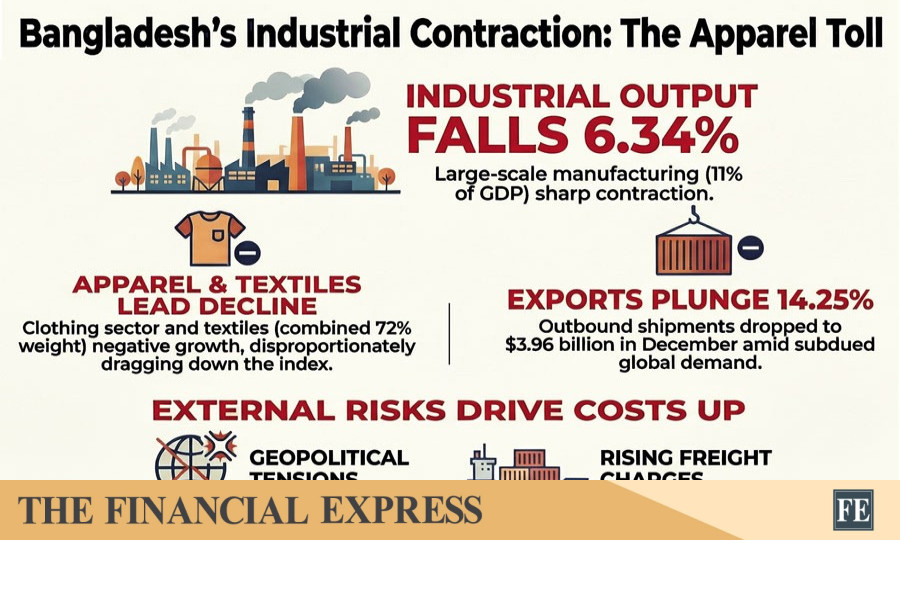
The large-scale manufacturing (LSM) sector contracted sharply in December last, underlining mounting pressure on the country's industrial base amid weak exports and rising global uncertainties.

Output in the sector fell 6.34 per cent year on year in December of the current fiscal year, according to data released by the Bangladesh Bureau of Statistics (BBS).

The segment accounts for roughly 11 per cent of gross domestic product (GDP), signifying a broader implication for overall economic growth.

People familiar with the development and some industry insiders attributed the decline primarily to a slowdown in the clothing industry, which carries the heaviest weight on the manufacturing index at about 61 per cent.

A fall in this segment tends to disproportionately drag down the overall index.

The textile sector - the second-largest component with a weight of more than 11 per cent - also declined by over 1.0 per cent during the period, compounding the contraction.

The weak industrial performance coincided with a drop in exports.

Bangladesh's outbound shipments fell 14.25 per cent year-on-year to $3.96b in December 2025, reflecting subdued global demand, elevated production costs, and heightened geopolitical tensions.

Of the 23 large industrial subsectors prepared by the BBS, seven recorded negative growth in December.

Some segments, however, posted gains.

Food manufacturing output rose by around 12 per cent, while sectors such as paper and pharmaceuticals expanded by about 10 per cent each.

But their relatively small weights on the index - with food accounting for only around 4.0 per cent - limited their impact on the overall index.

Business leaders say declining purchase orders for clothing have been a key for the overall contraction.

"We have been facing weak order flows for quite some time," said Mr Anwar Ul Alam Chowdhury Parvez, a former president of the Bangladesh Garment Manufacturers and Exporters Association (BGMEA) and managing director of Evince Group.

He added that rising global shipping costs were adding further strain, as international buyers pushed suppliers to absorb higher logistics expenses by lowering manufacturing prices.

Economists warn that external risks remain elevated, particularly amid the ongoing conflict involving Iran and Israel, which has disrupted trade routes and increased freight and input costs globally.

Dr Zahid Hussain, an independent economist, says the deteriorating global outlook is weighing on Bangladesh's external trade.

Higher freight charges and input costs are raising manufacturing expenses and eroding competitiveness, he says.

He further adds that large-scale manufacturing serves as a key proxy for overall economic activity, meaning the contraction could translate into slower GDP growth in the 2026 fiscal year if the trend persists.​
 

Bangladesh top denim exporter to US in 2025
Staff Correspondent 01 April, 2026, 23:16

1775104031235.webp

A file photo shows the 16th edition of Bangladesh Denim Expo in the capital. | UNB photo

Bangladesh remained the top denim exporter to the United States in 2025, exporting $955.7 million in denim, according to data from the US Office of Textiles and Apparel (Otexa).Diaspora community news

Moreover, the export earnings witnessed a robust year-on-year positive growth of 34.06 per cent from $713 million exported in 2024.

In 2025, the market share of the country in the US denim market stood at 25.97 per cent, said the Otexa data.

Bangladesh became the top denim exporter to the US in 2020, and retained the position for the next few years despite the pandemic, economic turmoil, and multiple global and local headwinds.

The North American country imported denim items from its global suppliers worth $3.68 billion in 2025, up 8.95 per cent from $3.37 billion in 2024.

In 2025, Bangladesh exported readymade garments worth $8.2 billion to the US, the largest single-country destination for Bangladeshi RMG exports, meaning denim export covered around 12 per cent of the total RMG exports.

Mostafiz Uddin, managing director of Denim Expert Limited, initiated the Bangladesh Denim Expo in 2014, which played a major role in this journey by promoting the country.Diaspora community news

Mostafiz Uddin said that in 2014, when he launched the Bangladesh Denim Expo, there were about a dozen mills, the number reaching to nearly 50 currently.

The 19th edition of the Bangladesh Denim Expo concluded last November, and the 20th edition is set to kick off on June 11 of this year.

He also said that international buyers favour Bangladesh because prices remain competitive compared to other sourcing destinations.

Along with the US, Bangladesh has been the top denim exporter to the European Union markets since 2017, outpacing China.

Denim exports to the EU rose to $1.64 billion in 2025, fetching a 21 per cent growth from $1.35 billion in 2024. Industry insiders estimate that one in three consumers in the EU wears Bangladeshi-made denim.

The market share of Bangladeshi denim in the EU is nearly 30 per cent.

Following Bangladesh, Mexico retained the second position and exported denim worth $640 million in 2025, though it witnessed a negative growth of 2.18 per cent from $654 million of 2025, claiming a market share of 17.39 per cent.

US denim imports from Vietnam experienced a growth of 26.33 per cent to $499 million in 2025, which made them third largest exporter with a market share of 13.56 per cent.

Pakistan’s denim export to the US reached $497 million in 2025, which was 16.62 per cent higher from $426 in 2024, with a market share of 13.50 per cent.

The export from Cambodia witnessed a 22.08 per cent surge to $249 million in 2025, a 6.76 per cent market share made them fifth largest supplier to the US, said the Otexa data.

According to local industry insiders, the sector›s rapid growth has been supported by strong local investment, with entrepreneurs investing over $1 billion to expand denim production.

Moreover, local mills currently meet around 70 per cent of denim fabric demand, while the remaining 30 per cent is imported from India, China and Pakistan.

Mahmud Hasan Khan, president of the Bangladesh Garment Manufacturers and Exporters Association, said global demand for Bangladeshi denim products is rising and the country has strong growth potential.Diaspora community news

He also said that Bangladesh is an important sourcing destination for international denim retailers.

Mohiuddin Rubel, former director of the BGMEA, said that, riding on a strong backward-linkage industry, a number of state-of-the-art mills were established in the country.

‘Bangladesh is now able to deliver denim orders very fast, which is also a positive sign for buyers. We want to shift to high-value products, and it all started with denim,’ he added.

Industry insiders also urged governmental policy support, an uninterrupted gas supply, and a policy to establish a sustainable fashion industry to sustain growth.​
 

Latest Posts

Back